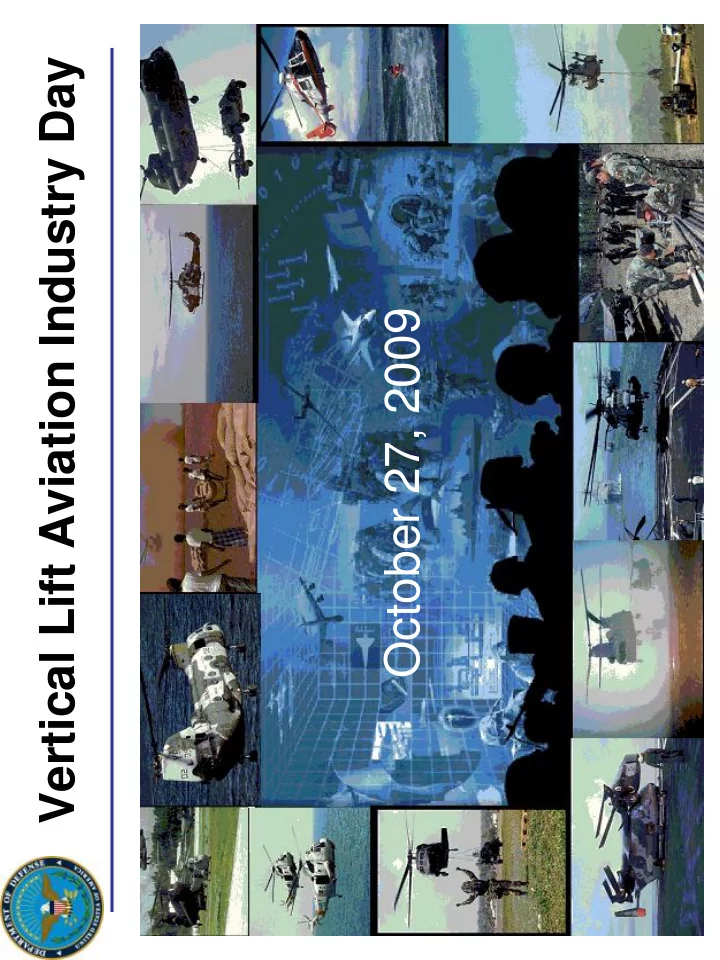
Vertical Lift Aviation Industry Day October 27, 2009 Vertical Lift - - PDF document
Vertical Lift Aviation Industry Day October 27, 2009 Vertical Lift Aviation Industry Day A First Step Towards the Future of Vertical Lift Aviation Tony Melita Office of Land Warfare and Munitions Office of the Secretary of Defense 3 Purpose
Vertical Lift Aviation Industry Day
A First Step Towards the Future
- f Vertical Lift Aviation
Tony Melita Office of Land Warfare and Munitions Office of the Secretary of Defense
3
Purpose of Industry Day
To engage interested members of the U.S. Vertical Lift Aviation Private Sector to consider the benefits and opportunities of entering into an OTA with the DoD. For the purposes of this meeting, the U.S. Vertical Lift Aviation Private Sector is defined as: U.S. companies, including U.S. companies under foreign ownership, control or influence (FOCI), that are both “FOCI-mitigated” and possess a facility clearance level (FCL) for the appropriate classification.
Why Do This Now? OSD sees urgent problems… …that neither the DoD nor individual companies alone can fix…. But we can collaboratively address them with a long-term commitment!
Agenda
An OSD Perspective Mike Walsh and Overview of Ongoing Activities Partnering with the DoD: Consortium Construct Denise Scott and Proposed Way Forward Steve Talmadge Q&A All
An OSD Perspective And Overview of Ongoing Activities
Mike Walsh OSD (AT&L)
Vertical Lift: Meeting Mission Needs
- “Aircraft of necessity” in two theaters since 2003;
millions of hours flown
- Very harsh environment for rotary wing aircraft
- Utilization sustained at very high rates
- Operational availability, readiness, and reliability
far exceed expectations
- Impressive logistics support
…But Challenges Remain
Oct 01-Dec 08 % of Losses % of Fatalities Loss Rate
1
Combat Hostile Action 20 30 2.6 Combat Non-hostile 40 40 5.1 Non-Combat 40 30 1.7
- 1. Per 100K flight hours,
>80% of losses not due to hostile action Between October 2001 and December 2008:
469 fatalities & 327 rotorcraft lost
Number corrected since presentation
Army Modernization: Aviation and UAS
FOUO USMC
LtCol Schaefer: Version 11 of 11
Date: 23 May 2007
Vertical Lift Inventory
- Comprise about half of DoD manned aircraft:
– Army: 66%; Marines: 15%;Navy:15%; USAF: 4% – Slight increase projected
- Aircraft age:
– New models starting to field – Most of inventory between 10 and 20 years old – Oldest aircraft 25-40 years old
- Breakdown by function/missions:
– 60% medium / utility – 25% attack and reconnaissance – 15% heavy lift / cargo
Major Production Ramps Are Underway
NOW
# of A/C AH-1Z UH-1Y V-22CV V-22MV MH-60R MH-60S UH-60M
20 40 60 80 100 120 140 160 180 200
FY 2001 FY 2002 FY 2003 FY 2004 FY 2005 FY 2006 FY 2007 FY 2008 FY 2009 FY 2010 FY 2011 FY 2012 FY 2013 FY 2014 FY 2015 FY 2016 FY 2017 FY 2018
Historical Perspective: DoD Rotary Wing Aircraft Origins
New Starts New Starts Derivative Derivative Mods Mods & & Remans Remans
XC-142 X-22 CH-47A CH-46A CH-53A AH-1G AH-56A XH-59 XV-15 AH-64A UH-60A XCH-62A MV-22A RAH-66A CH-47B/C CH-53D AH-1J
1960s 1970s 1980s 1990s 2000s
CH-47D CH-46E CH-53E AH-1S/F AH-1T OH-58D UH-60L MH-47E MH-60K AH-1W CH-47F AH-64D UH-1Y AH-1Z MH-60S VH-71A ARH-70A * UH-72A * MH-47G AH-64D BL III UH-60M CH-53K CSAR-X ARH (again)
Impact of Impact of Increasing Increasing Cost & Cost & Complexity Complexity Impact of Impact of Budget Budget Constraints Constraints
Cancelled COTS
*
15
Information Systems Technology, 1,835 Basic Research, 1,699 Weapons, 1,145 Human Systems, 425 Space Platforms, 456 Other, 654 Battlespace Environments, 231 Nuclear Technology, 230 Biomedical, 268 Sensors, Electronics, and Electronic Warfare, 1,731 Air Platforms, 813 Ground and Sea Vehicles, 557 Chemical /Biological Defense, 600 Materials /Processes, 571
FY09 President’s Budget S&T Program (BA 1-3)
Defense Technology Area Funding ($M)
- Total FY09 S&T $11.48B
- 2.22% of DoD Funding
- Air Platforms S&T $813M
- 7.1% of DoD S&T
(Not including related areas, e.g. electronics, materials, etc.)
FY09 Air Platforms and Rotary Wing Vehicle S&T Budgets
Army 75% Navy 5% DARPA 16% SOCOM 4% Fixed-Wing Vehicles 35% High-Speed/ Hypersonics 6% Rotary-Wing Vehicles 14% Turbine Engines 31% Unmanned Aerial Vehicles (UAVs) 6% Ballistic Protection 1% Aircraft Power 7%
Rotary Wing Vehicle S&T ~$110M in FY09 PBR (Does not include propulsion) Air Platforms S&T By Technology Sub-Area
Overall Development Time Takes about 3 Times Longer Now Than in Overall Development Time Takes about 3 Times Longer Now Than in the 60s the 60s
NOTE: REGRESSIONS ARE A LINEAR FIT
Development Cycle Time for Helicopters
17
Projections
20 40 60 80 100 120 140 160 180 New Starts Mods
Average Development Time by System Type
Source: OSD/USAF Study
- Aerospace Industries face acute shortages of skilled workers in the future
- No active US rotorcraft RDT&E after Apache Blk III and CH-53K
- Talent at home will be shrinking – but will be expanding globally
– Void in experience & knowledge – Qualified labor will be in high demand and hard to attract – Most future post graduate students will be overseas
- Global industry trends will impact defense contractors and their supply
chains
Engineering Talent Pool -- 2009
600 375 75
100 200 300 400 500 600 700
China India USA
S&E Graduates (000s)
Millions of Workers Execution Window
Resources - People
- DoD’s rotary wing “portfolio”: stable inventory
– investment dominated by production and sustainment – production capacity limited by decreasing supply base – mistakenly viewed as readily-available, low-value commodities – poor credibility due to recurring acquisition failures – rotary wing programs relatively low within Services’ priorities
- Industry’s military business base: stagnant
– stable oligopoly with business vice aerospace goals
– sustaining DoD’s inventory is best profit; only growth area – inventory replacement comprises extensive modifications to legacy designs – development programs are limited, derivative-designs; no new designs; little new technology
- Major industry initiatives unlikely without DoD
investment
Diagnosis: Industry Provides What DoD Wants
- DoD’s future “demand signal” unclear
- no new-starts within FYDP (VXX? CVLSP? CSAR-X? AAS?)
- technology base unable to support leap-ahead
possibilities
- OSD and Services’ S&T interests fragmented
- Reality not consistent with common perception that
vertical lift aircraft are: easy, cheap, and readily available, i.e. a commodity
- Acquisition failures undermine credibility of sector
Diagnosis (continued)
VertRep SAR
Decision-oriented approach to Capability Choices, Programming Options, and Acquisition Alternatives
MISSION
Attack Armed Recon Scout ISR Utility Medevac SOF ASW SUW Transport Assault Heavy Lift Mine CM SOF
SERVICE
ARMY ARMY USMC USMC ARMY ARMY USMC USMC USN USN USCG USCG USAF USAF ARMY ARMY USMC USMC USN USN
AH-1W UH-1Y CH/MH-47 D/F/G MH-53E OH-58D (KW) MH/AH-6J UH-72A CH-53K MV-22B CV-22B CVLSP*
Mine CM CSAR
CH-53E AH-1Z MH-60S MH-60R UH-60M MH-60T * Not Program of Record VH-3/60
2009 2020 2025 2030 2035 2015
Estimated End of Useful Life Estimated Half-life Initial Operational Capability DP 2: New Start EMD DP 1: SLEP or New Start Technology Development
Firescout MH-65C/DE
Tied to Army OH-58D replacement Pending decision on armed recon analysis
AH-64D
ICD in work
CH-53D CH-53K ~2050 2040 2011 2043 2046 VH-3D VH-60N 2010
22
VertRep SAR
Decision-oriented approach to Capability Choices, Programming Options, and Acquisition Alternatives
MISSION
Attack Armed Recon Scout ISR Utility Medevac SOF ASW SUW Transport Assault Heavy Lift Mine CM SOF
SERVICE
ARMY ARMY USMC USMC ARMY ARMY USMC USMC USN USN USCG USCG USAF USAF ARMY ARMY USMC USMC USN USN
AH-1W UH-1Y CH/MH-47 D/F/G MH-53E OH-58D (KW) MH/AH-6J UH-72A CH-53K MV-22B CV-22B CVLSP*
Mine CM CSAR
CH-53E AH-1Z MH-60S MH-60R UH-60M MH-60T * Not Program of Record VH-3/60
2009 2020 2025 2030 2035 2015
Estimated End of Useful Life Estimated Half-life Initial Operational Capability DP 2: New Start EMD DP 1: SLEP or New Start Technology Development
Firescout MH-65C/DE
Tied to Army OH-58D replacement Pending decision on armed recon analysis
AH-64D
ICD in work
CH-53D CH-53K ~2050 2040 2011 2043 2046 VH-3D VH-60N 2010
- 50% of Decision Points
- ccur within next 10 yrs
- 85% within next 15
23
E E N N D D O O F F P P R R O O D D U U C C T T I I O O N N
- Military demand implies little inventory growth.
- Replacement and increased capability appear to be the
future challenges that would stimulate growth:
- More production capacity than demand; potential consolidation?
- Aging workforce; no “noble work;” what attracts new talent?
- Bid protests are incentivized by rare, competitive opportunities
- Supply chain already critical
- Aging workforce; no “magic” in stable situation to attract
imagination / new talent
- Preserving critical engineering skills will increase production
- verhead costs
- US technological leadership in doubt
- Congressional oversight or “reform” efforts will not provide the
solution
Prognosis
Is There an Imperative ?
- Avoidable loss of life and equipment results from continued
acceptance of marginal safety, survivability performance
(Mindset: “rotorcraft operate in inherently dangerous environments”)
- No alternatives to current acquisition programs for DAE
- No government “demand” for new concepts that are a
lead-time away
- O&S cost growth of present inventory remains unchecked
- For industry:
– production programs end about 2018-2020 – eroding infrastructure and engineering expertise – limited R&D alternatives for transformation opportunities, new business, or technology upgrades
Prior Vertical Lift Aviation Studies
- 2000 Overarching Rotorcraft Commonality Assessment
- 2001 Non-Fixed Wing Aviation Study
- The Vertical Look Industrial Base: Outlook 2004-2014
- 2005 Aerospace Industries Association; Rotary Wing
Revitalization Project
- 2005 ASB Future Force Aerial Systems Capabilities
- 2005, 2007 Annual Industrial Capabilities Report to
Congress 2006 Joint Vertical Aircraft Task Force
- 2006 DCMA Helicopter Industrial Base Management
Capability Survey
- 2006 DSB Study on Seabasing
- 2007 DSB Study – Future Need for VTOL/STOL Aircraft
- 2008 Joint Heavy Lift ICD
Current Vertical Lift Studies and Activities
- Army Aviation Ops Capabilities Based Assessment
- Army Joint Multi-Role Study
- Navy Joint Multi-Role Study
- Naval Aviation Center Rotorcraft Aviation (NACRA)
- Army/DARPA Study on Rotary Wing Aviation
- Analyses of Alternatives for: Armed Scout Helicopter,
Presidential Helicopter, Combat Search and Rescue Helicopter
- Capabilities Documents for Common Vertical Lift Support
Platform and Joint Future Theater Lift
- Congressionally-funded efforts: Joint Heavy Lift, Vectored
Thrust Ducted Propeller, and others
- DDR&E Helicopter Survivability Task Force I and II
- Future Vertical Lift Initiative (Congressional Reports)
Congressional Language
28
- Sec 255 of the 2009 NDAA: Capabilities Based Assessment to
Outline a Joint Approach for Future Development of Vertical Lift Aircraft and Rotorcraft
- The Secretary and Chairman shall submit to the Congressional
defense committees a report on the assessment under sub- section (a) (Capabilities based assessment). The report shall include:
1) technology roadmap that addresses critical technologies required for future development 2) detailed science and technology investment and implementation plan and an identification of the resources required to implement such a plan 3) strategic plan that formalizes the strategic vision of DOD for the next generation of vertical lift aircraft and rotorcraft, establishes Joint requirements for the next generation, and emphasizes development of common Service requirements 4) detailed plan to establish a Joint Vertical Lift/Rotorcraft Office based on lessons learned from the Joint Advanced Strike Technology Office
CBA S&T Plan Strat Plan Office Plan
FVL Detailed Project Plan FVL Detailed Project Plan
Proposal for The Future -- A Government and Industry Partnership
August 13th, 2009
Proposal: Government and Industry Partnership
Establish a formal, long-term (~20 year) mechanism to facilitate teaming, networking, planning, and technology development
- - a means to an end!
For the Government: OSD-led; broad membership including all Services and cognizant functional organizations; open to NASA and the Coast Guard For Industry: an open consortium including traditional rotary wing industry, non-traditional contractors, academia, and associations For the Nation: a forum to establish U.S. leadership in the advancement
- f vertical lift technologies, and in the development and
production of vertical lift aircraft. How: by establishing a simple contracting relationship with a single U.S. consortium using 10 USC 2371, Other Transaction Authority
Questions ?
V-22 United States Marine Corps/USAF
Try this with a UAS or a JSF!!
BREAK
Denise C. Scott, 973-724-3410 10/28/2009 34
Partnering with the DoD – The Consortium Construct Legal Overview
Presented by Denise C. Scott Chief, RDECOM-ARDEC Legal Picatinny Arsenal, NJ
Denise C. Scott, 973-724-3410 10/28/2009 35
Concept of Operations
Companion Other Transaction Agreement (OTA)
and Consortium Member Agreement (CMA)
– Industry Day(s) – Letter of Intent – Fully executed CMA first – Sole source OTA executed with consortium
CMA governs dealings among industry/academia
– USG is not a party to the CMA – CMA mirrors OTA but is separate instrument that also includes non-OTA terms and conditions
– Membership is Consortium issue
Denise C. Scott, 973-724-3410 10/28/2009 36
WHAT IS AN OTHER TRANSACTION (OT)?
A legally binding instrument (contract) Defined by what it is NOT
– Not procurement contract/grant/cooperative agree’t – For performing basic, applied,advanced research and development (Research OT/10 USC 2371) OR – For prototype projects that are directly relevant to weapons or weapon systems proposed to be acquired or developed by the DoD (Prototype OT/Section 845 OT)
Denise C. Scott, 973-724-3410 10/28/2009 37
OTHER TRANSACTIONS (OT’S) PROTOTYPE PROJECTS
Authority: Section 845 of National Defense Authorization Act
- f 1994(PL 103-160), as amended by Section 804 of 1997
National Defense Authorization Act (PL104-201)
Must be at least one nontraditional defense contractor
participating to a significant extent OR
Mandatory One Third Cost Sharing for Traditional Defense
Contractor
– may be waived by senior procurement executive for the agency if exceptional circumstances justify the use of a transaction that provides for innovative business arrangements or structures that would not be feasible or appropriate under a procurement contract.
Section 845 Other Transaction Guide for Prototype Projects
– Under Secretary of Defense for Acquisition, Logistics & Technology, 21 December 2000
– 32 CFR part 3
Denise C. Scott, 973-724-3410 10/28/2009 38
Definition of Non-Traditional Contractor
Is a business unit that has not, for a period of at
least one year prior to the date of the OT agreement, entered into or performed on:
– (1) any procurement contract that is subject to full coverage under the cost accounting standards, OR – (2) any FAR based procurement contract in excess
- f $500,000 to carry out prototype projects or to
perform basic, applied or advanced research
Denise C. Scott, 973-724-3410 10/28/2009 39
Definition of Non-Traditional Contractor (cont’d)
What is a Business Unit?
– Any segment of an Organization, or an entire business organization that is not divided into segments – A segment is one or more divisions, product departments, plants or other subdivisions of an
- rganization reporting directly to a home
- ffice, usually identified with responsibility for
profit and/or producing a product or service
Denise C. Scott, 973-724-3410 10/28/2009 40
Significant Participation
- f a Non-Traditional
Supplying new key technology or products Accomplishing a significant amount of the
effort
Causing a material reduction in the cost or
schedule or increase in performance.
Denise C. Scott, 973-724-3410 10/28/2009 41
OTHER TRANSACTIONS (OT’s)
What does not apply?
– Competition in Contracting Act – Bayh-Dole & Rights in Technical Data – Truth in Negotiations Act – Contract Disputes Act – Procurement Protest System – Procurement Integrity Act – Grants and Agreements Regs (DODGARS) – See DOD Prototype Guide, Appendix 1
Denise C. Scott, 973-724-3410 10/28/2009 42
WHAT DOES AN OT DO FOR YOU?
Relief from FAR and supplemental
regulations
– FAR, DFAR, AFAR not applicable
Flexibility to use “best practices”
– Costs reasonable – Schedule & requirements enforceable
» Payment arrangement promote on time performance Competition only to maximum extent
practicable (CICA not applicable)
Denise C. Scott, 973-724-3410 10/28/2009 43
WHAT DOES AN OT DO FOR YOU?
Negotiable/Flexible
– Don’t feel constrained by previous USG contract practices and conventions. – Changes
» No automatic unilateral changes or equitable adjustment
– Termination
» No automatic Termination for Convenience or Default
– Flexible payment provisions (payable milestones) – Intellectual Property negotiable
Denise C. Scott, 973-724-3410 10/28/2009 44
WHAT DOES AN OT DO FOR YOU?
Costs – No mandatory cost accounting standards/reporting – No certified cost and pricing data – Commercial standards – No DCAA oversight (but mandatory Comptroller General Access under certain circumstances if over $5M) 32 CFR 3.7 Management Structure – Prime/sub relationship not required (teaming) – Subcontracting
» No mandatory clause flowdowns
Denise C. Scott, 973-724-3410 10/28/2009 45
PAYABLE MILESTONES
Proposed by you to fit your approach
– Observable technical achievements or events – Recognition of completion by USG Tech/PM
Cost share may be different milestone to milestone Two Types
– Firm Fixed Price
» Not adjusted for actual costs
– Cost Reimbursable
» Adjusted for actual costs based on awardees cost records » Need accounting system that accumulates and reports costs consistently within the appropriate business unit.
Denise C. Scott, 973-724-3410 10/28/2009 46
COST SHARING DEFINED
Resources expended by the award recipients on the proposed
project SOW and subject to the direction of the project management, i.e. costs a reasonable person would incur (necessary to) carrying out project SOW.
Cost Sharing does NOT involve Funds Directly to USG Two Types of Cost Sharing
– Cash: Outlays of funds to perform the OT project
» Includes labor, materials, new equipment, subcontractor effort » Sources include new IR&D funds, profit or fee from another contract,
- verhead or capital equipment expense pool
– In-Kind: Reasonable value of equipment, materials or other property used in performance of OT work
Denise C. Scott, 973-724-3410 10/28/2009 47
COST SHARING (cont’d)
IR&D funds can be utilized as cost sharing
– New IR&D funds offered to be spent on the project SOW and subject to the direction of the project management. – Parallel research that might be related to the project but will not be part of the SOW or subject to the direction of the project management is NOT considered cost share. – Will not count cost of prior research as cost share.
Denise C. Scott, 973-724-3410 10/28/2009 48
COST SHARING (cont’d)
– Cost share may be different among partners – Cost share may be different milestone to milestone – Need some financial reporting that provides appropriate visibility into expenditures of USG v. private funds – Agreement may provide for adjustment of investments if the other party is not able to make its required investment. Trigger and procedures for adjustment is negotiable. – Sometimes, costs incurred by awardee after beginning of negotiations but before OTA award may be considered.
Denise C. Scott, 973-724-3410 10/28/2009 49
COST SHARING (cont’d)
What is NOT Acceptable Cost Share
– Sunk costs or costs incurred prior to project – Foregone fees, profits, G&A. – Bid and Proposal costs. – Value claimed for existing intellectual property – Parallel or prior research. – Cash or in-kind whose availability is not clearly and convincingly demonstrated
» Burden of proof on proposer
Denise C. Scott, 973-724-3410 10/28/2009 50
OT LIMITATIONS
Criminal Law (False claims/statements)
applies
Federal Fiscal Law applies Comp Gen access to records required Laws of general applicability (e.g., Title
VI, Civil Rights Act)
No supporting regime of commercial law
– no UCC to fill in gaps – freedom of contract/ no regulatory framework
Denise C. Scott, 973-724-3410 10/28/2009 51
CONSORTIUM MEMBER AGREEMENT (CMA)
A set of rules and procedures which govern the
activities and relationships of the industry participants to the Agreement.
– Allocates risks, responsibilities, rewards – Establishes and maintains relationship – Someone Firmly in charge/ focus for USG
Not part of the OT Agreement
– Referenced in the OT – USG not a member or signatory
Denise C. Scott, 973-724-3410 10/28/2009 52
CMA
Unique Industry Issues
– National Cooperative Research and Production Act (15 USC 4301 et seq) (NCRPA)
» Attempts to clarify how antitrust laws apply to consortia and encourages joint R&D by providing some protection to participants
– Written notice to DOJ and FTC required – Federal Register Notice required – Protects industry
» Limits recovery of anti-trust plaintiffs to actual damages
Denise C. Scott, 973-724-3410 10/28/2009 53
CMA
Elements of Successful Consortia
– Survey of 455 CEOs of Electronics Companies – Most Essential & Important factors Identified
» Partner Selection » Senior Management Involvement/commitment » Clearly understood rules » Communication among partners » Clearly defined objectives » Someone firmly in charge who is the focus for USG » USG should facilitate the relationship through Industry Day and Draft Solicitation
Denise C. Scott, 973-724-3410 10/28/2009 54
CMA Best Practices in Terms & Conditions
Management Committee Established
– Empowered to determine ALL issues on behalf
- f consortium
» Policy, business, financial, legal, technical
– Empowered to represent the consortium in transacting business with the USG – Voting members from each party attends
» USG party may attend » Others attend with permission of committee
Denise C. Scott, 973-724-3410 10/28/2009 55
CMA Best Practices in Terms & Conditions
Management Committee (cont’d)
– Majority Rule NOT Unanimous vote
» Simple Majority for some issues » Larger majority for stated significant issues » Establish a Quorum rule » Decide if different members have different voting rights (or none at all) based on contributions to effort
Denise C. Scott, 973-724-3410 10/28/2009 56
CMA Best Practices in Terms & Conditions
Establish Membership Process
– Procedure to admit new members – Procedure to terminate membership
» Voluntarily at request of party » Involuntary termination for cause (breach) » Funding distribution upon exit » Disposition of intellectual property upon exit Establish Publication Guidelines Establish Dispute Resolution Process
Denise C. Scott, 973-724-3410 10/28/2009 57
CMA Consortium Intellectual Property
How will rights in Consortium Intellectual
Property be assigned, divided and licensed?
How will proprietary information be handled?
– Separate “Proprietary Information Exchange Agreement” to protect proprietary data – Process for publishing data
How will Patents be handled?
– Reporting of inventions, prosecution, maintenance, joint patents
Denise C. Scott, 973-724-3410 10/28/2009 58
Lessons Learned
Not a grant type effort Binding contract that needs clear terms and
conditions
Remember the constraints you do not have It works if all members stay involved Need single voice to USG
Proposed Way Forward- Contracting Overview
Briefing by Steven M. Talmadge Center Director, Emerging Technologies, Army Contracting Command, Picatinny Arsenal
Contracting Approach
- Two phased OTA contemplated for
Program Execution
– Phase I target award January 2010
- Initial Program Effort
- Cost Sharing anticipated
– Phase II target award TBD
- Request for Project Proposals
- Define framework for Annual Project
Definition/Selection
Consortium Formation
- Consortium Formation and CMA
Development is Industry Responsibility
– Gov’t cannot be party to the CMA – Gov’t can provide advisory comment for discussion only after Consortium Letter of Intent is submitted
- Must address Consortium member status (i.e.
Nontraditional, Traditional, Academia) and include Consortium technical capabilities
– CMA provisions cannot conflict with terms and conditions of OTA/Documents must be consistent
Consortium Approach
- Single Point of Entry Concept recommended
– Single entity operates as agent for Consortium – Single face to Gov’t
- Consortium has flexibility in construct/development
- f interface with Gov’t; e.g.
– Contracted Agent – Lead Consortium Member – Consortium Member Committee
- Can develop any other type of concept for
consideration
Government Evaluation/ Project Selection
Designated Entity Selected Projects funded and implemented under OTA Annual Project Plan submitted as OTA Deliverable “A Notional OTA Process” Consortium Members
Aggressive timeline
- Proposed Milestone Schedule
– Submission of formal Letter of Intent
- Identifies proposal membership and
construct of Consortium
- Allows conduct of advisory discussions
with Government on CMA
– Submission of Consortium Membership Agreement to the Government for Review – CMA is in place and Additional Consortium Documents Submitted to Government – Other Transaction Agreement is Executed
- 6 November 2009
- 7 December 2009
- 23 December 2009
- 15 January 2010
Key Contact Information for Army Contracting Command, Picatinny Arsenal
- Steven M. Talmadge (973) 724-2754
Center Director, Emerging Technologies
- Marion Doyle (973) 724-7465
Agreements Officer
- Morgan Ross (973) 724-3504
Agreements Specialist
Conclusion
- All reference material, slides and documentation
samples will be posted at the following address: http://procnet.pica.army.mil/dbi/download/GoGet SpecialNotice.cfm?SpecialNum=W15QKN-09-Z- 0214
- Questions and Answers