Virtual Machines COMP 520: Compiler Design (4 credits) Professor - - PowerPoint PPT Presentation

virtual machines
SMART_READER_LITE
LIVE PREVIEW

Virtual Machines COMP 520: Compiler Design (4 credits) Professor - - PowerPoint PPT Presentation

COMP 520 Winter 2016 Virtual Machines (1) Virtual Machines COMP 520: Compiler Design (4 credits) Professor Laurie Hendren hendren@cs.mcgill.ca WendyTheWhitespace-IntolerantDragon WendyTheWhitespacenogarDtnarelotnI From


slide-1
SLIDE 1

COMP 520 Winter 2016 Virtual Machines (1)

Virtual Machines

COMP 520: Compiler Design (4 credits) Professor Laurie Hendren

hendren@cs.mcgill.ca

From

http://www.devmanuals. com/tutorials/java/corejava/ JavaVirtualMachine.html
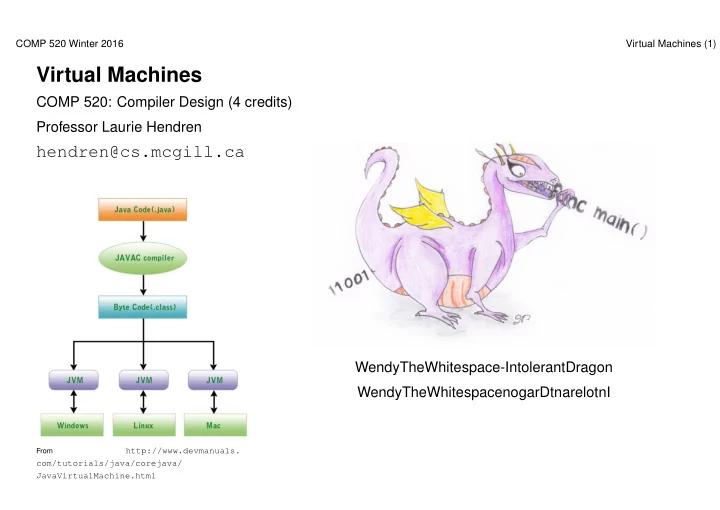
WendyTheWhitespace-IntolerantDragon WendyTheWhitespacenogarDtnarelotnI

slide-2
SLIDE 2

COMP 520 Winter 2016 Virtual Machines (2)

Compilation and execution modes of Virtual machines:

❄ ❄ ✲ ✛

Abstract syntax trees Virtual machine code Interpreter Native binary code AOT-compile JIT-compile interpret

slide-3
SLIDE 3

COMP 520 Winter 2016 Virtual Machines (3)

Compilers traditionally compiled to machine code ahead-of-time (AOT). Example:

  • gcc translates into RTL (Register Transfer Language), optimizes RTL, and then compiles RTL into

native code. Advantages:

  • can exploit many details of the underlying architecture; and
  • intermediate languages like RTL facilitate production of code generators for many target architectures.

Disadvantage:

  • a code generator must be built for each target architecture.
slide-4
SLIDE 4

COMP 520 Winter 2016 Virtual Machines (4)

Interpreting virtual machine code. Examples:

  • P-code for early Pascal interpreters;
  • Postscript for display devices; and
  • Java bytecode for the Java Virtual Machine.

Advantages:

  • easy to generate the code;
  • the code is architecture independent; and
  • bytecode can be more compact.

Disadvantage:

  • poor performance due to interpretative overhead (typically 5-20 × slower).

Reasons: – Every instruction considered in isolation, – confuses branch prediction, – . . . and many more.

slide-5
SLIDE 5

COMP 520 Winter 2016 Virtual Machines (5)

But, modern Java is quite efficient

http://blog.cfelde.com/2010/06/c-vs-java-performance/

slide-6
SLIDE 6

COMP 520 Winter 2016 Virtual Machines (6)

Let’s look at two virtual machines .... VirtualRISC: register-based IR Java Virtual Machine: stack-based IR

slide-7
SLIDE 7

COMP 520 Winter 2016 Virtual Machines (7)

VirtualRISC is a simple RISC machine with:

  • memory;
  • registers;
  • condition codes; and
  • execution unit.

In this model we ignore:

  • caches;
  • pipelines;
  • branch prediction units; and
  • advanced features.
slide-8
SLIDE 8

COMP 520 Winter 2016 Virtual Machines (8)

VirtualRISC memory:

  • a stack

(used for function call frames);

  • a heap

(used for dynamically allocated memory);

  • a global pool

(used to store global variables); and

  • a code segment

(used to store VirtualRISC instructions).

slide-9
SLIDE 9

COMP 520 Winter 2016 Virtual Machines (9)

VirtualRISC registers:

  • unbounded number of general purpose registers;
  • the stack pointer (sp) which points to the top of the stack;
  • the frame pointer (fp) which points to the current stack frame; and
  • the program counter (pc) which points to the current instruction.
slide-10
SLIDE 10

COMP 520 Winter 2016 Virtual Machines (10)

VirtualRISC condition codes:

  • stores the result of last instruction that can set condition codes (used for branching).

VirtualRISC execution unit:

  • reads the VirtualRISC instruction at the current pc, decodes the instruction and executes it;
  • this may change the state of the machine (memory, registers, condition codes);
  • the pc is automatically incremented after executing an instruction; but
  • function calls and branches explicitly change the pc.
slide-11
SLIDE 11

COMP 520 Winter 2016 Virtual Machines (11)

Memory/register instructions:

st Ri,[Rj] [Rj] := Ri st Ri,[Rj+C] [Rj+C] := Ri ld [Ri],Rj Rj := [Ri] ld [Ri+C],Rj Rj := [Ri+C]

Register/register instructions:

mov Ri,Rj Rj := Ri add Ri,Rj,Rk Rk := Ri + Rj sub Ri,Rj,Rk Rk := Ri - Rj mul Ri,Rj,Rk Rk := Ri * Rj div Ri,Rj,Rk Rk := Ri / Rj ...

Constants may be used in place of register values: mov 5,R1.

slide-12
SLIDE 12

COMP 520 Winter 2016 Virtual Machines (12)

Instructions that set the condition codes:

cmp Ri,Rj

Instructions to branch:

b L bg L bge L bl L ble L bne L

To express: if R1 <= 9 goto L1 we code:

cmp R1,9 ble L1

slide-13
SLIDE 13

COMP 520 Winter 2016 Virtual Machines (13)

Other instructions:

save sp,-C,sp save registers, allocating C bytes

  • n the stack

call L R15:=pc; pc:=L restore restore registers ret pc:=R15+8 nop do nothing

slide-14
SLIDE 14

COMP 520 Winter 2016 Virtual Machines (14)

slide-15
SLIDE 15

COMP 520 Winter 2016 Virtual Machines (15)

Stack frames:

  • stores function activations;
  • sp and fp point to stack frames;
  • when a function is called a new stack frame is created:

push fp; fp := sp; sp := sp + C;

  • when a function returns, the top stack frame is popped:

sp := fp; fp = pop;

  • local variables are stored relative to fp;
  • the figure shows additional features of the SPARC architecture.
slide-16
SLIDE 16

COMP 520 Winter 2016 Virtual Machines (16)

A simple C function:

int fact(int n) { int i, sum; sum = 1; i = 2; while (i <= n) { sum = sum * i; i = i + 1; } return sum; }

slide-17
SLIDE 17

COMP 520 Winter 2016 Virtual Machines (17)

Corresponding VirtualRISC code:

int fact(int n) { int i, sum; sum = 1; i = 2; while (i <= n) { sum = sum * i; i = i + 1; } return sum; }

_fact: save sp,-112,sp // save stack frame st R0,[fp+68] // save arg n in frame of CALLER mov 1,R0 // R0 := 1 st R0,[fp-16] // [fp-16] is location for sum mov 2,R0 // RO := 2 st RO,[fp-12] // [fp-12] is location for i L3: ld [fp-12],R0 // load i into R0 ld [fp+68],R1 // load n into R1 cmp R0,R1 // compare R0 to R1 ble L5 // if R0 <= R1 goto L5 b L4 // goto L4 L5: ld [fp-16],R0 // load sum into R0 ld [fp-12],R1 // load i into R1 mul R0,R1,R0 // R0 := R0 * R1 st R0,[fp-16] // store R0 into sum ld [fp-12],R0 // load i into R0 add R0,1,R1 // R1 := R0 + 1 st R1,[fp-12] // store R1 into i b L3 // goto L3 L4: ld [fp-16],R0 // put return value of sum into R0 restore // restore register window ret // return from function

slide-18
SLIDE 18

COMP 520 Winter 2016 Virtual Machines (18)

Note: slides of this format from: http://cs434.cs.ua.edu/Classes/20_JVM.ppt

slide-19
SLIDE 19

COMP 520 Winter 2016 Virtual Machines (19)

Java Virtual Machine has:

  • memory;
  • registers;
  • condition codes; and
  • execution unit.
slide-20
SLIDE 20

COMP 520 Winter 2016 Virtual Machines (20)

Java Virtual Machine memory:

  • a stack

(used for function call frames);

  • a heap

(used for dynamically allocated memory);

  • a constant pool

(used for constant data that can be shared); and

  • a code segment

(used to store JVM instructions of currently loaded class files).

slide-21
SLIDE 21

COMP 520 Winter 2016 Virtual Machines (21)

slide-22
SLIDE 22

COMP 520 Winter 2016 Virtual Machines (22)

Java Virtual Machine registers:

  • no general purpose registers;
  • the stack pointer (sp) which points to the top of the stack;
  • the local stack pointer (lsp) which points to a location in the current stack frame; and
  • the program counter (pc) which points to the current instruction.
slide-23
SLIDE 23

COMP 520 Winter 2016 Virtual Machines (23)

Java Virtual Machine condition codes:

  • stores the result of last instruction that can set condition codes (used for branching).

Java Virtual Machine execution unit:

  • reads the Java Virtual Machine instruction at the current pc, decodes the instruction and executes it;
  • this may change the state of the machine (memory, registers, condition codes);
  • the pc is automatically incremented after executing an instruction; but
  • method calls and branches explicitly change the pc.
slide-24
SLIDE 24

COMP 520 Winter 2016 Virtual Machines (24)

Java Virtual Machine stack frames have space for:

  • a reference to the current object (this);
  • the method arguments;
  • the local variables; and
  • a local stack used for intermediate results.

The number of local slots and the maximum size of the local stack are fixed at compile-time.

slide-25
SLIDE 25

COMP 520 Winter 2016 Virtual Machines (25)

slide-26
SLIDE 26

COMP 520 Winter 2016 Virtual Machines (26)

Java compilers translate source code to class files. Class files include the bytecode instructions for each method.

Java Compiler foo.java foo.class magic number (0xCAFEBABE) minor version/major version this class super class interfaces fields methods attributes constant pool access flags

slide-27
SLIDE 27

COMP 520 Winter 2016 Virtual Machines (27)

Class Loading

  • Classes are loaded lazily when first accessed
  • Class name must match file name
  • Super classes are loaded first (transitively)
  • The bytecode is verified
  • Static fields are allocated and given default values
  • Static initializers are executed.
slide-28
SLIDE 28

COMP 520 Winter 2016 Virtual Machines (28)

Class Loaders

  • A class loader is an object responsible for loading classes.
  • Each class loader is an instance of the abstract class java.lang.ClassLoader.
  • Every class object contains a reference to the ClassLoader that defined it.
  • Each class loader has a parent class loader

– First try parent class loader if class is requested – There is a bootstrap class loader which is the root of the classloader hierarchy.

  • Class loaders provide a powerful extension mechanism in Java

– Loading classes from other sources – Transforming classes during loading

slide-29
SLIDE 29

COMP 520 Winter 2016 Virtual Machines (29)

slide-30
SLIDE 30

COMP 520 Winter 2016 Virtual Machines (30)

slide-31
SLIDE 31

COMP 520 Winter 2016 Virtual Machines (31)

A simple Java method:

public int Abs(int x) { if (x < 0) return(x * -1); else return(x); }

Corresponding bytecode (in Jasmin syntax):

.method public Abs(I)I // one int argument, returns an int .limit stack 2 // has stack with 2 locations .limit locals 2 // has space for 2 locals // --locals--

  • -stack---

// [ o -3 ] [ * * ] iload_1 // [ o -3 ] [ -3 * ] ifge Label1 // [ o -3 ] [ * * ] iload_1 // [ o -3 ] [ -3 * ] iconst_m1 // [ o -3 ] [ -3 -1 ] imul // [ o -3 ] [ 3 * ] ireturn // [ o -3 ] [ * * ] Label1: iload_1 ireturn .end method

Comments show trace of o.Abs(-3).

slide-32
SLIDE 32

COMP 520 Winter 2016 Virtual Machines (32)

A sketch of a bytecode interpreter:

pc = code.start; while(true) { npc = pc + instruction_length(code[pc]); switch (opcode(code[pc])) { case ILOAD_1: push(local[1]); break; case ILOAD: push(local[code[pc+1]]); break; case ISTORE: t = pop(); local[code[pc+1]] = t; break; case IADD: t1 = pop(); t2 = pop(); push(t1 + t2); break; case IFEQ: t = pop(); if (t == 0) npc = code[pc+1]; break; ... } pc = npc; }

slide-33
SLIDE 33

COMP 520 Winter 2016 Virtual Machines (33)

The JVM has 256 instructions for:

  • arithmetic operations
  • branch operations
  • constant loading operations
  • local operations
  • stack operations
  • class operations
  • method operations

The JVM specification gives the full list

slide-34
SLIDE 34

COMP 520 Winter 2016 Virtual Machines (34)

Unary arithmetic operations:

ineg [...:i] -> [...:-i] i2c [...:i] -> [...:i%65536]

Binary arithmetic operations:

iadd [...:i1:i2] -> [...:i1+i2] isub [...:i1:i2] -> [...:i1-i2] imul [...:i1:i2] -> [...:i1*i2] idiv [...:i1:i2] -> [...:i1/i2] irem [...:i1:t2] -> [...:i1%i2]

Direct operations:

iinc k a [...]

  • > [...]

local[k]=local[k]+a

slide-35
SLIDE 35

COMP 520 Winter 2016 Virtual Machines (35)

Nullary branch operations:

goto L [...]

  • > [...]

branch always

Unary branch operations:

ifeq L [...:i] -> [...] branch if i == 0 ifne L [...:i] -> [...] branch if i != 0 ifnull L [...:o] -> [...] branch if o == null ifnonnull L [...:o] -> [...] branch if o != null

slide-36
SLIDE 36

COMP 520 Winter 2016 Virtual Machines (36)

Binary branch operations:

if_icmpeq L [...:i1:i2] -> [...] branch if i1 == i2 if_icmpne L [...:i1:i2] -> [...] branch if i1 != i2 if_icmpgt L [...:i1:i2] -> [...] branch if i1 > i2 if_icmplt L [...:i1:i2] -> [...] branch if i1 < i2 if_icmple L [...:i1:i2] -> [...] branch if i1 <= i2 if_icmpge L [...:i1:i2] -> [...] branch if i1 >= i2 if_acmpeq L [...:o1:o2] -> [...] branch if o1 == o2 if_acmpne L [...:o1:o2] -> [...] branch if o1 != o2

slide-37
SLIDE 37

COMP 520 Winter 2016 Virtual Machines (37)

Constant loading operations:

iconst_0 [...]

  • > [...:0]

iconst_1 [...]

  • > [...:1]

iconst_2 [...]

  • > [...:2]

iconst_3 [...]

  • > [...:3]

iconst_4 [...]

  • > [...:4]

iconst_5 [...]

  • > [...:5]

aconst_null [...]

  • > [...:null]

ldc_int i [...]

  • > [...:i]

ldc_string s [...]

  • > [...:String(s)]
slide-38
SLIDE 38

COMP 520 Winter 2016 Virtual Machines (38)

Locals operations:

iload k [...]

  • > [...:local[k]]

istore k [...:i] -> [...] local[k]=i aload k [...]

  • > [...:local[k]]

astore k [...:o] -> [...] local[k]=o

Field operations:

getfield f sig [...:o] -> [...:o.f] putfield f sig [...:o:v] -> [...]

  • .f=v
slide-39
SLIDE 39

COMP 520 Winter 2016 Virtual Machines (39)

Stack operations:

dup [...:v1] -> [...:v1:v1] pop [...:v1] -> [...] swap [...:v1:v2] -> [...:v2:v1] nop [...]

  • > [...]
slide-40
SLIDE 40

COMP 520 Winter 2016 Virtual Machines (40)

Class operations:

new C [...]

  • > [...:o]

(note that new only allocates space, must call <init> to execute body instance_of C [...:o] -> [...:i] if (o==null) i=0 else i=(C<=type(o)) checkcast C [...:o] -> [...:o] if (o!=null && !C<=type(o)) throw ClassCastException

slide-41
SLIDE 41

COMP 520 Winter 2016 Virtual Machines (41)

Method operations:

invokevirtual m sig [...:o:a1:...:an] -> [...] //overloading already resolved: // signature of m is known! entry=lookupHierarchy(m,sig,class(o)); block=block(entry); push stack frame of size block.locals+block.stacksize; local[0]=o; //local points to local[1]=a1; //beginning of frame ... local[n]=an; pc=block.code;

slide-42
SLIDE 42

COMP 520 Winter 2016 Virtual Machines (42)

Method operations:

invokespecial m sig [...:o:a1:...:an] -> [...] //overloading already resolved: // signature of m is known! entry=lookupClassOnly(m,sig,class(o)); block=block(entry); push stack frame of size block.locals+block.stacksize; local[0]=o; //local points to local[1]=a1; //beginning of frame ... local[n]=an; pc=block.code;

For which method calls is invokespecial used? ANSWER: <init>(..), private, super method calls Also, invokestatic and invokeinterface.

slide-43
SLIDE 43

COMP 520 Winter 2016 Virtual Machines (43)

Method operations:

ireturn [...:<frame>:i] -> [...:i] pop stack frame, push i onto frame of caller areturn [...:<frame>:o] -> [...:o] pop stack frame, push o onto frame of caller return [...:<frame>] -> [...] pop stack frame

Those operations also release locks in synchronized methods.

slide-44
SLIDE 44

COMP 520 Winter 2016 Virtual Machines (44)

A Java method:

public boolean member(Object item) { if (first.equals(item)) return true; else if (rest == null) return false; else return rest.member(item); }

slide-45
SLIDE 45

COMP 520 Winter 2016 Virtual Machines (45)

Corresponding bytecode (in Jasmin syntax):

.method public member(Ljava/lang/Object;)Z .limit locals 2 // local[0] = o // local[1] = item .limit stack 2 // initial stack [ * * ] aload_0 // [ o * ] getfield Cons/first Ljava/lang/Object; // [ o.first *] aload_1 // [ o.first item] invokevirtual java/lang/Object/equals(Ljava/lang/Object;)Z // [ b * ] for some boolean b ifeq else_1 // [ * * ] iconst_1 // [ 1 * ] ireturn // [ * * ] else_1: aload_0 // [ o * ] getfield Cons/rest LCons; // [ o.rest * ] aconst_null // [ o.rest null] if_acmpne else_2 // [ * * ] iconst_0 // [ 0 * ] ireturn // [ * * ] else_2: aload_0 // [ o * ] getfield Cons/rest LCons; // [ o.rest * ] aload_1 // [ o.rest item ] invokevirtual Cons/member(Ljava/lang/Object;)Z // [ b * ] for some boolean b ireturn // [ * * ] .end method

slide-46
SLIDE 46

COMP 520 Winter 2016 Virtual Machines (46)

Bytecode verification:

  • bytecode cannot be trusted to be well-formed and well-behaved;
  • before executing any bytecode, it should be verified, especially if that bytecode is received over the

network;

  • verification is performed partly at class loading time, and partly at run-time; and
  • at load time, dataflow analysis is used to approximate the number and type of values in locals and on

the stack.

slide-47
SLIDE 47

COMP 520 Winter 2016 Virtual Machines (47)

Bytecode Verification: Syntax

  • The first 4 bytes of a class file must contain the magic number 0xCAFEBABE.
  • The bytecodes must be syntactically correct.

– Branch targets are within the code segment – Only legal offsets are referenced – Constants have appropriate types – All instructions are complete – Execution cannot fall of the end of the code

slide-48
SLIDE 48

COMP 520 Winter 2016 Virtual Machines (48)

Interesting properties of verified bytecode:

  • at any program point, the stack is the same size along all execution paths;
  • each instruction must be executed with the correct number and types of arguments on the stack, and

in locals (on all execution paths);

  • every method must have enough locals to hold the receiver object (except static methods) and the

method’s arguments; and

  • no local variable can be accessed before it has been assigned a value.
  • fields are assigned appropriate values
slide-49
SLIDE 49

COMP 520 Winter 2016 Virtual Machines (49)

Slides of this format from: http://cs.au.dk/~mis/dOvs/slides/39a-javavirtualmachine.pdf

slide-50
SLIDE 50

COMP 520 Winter 2016 Virtual Machines (50)

slide-51
SLIDE 51

COMP 520 Winter 2016 Virtual Machines (51)

slide-52
SLIDE 52

COMP 520 Winter 2016 Virtual Machines (52)

slide-53
SLIDE 53

COMP 520 Winter 2016 Virtual Machines (53)

Java class loading and execution model:

  • when a method is invoked, a ClassLoader finds the correct class and checks that it contains an

appropriate method;

  • if the method has not yet been loaded, then it is verified (remote classes);
  • after loading and verification, the method body is interpreted.
  • If the method becomes executed multiple times, the bytecode for that method is translated to native

code.

  • If the method becomes hot, the native code is optimized.

The last two steps are very involved and a lot of research and industrial effort has been put into good adaptive JIT compilers.

slide-54
SLIDE 54

COMP 520 Winter 2016 Virtual Machines (54)

Split-verification in Java 6+:

  • Bytecode verification is easy but still polynomial, i.e. sometimes slow, and
  • this can be exploited in denial-of-service attacks:

http://www.bodden.de/research/javados/

  • Java 6 (version 50.0 bytecodes) introduced StackMapTable attributes to make verification linear.

– Java compilers know the type of locals at compile time. – Java 6 compilers store these types in the bytecode using StackMapTable attributes. – Speeds up construction of the “proof tree” ⇒ also called “Proof-Carrying Code”

  • Java 7 (version 51.0 bytecodes) JVMs will enforce presence of these attributes.
slide-55
SLIDE 55

COMP 520 Winter 2016 Virtual Machines (55)

Future use of Java bytecode:

  • the JOOS compiler produces Java bytecode in Jasmin format; and
  • the JOOS peephole optimizer transforms bytecode into more efficient bytecode.

Future use of VirtualRISC:

  • Java bytecode can be converted into machine code at run-time using a JIT (Just-In-Time) compiler;
  • we will study some examples of converting Java bytecode into a language similar to VirtualRISC;
  • we will study some simple, standard optimizations on VirtualRISC.
slide-56
SLIDE 56

COMP 520 Winter 2016 Virtual Machines (56)

Let’s Practice!" Write virtualRISC code for the following function. Assume that x is in R0 and n is in R1 on input, and that the result should be returned in R0.

int power1(int x, int n) { int i; int prod = 1; for (i=0; i<n; i++) prod = prod * (x+1); return(prod); }

You can also assume that the variables are mapped to following spots in the stack frame. You can use registers only if you like.

Parameters: x -> [fp+68] n -> [fp+72] Locals: i -> [fp-12] prod -> [fp-16]

Try, gcc -S power1.c and gcc -O -S power1.c, and compare the difference.

slide-57
SLIDE 57

COMP 520 Winter 2016 Virtual Machines (57)

Possible VirtualRISC code with loop invariant expression removed

_power1: save sp,-112,sp // save stack frame st R0,[fp+68] // save input args x, n in frame of CALLER st R1,[fp+72] // R0 holds x, R1 holds n mov 1,R2 // R2 :=1, R2 holds prod add R0,1,R4 // R4 := x + 1, loop invariant mov 0,R3 // R3 := 0, R3 holds i begin_loop: cmp R3,R1 // if (i < n) bge end_loop begin_body: mul R2,R4,R2 // prod = prod * (x+1) add R3,1,R3 // i = i + 1 goto begin_loop end_loop: mov R2, R0 // put return value of prod into R0 restore // restore register window ret // return from function

slide-58
SLIDE 58

COMP 520 Winter 2016 Virtual Machines (58)

Now for some bytecode Write the Java bytecode version of the static method.

public class p1{ static int power1(int x, int n) { int i; int prod = 1; for (i=0; i<n; i++) prod = prod * (x+1); return(prod); } }

You can assume the following mapping of variables to bytecode locals:

Parameters: x -> local 0 n -> local 1 Locals: i -> local 2 prod -> local 3

What is the “baby" stack limit? Try: javac p1.java, javap -verbose p1.class

slide-59
SLIDE 59

COMP 520 Winter 2016 Virtual Machines (59)

Jasmin code for power1

.method static power1(II)I .limit stack 3 .limit locals 4 Label2: 0: iconst_1 1: istore_3 ; prod = 1 2: iconst_0 3: istore_2 ; i = 0; Label1: 4: iload_2 5: iload_1 6: if_icmpge Label0 ; (i >= n)? 9: iload_3 10: iload_0 11: iconst_1 ; high water mark for baby stack, 3 12: iadd 13: imul 14: istore_3 ; prod = prod * (x + 1) 15: iinc 2 1 ; i++ 18: goto Label1 Label0: 21: iload_3 22: ireturn ; return(prod) .end method

slide-60
SLIDE 60

COMP 520 Winter 2016 Virtual Machines (60)

Jasmin code for power1, with loop invariant removal

.method static power1(II)I .limit stack 2 .limit locals 5 Label2: 0: iconst_1 1: istore_3 ; prod = 1 2: iload_0 3: iconst_1 4: iadd 5: istore 4 ; t = x + 1 7: iconst_0 8: istore_2 ; i = 0 Label1: 9: iload_2 10: iload_1 11: if_icmpge Label0 (i >= n)? 14: iload_3 15: iload 4 17: imul 18: istore_3 ; prod = prod * t; 19: iinc 2 1 22: goto Label1 Label0: 25: iload_3 26: ireturn ; return (prod) .end method

slide-61
SLIDE 61

COMP 520 Winter 2016 Virtual Machines (61)

A useful tool for dealing with class files, tinapoc

http://sourceforge.net/projects/tinapoc/ supports several tools including: > java dejasmin Test.class will disassemble Test.class and produce Jasmin output > java dejasmin --warmode Test.class > Test.dump will dump the WHOLE content of the class in Test.dump See dejasmin documentation for more details. > java jasmin test.j assembles test.j. See Jasmin documentation for more details.

slide-62
SLIDE 62

COMP 520 Winter 2016 Virtual Machines (62)

Some useful scripts (Windows cygwin versions)

#! /bin/tcsh # jas - java jasmin setenv TOOLDIR "/cygdrive/c/Users/Laurie/Documents/Courses/520/Java" java -classpath ‘cygpath -wp $TOOLDIR/tinapoc.jar:$TOOLDIR/bcel-5.1.jar‘ jasmin $* #!/bin/csh # djas - java dejasmin setenv TOOLDIR "/cygdrive/c/Users/Laurie/Documents/Courses/520/Java" java -classpath ‘cygpath -wp $TOOLDIR/tinapoc.jar:$TOOLDIR/bcel-5.1.jar‘ dejasmin $*

Try: djas p1.class > p1.j and jas p1.j

djas -warmode p1.class > p1.dump

slide-63
SLIDE 63

COMP 520 Winter 2016 Virtual Machines (63)

Let’s consider this mystery program

public class u1 { public static void main(String [] args) { int r = prod(4); System.out.println(r); } static int prod(int n) { ... written only in bytecode ... } }

slide-64
SLIDE 64

COMP 520 Winter 2016 Virtual Machines (64)

Now in bytecode (jasmin source)

.class public ul .super java/lang/Object .method public <init>()V .limit stack 1 .limit locals 1 Label0: aload_0 invokespecial java/lang/Object/<init>()V Label1: return .end method .method public static main([Ljava/lang/String;)V .limit stack 2 .limit locals 2 Label0: ldc 4 invokestatic ul/prod(I)I istore_1 getstatic java.lang.System.out Ljava/io/PrintStream; iload_1 invokevirtual java/io/PrintStream/println(I)V Label1: return .end method

slide-65
SLIDE 65

COMP 520 Winter 2016 Virtual Machines (65)

What does this method do?

.method static prod(I)I .limit stack 5 .limit locals 2 Begin: iconst_1 istore_1 PushLoop: iload_1 iinc 1 1 iload_1 iload_0 if_icmple PushLoop iconst_1 istore_1 PopLoop: imul iinc 1 1 iload_1 iload_0 if_icmplt PopLoop ireturn .end method

Try java -noverify ul and java ul.

slide-66
SLIDE 66

COMP 520 Winter 2016 Virtual Machines (66)

BUT .... is stack code really suitable for optimizations and transformations? No, tools like Soot are useful for this.

http://sable.github.io/soot/, use the nightly build.

A useful script,

#! /bin/tcsh # soot with the soot classpath set setenv TOOLDIR "/cygdrive/c/Users/Laurie/Documents/Courses/520/Java" java -jar ‘cygpath -wp $TOOLDIR/soot-trunk.jar‘ -cp ‘cygpath -wp $TOOLDIR/rt.jar:$TOOLDIR/jce.jar:.‘ $*

slide-67
SLIDE 67

COMP 520 Winter 2016 Virtual Machines (67)

Let’s look at the power1 example again...

public class p1 { public static void main(String [] args) { int r = power1(10,2); System.out.println(r); } static int power1(int x, int n) { int i; int prod = 1; for (i=0; i<n; i++) prod = prod * (x+1); return(prod); } }

slide-68
SLIDE 68

COMP 520 Winter 2016 Virtual Machines (68)

Using Soot to create Jimple: soot -f jimple p1 Creates file sootOutput/p1.jimple.

public class p1 extends java.lang.Object { public void <init>() { p1 r0; r0 := @this: p1; specialinvoke r0.<java.lang.Object: void <init>()>(); return; } public static void main(java.lang.String[]) { java.lang.String[] r0; int i0; java.io.PrintStream $r1; r0 := @parameter0: java.lang.String[]; i0 = staticinvoke <p1: int power1(int,int)>(10, 2); $r1 = <java.lang.System: java.io.PrintStream out>; virtualinvoke $r1.<java.io.PrintStream: void println(int)>(i0); return; } ...

slide-69
SLIDE 69

COMP 520 Winter 2016 Virtual Machines (69)

... static int power1(int, int) { int i0, i1, i2, i3, $i4; i0 := @parameter0: int; i1 := @parameter1: int; i3 = 1; i2 = 0; label1: if i2 >= i1 goto label2; $i4 = i0 + 1; i3 = i3 * $i4; i2 = i2 + 1; goto label1; label2: return i3; } }

slide-70
SLIDE 70

COMP 520 Winter 2016 Virtual Machines (70)

You can also decompile .class files to .java Try soot -f dava -p db.renamer enabled:true p1

import java.io.PrintStream; public class p1 { public static void main(String[] args) { int i0; i0 = p1.power1(10, 2); System.out.println(i0); } static int power1(int i0, int i1) { int i, i3; i3 = 1; for (i = 0; i < i1; i++) { i3 = i3 * (i0 + 1); } return i3; } }

slide-71
SLIDE 71

COMP 520 Winter 2016 Virtual Machines (71)

EOE