Vo Vouchers: Addressing inequities in access to contraceptive - - PDF document

vo vouchers addressing inequities in access to
SMART_READER_LITE
LIVE PREVIEW

Vo Vouchers: Addressing inequities in access to contraceptive - - PDF document

10/18/2017 Vo Vouchers: Addressing inequities in access to contraceptive services October 18, 2017 Nandita Thatte, WHO/IBP, Facilitator Nandita leads the WHO/IBP Secretariat based in Geneva. Her current portfolio includes


slide-1
SLIDE 1

10/18/2017 1

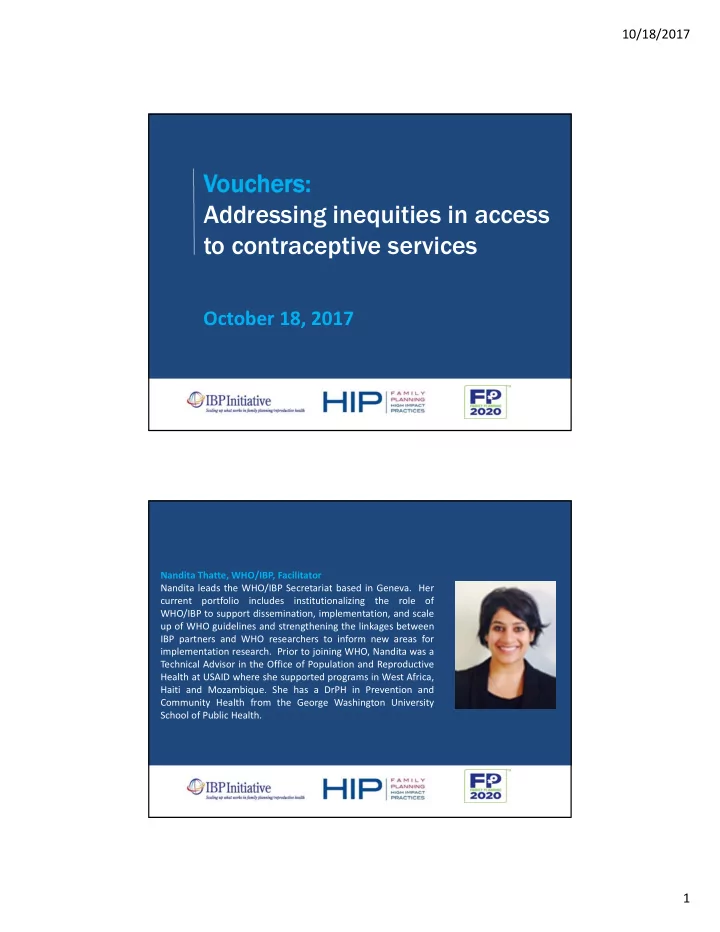
Vo Vouchers: Addressing inequities in access to contraceptive services

October 18, 2017

Nandita Thatte, WHO/IBP, Facilitator Nandita leads the WHO/IBP Secretariat based in Geneva. Her current portfolio includes institutionalizing the role

  • f

WHO/IBP to support dissemination, implementation, and scale up of WHO guidelines and strengthening the linkages between IBP partners and WHO researchers to inform new areas for implementation research. Prior to joining WHO, Nandita was a Technical Advisor in the Office of Population and Reproductive Health at USAID where she supported programs in West Africa, Haiti and Mozambique. She has a DrPH in Prevention and Community Health from the George Washington University School of Public Health.

slide-2
SLIDE 2

10/18/2017 2

  • Welcome and Introduction
  • HIP brief

Nandita Thatte, WHO

  • Financing Mechanism/Programmatic Tool

Elaine Menotti, USAID

  • Increasing contraceptive access with vouchers in Uganda

Ben Bellows, Population Council ‐ Zambia

  • Youth vouchers in Madagascar

Anna Mackay, MSI

  • Voucher Program in Punjab, Pakistan

Moazzam Ali, WHO

  • Questions and Answers

Agenda

Objectives:

  • Participants have a better understanding of the vouchers HIP
  • Share implementation successes and challenges in voucher at global and country levels

Logistics:

  • Questions

During presentations, please submit any questions using the question feature of the

  • application. We have allotted time at the end of the webinar for Q&A
  • Webinar presentation and recording

This webinar will be recorded and posted on the HIPs YouTube channel and the IBP

  • channel. Links will be shared at the end of the webinar. The presentation will be shared

with participants

  • Handouts

There are handouts that you can download for your own viewing and reference

Vouchers Webinar

slide-3
SLIDE 3

10/18/2017 3

Vouchers HIP Brief

What is the high‐impact practice in family planning service delivery? Provide vouchers where financial and information barriers impede access to modern methods of contraceptives

HIP Categories

slide-4
SLIDE 4

10/18/2017 4

HIP Categories

slide-5
SLIDE 5

10/18/2017 5

  • Background
  • Why is this practice important?
  • What is the impact?
  • How to do it: Tips from implementation experience
  • Priority research questions
  • References

Today’s Panelists

Elaine Menotti USAID Moazzam Ali WHO Ben Bellows Population Council Anna Mackay MSI

slide-6
SLIDE 6

10/18/2017 6

Elaine Menotti, USAID

Elaine is a Technical Advisor at USAID’s Bureau for Global Health in the Office of Population and Reproductive Health where she works on the Private Sector team, manages health service delivery programs and supports public/private partnerships and strategic initiatives to implement total market approaches. Previously, she worked in USAID’s Health, Infectious Disease and Nutrition Office on community based maternal and child health programming. She has an MPH in Health Behavior and Health Education and a Certificate in Reproductive and Women’s Health from the University of Michigan and a BA in Anthropology from Duke University.

Voucher webinar 12

VOUCHERS for Family Planning: Financing Mechanism, Programmatic T

  • ol

VOUCHERS for Family Planning: Financing Mechanism, Programmatic T

  • ol

Elaine Menotti, MPH USAID Office of Population and Reproductive Health Elaine Menotti, MPH USAID Office of Population and Reproductive Health

slide-7
SLIDE 7

10/18/2017 7

  • What? Paper or electronic tickets distributed or sold to select client

segments who exchange them for products and/or services at accredited sites

  • Why? To increase access to and use of high quality FP services for those who

may otherwise face barriers

Voucher webinar 13

Vouchers: What are they and what can they do?

EQUITY: VOUCHERS FACILITATE TARGETING SUBSIDY TO 1) THOSE SEGMENTS WHO NEED IT MOST (e.g. poor, youth, postpartum) 2) CRITICAL, HIGH IMPACT HEALTH SERVICES And can reduce other barriers to seeking care, if implemented well.

Voucher webinar 14

Why not just make services free?

  • Despite high unmet need, the poorest often have lower rates of service utilization than

their wealthier counterparts*

  • Health systems are often stretched and face difficulties adequately financing and

supporting health facilities and programs, especially lower levels  Need to address cost barriers and other factors affecting service utilization to reduce inequities

*Wang et al. 2010. Who Benefits from Government Subsidies to Public Health Facilities in Liberia? HS2020

slide-8
SLIDE 8

10/18/2017 8

15

1) Foundational structure

– Funding (govt, donor, both) – Program Objectives – Governance structure

2) Management systems

– Voucher management agency – Voucher design – Provider QA – Claims, fraud control, M&E

3) Providers / facilities

– Which ones, how to engage, reimburse, support

4) Clients

– Who, how to engage, what services

What are the key components to voucher programs?

16

HOW DO THEY WORK IN PRACTICE?

Adapted from WB 2005, Islam 2006, Grainger et al 2014

slide-9
SLIDE 9

10/18/2017 9

  • Include Supply + Demand related inputs

– Inputs to providers and facilities to ensure strong FP quality

  • Training, monitoring, supportive supervision,

site improvements

– SBCC to reach desired population group

  • Promote FP services, create a “buzz”
  • Opportunity for counseling and interpersonal

communication

  • Means testing to ensure vouchers go to

those who need them

  • Voucher revenue reinvested at the facility

level

17

What Makes for better Voucher Programs?

  • Increase voluntary uptake of modern contraceptive

methods

  • Improve quality and continuity of FP services

– Can include follow up, removal services

  • Enhance method choice by offering a broad range

– Increase number and types of providers “network”

  • ffering quality FP

– In many countries, gaps in LARC/PM access – Reimbursement rates can level playing field with less costly methods

  • Enable client purchasing power+ provider choice
  • Create pathway for strategic purchasing

– Accustom providers to accreditation, reimbursement,

  • versight

– Including FP as methods vary in provision costs – Including private providers

18

WHAT CAN THEY DO FOR FP?

slide-10
SLIDE 10

10/18/2017 10

  • T
  • o heavy administrative lift to set up voucher programs?
  • Integrated package or FP services alone?
  • Are there unintended consequences on other service

provision? – Increase service volume and overwhelm providers?

  • How long to sustain them?

– Creates quality assured provider network with FP service capacity – Platform for other financing mechanisms, like insurance

  • What else can we ask/monitor? Can they help improve FP

continuation?

  • What are most important design features for success?

19

Challenges we face, questions we ask

10/18/2017 20

Elaine Menotti, MPH emenotti@usaid.gov Elaine Menotti, MPH emenotti@usaid.gov

FOOTER GOES HERE

slide-11
SLIDE 11

10/18/2017 11

Ben Bellows, Population Council – Zambia

Ben is an associate with the Population Council's Reproductive Health program in Lusaka, Zambia. He joined the Council in 2009 to lead a five‐country, five‐year initiative to measure the impact

  • f reproductive health vouchers on health service uptake,

equity, quality of care, cost‐effectiveness, and sustainability in East Africa and South and Southeast Asia. Bellows received his MPH in epidemiology/biostatistics and social behavior and his PhD in epidemiology from the University of California, Berkeley, where his research focused on the impact of low‐income subsidies for care on population health in East Africa.

Increasing contraceptive access for hard-to- reach populations with vouchers and social franchising in Uganda

Ben Bell Ben Bellows Vouch uchers: High Im rs: High Impact Practice pact Practice in FP in FP HIPs W HIPs Webin binar Series r Series 18 Oc 18 October 20 r 2017

Full study: Bellows, B., Mackay, A., Dingle, A., Tuyiragize, R., & Nnyombi, W. (2017). Increasing Contraceptive Access for Hard-to-Reach Populations With Vouchers and Social Franchising in Uganda. Global Health Science and Practice, 5(3), 446–455. http://www ghspjournal org/content/5/3/446

Paper development supported by the Support for International Family Planning Organizations (SIFPO) program funded by the U.S. Agency for International Development (USAID) under Cooperative Agreement No. AID-OAA-A-10-00059

slide-12
SLIDE 12

10/18/2017 12

Background: Study

  • Study objective: Estimate impact of services

and program’s contribution to national CPR and additional users

  • 2011 DHS: 34% of married women of

reproductive age indicated unmet need for FP services

  • Inaccessible due to costs, lack of trained

providers, lack of consumer awareness, weak supply chains

Background: Study

  • +50% of Ugandan FP users access services

through private sector

– Lack of training – Where available, LARCs expensive

slide-13
SLIDE 13

10/18/2017 13

Background: Program design

  • Combined social franchising & voucher

program contracted 400 private facilities to increase access to LARCs and PMs March 2011–Dec. 2014

  • FP voucher covered counseling, LARCs, PMs,

and follow-up services as necessary

  • Vouchers intended for poor women identified

with poverty grading tool

Voucher programs and social franchising scheme

Vouch ucher manage r management & & fran franchi chisor (pur (purcha chaser)

  • Voucher marketing & distribution
  • Quality assessment, improvement, and assurance
  • Contracting and licensing, claims processing, fraud control,

performance monitoring and evaluation

Facility ( cility (Franchisees) ranchisees)

  • Clinical practice
  • Administrative management
  • Reimbursed for claims by

purchaser

Clien Client

  • Voucher acquisition
  • Care seeking and adherence
  • Review service provision
slide-14
SLIDE 14

10/18/2017 14

Study Methods

  • Estimate program’s health impact using

Impact 2 Model

– Number of pregnancies averted – Adverse health and financial outcomes averted

  • Input client demographics and facility

routine service delivery

Results: SF & voucher program

  • 330,826 FP services provided to women
  • 69.8% used vouchers to purchase implant
  • 25.1% used vouchers to purchase IUD
  • Noted increases in contraceptive uptake and

client volume at franchised facilities

slide-15
SLIDE 15

10/18/2017 15

Results: Impact2

  • 218,000 unintended pregnancies and 520

maternal deaths averted (2014 services)

  • USD$14 million saved in direct costs
  • 280,000 of Uganda’s 8.6 million women of

reproductive age using a method supplied by program

  • 120,000 clients were additional users
  • Program contributed 1.4% to national CPR

within study period

slide-16
SLIDE 16

10/18/2017 16

Conclusions

  • Existing private sector can be leveraged to

expand FP access and method mix, particularly for marginalized populations

  • CPR can be improved nationally when program

is scaled up

  • Future research: are higher clinical service

quality scores associated with higher client volumes? Potential for positive feedback.

Full study: Bellows, B., Mackay, A., Dingle, A., Tuyiragize, R., & Nnyombi, W. (2017). Increasing Contraceptive Access for Hard-to-Reach Populations With Vouchers and Social Franchising in Uganda. Global Health Science and Practice, 5(3), 446–455. http://www.ghspjournal.org/content/5/3/446

The The Populat pulation

  • n Counc

Council conduct l conducts resear research ch and deliv and delivers solution rs solutions that s that im impr prove liv e lives s ar aroun

  • und the w

the world. Big ideas suppor

  • rld. Big ideas supported b

d by eviden idence ce: : It’s It’s our model f

  • ur model for global

r global chan change. ge.

Ideas

  • Ideas. Evidence
  • Evidence. Im

Impact pact.

slide-17
SLIDE 17

10/18/2017 17

Anna Mackay, Marie Stopes International

Anna is the SIFPO 2 Director with Marie Stopes International (MSI). Anna has over ten years of public health program management experience, including seven years at MSI supporting SRH programming across sub‐Saharan Africa and South Asia. During this time Anna supported the development and management of MSI’s voucher programs in Madagascar and

  • Uganda. Prior to working with MSI, Anna managed post‐conflict

health systems strengthening projects in West and Central Africa with Merlin. She holds an MSc in Violence, Conflict and Development from the University of London.

Increasing FP access for young people through the private sector: Youth vouchers in Madagascar

Anna Mackay Marie Stopes International

slide-18
SLIDE 18

10/18/2017 18

Youth voucher program: design & development

Marie Stopes International 35

1/3 of 15-19 year

  • lds have

children, 27% have unmet FP need Cost barrier for young people to access quality SRH services Only 12% of MSM franchisee clients 15-19 MSM experienced in voucher programs Launch of the youth voucher for FP and STI services for 15-19 year olds distributed by CHWs and available for redemption at franchisees Training CHWs and franchisees in youth friendly services Adapted existing voucher management software Rationale Preparation Launch

Results (18 month pilot phase)

Marie Stopes International 36

IUD insertion 8,217 Implant insertion 25,794 Short term FP 8,789 Counseling 535 STI counseling 22,004 LARC removal 688

  • 58,417 vouchers distributed
  • 43,352 young people used

vouchers to take up a service

  • 78% chose to take a LARC
  • 51% had STI counselling
slide-19
SLIDE 19

10/18/2017 19

Who are the voucher clients? 69% had never previously

used a method of family planning

96% of clients were aged 20

  • r younger

47% had one or more

children

Lesson learned from the pilot: evolving the voucher format to include a paper voucher

Marie Stopes International 38

E-vouchers were not being frequently used due to:

a high number of young people interested in receiving a service but who did not own a mobile phone

Reluctance to provide mobile number due to the sensitive nature of the SMS content

New distribution strategy was established:

Paper-based voucher distributed at community level

E-vouchers via MSM’s Call Center (toll-free number)

slide-20
SLIDE 20

10/18/2017 20

Feedback from franchisees

Marie Stopes International 39

Youth-friendly training helped equip them to provide confidential, non-judgemental information and services

Increased youth client load improved provider confidence and willingness to provide services, including voluntary LARCs, to young people

Conclusion

  • Results demonstrate that vouchers can be an effective tool to

reach adolescents at scale, provide them with FP choice, and leverage existing private health infrastructure

  • MSI also operating adolescent vouchers in Kenya and Uganda
  • When young people have the choice, many of them choose LARCs
  • Holistic demand and supply side intervention key to success
  • Mobile technology not always the right solution

Marie Stopes International 40

slide-21
SLIDE 21

10/18/2017 21

WANT TO HEAR MORE? JOIN US ON OCT 31

Marie Stopes International 41

Scaling-up access for the underserved: The role of vouchers for family planning

Tuesday 31st October, 8.30am- 4pm Whittemore House, 1526 New Hampshire Ave NW, Washington DC RSVP: jenny.haydock@mariestopes.org How can voluntary family planning vouchers help us reach FP2020 goals and pave the way for sustainable FP financing? MSI, FP2020 and USAID invite you to join us for a day of discussion and learning. Implementers, researchers and donors will share FP voucher programming results, insights and challenges, and explore the potential of vouchers in the future FP financing landscape.

Moazzam Ali, WHO

Moazzam is a Medical Officer at the Department of Reproductive Health and Research at WHO

  • Headquarters. He is physician by training and has

masters and doctorate in public health. His main interest is in clinical trials, strengthening research capacity and health care financing modalities in family planning.

slide-22
SLIDE 22

10/18/2017 22

43 43

Effectiveness of a voucher program in meeting birth spacing needs of the underserved in Punjab, Pakistan

October 18, 2017.

Department of Reproductive Health and Research

Moazzam Ali, Khurram Azmat, Waqas Hameed

44 44

Background – Pakistan

 Approx. 210 million population ‐ 6th largest (Census 2017)  Overall Contraceptive Prevalence Rate (CPR) is 35%

– Modern CPR is 26% ‐ LARC methods lowest 2‐3%

 Approx. 9 million pregnancies in 2012 ‐ 4.2 million

pregnancies unintended

 Inequities: rural and urban populations especially  Narrowing gap ‐ Increasing role of private sector in FP service

provision – public sector 46%, and private sector 42%

Filename

slide-23
SLIDE 23

10/18/2017 23

45 45

Main objectives

 To assess the effectiveness of a single‐purpose

voucher approach (MSS model) in increasing the uptake, use and better targeting of modern contraceptives among women from the lowest two wealth quintiles in rural and urban communities of Punjab province, Pakistan

Filename

Single purpose free voucher by Marie Stopes Society Pakistan (MSI). Three components:

  • Services
  • Follow up /side effect management
  • Removal services for LARCs

46 46

Study design

 MSS used a combination of social franchising and voucher

program to reach out to the underserved in selected areas in Punjab province, Pakistan to increase access to all methods with a special focus on LARCs (2011 to 2015)

 Quasi‐experimental study (pre & post intervention)  Intervention and control arm

– Intervention district: Chakwal, Punjab – Control district: Bhakkar, Punjab

 Intervention time : Approx. 30 months  Multi stage cluster sampling with 1276 clients each from

Intervention and control areas

 Distance between districts at least 100 Km to minimize

contamination

Filename

slide-24
SLIDE 24

10/18/2017 24

47 47

Voucher management system

Filename

48 48

Socio‐demographic characteristics

 Age of MWRA : Similar between baseline and end

line in both arms (average ± 31 and 30)

 Age of Husband: Similar between baseline and end

line in both arms (average ± 37 and 34)

 Average household size: 6.5 to 4.9 in the intervention

areas while no effect on control (6.2)

slide-25
SLIDE 25

10/18/2017 25

49 49

Utilization of contraceptives

Intervention Control Intervention Control

Filename

a) Chakwal Current user p=<0.0001, b) Bhakkar Current user p= <0.0001 a) Modern methods uptake b) Traditional methods uptake

50 50

Utilization: FP method preferences

Chakwal Bhakkar

Baseline (n=692) End line (n=1318) p‐value Baseline (n=2583) End line (n=1296) p‐value % % % % Current users 21 51 <0.0001 18 32 <0.0001 Pill 2 3 0.1852 2 1 0.0217 IUD 2 20 <0.0001 2 4 0.0003 Injections 3 4 0.2564 2 2 1 Implants ‐ 2 ‐ ‐ ‐ Condom 7 13 <0.0001 7 9 0.0272 Female sterilization 5 8 0.0121 3 6 <0.0001 Male sterilization ‐ ‐ Diaphragm/foam/Jelly ‐ ‐ ‐ ‐ Periodic Abstinence ‐ 2 1 0.0217 Withdrawal 1 ‐ 3 ‐ LAM ‐ 1 ‐ ‐ 6 ‐

Filename

slide-26
SLIDE 26

10/18/2017 26

51 51

Utilization: Difference in Difference Analysis

Control

Intervention

Absolute difference (% change)+ Net effect (% change) ^ Baseline (%) Endline (%) Baseline (%) Endline (%) Control Intervention Ever user

25 58 35 79 33 44 11

Current user 1

18 32 21 51 14 30 16

Modern Method 2

16 22 19 50 6 32 26

Pill

2 1 2 3 ‐1 1 2

IUD a

2 4 2 20 2 18 16

Injections

2 2 3 4 1 1

Implants

2 2 2

Condom

7 9 7 13 2 6 4

Female sterilization

3 6 5 8 3 3

Traditional Method 3

2 10 1 1 8 ‐8

Periodic Abstinence

2 1 ‐1 1

Withdrawal

3 1 3 ‐1 ‐2

LAM b

6 1 6 1 ‐5

Filename +Absolute difference is the percentage change from baseline to endline

^ Net effect is the percentage change in intervention group subtracting the percentage change in control group. a) Intra uterine device, b) Lactational amenorrhea method

1 Percentage totals % for 2 + 3

52 52

Method continuation and switching

(during study period)

Filename

Intervention site (Chakwal) Control site (Bhakkar)

n=842 n (%) n=354 n (%)

Discontinued modern method

115 (13.7) 95 (26.8)

Switched to different method

392 (46.6) 47 (13.3)

slide-27
SLIDE 27

10/18/2017 27

53 53

Key findings: Targeting

Characteristics

Odds ratio (95% Confidence interval)

Contraceptive Knowledge any

  • ne method

Ever use (any method) Current use (any method) Modern method use First time modern contraceptive use Study area Intervention

0.72 (0.45‐1.17) 1.8 (1.44‐2.24) 1.68 (1.31‐2.16) 2.18 (1.67‐2.84) 0.87 (0.49−1.56)

Control

1.00 1.00 1.00 1.00 1.00

Household size

1.02 (0.99‐1.06) 1.07 (1.03‐1.11) 1.07 (1.03‐1.10) 1.07 (1.04‐1.11) 0.98 (0.92−1.04)

Wealth quintile Poorest

1.78 (1.06‐2.97) 1.68 (1.16‐2.42) 1.67 (1.13‐2.46) 1.69 (1.13‐2.55) 0.56 (0.27−1.19)

Poor

1.26 (0.89‐1.79) 1.58 (1.23‐2.04) 1.37 (1.02‐1.85) 1.39 (1.00‐1.94) 0.62 (0.27−1.43)

Average

1.27 (0.90‐1.81) 1.29 (1.03‐1.62) 1.29 (0.95‐1.75) 1.29 (0.93‐1.80) 0.61 (0.25−1.47)

Rich

0.97 (0.76‐1.24) 0.96 (0.77‐1.20) 0.98 (0.76‐1.27) 0.94 (0.68‐1.29) 0.48 (0.21−1.08)

Richest

1.00 1.00 1.00 1.00 1.00

Filename

Multilevel logistic regression models identifying factors associated with contraceptive knowledge and use, MSS project area, Pakistan

Adjusted for respondent age and education, husband’s age and education, baseline and endline time points

54 54

Conclusion

 Increase uptake and utilization of modern contraceptive

– Client’s empowerment

 Targeting the underserved

– Reaching out to those who need the services

 Connecting clients with the facility

– community field workers or LHWs

 Social franchising as tool to engage private sector  Future directions

– Poverty tool vs. geographical targeting – Sustainability and Scalability

Filename

slide-28
SLIDE 28

10/18/2017 28

Vo Vouchers: Addressing inequities in access to contraceptive services

October 18, 2017

Q & A Q & A

Recording and presentation available at:

https://www.youtube.com/playlist?list=PLmc4ZL8DM ckoSaVUuSDyaaYMCBJvuG-sI

& https://channel.webinar.com/channel/965084607 443925509

slide-29
SLIDE 29

10/18/2017 29

For more inf r more information, please visit: rmation, please visit:

www.fphighimpactpractices.org www.ibpinitiative.org www.familyplanning2020.org Follow us on Twitter #IBPInitiative and #HIPs4FP THANK Y THANK YOU