Von Neumann Execution Model Fetch: send PC to memory transfer - - PowerPoint PPT Presentation

von neumann execution model
SMART_READER_LITE
LIVE PREVIEW

Von Neumann Execution Model Fetch: send PC to memory transfer - - PowerPoint PPT Presentation

Von Neumann Execution Model Fetch: send PC to memory transfer instruction from memory to CPU increment PC Decode & read ALU input sources Execute an ALU operation memory operation branch target calculation


slide-1
SLIDE 1

Winter 2006 CSE 548 - Dataflow Machines 1

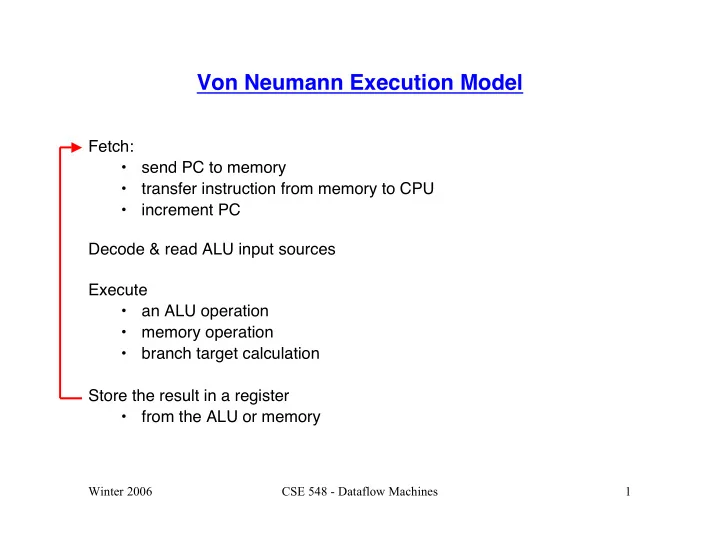
Von Neumann Execution Model

Fetch:

  • send PC to memory
  • transfer instruction from memory to CPU
  • increment PC

Decode & read ALU input sources Execute

  • an ALU operation
  • memory operation
  • branch target calculation

Store the result in a register

  • from the ALU or memory
slide-2
SLIDE 2

Winter 2006 CSE 548 - Dataflow Machines 2

Von Neumann Execution Model

Program is a linear series of addressable instructions

  • send PC to memory
  • next instruction to execute depends on what happened during the

execution of the current instruction Next instruction to be executed is pointed to by the PC Operands reside in a centralized, global memory (GPRs)

slide-3
SLIDE 3

Winter 2006 CSE 548 - Dataflow Machines 3

Dataflow Execution Model

Instructions are already in the processor: Operands arrive from a producer instruction Check to see if all an instruction’s operands are there Execute

  • an ALU operation
  • memory operation
  • branch target calculation

Send the result

  • to the consumer instructions or memory
slide-4
SLIDE 4

Winter 2006 CSE 548 - Dataflow Machines 4

Dataflow Execution Model

Execution is driven by the availability of input operands

  • perands are consumed
  • utput is generated
  • no PC

Result operands are passed directly to consumer instructions

  • no register file
slide-5
SLIDE 5

Winter 2006 CSE 548 - Dataflow Machines 5

Dataflow Computers

Motivation:

  • exploit instruction-level parallelism on a massive scale
  • more fully utilize all processing elements

Believed this was possible if:

  • expose instruction-level parallelism by using a functional-style

programming language

  • no side effects; only restrictions were producer-consumer
  • scheduled code for execution on the hardware greedily
  • hardware support for data-driven execution
slide-6
SLIDE 6

Winter 2006 CSE 548 - Dataflow Machines 6

Instruction-Level Parallelism (ILP)

Fine-grained parallelism Obtained by: – instruction overlap (later, as in a pipeline) – executing instructions in parallel (later, with multiple instruction issue) In contrast to: – loop-level parallelism (medium-grained) – process-level or task-level or thread-level parallelism (coarse- grained)

slide-7
SLIDE 7

Winter 2006 CSE 548 - Dataflow Machines 7

Instruction-Level Parallelism (ILP)

Can be exploited when instruction operands are independent of each

  • ther, for example,

– two instructions are independent if their operands are different – an example of independent instructions Each thread (program) has a fair amount of potential ILP – very little can be exploited on today’s computers – researchers trying to increase it ld R1, 0(R2)

  • r R7, R3, R8
slide-8
SLIDE 8

Winter 2006 CSE 548 - Dataflow Machines 8

Dependences

data dependence: arises from the flow of values through programs – consumer instruction gets a value from a producer instruction – determines the order in which instructions can be executed name dependence: instructions use the same register but no flow of data between them – antidependence – output dependence ld R1, 32(R3) add R3, R1, R8 ld R1, 32(R3) add R3, R1, R8 ld R1, 16 (R3)

slide-9
SLIDE 9

Winter 2006 CSE 548 - Dataflow Machines 9

Dependences

control dependence

  • arises from the flow of control
  • instructions after a branch depend on the value of the branch’s

condition variable Dependences inhibit ILP beqz R2, target lw r1, 0(r3) target: add r1, ...

slide-10
SLIDE 10

Winter 2006 CSE 548 - Dataflow Machines 10

Dataflow Execution

All computation is data-driven.

  • binary represented as a directed graph
  • nodes are operations
  • values travel on arcs
  • WaveScalar instruction

+ b a+b a

  • pcode destination1 destination2

slide-11
SLIDE 11

Winter 2006 CSE 548 - Dataflow Machines 11

Dataflow Execution

Data-dependent operations are connected, producer to consumer Code & initial values loaded into memory Execute according to the dataflow firing rule

  • when operands of an instruction have arrived on all input arcs,

instruction may execute

  • value on input arcs is removed
  • computed value placed on output arc

+

a+b

a b

slide-12
SLIDE 12

Winter 2006 CSE 548 - Dataflow Machines 12

Dataflow Example

A[j + i*i] = i; b = A[i*j]; * Load Store + j i * b A + +

slide-13
SLIDE 13

Winter 2006 CSE 548 - Dataflow Machines 13

Dataflow Example

A[j + i*i] = i; b = A[i*j]; * Load Store + j i * b A + +

slide-14
SLIDE 14

Winter 2006 CSE 548 - Dataflow Machines 14

Dataflow Example

A[j + i*i] = i; b = A[i*j]; * Load Store + j i * b A + +

slide-15
SLIDE 15

Winter 2006 CSE 548 - Dataflow Machines 15

Dataflow Execution

Control

  • Split (steer)

merge (φ)

  • convert control dependence to data dependence with value-

steering instructions

  • execute one path after condition variable is known (split)
  • r
  • execute both paths & pass values at end (merge)

+ predicate T path F path value + predicate T path F path value

slide-16
SLIDE 16

Winter 2006 CSE 548 - Dataflow Machines 16

WaveScalar Control

steer φ

slide-17
SLIDE 17

Winter 2006 CSE 548 - Dataflow Machines 17

Dataflow Computer ISA

Instructions

  • peration
  • destination instructions

Data packets, called Tokens

  • value
  • tag to identify the operand instance & match it with its fellow
  • perands in the same dynamic instruction instance
  • architecture dependent
  • instruction number
  • iteration number
  • activation/context number (for functions, especially recursive)
  • thread number
  • Dataflow computer executes a program by receiving, matching &

sending out tokens.

slide-18
SLIDE 18

Winter 2006 CSE 548 - Dataflow Machines 18

Types of Dataflow Computers

static:

  • ne copy of each instruction
  • no simultaneously active iterations, no recursion

dynamic

  • multiple copies of each instruction
  • better performance
  • gate counting technique to prevent instruction explosion:

k-bounding

  • extra instruction with K tokens on its input arc; passes a token

to 1st instruction of loop body

  • 1st instruction of loop body consumes a token (needs one extra
  • perand to execute)
  • last instruction in loop body produces another token at end of

iteration

  • limits active iterations to k
slide-19
SLIDE 19

Winter 2006 CSE 548 - Dataflow Machines 19

Prototypical Early Dataflow Computer

Original implementations were centralized. Performance cost

  • large token store (long access)
  • long wires
  • arbitration for PEs and return of result

data packets processing elements token store instructions instruction packets

slide-20
SLIDE 20

Winter 2006 CSE 548 - Dataflow Machines 20

Problems with Dataflow Computers

Language compatibility

  • dataflow cannot guarantee a global ordering of memory operations
  • dataflow computer programmers could not use mainstream

programming languages, such as C

  • developed special languages in which order didn’t matter

Scalability: large token store

  • side-effect-free programming language with no mutable data

structures

  • each update creates a new data structure
  • 1000 tokens for 1000 data items even if the same value
  • associative search impossible; accessed with slower hash function
  • aggravated by the state of processor technology at the time

More minor issues

  • PE stalled for operand arrival
  • Lack of operand locality
slide-21
SLIDE 21

Winter 2006 CSE 548 - Dataflow Machines 21

Partial Solutions

Data representation in memory

  • I-structures:
  • write once; read many times
  • early reads are deferred until the write
  • M-structures:
  • multiple reads & writes, but they must alternate
  • reusable structures which could hold multiple values

Local (register) storage for back-to-back instructions in a single thread Cycle-level multithreading

slide-22
SLIDE 22

Winter 2006 CSE 548 - Dataflow Machines 22

Partial Solutions

Frames of sequential instruction execution

  • create “frames”, each of which stored the data for one iteration or
  • ne thread
  • not have to search entire token store (offset to frame)
  • dataflow execution among coarse-grain threads

Partition token store & place each partition with a PE Many solutions led away from pure dataflow execution