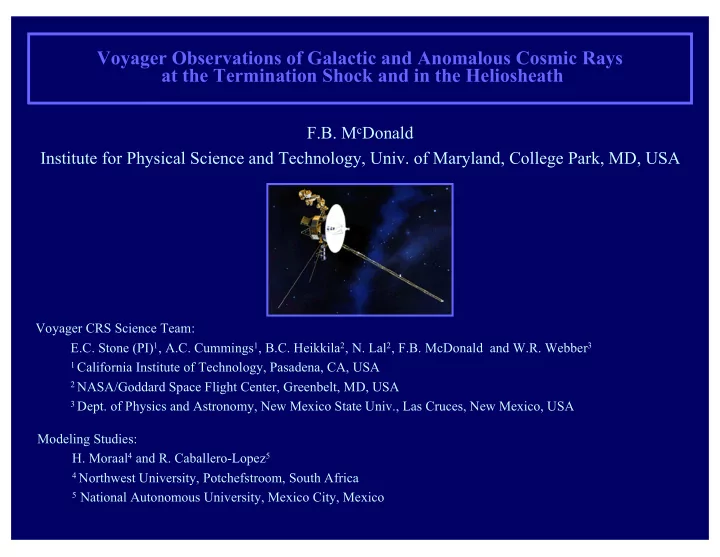
SLIDE 1 Voyager Observations of Galactic and Anomalous Cosmic Rays at the Termination Shock and in the Heliosheath
Voyager CRS Science Team: E.C. Stone (PI)1, A.C. Cummings1, B.C. Heikkila2, N. Lal2, F.B. McDonald and W.R. Webber3
1 California Institute of Technology, Pasadena, CA, USA 2 NASA/Goddard Space Flight Center, Greenbelt, MD, USA 3 Dept. of Physics and Astronomy, New Mexico State Univ., Las Cruces, New Mexico, USA
F.B. McDonald Institute for Physical Science and Technology, Univ. of Maryland, College Park, MD, USA
Modeling Studies:
- H. Moraal4 and R. Caballero-Lopez5
4 Northwest University, Potchefstroom, South Africa 5 National Autonomous University, Mexico City, Mexico
SLIDE 2
OUTLINE
I. Introduction II. The Heliosheath III. Where were the Anomalous Cosmic Rays when Voyager 1 crossed the Termination Shock IV. Galactic Cosmic Rays in the Heliosheath V. 2.5 - 100 MeV Galactic Cosmic Ray Electrons VI. The Future as Viewed through a Cloudy Crystal Ball
SLIDE 3 WHAT WE SAW
- V1 crossed the heliospheric TS on
- Dec. 16, 2004 at 94 AU and entered
the region of the heliosheath, where it has remained for almost 2.3 years.
- At the TS the ACR intensity > 4
MeV/n was well below the predicted level and significantly below that
- bserved for the first V1 TS Particle
event starting in 2002.54 at 85 AU.
- Energetic particles probe the
properties of the heliosheath and the termination shock at distances that extend far beyond the Voyager spacecraft.
SLIDE 4 WHAT WAS EXPECTED AT THE TERMINATION SHOCK
- GCR ions and electrons traverse the heliosheath and cross the TS before interacting with the
supersonic solar wind and may experience modest local reacceleration through their encounter with the TS. This interaction could be a major effect for low energy galactic electrons [1-100 MeV]. Increases in GCR ion and electron intensity were expected as Voyager 1 approached the TS.
- The termination shock is the most probable source of ACRs.
Would expect to observe the ACR source spectra.
- The TS may play a role in further accelerating the solar/interplanetary (S/IP) ions associated with
the merged interaction regions that sweep across it.
- In the heliosheath significant GCR ion modulation and strong modulation of low energy GCR
electrons is expected.
SLIDE 5
July 9, 2007: Voyager 1 103.2 AU 34.14° N Voyager 2 83.2 AU 27.48° S TRAJECTORY
SLIDE 6 Science Team
E.C. Stone (PI), A.C. Cummings (Caltech)
- N. Lal, B.C. Heikkila (GSFC)
F.B. McDonald (Univ. of Maryland) W.R. Webber (New Mexico State Univ.) Energetic Particle Coverage H: 1.8-300 MeV He: 1.8-650 MeV/n Z = 1-28 (Resolves Isotopes) E: 2.5 – 140 MeV
CRS EXPERIMENT
SLIDE 7
- The Heliosheath at the nose is
estimated to be 30-60 AU wide.
- At the TS, radial velocity of
the solar wind will decrease by a factor of 2.4 – 4 depending on the strength of the TS, and will continue to decrease as 1/r2 where r is the heliocentric distance.
- The intensity of the transverse
component of the interplanetary magnetic field jumps by the same factor and continues to increase proportional to r across the heliosheath.
HELIOSHEATH
SLIDE 8
HELIOSPHERIC STRUCTURE
1-shock model
Zank, 2007
SLIDE 9
Time-dependent structure of the heliopause and heliosheath: Rayleigh-Taylor- like and Kelvin-Helmholtz-like instabilities driven by interstellar neutrals Zank, 2007
SLIDE 10
ANOMALOUS COSMIC RAYS
SLIDE 11
An Annotated History of Anomalous Cosmic Rays
In the beginning – The Three Discovery Papers: Flat Helium Spectrum 12-55 MeV/n – IMP 5 Garcia-Munoz, Mason, Simpson ApJ 182, L81, 1973 October 1972 High Intensity, Flat Oxygen Spectra 2-8 MeV/n C/O = 0.8 ± 0.4 Hovestadt, Vollmer, Gloeckler and Fan Physical Review Letters, 31, 650, 1973
SLIDE 12 An Annotated History of Anomalous Cosmic Rays
- Mar. 1972 – Mar. 1973 (1–3.8 AU)
Flat He Spectra 5–60 MeV/n Large non-solar increase in Oxygen 7-25 MeV/n Nitrogen enhanced Low C/O ratio: 0.08 ± 0.03, Small but positive radial gradients McDonald, Teegarden, Trainor and Webber ApJ 187, L105, 1974 Based on this fragment of information on Anomalous Cosmic Rays (ACR’s) Fisk, Kozlousky and Ramaty (ApJ 190, L39, 1974) proposed ACR’s had their origin as interstellar neutral ions that were ionized in the region of the supersonic solar wind and were convected out to the distant heliosphere where they were accelerated to ACR energies. Composition should reflect that of local interstellar neutrals (H, Ne and Ar should also be present). ACR’s should be singly-ionized.
SLIDE 13
- Anomalous Neon Detected – IMP 7,8 09/1972 – 11/1974
Von Rosenvinge and McDonald, Proc 14th ICRC (Munich) 2, 792,1975
- Prediction that ACRs could be stably trapped in the Earth’s magnetosphere
Blake and Friesen 15th ICRC (Plovdiv) 2, 341, 1977
- 1981 Pesses, Jokipii and Eichler (ApJ 246, L85, 1981)
Proposed ACRs accelerated at the termination shock
- Determination of Oxygen charge state: 1984-1988 ~10 COSMOS flights/year with cellulose nitrate
- detectors. IMP8 and ICE outside the magnetosphere found mean charge state for 10 MeV/n Oxygen
= 0.9 + 0.3 (- 0.2)
Adams et al. ApJ 375, L45 1981
- Sampex Observations in Earth’s magnetosphere also established that ACR Oxygen is
predominantly singly ionized with an upper limit of 10% for higher ionization states (similar results for Nitrogen and Neon)
Christian, et al., ApJ 334, 677, 1988; McDonald et al., ApJ 446, L101, 1995; Christian et al., ApJ L105, 1995.
An Annotated History of Anomalous Cosmic Rays
SLIDE 14
- There have been extensive studies of interstellar pick-up ions in the solar wind
An Annotated History of Anomalous Cosmic Rays
- Also observed H+, 3He+, 4He+, N+, O+, 20Ne+, 22Ne+
- J. Geiss, G.Gloecker et al., Astron & Astro, 282, 924, 1994
(Klecker et al., ApJ 442, L69, 1995) (Fichtner, Sp Sci Rev., 95, 639, 2001)
SLIDE 15
- Continuing Voyager 1 and Voyager 2 observations of ACR temporal and spatial variations in the
distant heliosphere.
- Development of detailed models of the acceleration and transport of ACR:
Steenkamp, R., Shock Acceleration as a Source of the Anomalous Component of Cosmic Rays in the Heliosphere, PhD Thesis, Potchefstroom University for CHF, South Africa, 1995 Steenberg, C.D., Modeling of ACR and GCR Modulation in the Outer Heliosphere, PhD Thesis, Potchefstroom University for CHE, South Africa, 1998
An Annotated History of Anomalous Cosmic Rays
The ACRs were the most thoroughly understood energetic particle population in our heliosphere. Only
To Observe the ACR Source Spectra at the Heliospheric Termination Shock
Ulysses Determination of Velocity of Interstellar Wind
Helium V = 25.3 ± 0.4 km/s Ecliptic Longitude: 73.9 ± 0.8, Ecliptic Latitude: -5.6 ± 0.4 Witte et al., Sp Sci Reviews, 78, 289, 1996
SLIDE 16 WHAT WE THINK IS GOING ON
After 27 months of V1 observations in the heliosheath and the simultaneous V2 observations of TSPs, we conclude: At energies > ~4 MeV/n, TSP events are an effective monitor of ACRs at mid heliolatitudes at the TS. The data suggest 3 principal effects to explain the low ACR intensity at the TS on 16 Dec 2004:
- The large interplanetary transients associated with the intense Oct/Nov 2003 “Halloween” solar
events and subsequent solar activity play a major role in reducing the energetic particles over the ~4 month period prior to the TS crossing.
- There is a long term variation of the ACRs that appears to track the 11 year galactic cosmic ray
variation.
- The intensity of low energy ACRs (ie He < ~15 MeV) is significantly affected by the polarity
reversal of the interplanetary magnetic field near the time of solar maximum.
From The TS Crossing To The Present The V1/V2 ACR Variations Are Primarily Temporal And Not Spatial
SLIDE 17
SLIDE 18
TSPs are a Good Monitor of ACRs in the Inner Heliosheath
SLIDE 19
ACR/GCR REGRESSION ANALYSIS
SLIDE 20
SLIDE 21 Florinski, V., and Zank, G.P., GRL, 33, L15110, 2006
- Interaction between MIR and TS produces a forward
shock /reverse shock pair followed by a forward rarefaction / reverse rarifaction pair.
- Higher energy ACRs are less affected because of their
larger diffusive mean free paths.
- High acceleration rates at lower energies.
- Mid-range ACRs most strongly affected.
SLIDE 22
SLIDE 23 17 October 2001 November 2000 2000.77 (early Oct.) Completion
May 2002 April 2001 May 2001 19 September 2001 June 2000 2000.45 (mid June) Onset of Reversal Southern Hemisphere 2 June 2001 April 2000 2000.60 (early Aug.) Completion
November 2000 February 2001 March 2001 6 May 2001 January 2000 2000.44 (early June) Onset of Reversal Northern Hemisphere Gopalswarmy et al. (2003) Bilenico (2002) Harvey & Recely (2002) Durant & Wilson (2003) Wang et. al. Voyager Observation Photosperic Magnetic Field Interplanetary Magnetic Field Heliospheric Termination Shock
TABLE 2: Comparison of Observed Reversal of the Solar Magnetic Polarity
SLIDE 24
COSMIC RAY MODULATION
SLIDE 25
- Reduction of 150-380 MeV/n
GCR He Solar Min to Solar Max in Cycle 23. IMP8 (1AU) factor of 4.4 V2 (63.5 AU) 33% V1 (81 AU) 22%
- Essentially all of the modulation
associated with the 11 year solar activity cycle occurs in the region
- f the supersonic solar wind.
The Current State of the Heliosphere as Defined by Galactic Cosmic Rays
SLIDE 26
COSMIC RAY MODULATION
SLIDE 27
COSMIC RAY MODULATION
SLIDE 28
COSMIC RAY MODULATION
SLIDE 29
COSMIC RAY MODULATION
SLIDE 30
COSMIC RAY MODULATION
SLIDE 31 MODULATION CONCLUSIONS
- Over the 11 year modulation cycle changes in propagation conditions occur mainly between 15AU
and the TS.
- Propagation conditions in the inner heliosphere appear to change significantly less from solar
minimum to solar maximum than in the outer heliosphere.
- Observations suggest that GCR modulation in the heliosheath has remained essentially constant
- ver cycle 23.
- Based on the latest estimate of the local interstellar galactic cosmic ray intensity (Webber and
Lockwood) and a heliosheath thickness of 40 AU, we expect to observe a radial intensity gradient
- f ~1.7%/AU. The observed gradient is 0.2 ± 0.2 %/AU
- The amount of the modulation of GCR ions in the heliosheath requires a more accurate estimate of
the LIS GCR energy spectra.
- V1/V2 265 MeV/n GCR He data is consistent with modest reacceleration at the TS. However, the
magnitude of the latitudinal gradients are not known.
SLIDE 32
Low Energy Galactic Cosmic Ray Electrons (2 – 160 MeV)
SLIDE 33
Low Energy Galactic Cosmic Ray Electrons (2 – 160 MeV)
SLIDE 34
Low Energy Galactic Cosmic Ray Electrons (2 – 160 MeV)
SLIDE 35
Low Energy Galactic Cosmic Ray Electrons (2 – 160 MeV)
SLIDE 36
Low Energy Galactic Cosmic Ray Electrons (2 – 160 MeV)
SLIDE 37 CONCLUSIONS
- We are within a few months of solar minimum GCR intensities at 1 AU
- These conditions will take some 9-10 months to propagate out to the TS
- Expect ACR spectra to continue to evolve toward those predicted by previous models
- V2 ACR He intensities in the 20-70 MeV/n interval should exceed those of V1 in the
near future as V1 moves away from the TS and V2 moves closer
- We predict that the ACR intensity will decrease at both space craft with the onset of
cycle 24 modulation in the distant heliosphere. 2 – 150 MeV GCR Electrons
- Essentially all of the electron modulation in this energy range occurs in the heliosheath
- Large fluctuations in this very low rigidity component reveals a turbulent heliosheath
- Expect electron intensities to continue to increase toward interstellar intensities as V1
approaches the heliopause.