VTE Prevention: From Filters to No Current Disclosures Fondaparinux - - PDF document

vte prevention from filters to no current disclosures
SMART_READER_LITE
LIVE PREVIEW

VTE Prevention: From Filters to No Current Disclosures Fondaparinux - - PDF document

6/1/2013 VTE Prevention: From Filters to No Current Disclosures Fondaparinux Prior Support: Glaxo; Kendall; Rhone-Poulenc M. Margaret Knudson MD U. California, San Francisco CASE PRESENTATION 21 year old chef stabbed in the Mission


slide-1
SLIDE 1

6/1/2013 1

VTE Prevention: From Filters to Fondaparinux

  • M. Margaret Knudson MD
  • U. California, San Francisco

No Current Disclosures

  • Prior Support: Glaxo; Kendall; Rhone-Poulenc

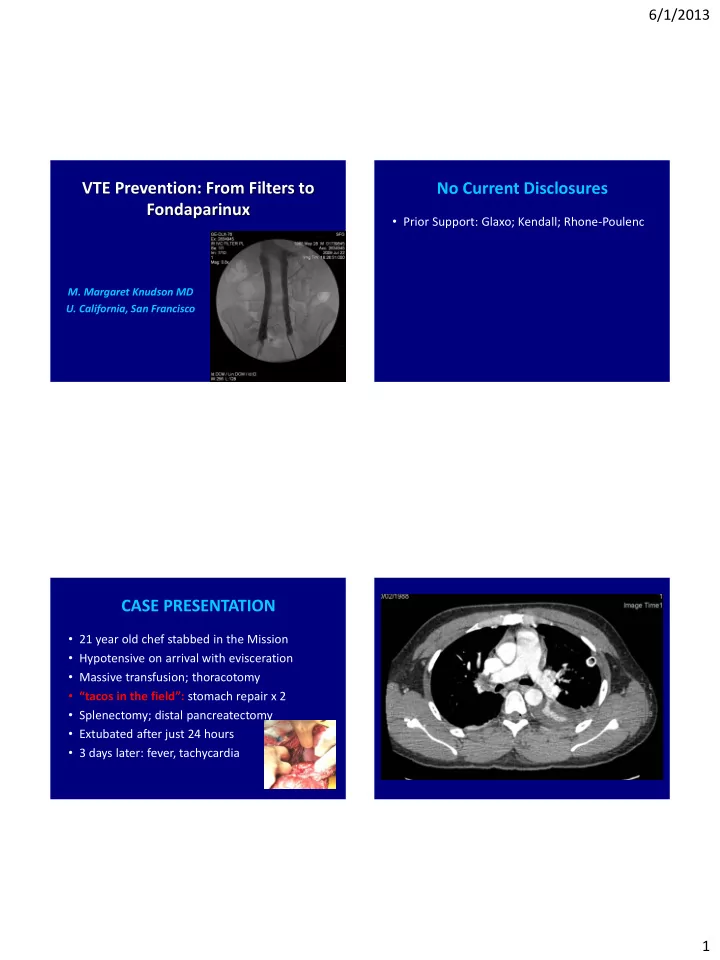
CASE PRESENTATION

  • 21 year old chef stabbed in the Mission
  • Hypotensive on arrival with evisceration
  • Massive transfusion; thoracotomy
  • “tacos in the field”: stomach repair x 2
  • Splenectomy; distal pancreatectomy
  • Extubated after just 24 hours
  • 3 days later: fever, tachycardia
slide-2
SLIDE 2

6/1/2013 2

Case Presentation Continued

  • Full-dose anticoagulation with heparin
  • Lower GI bleed with drop in Hematocrit
  • Transfused; IVC Filter placed
  • Prophylatic doses of enoxaparin
  • Eventually transitioned to Coumadin

Historical Perspectives

“ A study of protocols of 9,882 postmortem exams including death from injury…in the traumatic group embolisms were found in 61 cases(3.8%) and in the non-traumatic group in 222 cases (2.6%). Statistically, this appears to be a significant difference.” J.S. McCartney, 1934

Historical Perspectives

  • 124 trauma patients: venograms
  • Fracture patients: 35% venous thrombosis
  • Thrombus found within 24 hours of injury
  • Both injured/uninjured extremity
  • 2/3rds with DVT-asymptomatic

Freeark et al, 1967

slide-3
SLIDE 3

6/1/2013 3

INCIDENCE: OCCULT DVT

  • 349 injured patients: screening venography*
  • None receiving prophylaxis
  • Proximal DVT rate: 18%
  • PE rate: 2% (43% mortality!!)

*Geerts et al, NEJM 1994

Incidence of Occult PE after Trauma

  • 90 consecutive patients; ISS> 9
  • Asymptomatic; no DVT
  • Chest CT: between 3-7 days
  • 22 had clot on CT; 4 were major!
  • 30% were receiving prophylaxis

Schultz et al J Trauma 2004

THROMBOEMBOLISM AFTER TRAUMA

AN ANALYSIS OF 1602 EPISODES FROM THE ACS NATIONAL TRAUMA DATA BANK Annals of Surgery 2004

  • M. Margaret Knudson MD

Danagra G. Ikossi MD Linda Khaw BA Diane Morabito RN, MPH Larisa S. Speetzen BA The University of California, San Francisco

METHODS

  • Data source: NTDB (1994-2001)
  • Data analysis:
  • Demographics
  • Nature/severity of injuries
  • Complications/outcomes
  • Survey: participating trauma centers
  • VTE risk factors/protocols
slide-4
SLIDE 4

6/1/2013 4

RESULTS

  • 450,375 patients included
  • 84% blunt injuries
  • 31% ISS>10
  • 998 pts: DVT (0.36%)
  • 522 pts: PE (0.13%)
  • 82 pts: both DVT/PE
  • PE mortality: 18.7%

Risk Factor * Odds Ratio

Shock on admission (BP < 90 mHg) 1.95 Age > 40 yrs. 2.29

RISK FACTOR ANALYSIS

Head injury (AIS > 3) 2.59 Pelvic fracture 2.93

p < .0001 for all factors * Greenfield 1997, 2000; Knudson 1994, 1996

Lower extremity fracture 3.16 Spinal cord injury with paralysis 3.39

Risk Factor Odds Ratio

Ventilator days > 3 10.62 Venous injury 7.93

RISK FACTOR ANALYSIS (CONT’)

p < .0001 for all factors

Major surgical procedure 4.32

Risk Factor Odds Ratio

p  0.0125 for all factors

MULTIVARIATE ANALYSIS

Ventilator days > 3 8.08 Venous injury 3.56 Age  40 years 2.01 Lower extremity fracture (AIS  3) 1.92 Major operative procedure 1.53 Head injury (AIS  3) 1.24

slide-5
SLIDE 5

6/1/2013 5

PROPOSED ALGORITHM

Injured Patient High Risk Factor

(OR for VTE = 2-3)

  • Age ≥ 40
  • Pelvic fx
  • Lower extremity fx
  • Shock
  • Spinal cord injury
  • Head trauma (AIS ≥ 3)

Contraindication for heparin? No LMWH* Mechanical compression

*Prophylactic dose

Yes VERY High Risk Factor

(OR for VTE = 4-10)

  • Major operative procedure
  • Venous injury
  • Ventilator days > 3
  • 2 or more high risk factors

Contraindication for heparin? LMWH* and mechanical compression No Yes Mechanical compression and serial CFD OR temporary IVC filter

“APPEARANCES ARE DECEPTIVE”*

*Critical Evaluation of Vena Cava Plication: Bergen et al. Arch Surg 1964

Historical Perspectives

  • 1850: Rudolph Virchow described PE
  • Recognized origin in femoral/pelvic veins
  • 1910: Trendelberg ligated IVC for PE
  • 1948: Only 48 cases
  • f IVC ligation

IVC Plication

  • IVC Ligation: post-op edema/ulceration
  • IVC Ligation: Sudden hypotension!
  • IVC Plication: absorbable sutures:

unpredictable

  • 1964: IVC Clip
slide-6
SLIDE 6

6/1/2013 6

IVC Filters: Indications

  • Recurrent VTE despite adequate

anticoagulation

  • Documented VTE but with contraindications

to anticoagulation

  • Complications while on anticoagulation

Greenfield: Textbook of Surgery

“Filter Fever”

From Filter Fever to Filter Failure

  • Technical
  • Timing
  • Truth
  • Trievable (as in Re)
  • Tale

Prophylactic Vena Cava Filters?

  • Problems:
  • Recurrent PE: 3%
  • No protection against DVT
  • 10%: caval thrombosis
  • permanence: leg edema
  • migration/IVC perforation
  • timing: 6% PE within 24 hours
slide-7
SLIDE 7

6/1/2013 7

TIMING

  • PE-occurs within 24 hours of injury: 6%*
  • PE-seen on CT on day 1: 38%**
  • Early PE: highest in patients with fractures
  • For filter to be effective: placement in ED?

*Owens 1997 **Scalea 2007

TRUTH

Independent Risk Factors Odds Ratios Head Injury (AIS>3) 1.24 Major Operation 1.53 Lower Extremity Fx (AIS>3) 1.92 Age > 40 years 2.01

Venous Injury 3.56 Ventilator Days >3 8.08 Knudson et al: Analysis of 1602 Episodes of VTE;

  • NTDB. Annals of Surgery, 2004
slide-8
SLIDE 8

6/1/2013 8

TRUTH: PART II

  • 3,883/450,375: IVC FILTERS
  • 86%: PROPHYLACTICALLY
  • 410 PATIENTS: NO RISK FACTOR!

Retrievable Filters: “NOT”

  • May be retrieved within 5 days
  • May be left in place: 30 days?
  • Solution for high risk patients?
  • Leads to 3-fold increase use
  • AAST study: >400 patients
  • Only 22% were retrieved!
  • $100,000/ PE prevented

Antevil J Trauma 2006 Karmy-Jones J Trauma 2007

FICTION FEVER (AS IN “PULP”) Hospital-Specific Risk Factors for Filter Fever

  • 263 Northern California Hospitals
  • Frequency of VCF for VTE varied widely
  • Risk of getting a filter for acute VTE:
  • Admission to Rural Hospital
  • Admission to small hospital
  • Admission to private hospital
  • Not admitted to Kaiser

JAMA 2013

slide-9
SLIDE 9

6/1/2013 9 Fondaparinux For The Prevention Of Venous Thromboembolism In High-risk Trauma Patients

J.P. Lu, MD and M. Margaret Knudson

  • U. Of California, San Francisco

Fondaparinux

  • Synthetic, non-heparin polysaccharide
  • Long half life: once-daily dosing
  • Excreted unchanged by kidney
  • Effective in orthopedics and general surgery
  • Previously untested in trauma

Mechanism Of Action

  • Binds to antithromin III, which inactivates factor

Xa, preventing thrombin formation

Study Objectives

  • To evaluate the efficacy and safety of

fondaparinux for DVT prophylaxis in trauma patients

  • To implement a VTE prevention protocol

based on stratified risk factors

  • To measure Fondaparinux anti Xa activity in

trauma patients

slide-10
SLIDE 10

6/1/2013 10

Hypotheses

  • VTE rate would be less than 5% in high-risk

trauma patients with Fondaparinux

  • Fondaparinux would NOT cause bleeding
  • Anti-Xa activity would be therapeutic

Methods

  • Subjects: consecutive trauma admissions
  • Inclusion criteria:

– Age > 18 – Risk factor for VTE – Anticipated hospital stay > 5 days

  • Exclusion criteria:

– Prisoners – Pregnant women

Proposed Algorithm

Injured Patient High Risk Factor

(OR for VTE = 2-3)

  • Age ≥ 40
  • Pelvic fx
  • Lower extremity fx
  • Shock
  • Spinal cord injury
  • Head trauma (AIS ≥ 3)

Contraindication for heparin? No FND: 2.5mg Mechanical compression Yes VERY High Risk Factor

(OR for VTE = 4-10)

  • Major operative procedure
  • Venous injury
  • Ventilator days > 3
  • 2 or more high risk factors

Contraindication for heparin? FND and mechanical compression No Yes Mechanical compression and serial CFD OR temporary IVC filter

Protocol

  • Enrollment after

consent

  • Ultrasound on

admission and Q 5-7 days

  • Included both upper

and lower extremities

  • Fondaparinux within 36

hours

slide-11
SLIDE 11

6/1/2013 11

Results: Enrollment

Enrolled Patient, n = 106 excluded n=12 excluded n=2 No fondaparinux n=6 fondaparinux n=81 excluded after late crossover n=5

12 76 1 5 2 5

No fondaparinux n=17 fondaparinux n=89

5

Results: Risk Factors

7% 17% 19% 20% 25% 47% 65% 10 20 30 40 50 60 70 80 Major Operation Age>40 LE Fx SBP<90 Mech Vent>72hr Pelvic Fx Venous injury DVT risk factor Percentage

Results: Incidence Of DVT

2.5% 33.3% 5 10 15 20 25 30 35 % fondaparinux No fondaparinux 2/81 2/6

Results: Incidence Of DVT

2.5% 33.3% 5 10 15 20 25 30 35 % fondaparinux No fondaparinux 2/81 2/6

slide-12
SLIDE 12

6/1/2013 12

Results

  • 2 DVTs in Fondaparinux: 1 with PIC line; 1 on

initial scan prior to receiving drug*

  • No bleeding associated with Fondaparinux
  • No thrombocytopenia
  • No other major AEs identified

*intent to treat

Results: Anti Xa Activity

0.05 0.3 0.05 0.1 0.15 0.2 0.25 0.3 0.35 0.4 mg/L Trough Peak

Fondaparinux levels Summary

  • Fondaparinux has several advantages:

– No risk of HIT – Once daily dosing: improves compliance – Cost effective

  • No major bleeding episodes or AEs
slide-13
SLIDE 13

6/1/2013 13

Conclusions

  • Fondaparinux: safe and effective in trauma
  • DVT rate: < 2% in high-risk patients
  • Algorithm: identified all high-risk patients
  • Combination of algorithm and Fondaparinux:

Promising new approach to DVT prophylaxis

Practice Patterns VTE Prophylaxis in Trauma

  • 315 patients: 11% VTE
  • Early prophylaxis: 4% risk
  • Prophylaxis after 4 days: 3 times greater!

3738 POST-TRAUMATIC PULMONARY EMBOLI

A NEW LOOK AT AN OLD DISEASE M.M.Knudson, D. Gomez, B.Haas, MJ Cohen, AB Nathens

  • U. California San Francisco, U. Toronto

Historical Perspective: Pulmonary Emboli

  • Recognized post-injury complication: 1934*
  • Mortality rates: 25-50%
  • Clinical presentation: acute hypoxia, collapse
  • Diagnostic study: autopsy

*McCartney, Am J Pathology

slide-14
SLIDE 14

6/1/2013 14

Current Perspective: PE

  • “Potentially preventable” complication
  • Clinical Presentation: unexplained drop Pa02
  • Often incidental finding: multidector CT scan
  • Quality indicator: CMS, JACHO, AHRQ

Purpose

  • To describe the current incidence of

pulmonary embolism following trauma in the United States

  • To determine the PE-attributable mortality

Major Hypotheses

  • 1. Risk factors for PE-different from DVT
  • 2. PE-incidence rates are increasing
  • 3. PE-attributable mortality is decreasing

Methods

  • ACS/NTDB
  • Adult patients: Level I/II centers*
  • Current version: 2007-2009
  • Historical comparison: 1994-2001 (version 1)
  • Comparison: centers contributing to both
  • Hierarchical logistic regression models: risk

factors, mortality *(centers reporting at least one complication)

slide-15
SLIDE 15

6/1/2013 15

Results: Current NTDB Cohort

  • 888,652 Patients; 326 Trauma Centers
  • Overall mortality: 1.8%
  • 9,398 episodes: DVT (1.06%)
  • 3,738 episodes: PE (0.42%)
  • Only 20% with PE had DVT reported

Risk Factor Analysis

Risk Factor DVT (9,398); OR (95% CI) PE (3,738); OR (95% CI) Severe TBI 1.34 (1.20-1.48)* 0.87 (0.73-1.04) Ventilator Days >3 5.31 (5.05-5.60)* 3.81 (3.48-4.18) Severe Chest Injury (AIS>3) 1.07 (1.01-1.12) 1.42 (1.30-1.55)* Lower Ext. Fracture (AIS>3) 1.53 (1.45-1.62) 1.81 (1.67-1.97) Pelvic Fracture 1.32 (1.24-1.41) 1.19 (1.08-1.32) Spine Injury (AIS>4) 1.58 (1.42-1.75) 1.91 (1.61-2.27) Shock (SBP<90) 1.23 (1.14-1.34) 1.19 (1.04-1.36) Knudson, et al., Annals of Surgery, 2004

Results: IVC Filters

  • 16,809 patients: 1.9% of total population
  • 13,201: Prophylactic
  • Center clustering: 0%-10.6%

Changes over Time: PE

Historical Number (%) Adjusted OR (95% CI) Current Number (%) Adjusted OR (95% CI) PE Rate 499 (0.21%) 890 (0.49%) p<0.01) Mortality-PE 73 (15%) 4.05(3.02-5.46) 111 (11%) 2.42(1.91-3.06) p<0.01)

slide-16
SLIDE 16

6/1/2013 16

Discussion: Potential Explanation

  • 1. True increased incidence of PE
  • 2. Better reporting in NTDB/ NTDS
  • 3. “Sicker” patients in current cohort
  • 4. Failure of VTE prophylactic measures*
  • 5. Improved methods of detection*

Uncoupling DVT and PE

Severely Injured Patient

  • Shock
  • Coagulopathy

Protein C Depletion?

Hypercoagulable State TBI Stasis Fractures Venous Injury Chest Injury Inflammation DVT PE

PE rates versus Prophylactic IVC filters

Prophylactic IVC Filters PE rates

0.60% 0.50% 0.40% 0.30% 0.20% 0.10% 0.00%

Historical Current

0.49% 0.21% 1.6% 1.4% 1.2% 1.0% 0.80% 0.60% 0.40% 0.20% 0.00%

Historical Current

1.5% 0.75%

Conclusions

  • PE: increasingly recognized post injury
  • PE: decreased attributable mortality
  • PE: may develop de novo
  • PE: chest trauma/inflammation
  • PE: may not be prevented by filters

Perivascular Hemorrhage

  • Pulm. Artery

with Thrombus

slide-17
SLIDE 17

6/1/2013 17

MULTIPLE TRANSFUSIONS SEVERE INJURIES

HYPERCOAGULABILITY

Knudson’s Trauma Triad

Knudson, et al., J Trauma, 1994

Knudson’s Trauma Square

MULTIPLE TRANSFUSIONS SEVERE INJURIES VENOUS TRAUMA FRACTURES CHEST TRAUMA PARALYSIS IMMOBILIZATION STASIS ENDOTHELIAL DAMAGE INFLAMMATION HYPERCOAGULABILITY

MILITARY EXPERIENCE WITH VTE

  • High amputation rate: “dismount” injuries
  • Massive transfusions and shock
  • Prolonger Air-Evac
  • Screening: 14.5% DVT RATE
  • Screening: 4.42% PE RATE
  • Thrombosis post-blast?

POC Coagulation Monitoring

Thromb- elastograph

(Haemoscope Corp.)

Sonoclot

(Sienco Inc.)

1 ACT 2 Clot Rate 3 Platelet Function

slide-18
SLIDE 18

6/1/2013 18

TEG Monitoring of Enoxaparin

  • Standard prophylactic doses are inadequate in

some patients: anti-Xa levels

  • TEG-based dosing decreased DVT
  • Prospective multicenter study
  • Malowski J Trauma 2010; Van J Trauma 2009

VTE PROPHYLAXIS IN TBI

  • Progression of the injury vs. PE
  • DEEP I Study: enoxaparin safe at 72 hours*
  • SFGH/TEG Study: Normal at 24 hours*
  • Severe TBI: hypercoagulable

Phelan et al J Trauma 2012 Phelan: J Neurotrauma 2012 Cohen: unpublished

THE ORIGINAL MISSION HOSPITAL SFGH: AS REAL AS IT GETS!

slide-19
SLIDE 19

6/1/2013 19

BADASS GRL: PE Prevention Possible. Think

  • utside