VTmtss February Office Hour Family Engagement Through the Lens of - - PowerPoint PPT Presentation

vtmtss february office hour
SMART_READER_LITE
LIVE PREVIEW

VTmtss February Office Hour Family Engagement Through the Lens of - - PowerPoint PPT Presentation

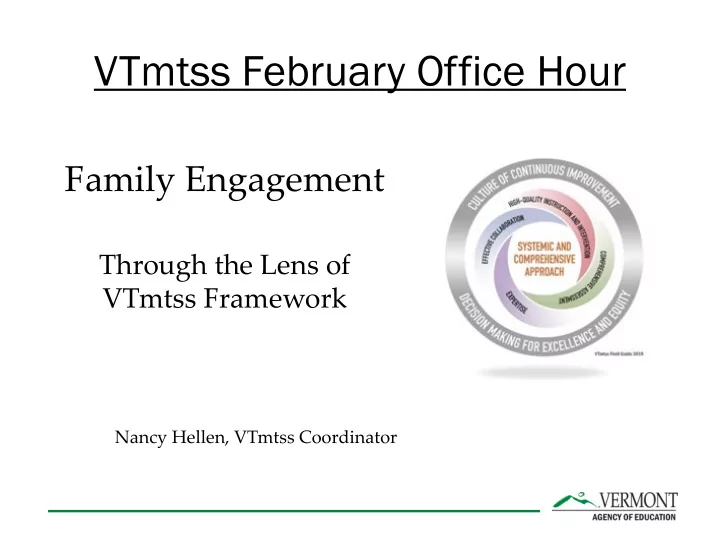
VTmtss February Office Hour Family Engagement Through the Lens of VTmtss Framework Nancy Hellen, VTmtss Coordinator Wha hat R t Rese search Indicates When students report feeling support from both home and school, they have more

slide-1
SLIDE 1

VTmtss February Office Hour

Family Engagement

Through the Lens of VTmtss Framework

Nancy Hellen, VTmtss Coordinator

slide-2
SLIDE 2

Wha hat R t Rese search Indicates

  • When students report feeling support from both home and

school, they have more self-confidence, feel school is more important and as a result tend to do better in school.

  • Increased family engagement in schools is strongly

associated with:

– Faster rates of literacy acquisition among children – Increased rates of going on to secondary education among youth – Increased attendance rates among students – Decreased rates of school dropout among youth

  • The literature also underscores the importance of even

basic communication between school and home.

slide-3
SLIDE 3

The heor

  • ry of
  • f Acti

tion

If the AOE is fully committed to continuous improvement for Vermont Education Quality Standards (EQS) and Every Student Succeeds Act (ESSA) expectations, then, we will

  • perate from a shared vision and collective responsibility

and apply a systemic approach to continuous improvement by:

  • Engaging in partnerships with community members,

families, institutes of higher education, other government agencies and other relevant stakeholders;

slide-4
SLIDE 4

Overview o

  • f VTmtss

tss

The VTmtss Framework is a systemic approach to decision–making for excellence and equity within a culture

  • f continuous improvement that focuses on successful
  • utcomes for all students. This systemic approach:
  • Supports the effective collaboration of all adults to meet

the academic, behavioral, social emotional needs of all students;

  • Engages and develops the collective expertise of

educators, students, family and community partnerships.

slide-5
SLIDE 5

Wh What at - Fami mily ly E Eng ngageme ment

  • Families come in many variations, inclusive language
  • Build trusting collaborative relationships
  • Recognizing and respecting and

addressing families' needs

  • Embracing a philosophy of

partnership

slide-6
SLIDE 6

Your E Experi rienc nce

  • Consider a time you have felt

welcomed and in partnership?

What was in place? What words would describe this?

slide-7
SLIDE 7

Equit ity

  • The Agency of Education implements state and federal

laws, policies, and regulations to ensure all Vermont learners have equitable access to high-quality learning

  • pportunities.
  • Requirements:

Federal programs requirements Special education State laws & policies

  • Guidance, Tools, Technical Assistance, Professional

Development

slide-8
SLIDE 8

Differences by Parental Educational Attainment

Source: Child Trends

slide-9
SLIDE 9

Fami mily E Engag agemen ement T Toolkit a and S Sel elf-Asse sessm sment nt

  • Available on Vermont Multi-

tiered System of Supports AOE webpage for all to use –under Professional Resources

  • Created as part of the State

Systemic Improvement Plan (SSIP) in 2019

slide-10
SLIDE 10

7 Core re P Pri rinci nciple les of Fami mily ly E Eng ngagement

  • Creating a Welcoming Environment
  • Building Effective Two-Way

Communication

  • Supporting the Success of Students
  • Sharing Power and Responsibility
  • Partnering with the Community
  • Providing Equity and Access
  • Ensuring Sustainability
slide-11
SLIDE 11
  • Each core principle includes a ‘What does it look like

in practice?’ section.

This section is comprised of elements which provide a foundation of what is in place with the core principle as the focus.

Core Principle: Creating a Welcoming Environment

– Element: Families have a personal relationship with one

  • r more school staff members and feel comfortable sharing

their thoughts and opinions.

slide-12
SLIDE 12

Consi siderati tion

  • ns f

s for F Family E Engagement

  • Considerations for Partnering with Families in Crisis
  • Considerations for Partnering with Diverse Families
slide-13
SLIDE 13

Ro Role-Sp Specific ic G Guidan ance

  • Family Engagement for

Administrators: A Whole-School Approach

  • Family Engagement for Teachers:

Building a Welcoming Classroom

  • Family Engagement for IEP Team

Members: Ensuring Meaningful Participation by Families

  • Family Engagement for Other

School Professionals

slide-14
SLIDE 14

Fami mily Eng ngagement nt S Self lf-Ass Assessm ssment

Rating system

slide-15
SLIDE 15

Fin inal al Sel Self-Asse Assess ssment S t Score

slide-16
SLIDE 16

Conti tinuou

  • us I

s Improvement

Action Planning for Family Engagement

  • Four Steps for Action Planning: The

Plan, Do, Study, Act Cycle

  • Brainstorming Worksheet:

For the priorities listed above, what are the unique considerations for different subgroups in your school? What current initiatives and activities can be leveraged to support the priorities you have identified for family engagement?

slide-17
SLIDE 17

Und nder erstand anding C ing Cur urrent ent F Fam amil ily E Engag ngagem ement ent Pr Prac actices es

  • Sample Process Agenda for Completing the Self-

Assessment

  • Gathering Feedback from Stakeholders on Family

Engagement: Tips and Best Practices

  • Family Focus Group Question Bank
  • Family Survey Question Bank.
slide-18
SLIDE 18

Sample ple P Proce cess A Agend nda f for r Compl pleting t the Self lf-Asse Assess ssment

Sample Questions for “Family Engagement in Your School/District/SU”

  • How do we approach planning family engagement

activities from year to year? Do we have a family engagement plan? Sample Questions for “Determining Additional Data Collection Needs”

  • How do you currently gather information from families

about their experiences with the school?

slide-19
SLIDE 19

Pla lann nning ng Y Your ur Fami mily Eng ngagement nt W Work

  • Sample Process Agenda for Action Planning and

Stakeholder Engagement

  • Family Engagement Brainstorming Worksheet
  • Action Planning and Stakeholder Engagement Template
  • Sample Process Agenda for Sustainability Planning
slide-20
SLIDE 20

Reso sources to

  • Sha

hare wi with F th Families

  • Partnering with Your Child’s School: What Families

Need to Know, Share, and Ask

  • Resources for Vermont Families
  • Preparing for and Participating in Your Child’s IEP Team

Meeting

slide-21
SLIDE 21

Introduction Vid Video

An Introduction To Vermont Family Engagement Toolkit and Self-Assessment AOE VTmtss webpage

  • under Professional Resources
slide-22
SLIDE 22

Poll

Does your School Improvement Plan include these components: Mark all that apply  Social-emotional climate  Family engagement  Community involvement

slide-23
SLIDE 23

Family E Engag agement nt i in School

  • ols

2018 School Health Profiles Vermont Department of Health

slide-24
SLIDE 24

Vermont School Health Profiles 2018 Report

Working with Families Schools can increase parent and family engagement through a variety of strategies. Specific strategies are shown to the right. Overall, 69% of schools engage in at least four strategies, shown to the right, to increase parent and family

  • engagement. High schools are

significantly less likely than middle schools to implement parent engagement strategies (55% vs 75%).

FAMILY ENGAGEMENT STRATEGIES

slide-25
SLIDE 25

VTmt mtss F Fra rame mework

slide-26
SLIDE 26

The he VTmtss ss Fra rame mework C Compo ponent nts

Systemic and Comprehensive Approach Effective Collaboration High-Quality Instruction and Intervention Comprehensive and Balanced Assessment System Expertise

slide-27
SLIDE 27

VTmt Tmtss Com

  • mponents &

& Fami amily Engagement Cor

  • re P

Principles

  • Systemic and

Comprehensive Approach

  • Effective Collaboration
  • High-Quality Instruction and

Intervention

  • Comprehensive and Balanced

Assessment System

  • Expertise
  • Creating a Welcoming

Environment

  • Building Effective Two-Way

Communication

  • Supporting the Success of

Students

  • Sharing Power and

Responsibility

  • Partnering with the

Community

  • Providing Equity and

Access

  • Ensuring Sustainability
slide-28
SLIDE 28

VTmtss Framework Tools (draft)

Tools Intended Audience Minimum Anticipated Time to Complete CIP Overview Planning VTmtss Framework Component Reflection Tools SU or school leadership teams ~ 90 minutes: Allocate the time necessary for deep thinking and discussion. Consider multiple sessions to complete more than

  • ne Reflection Tool.

A set of tools for engaging in conversations to identify existing strengths and

  • pportunities within each

component of your system and to articulate problems of practice that need to be addressed. VTmtss in Action Vignettes All educators ~ 1 hour per Vignette: time to read and reflect/ discuss with others Examples of Vermont schools exploring problem of practice. VTmtss Self- Assessment Tool (available Spring 2020) A SU or School Leadership Team ~2-3 hours + time to gather data A tool to provide a district or school with a clear process and the evidence to address the identified priorities in a driver diagram using the VTmtss Framework Components as the primary drivers.

slide-29
SLIDE 29

Resou

  • urces &

s & Conta tacts ts

VTmtss webpage Professional Resources

  • Family Engagement Toolkit and Self-Assessment
  • An Introduction To Vermont Family Engagement Toolkit

and Self-Assessment (video) VTmtss Field Guide 2019 Education Quality and Continuous Improvement Framework Nancy Hellen Vermont Multi-tiered System of Supports – Coordinator