W. Bradford Wilcox & Joseph P. Price U.Va. / AEI/ IFS BYU/ - - PowerPoint PPT Presentation

w bradford wilcox joseph p price u va aei ifs byu nber
SMART_READER_LITE
LIVE PREVIEW

W. Bradford Wilcox & Joseph P. Price U.Va. / AEI/ IFS BYU/ - - PowerPoint PPT Presentation

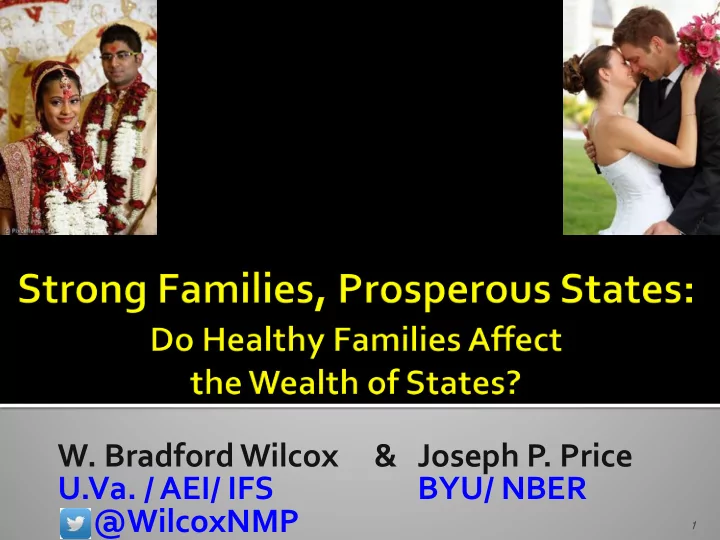
W. Bradford Wilcox & Joseph P. Price U.Va. / AEI/ IFS BYU/ NBER @WilcoxNMP 1 The new conventional wisdom is that marriage doesnt matter. Hollywood Star Jennifer Aniston: Women are realizing it more and more knowing that

slide-1
SLIDE 1
  • W. Bradford Wilcox & Joseph P. Price

U.Va. / AEI/ IFS BYU/ NBER @WilcoxNMP

1

slide-2
SLIDE 2

 The new conventional wisdom is that marriage

doesn’t matter.

 Hollywood Star Jennifer Aniston: “Women are

realizing it more and more knowing that they don’t have to settle with a man just to have that child.”

 Cornell Psychologist Peggy Drexler: “[W]omen

possess the innate mompower that in itself is more than sufficient to raise fine sons.”

slide-3
SLIDE 3

3

slide-4
SLIDE 4

 Men, women, and children are more likely to flourish—

and to realize the American Dream—when marriage grounds adult intimacy and the rearing of the next generation.

 Marriage provides meaning, direction, purpose, and

stability to our deepest needs for bonding and belonging.

 Marriage offers one of the most durable paths for

broad-based prosperity at the community level.

4

slide-5
SLIDE 5
slide-6
SLIDE 6
  • 1. How marriage matters
  • 2. Why marriage matters
  • 3. The States of Our Unions
  • 4. A family agenda
slide-7
SLIDE 7
slide-8
SLIDE 8

8

slide-9
SLIDE 9

 Where families are strongest, so too is the

economy:

  • State growth is higher
  • State child poverty is lower
  • State family median income is higher
  • The American Dream is stronger

9

slide-10
SLIDE 10

10

slide-11
SLIDE 11

11

slide-12
SLIDE 12

12

slide-13
SLIDE 13

 Wisconsin is #19 for the share of children living

with married parents (70%)

 If Wisconsin enjoyed 1980 levels of married

parenthood:

  • GDP would be about 3.2% higher
  • Child poverty would be about 12% lower
  • Median family income would be about 7.4% higher

13

slide-14
SLIDE 14

 The “share of parents in a state who are

married is… a stronger predictor of economic mobility, child poverty, and median family income in the American states than are the educational, racial, and age compositions of the states.”

 ~ Strong Families, Prosperous States

14

slide-15
SLIDE 15

The Bottom Line:

 If you care about growth, child poverty,

family income, and the American Dream, you should care about the health of the family in the Badger State.

15

slide-16
SLIDE 16
  • 1. How marriage matters
  • 2. Why marriage matters
  • 3. The States of Our Unions
  • 4. A family agenda
slide-17
SLIDE 17

 Nobel Laureate George Akerlof (1998):

  • “Men settle down when they get married... ”

 Marriage motivates men:

  • To work more
  • To work more strategically
  • To work more successfully

17

slide-18
SLIDE 18

18

slide-19
SLIDE 19

19

 Married families have more money to manage &

manage it more prudently:

  • Economies of scale
  • Income pooling
  • Higher rates of saving
  • Greater financial support from kin
  • More long-term stability
slide-20
SLIDE 20

20

slide-21
SLIDE 21

 Children from intact, married families more

likely to acquire the human capital they need to thrive in today’s marketplace:

  • To graduate from high school & college
  • To be gainfully employed as young adults

21

slide-22
SLIDE 22

22

slide-23
SLIDE 23

 When more families are headed by married

parents, teenage boys and young men are:

  • Less likely to commit crime
  • Less likely to end up in jail

 At the community level:

  • Government can spend less on public safety
  • Businesses benefit from lower security costs
  • Safer neighborhoods promote greater upward

mobility among the poor

23

slide-24
SLIDE 24

24

slide-25
SLIDE 25

The Bottom Line

 Strong families:

  • Deepen men’s connection to the work force
  • Boost family income & assets
  • Foster better educational & labor force outcomes for

children and young adults

  • Linked to higher levels of public safety & less spending on

police and incarceration.

25

slide-26
SLIDE 26
  • 1. How marriage matters
  • 2. Why marriage matters
  • 3. The States of Our Unions
  • 4. A family agenda
slide-27
SLIDE 27
slide-28
SLIDE 28

 “From an economist’s perspective, our

collective allergy to matrimony might be a macroeconomic issue: In order to save marriage, we’d have to have end poverty” ~ Annie Lowrey, New York Times

28

slide-29
SLIDE 29

 But a “purely economic theory falls short as

an explanation of the dramatic transformation of family life in the U.S. in recent decades.” ~ Isabel Sawhill, Brookings Institution

29

slide-30
SLIDE 30

30

slide-31
SLIDE 31

 Economics and education clearly matter

  • States with low levels of education or median

income for men without college degrees most affected by retreat from marriage

▪ Mississippi and Georgia

  • States with high levels of education and median

income for men without college degrees least affected by retreat from marriage

▪ Minnesota and New Hampshire

31

slide-32
SLIDE 32

 States with middling or even low levels of

education but a high degree of cultural conservatism some of the most resistant to retreat from marriage

  • Idaho, South Dakota, and Utah

 The “respect and even reverence for the idea of

marriage [found] in conservative communities [may affect] people’s behavior and attitudes”

 ~ David Leonhardt, New York Times

32

slide-33
SLIDE 33

33

The Bottom Line:

 “Our conclusion is that both structural and

cultural factors explain why some states have proved to be more successful in resisting the nationwide retreat from marriage.” New Hampshire & Minnesota and Idaho & Utah

slide-34
SLIDE 34
  • 1. How marriage matters
  • 2. Why marriage matters
  • 3. The States of Our Unions
  • 4. A family agenda
slide-35
SLIDE 35
slide-36
SLIDE 36

 Public policy should “do no harm” to marriage

  • esp. when it comes to low-income families:
  • Today, about 40% of American families receive

means-tested benefits.

  • Many benefits penalize marriage.
  • The “probability of marriage falls as the marriage

penalty increases” (Alm, Dickert-Conlin, & Whittington 1999).

  • Reform TANF, SNAP, & Medicaid with an eye

towards minimizing marriage penalty.

36

slide-37
SLIDE 37

 Most Americans will not get a college degree.  We need to improve economic prospects of

Americans from poor & working-class communities by expanding vocational education & apprenticeship programs:

  • Career Academies boosts work hours, income,

and marriage rates of young men from low- income families (MDRC 2008).

  • Wisconsin’s Youth Apprenticeship System step in

right direction.

37

slide-38
SLIDE 38

 Raising children is expensive today, especially for

working-class families with stagnant incomes

 Expand child tax credit to $2500  Acknowledge & encourage the investments

families are making in future workers & taxpayers

38

slide-39
SLIDE 39

 Need state campaigns to expand civic and

cultural supports for marriage:

  • “Success Sequence” (finish high school, work,

marry, & become a parent, in that order);

  • Focus this campaign on less-educated men.
  • Think this is quixotic?

▪ National Campaign to Prevent Teen and Unplanned Pregnancy has helped to drive teen pregnancy down 50% since 1990.

39

slide-40
SLIDE 40

 Given the central role that marriage plays in fostering

growth, prosperity, and the American Dream, states need to renew the

  • Economic
  • Policy
  • Civic &
  • Cultural

foundations of marriage & family life for 21st century.

40

slide-41
SLIDE 41

www.family-studies.org @WilcoxNMP

41