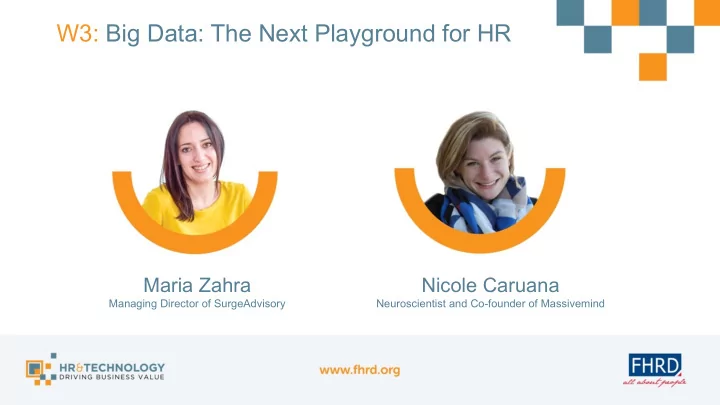
SLIDE 1 W3: Big Data: The Next Playground for HR
Nicole Caruana
Neuroscientist and Co-founder of Massivemind
Maria Zahra
Managing Director of SurgeAdvisory
SLIDE 2 Big Data: The Next Playground for HR
Workshop 3
Maria Bartolo Zahra & Nicole Caruana
part of the Crew from
SLIDE 3
www.boomerang.com.mt
SLIDE 4
HR data science
They are HOT for a very good reason.
people analytics
big data
SLIDE 5 What’s all this?
- Data: coded values collected from business processes, raw
facts…but it’s BIG DATA
- Analytics: compared to what? since when?
SLIDE 6
Data tells a story, so it needs to be presented like one.
SLIDE 7
We have been data collectors for a long time.
SLIDE 8 Simple HR Data
- Workforce profile:
- Headcount
- Age
- Length of service
- Type, e.g. sales/support/marketing/finance
- Grade
- Performance and productivity
- Absence
- Performance ratings
- Reward
- Percentage of employees paid above or below market rate
SLIDE 9 Traditionally this is how HR has done things…
- Annual engagement surveys
- Training evaluation forms
- Face-to-face interviews (e.g. selection or exit interviews)
- Personal observation
While there is nothing inherently wrong with using these methods…they certainly have their shortcomings!
SLIDE 10 So what has happened now?
- Fundamental shift in how HR works with the business
- Big data has revolutionised marketing and finance…now it is HR’s
turn
- New technologies and the realisation that big data can help you
take fact-based decisions
- HR analytics can help organisations achieve strategic objectives
- What matters is what the data does for you
Are we ready?
SLIDE 11
A new way of looking at the same problems.
SLIDE 12 Can you answer any of these questions?
- What skills do your employees have in common?
- How many of your employees are likely to resign in 2018?
- How many of your employees are under-performing?
- Is our recruitment strategy providing the talent we need?
SLIDE 13 Big data can help…
- It gives accurate information on what is happening in the
business in relation to a given issue – e.g. employee engagement.
- It helps make decisions about where the business should
spend its money and direct resources.
SLIDE 14
Don’t try to rule the world.
SLIDE 15 “You can’t manage what you don’t measure.”
Peter Drucker
SLIDE 16
Start with WHY
How do I become data-driven?
SLIDE 17 Gaining competitive advantage through:
- Prediction of future job vacancies and leadership needs
- Turnover prediction and analysis
- Data-based risk management
- Prediction of future performance and pre-hire flight risk.
SLIDE 18
Look at WHO
SLIDE 19 Understand WHAT you want to quantify
- Is it relevant?
- Can it be quantified?
- Do you have the resources?
SLIDE 20 What can we measure?
- Engagement: Likelihood of recommendation, foreseen tenure
in number of years, current level of job satisfaction and immediate happiness (pulse-based)
- Productivity: metrics that deal with participation in voluntary
events and public online communication, out-of-hours contribution and the regularity of updates on project management platforms (automated)
SLIDE 21 HOW?
In-house development
SLIDE 23
Decide WHICH platform to go with
SLIDE 24
Per head vs. group
What’s hot right now?
Decision based on:
SLIDE 25
- Pulse-based: likelihood of recommendation, foreseen tenure in
number of years, current level of job satisfaction and immediate happiness
- Automated: metrics that deal with participation in voluntary
events and public online communication, out-of-hours contribution and the regularity of updates on project management platforms
SLIDE 26
Gamification
SLIDE 27
Application Integration
SLIDE 28
Industry Comparison
SLIDE 29 What can we do with the results?
- Real-time overview of employee pulse at your fingertips
- Base high-level decisions on current information
- Visualise trends and find patterns in existing metrics (new
insights)
- Instantly notice problem areas and tackle them
SLIDE 30 What is the future of Big Data and HR?
Predictive Analytics Artificial Intelligence
SLIDE 31