W4231: Analysis of Algorithms Subset Sum The Subset Sum problem is - - PDF document

w4231 analysis of algorithms
SMART_READER_LITE
LIVE PREVIEW

W4231: Analysis of Algorithms Subset Sum The Subset Sum problem is - - PDF document

W4231: Analysis of Algorithms Subset Sum The Subset Sum problem is defined as follows: 11/30/99 Given a sequence of integers a 1 , . . . , a n and a parameter k , NP-completeness of Subset Sum, Partition, Minimum Bin Packing. Decide


slide-1
SLIDE 1

W4231: Analysis of Algorithms

11/30/99

  • NP-completeness of Subset Sum, Partition, Minimum Bin

Packing.

– COMSW4231, Analysis of Algorithms – 1

Subset Sum

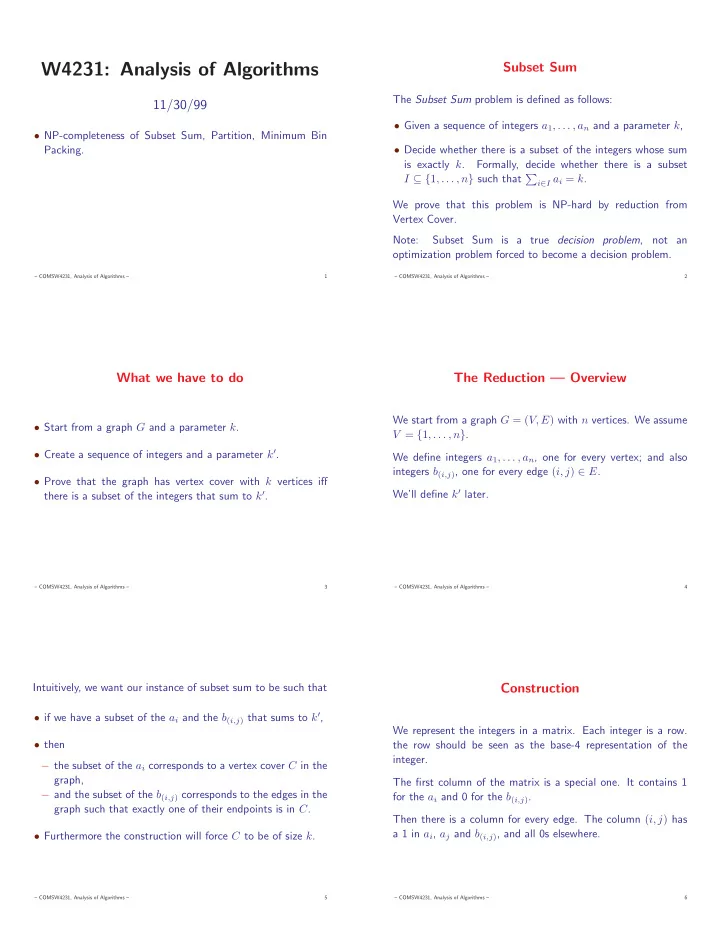
The Subset Sum problem is defined as follows:

  • Given a sequence of integers a1, . . . , an and a parameter k,
  • Decide whether there is a subset of the integers whose sum

is exactly k. Formally, decide whether there is a subset I ⊆ {1, . . . , n} such that

i∈I ai = k.

We prove that this problem is NP-hard by reduction from Vertex Cover. Note: Subset Sum is a true decision problem, not an

  • ptimization problem forced to become a decision problem.

– COMSW4231, Analysis of Algorithms – 2

What we have to do

  • Start from a graph G and a parameter k.
  • Create a sequence of integers and a parameter k′.
  • Prove that the graph has vertex cover with k vertices iff

there is a subset of the integers that sum to k′.

– COMSW4231, Analysis of Algorithms – 3

The Reduction — Overview

We start from a graph G = (V, E) with n vertices. We assume V = {1, . . . , n}. We define integers a1, . . . , an, one for every vertex; and also integers b(i,j), one for every edge (i, j) ∈ E. We’ll define k′ later.

– COMSW4231, Analysis of Algorithms – 4

Intuitively, we want our instance of subset sum to be such that

  • if we have a subset of the ai and the b(i,j) that sums to k′,
  • then

− the subset of the ai corresponds to a vertex cover C in the graph, − and the subset of the b(i,j) corresponds to the edges in the graph such that exactly one of their endpoints is in C.

  • Furthermore the construction will force C to be of size k.

– COMSW4231, Analysis of Algorithms – 5

Construction

We represent the integers in a matrix. Each integer is a row. the row should be seen as the base-4 representation of the integer. The first column of the matrix is a special one. It contains 1 for the ai and 0 for the b(i,j). Then there is a column for every edge. The column (i, j) has a 1 in ai, aj and b(i,j), and all 0s elsewhere.

– COMSW4231, Analysis of Algorithms – 6

slide-2
SLIDE 2

The parameter k′ is defined as k′ := k · 4|E| +

|E|−1

  • j=0

2 · 4i

– COMSW4231, Analysis of Algorithms – 7

Correctness — From Covers to Subsets

Suppose there is a vertex cover C of size k in G. Then we choose all the integers ai such that i ∈ C and all the integers b(i,j) such that exactly one of i and j is in C. Then, when we sum these integers, doing the operation in base 4, we have a 2 in all digits. In the most significant digit, we are summing 1 |C| = k times.

– COMSW4231, Analysis of Algorithms – 8

Correctness — From Subsets to Covers

Suppose we find a subset C ⊆ V and E′ ⊆ E such that

  • i∈C

ai +

  • (i,j)∈E′

b(i,j) = k′ First note that we note that we never have a carry in the |E| less significant digits: operations are in base 4 and there are at most 3 ones in every column.

– COMSW4231, Analysis of Algorithms – 9

Since the b(i,j) can contribute at most one 1 in every column, and k′ has a 2 in all the |E| less significant digits, it means that for every edge (i, j) C must contain either i or j. So C is a cover. Every ai is at least 4|E|, and k′ gives a quotient of k when divided by 4|E|. So C cannot contain more than k elements.

– COMSW4231, Analysis of Algorithms – 10

Partition

  • Given a sequence of integers a1, . . . , an.
  • Determine whether there is a partition of the number into to

subsets such the sum of the elements in one subset is equal to the sum of the elements in the other. Formally, determine whether there exists I ⊆ {1, . . . , n} such that

i∈I ai = (n i=1 ai)/2.

Partition is a special case of Subset Sum. We will prove that it is NP-hard by reduction from Subset Sum.

– COMSW4231, Analysis of Algorithms – 11

Reduction

Given an instance of Subset Sum we have to construct an instance of Partition. Let the instance of Subset Sum have items of size a1, . . . , an and a parameter k. Let A = n

i=1 ai.

– COMSW4231, Analysis of Algorithms – 12

slide-3
SLIDE 3

Consider the instance of Partition a1, . . . , an, b, c where b = 2A − k and c = A + k. Then the total size of the items of the Partition instance is 4A and we are looking for the existence of a subset of a1, . . . , an, b, c that sums to 2A. The partition exists iff there exists I ⊆ {1, . . . , n} such that

  • i ai = k.

– COMSW4231, Analysis of Algorithms – 13

Bin Packing

  • Given items of size a1, . . . , an, and given unlimited supply of

bins of size B, we want to pack the items into the bins so as to use the minimum possible number of bins.

  • Examples of bins/items:

tapes and songs; breaks and commercials; bandwith and packets.

– COMSW4231, Analysis of Algorithms – 14

  • Decision version:

− Given items of size a1, . . . , an, given bin size B, and parameter k, − Determine whether it is possible to pack all the items in k bins of size B. The problem is NP-hard. Reduction from Partition.

– COMSW4231, Analysis of Algorithms – 15

Example

Bin Size 7 Items 3,5,4,4,3,2 – COMSW4231, Analysis of Algorithms – 16

Reduction

Given items of size a1, . . . , an, make an instance of Bin Packing with items of the same size and bins of size (

i ai)/2.

There is a solution for Bin Packing that uses 2 bins if and only if there is a solution for the Partition problem.

– COMSW4231, Analysis of Algorithms – 17