WalkUP Roslindale Neighborhood Slow Streets Informational Meeting - - PowerPoint PPT Presentation

walkup roslindale neighborhood slow streets informational
SMART_READER_LITE
LIVE PREVIEW

WalkUP Roslindale Neighborhood Slow Streets Informational Meeting - - PowerPoint PPT Presentation

WalkUP Roslindale Neighborhood Slow Streets Informational Meeting February 13, 2017 Introduction What is WalkUP Roslindale? WalkUP = Walkable Urban Place Who we are What weve done Why Are We Here? September 2016, Belgrade


slide-1
SLIDE 1

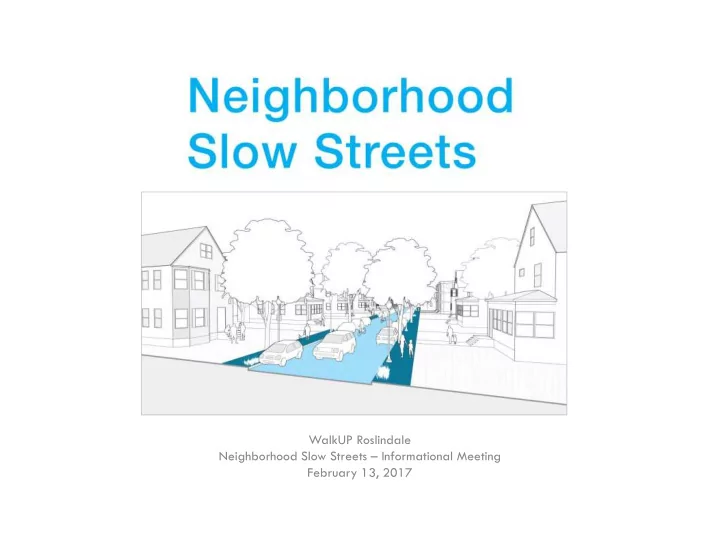
WalkUP Roslindale Neighborhood Slow Streets – Informational Meeting February 13, 2017
slide-2
SLIDE 2

Introduction

  • What is WalkUP Roslindale?

– WalkUP = Walkable Urban Place – Who we are – What we’ve done

slide-3
SLIDE 3

Why Are We Here?

July 2015, Washington Street September 2016, Belgrade Ave January 2017, Bussey Street October 2016, American Legion Hwy

Two pedestrian fatalities in Roslindale in 2016 (Washington/Blue Ledge & Morton/Canterbury).

Images from Universal Hub

slide-4
SLIDE 4

Goals for Meeting

  • Inform community about

new program

  • Encourage residents to:

– advocate for improvements – open lines of communication with City – collaborate/meet neighbors – form new neighborhood traffic/safety groups

slide-5
SLIDE 5

Agenda

  • Overview of Slow Streets Program

– Background – Traffic Calming overview – Slow Zone Treatments – Application Process – Ideal Neighborhoods – City Process for Improvements – Previously selected neighborhoods – Assistance from WalkUP – Questions

  • Opportunity to strategize/meet neighbors
slide-6
SLIDE 6

Background

  • Vision Zero

– City wants zero roadway fatalities by 2030 – Recently lowered speed limits to 25 mph

slide-7
SLIDE 7

Background

  • Slow Streets – New

Program for City

– Why: Requests from residents, advancing Vision Zero – Goals: Reduce crashes, lessen cut-through traffic impacts, add to quality of life, create 20 mph zones – How: Quick install, low- cost fixes, neighborhood approach – not one street

slide-8
SLIDE 8

Traffic Calming

  • “Street designs that self-enforce slower speeds

and safer behaviors”

  • Engineering solutions that go beyond signage

and enforcement

slide-9
SLIDE 9

Slow Zone Treatments

  • Each Slow Streets

zone will have:

– “Welcome Mats” – Pavement markings and signage – Daylighting – Speed humps

slide-10
SLIDE 10

Slow Zone Treatments

  • “Welcome Mats”
  • Pavement Markings/

Signs

slide-11
SLIDE 11

Slow Zone Treatments

  • Daylighting
  • No parking within 20’
  • f intersections
  • Speed Humps
  • 4” tall, 12-14’ long
  • Made for 20-25 mph
slide-12
SLIDE 12

Possible Treatments

  • Some Slow Streets zones will have:

– Raised crosswalks – Raised intersections – Chicanes – Neighborhood traffic circles – Diverters – Changes to street direction – Street murals

slide-13
SLIDE 13

Possible Treatments

  • Raised Crosswalks
  • Crosswalk is at

sidewalk level

  • Raised Intersections
  • Intersection is at

sidewalk level

slide-14
SLIDE 14

Possible Treatments

  • Chicanes
  • “S” curve in roadway
  • Neighborhood Traffic

Circles

slide-15
SLIDE 15

Possible Treatments

  • Diverters
  • Temporary or

permanent restriction

  • Changes to street

direction

  • One-ways may be

reversed to limit cut- through traffic

slide-16
SLIDE 16

Possible Treatments

  • Street Murals

– Purely aesthetic – Not intended as traffic calming – Beautify space

slide-17
SLIDE 17

Application Process

  • Application available
  • n WalkUP Roslindale

website - or - search “Neighborhood Slow Streets Application Packet”

  • Application due:

Friday, March 24

slide-18
SLIDE 18

Application Components

  • Application Form
  • Map of proposed Neighborhood Slow Zone

– Identify schools, parks, community centers, hospitals, police stations, firehouses, etc. – Hospitals, firehouses, police stations, major bus routes should be on boundary streets only

  • Address local concerns (speeding, etc)
  • Letters of support from stakeholders
  • Presentation to neighborhood
  • Optional additional documentation (petition,

surveys, etc)

slide-19
SLIDE 19

Ideal Neighborhoods

  • High number of youth/elderly
  • Local destinations – parks, libraries,

schools, community centers

  • Streets are City-owned
  • Residential streets internal to Slow Zone
  • Well-defined boundaries:

– busier streets, large parks/cemeteries, etc

  • 10-15 blocks
  • Who can apply?

– Neighborhood associations, community

  • rganizations, faith-based institutions
slide-20
SLIDE 20

City Process

  • Evaluation Criteria

– Community support – Households with ages <18 and >65 – Presence of schools, parks, libraries, public housing – Proximity to rail/bus – Walking or biking routes present – Strong boundaries – Feasibility

  • City selects 2-3

neighborhoods

  • City will work with

the local residents to identify problems and design solutions

  • Implementation
  • Process may take 2

years

slide-21
SLIDE 21

Previously Selected Neighborhoods

  • JP – Stonybrook

Neighborhood

  • Proposed Plans include:

– Gateway Treatment – Daylighting – Speed Humps – Shared lane markings – Diverter – Crosswalks

slide-22
SLIDE 22

Speed Hump Gateway Treatment Daylighting Diverter

slide-23
SLIDE 23

Previously Selected Neighborhoods

  • Dorchester – Talbot-Norfolk

Triangle

  • Proposed Plans include:

– Gateway Treatment – Daylighting – Speed Humps – Raised Crosswalk – Chicane – Shared Lane markings – 4-way stop – Crosswalks – Parking lines

slide-24
SLIDE 24

Speed Hump Chicane Raised Crosswalk

slide-25
SLIDE 25

How can WalkUP Roslindale help?

  • Strategy Session at

beginning of process

– Slow Street Neighborhood Boundaries – Outreach list

  • Letter of Support
  • List of elected officials

for your neighborhood

  • Organize/attend a

neighborhood meeting

  • Assist with questions
slide-26
SLIDE 26

Questions?

slide-27
SLIDE 27

Contact

  • Website:

walkuproslindale.org

  • Email:

info@walkuproslindale.org