SLIDE 1
SLIDE 2
Wash riding is an essential skill and tactic
for all paddlers to acquire. Canoe-kayak athletes should start to develop these skills as early as possible.
It is not just as a skill to be successful in
long distance competitions, but is also a tool to use in endurance training sessions.
SLIDE 3 Academic study:
“Importance of wash riding in kayaking training and competition” .
- Med. Sci. Sports Exerc. - PÉREZ-LANDALUCE, JAVIER; RODRÍGUEZ-
ALONSO, MANUEL; FERNANDEZ-GARCIA, 1998
Purpose: The use of different wash-riding techniques is common
during kayak training and competition. Changes in wash-riding positions could imply different exercise intensity.
Methods: Eight male international flat water kayakers, who
performed a field test of 2000 m in each of the four wash-riding positions, head (H), right wave (RW), left wave (LW), and end position (V), were studied.
The study concluded that "wash riding" involves a saving in energy
cost of between 18% and 31.9%, depending on the position. This conclusion is of importance for the quantification and calibration of kayak training and competition.
SLIDE 4
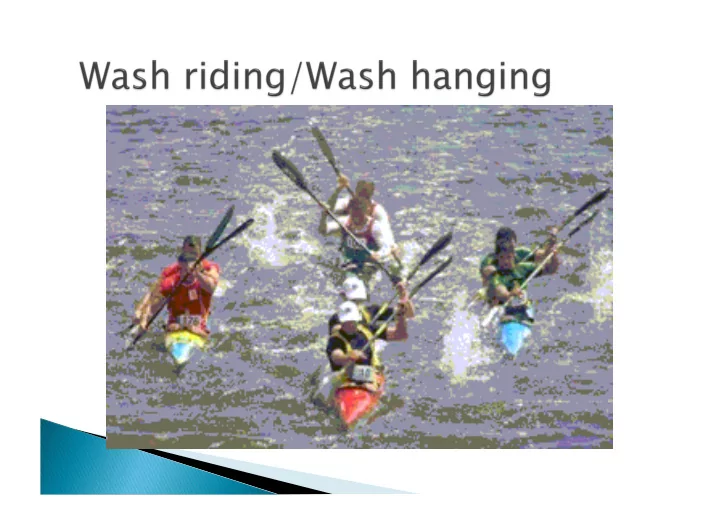
Wash riding/ wash hanging, refers to using
another boats wash or wake to reduce the required effort to maintain the same speed.
SLIDE 5
When sitting in the right position, the
paddler will physically feel the nose of the kayak drop and the boat being drawn along by the wake of another boat or boats. Like surfing on a smaller scale.
You will need to counter act the forces that
will try and draw you into the lead kayak.
SLIDE 6
SLIDE 7
Sitting on side washes, and especially v-washes,
requires paddlers to have good steering skills and/or boats to be responsive. Concentration and subtle movements are often needed.
It is possible to also sit on the rear wash of
another boat, directly astern in a crocodile line. This may not be as efficient as siting in a v-wash but it is easier to steer.
Often used in surf ski racing or racing rudderless
boats where steering can be difficult.
SLIDE 8
If you do drop back, there are two ways of
catching up:
1. Approach the leading craft from behind.
Paddle hard as you go up and over a wave, then recuperate temporarily by taking advantage of the small stern wave before sprinting to get up and over the next one.
2. Approach from the side. The further back
you go the wider the waves spread out. By paddling hard you can gradually climb over the small waves and move in towards the leading boat to take the normal wash hanging position.
SLIDE 9
SLIDE 10 Take advantage of your endurance abilities, lead and set the pace Short burns of the ATP system are sometimes sufficient to forge ahead They also have a limited effect on long term endurance. If you have
acquired a good endurance base you should be capable of sustaining a long surge of effort without building up an oxygen debt at all
But remember: But remember:
Do not
Do not accelerate at such a pace that you place excessive demands on your anaerobic metabolism.
If your fellow competitor initiates a sprint or "burn" and you start to drop
back, move slightly wider and further back but staying on the wave. The wave is smaller but you have a better chance of moving back once the speed drops again
SLIDE 11 As a distance race progresses the group sizes
will reduce.
Common places where paddlers will drop off
groups are:
- At Turns
- When one boat tries to overtake (burn)
- At portages
- Change in water conditions: Rapids,
shallows, eddies.
SLIDE 12 Canoe racing is a non-contact sport. Group paddling has benefits to
most people in the group except the lead paddler. If the group works together, in co-operation, it will make extra time on other
- paddlers. You may have to work with others in the group if two or
more boats get dropped. DO NOT EXPECT OTHERS TO HELP YOU IF YOU DO NOT TREAT OTHER PADDLERS WITH RESPECT.
When a canoe or kayak is overtaking another canoe or kayak, it is
the duty of the overtaking craft to keep clear of other competitors at all times.
When a canoe or kayak is racing in a group of paddlers it is the duty
- f all the competitors in the group to keep clear of the others at all
time, and this rules applies to any maneuvering with the group.
SLIDE 13