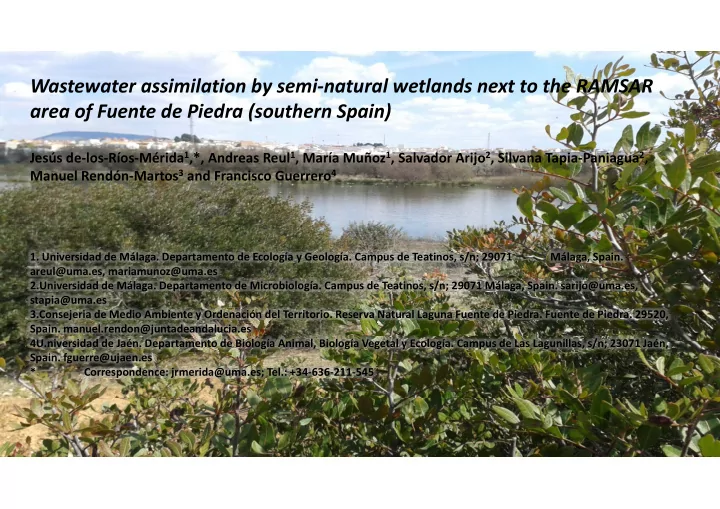
SLIDE 1 Wastewater assimilation by semi‐natural wetlands next to the RAMSAR area of Fuente de Piedra (southern Spain) area of Fuente de Piedra (southern Spain)
Jesús de‐los‐Ríos‐Mérida1,*, Andreas Reul1, María Muñoz1, Salvador Arijo2, Silvana Tapia‐Paniagua2, Manuel Rendón‐Martos3 and Francisco Guerrero4
- 1. Universidad de Málaga. Departamento de Ecología y Geología. Campus de Teatinos, s/n; 29071 Málaga, Spain.
areul@uma.es, mariamunoz@uma.es 2 U i id d d Mál D t t d Mi bi l í C d T ti / 29071 Mál S i ij @ 2.Universidad de Málaga. Departamento de Microbiología. Campus de Teatinos, s/n; 29071 Málaga, Spain. sarijo@uma.es, stapia@uma.es 3.Consejeria de Medio Ambiente y Ordenación del Territorio. Reserva Natural Laguna Fuente de Piedra. Fuente de Piedra. 29520,
- Spain. manuel.rendon@juntadeandalucia.es
4U i id d d J é D t t d Bi l í A i l Bi l í V t l E l í C d L L ill / 23071 J é 4U.niversidad de Jaén. Departamento de Biología Animal, Biología Vegetal y Ecología. Campus de Las Lagunillas, s/n; 23071 Jaén,
* Correspondence: jrmerida@uma.es; Tel.: +34‐636‐211‐545
SLIDE 2
Introduction
Natural wetlands have long been recognized as “natural purifiers of water” systems, providing an effective treatment for many kinds of water pollution leading in the 1980s to the development of constructed wetland technology In our case study the wastewater treatment plant of the In our case study, the wastewater treatment plant of the Fuente de Piedra village, located adyacent to the Fuente de Piedra RAMSAR wetland releases the treated water into the RAMSAR wetland. After a dry year, without rain during 2016, the RAMSAR wetland was dry and no ffl ld dil h ill d Thi di i i l water affluent could dilute the spilled wastewater. This condition were optimal to study the effect of biologic processes on the water quality, and four sampling sation were sampled in april 2016 in order to determine the purifying effect of these wetlands in contrast to spilling the wastewater directly in te RAMSAR p g y wetland.
SLIDE 3
Objective
Determine the purifying effect of the semi‐artificial wetland system on the spilled wastewater from a wáter treatment plant. Figure 1. Map, location and water flow through the wetland system (blue arrows) and direct to the RAMSAR wetland (red arrow).
SLIDE 4
Results
Lowest temperature was observed at point A where the wastewater enters into the first small wetland called “Laguneto” and warms up according it passes throuht the wetland system (Figure 2a). pH was lowest at the entrance (point A) and reached its highest value at the exit of “Laguneto” (point B). Then it decreased as it flows towards the RAMSAR wetland “Laguna de Fuente de Piedra” (Figure 2b). Conductivity was between 2500 and 4500 µS cm‐1 Conductivity decreased from the entrance (point A) between 2500 and 4500 µS cm‐1. Conductivity decreased from the entrance (point A) to the exit of “Laguneto” wetland (point B) and increased as it approaches to the RAMSAR wetland (Figure 2c). Figure 2 Longitudinal profile through the semi artificial wetland system: (a) Temperature; (b) pH; (c) Figure 2. Longitudinal profile through the semi‐artificial wetland system: (a) Temperature; (b) pH; (c) Electric conductivity.
SLIDE 5
Total Nutrients
Total phosphorus was high (5 mg l‐1) at the entrance to the semi‐natural wetlands system (point A), then it decreased to values arround 2 mg l‐1 at point B and C, and finally is relased ith 3 l 1 t th RAMSAR t ( i t C Fi 3 ) O th th h d t t l it with 3 mg l‐1 to the RAMSAR ecosystem (point C, Figure 3a). On the other hand, total nitrogen was highest at the point A with a value of 14.7 mg l‐1, and decrease at the exit of “Laguneto” (point C), increasing afterwards to 11.3 mg l‐1 and maintenance this value along the circuit towars the RAMSAR wetland (Figure 3b). ( g ) Figure 3. Longitudinal profile of nutrients: (a) Total Phosphorus; (b) Total Nitrogen.
SLIDE 6 600
Chlorophyll a and phytoplankton
500 600
Green Algae Bluegreen Diatoms
Chlorophyll a and phytoplankton composition
300 400
yll a (μg l‐1) Diatoms Cryptophyta
Tota chlorophyll a (Chl a) concentration was very high (arround 500 mg l‐1) at the entrance (point A) and exit (point B) of “Laguneto”, the first wetland reciving the wastewater. Then it drops to values arround 100 mg l‐1 at point C and is
200 300
Chlorophy
Then it drops to values arround 100 mg l at point C and is relased to the RAMSAR wetland with Chl a concentration <20 mg l‐1 (point D, Figure 4). Except for sampling point D, the phytoplankton composition is dominated by green l hi h d id bl f i t B t i t C
100
algae, which decreases considerably from point B to point C. Finally at point D bluegreen algae predominate the phytoplankton community (Figure 4).
A B C D
Sampling station
Figure 4. Longitudinal profile of total chlorophyll a and relative contribution of groups identificable by fluorescence fingerprints.
SLIDE 7 Phytoplankton and zooplankton
Also phytoplankton biovolumen of cells between 5‐100 mm Equivalent Spherical Zooplankton biovolume shows an opposite distribution as Diameter (ESD), reached highest values at the entrance to the wetland system (point A) (>5x1010 mm3 ml‐1) decreasing to concentration arround (1.5x1010 mm3 ml‐1) at the exit
- f the first wetland (point B, Figure 5a). Then phytoplankton biovolume decreased to
4 3x109 mm3 ml‐1 at point C and is released with the same value to the RAMSAR distribution as phytoplankton biovolumen, being lowest (3.5x107 mm3 ml‐1) at the entrance to the 4.3x10 mm ml at point C and is released with the same value to the RAMSAR wetland (point D, Figure 5a). wetland system (point A), increasing slightly (1.7x108 mm3 ml‐1) at the exit of “Laguneto” wetland (point Laguneto wetland (point B). Then zooplankton biovolume increased 15 times to values of 2.6x10⁹
3
l 1 d d d mm3 ml‐1 and decreased slightly (1.6x109 mm3 ml‐1) to point D, before releasing to the RAMSAR wetland. The increase of zooplankton biovolume was due to proliferation of Daphnia sp which Figure 5. Longitudinal profile of: (a) Phytoplankton biovolumen 5‐100 μm ESD; (b) Zooplankton biovolumen 250‐1000 μm ESD. Daphnia sp. which dominated the zooplankton community.
SLIDE 8 Heterotrophic and fecal bacteria
The total of heterotrophic bacteria, both growth at 22 °C and 37 °C, decreased three orders of magnitude from point A (1.29x10⁵ and 2.10x10⁵ cfu ml‐1, respectively) (Table 1). Abundance of fecal coliforms was highest (655 ± 18 cfu/100 ml) at the exit of Laguneto wetland (point B) being 1 (655 ± 18 cfu/100 ml) at the exit of Laguneto wetland (point B) being 1
- rden of magnitude less abundant at the entrance of wastewater (point
A) and the water released to the RAMSAR wetland (point D, Table 1). Fecal streptococci, in contrast, showed highest abundances at the entrance (point A) of the wastewater (1033 ±351 cfu/100 ml), decreasing three times towards the exit of “Laguneto” wetland (point B). Finally fecal streptococci concentration released to the RAMSAR wetland (point D) was about 1 cfu/100 ml (Table 1)
Table 1. Quantifying colonial‐forming units.
Bacteria A B D
about 1 cfu/100 ml (Table 1).
Heterotrophic bacteria at 22 °C (cfu ml‐1) (1.29 ± 0.60) x 105 (2,.10 ± 1.39) x 104 388 ± 151 Heterotrophic bacteria at 37 °C (cfu ml‐1) (2.39 ± 2.23) x 105 (3.18 ± 1.17) x 104 247 ± 135 Fecal coliforms (cfu/100 ml) 65 ± 40 655 ± 18 17 ± 21 Fecal streptococci (cfu/100 ml) 1033 ± 351 388 ± 68 1 ± 1
SLIDE 9
Conclusions
The wetland system fulfill two functions, (i) improves the water quality of spilled water of the treatment plant, and (ii) provide water during dry years guaranteeing the presence of avifauna, important for local tourism. The obtained results allow us to recommend that this semi‐natural or artificial laggons should be extrapolable to other aquatic ecosystems (wetlands) that receive contributions of residual waters. However, it must be said, that a better functioning of the treatment plant would be desirable and improve the conservation of the RAMSAR and adyacent wetland system.