
SLIDE 1
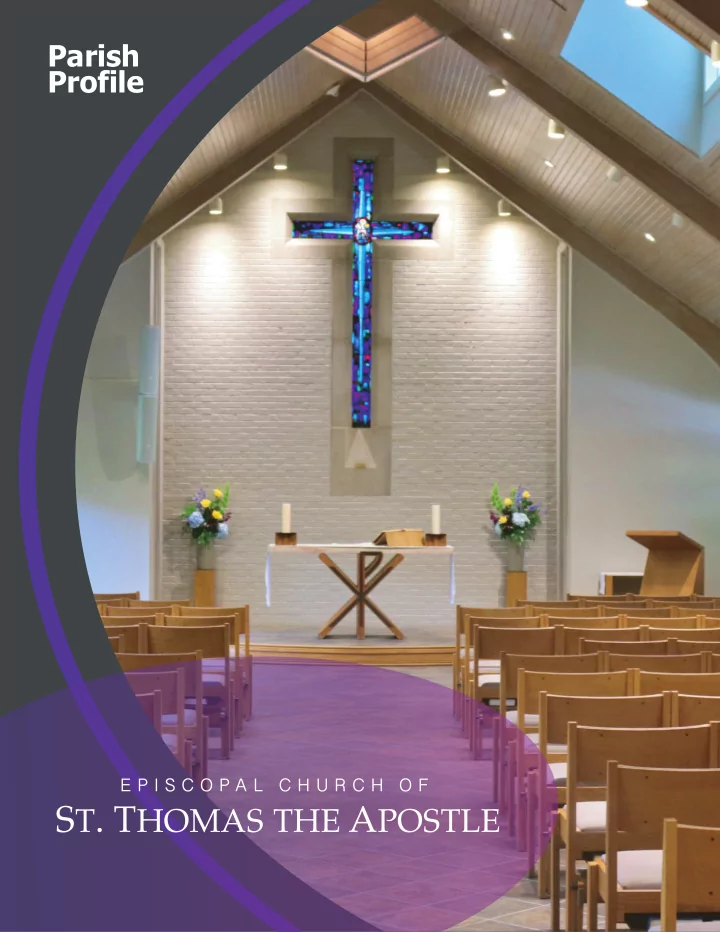
- ST. THOMAS THE APOSTLE
E P I S C O P A L C H U R C H O F
Watch our presentation video. Scan the QR code with your camera - - PDF document
Parish Profile E P I S C O P A L C H U R C H O F S T . T HOMAS THE A POSTLE Watch our presentation video. Scan the QR code with your camera phone or click the link below. http://bit.ly/30Qyvg1 INTRODUCTION Weve hugged more than usual
E P I S C O P A L C H U R C H O F
Watch our presentation video. Scan the QR code with your camera phone or click the link below. http://bit.ly/30Qyvg1
Parishioners describe The Episcopal Church of
small church with a big heart. It’s a progressive parish with a long history of inclusiveness. It’s a way station where people broken in spirit can heal and find their niche in life. Our vision statement reads: “To be an engag- ing, passionate, spiritually healthy community,
However, each of us chooses to characterize
we soon felt like family. “Church family” may be an overused term in other parishes, but certainly not at St. Thomas. It’s especially apt here. We genuinely see our- selves as members of an extended family. We pray together. We volunteer together. We laugh together. We cry together. And, of course, we hug. First-time visitors to St. Thomas are often struck by our friendly embraces during the Peace on Sunday morn-
We’ve hugged more than usual since the retire- ment of a beloved priest earlier this year. But we know the life of any church, like any family, is made up of comings and goings. We look forward to our future with a new rector. During this interim period, we have done con- siderable reflection and self-evaluation. We’ve taken stock of what we’ve accomplished as a parish, who we are today and where we see
learned into this church profile and hope it introduces us to you. You’ll find a history of our parish, a Who’s Who
an overview of our community service and ministries, a description of the qualities we’re seeking in a rector and our hopes for tomor- row. We trust that, after reading our profile, you’ll agree that St. Thomas the Apostle is indeed a special place that not only nurtures its own members but also understands the importance
the broader community. This is a place where people can come to cele- brate their faith, tend a community garden and grow food for the hungry, care for the sick and homebound and, yes, where they can also come to watch old movies and share a few laughs. Call us proud Episcopalians. No doubt about it.
Helping Hands Healing Hearts Welcome All
The 69-year history of St. Thomas the Apostle has been, and remains, a story of inclusive-
without reservation and provide a sanctuary for self-examination, growth and healing. The parish’s roots go back to 1950 and the post-World War II boom in Dallas. Henry Hutchins Jr., a young ex-GI, and Greer Taylor, a young seminarian, worked through the bishop
the Apostle. The Rev. Edward Ferguson became the part-time priest in charge. Less than two years later, The Rev. Guy Usher became the full-time vicar. During its first six years, the fledging mission worshipped at parishioners’ homes, then at Arlington Hall in Lee Park, two private schools and, finally, at the Inwood Theater. This itiner- ant period of St. Thomas’ history calls up stories of certain trials and tribulations, such as the need for especially stout parishioners to lug around a pump organ that had been borrowed from St. Matthew’s Cathedral. By 1955, the mission had gained parish status and called Father Guy to be the first rector. The parish’s present site at Inwood Road and Mock- ingbird Lane was purchased, and construction
built for $75,000 — were consecrated, and the 50 families who then belonged to St. Thomas settled into the parish’s permanent home. From early on, inclusiveness was woven into the church’s fabric. In 1962, Ethel Stewart had heard of the friendly neighborhood church at Inwood and Mockingbird and wanted to become a part of it. Yet Ms. Stewart was Afri- can-American, and segregation was the accepted norm in Dallas at the time. Despite outside threats, including hateful signs posted on the church doors by unknown per- sons, and the need to have police presence on Sundays, the St. Thomas family welcomed her into their midst and became the first integrated parish in the diocese.
as the first parish in the diocese to elect a woman to its Vestry and the first parish in the diocese to have women at the altar. Still, the moment that speaks most profoundly to the parish’s commitment to “receive all people into
when a young man named Jerome walked into
He was dying of AIDS and had been turned away by three other churches. The Rev. Ted Karpf, a young priest who had become St. Thomas’ second rector a year before, reached
the man into their church family and cared for
help, and an AIDS ministry, the first of its kind in Dallas, began and grew at St. Thomas. The new ministry was not without challenges. As people with AIDS started attending worship services, some members left St. Thomas out of fear of using the same chalice for communion. Ultimately, though, the parish’s willingness to answer a desperate community need energized the church and made it more diverse. The Rev. Stephen Waller became the parish’s third rector in 1989, and St. Thomas evolved into a “destination church.” People drove from many miles away to worship and serve.
Father Stephen’s 23 years at St. Thomas brought an ambitious million-dollar-plus rebuilding of the parish’s facilities and grounds and a broad community outreach program. From the church’s focus on helping those living with AIDS in the 1980s and 1990s sprang other volunteer efforts to feed the homeless, clothe the needy, tutor and support neighborhood schoolchildren, and care for people recovering from surgery and illness. After Father Stephen’s retirement, the Vestry called The Rev. Joy Daley to become the church’s fourth rector in 2014. Under her cheerful leadership, the parish broadened its community outreach and initiated educational programs and community service projects with
Joy and the parish successfully advocated for equal access to “all sacraments for all people” at the 2018 General Convention. The years-long effort came to a joyful culmination in early 2019, when Mother Joy, along with the retired Bishop of New Hampshire, the Right Reverend Gene Robinson, was able to bless the marriages of same-sex couples at St. Thomas who had long been forbidden by the Diocese of Dallas to marry in their own church. “Our doors are open to all,” parishioners say of the inclusiveness that distinguishes the church’s past and promises to further enrich its
just like Ethel Stewart, people continue to arrive at St. Thomas the Apostle’s doorstep to become part of something much larger, much grander, than themselves.
Who’s Who
Staff
The Rev. Leo Loyola, Assisting Priest In addition to his liturgical duties, Father Leo has assisted with Christian education pro- grams, pastoral care and community outreach. A recent transplant to Texas, he previously served as vicar of Calvary Episcopal Church in the Diocese of Hawaii, helping to guide it from a fractured congregation back to its good standing with the diocese. Lee Corbin, Organist and Choirmaster Lee has been organist and choirmaster at St. Thomas since 1985. Nearly every summer since 1999, he has joined other organists from the United States, Canada and Australia for a tour of organs in the United Kingdom. Lee has played many of the historic instruments in cathedrals, town halls and parish churches in England, Wales, Ireland and Scotland. In addition to our professional and small sup- port staff, you will often find the office and campus tended by a number of dedicated volunteers from the parish family itself.
Vestry
Nancy LeGros, Senior Warden Steven Lee, Junior Warden Jean Edwards Todd Frary Kenneth Goodwin Dale Lee Charles Mullins Jr. Jack McCroskey Dianna Rooney Denise Webb Glass, Chancellor Rusty Rippamonti, Vice Chancellor Mike Gsell, Treasurer Paul McCright, Clerk
Search Committee
Rusty Rippamonti, chairman Nan Alexander Susan Arellano Joe DeuPree David Hess Michael Legacy Charles Mullins Jr. Jack McCroskey Lisa Pearson
Our City: The New Dallas
The Dallas where most St. Thomas parishio- ners live is a different place from the rest of the state — different also from the city’s image nationwide. Dallas is a complex and sophisticated place serviced by the largest light-rail commuter system in the country and dotted with newly revitalized urban neighborhoods — particularly in areas near St. Thomas, such as Uptown, Oak Lawn, the Cedars, the Design District and Oak
boom in public amenities, with parks, muse- ums and performance halls. The one cliché that is accurate is that Dallas is big — bigger, in fact, than many people realize. The city, which itself has more than 1.3 million people, is at the center of the fourth-largest metropolitan area in the country — behind
and Los Angeles. St. Thomas is located in the urban heart of the Metroplex, a local term for the metropolitan area. Like every other big city in the country, Dallas is home to miles of suburbia. But many of those suburbs are surprisingly diverse — with a vibrant Hispanic population, certainly, but also with large communities from Asia, Africa, the Caribbean and the Middle East. The LGBTQ+ community, once most visibly present in Oak Lawn, is now much more diffused, but it’s still one of the most active and politically powerful communities between Chicago and Los Angeles. For those who equate all of Texas with political conservatism, the voting patterns here might come as a surprise. Dallas County voted for the national Democratic ticket in 2008, 2012 and
now held by Democrats. All of which is to say that progressive-minded individuals can feel right at home, deep in the heart of Big D. That’s D, as in diversity.
Our Diocese
The Diocese of Dallas has about 67 parishes and missions and is known for its many minis- tries and extensive community outreach. The current bishop is The Right Reverend George Sumner, elected in 2015. After the 2018 General Convention’s actions on marriage equality, Bishop Sumner determined that he could not oversee our parish that had wanted to and has moved forward in providing marriage rites for gay and lesbian couples. As a result, The Right Reverend Wayne Smith, bishop of the Diocese of Missouri, is now pro- viding that pastoral oversight to St. Thomas and two other parishes in the Diocese of Dallas that have chosen to perform same-sex mar- riages.
Who We Are
Bishop Smith is providing spiritual oversight, while the Diocese of Dallas maintains temporal
Thomas’ Vestry and Search Committee and expressed his strong support for the parish’s mission and vision. The Rev. Canon Joseph Chambers, canon to the ordinary of the Dio- cese of Missouri, is assisting the Vestry and Search Committee. The Right Reverend George Wayne Smith Diocese of Missouri The Right Reverend George R. Sumner Diocese of Dallas
6% 4% 35% 55%
PERSONS IN HOUSEHOLD LEVEL OF EDUCATION
2% 17% 28% 5% 48%
AGE TENURE
2% 5% 5% 15% 41% 10% 22%
GENDER
Who We Are
Most of us at St. Thomas the Apostle prefer not to be defined merely by categories, but we thought it would be useful to prospective rectors if we did just that. Here’s a brief over- view of who we are.
32% 68% 35-44 2% +65 52% 45-54 10% 55-64 36% 0% 0% 0% 0% 0% 0% 0%
Our Worship and Christian Education
We have two services each Sunday morning. The main service at 10 o’clock uses Rite II. The choir and organ play prominent roles. Our con- gregation loves to sing, not just the traditional hymns but portions of the Mass as well. We also look forward to challenging and timely homilies from the rector or other clergy. As a parish, we laugh easily during lighter moments
Peace and clap as a show of support after indi- vidual blessings, such as for birthdays, anniver- saries and travel. On special holy days, we use incense. On Sunday, we also have an 8 o’clock Rite I
8 o’clock, communicants typically form a semi- circle in front of the altar and pass the Body and Blood of Christ from one to another. Evening worship services and educational pro- grams are held during Lent and Advent. Many parishioners participate in our midweek Bible Study. The group recently began a 14-week “Journey Through the Bible” series, which is an overview of the foundational docu- ments of the Christian faith. Also popular is the
array of thought-provoking reading and discus-
groundbreaking classic on race in America, “Race Matters.” Like any church, St. Thomas couldn’t function without the helping hands of its members. Each fall, the church holds a Ministry Fair at which parishioners can learn about the various ministries and choose the ones they’d like to
they’re involved. Some will be more familiar to you than others.
Acolytes,
are among our most visible parishioners, carry- ing the cross and torches in the processional and recessional and assisting the celebrant each Sunday.
Altar Guild,
members, on the other hand, work behind the
silver, glass and other utensils used in the Eucharist and set up the altar and church for services.
Beyond the Pew,
events bring together long-standing parishio- ners, newer parishioners and prospective parishioners for an evening of good food and casual conversation at a church member’s
and cheese tastings and, of course, because we’re all Texans, chili cook-offs.
Choir,
members are among our parish’s most gifted
those of us who can’t carry a tune but still look forward to their music.
Our Ministries
Daughters of the King,
an order of the Episcopal Church, that serves the rector and parish through prayers, service, and evangelism.
Foyers,
give church members a chance to know their fellow parishioners better. Members who volun- teer for Foyer are randomly assigned to small groups, which usually meet monthly for six
assist other parishioners who need help with some of their everyday living activities. Angels might provide a ride to a doctor’s appointment, bring in a meal or two, take them grocery shopping or visit them in a hospital or resi- dence.
Kitchen Crew and Social Committee,
members put together our social events at St. Thomas and plan, prepare and organize the delicious meals we have throughout the year, such as our “flaming dish” lunch on Pentecost and our Thanksgiving feast on the Sunday before the holiday.
Lay Eucharistic Ministers,
commissioned by the bishop, help administer the chalice during worship services and deliver communion to homebound members.
Lectors,
read the Scripture lessons during Mass and lead the Prayers of the People.
Ushers,
hand out service bulletins, collect the offering and help with the orderly flow of the congrega-
Welcome Guild,
members greet visitors to St. Thomas, making them feel welcome and often assisting first-time guests who may be unfamiliar with Episcopal services.
Connecting at St. Thomas Brunches,
held following the 10 o’clock service on the first Sunday of each month at a casual neighbor- hood restaurant, give parishioners an opportu- nity to welcome new or prospective members and form deeper friendships with other mem- bers.
Our Community Outreach
Our church’s mission statement reads: “Help- ing hands, healing hearts, welcome all.” Com- munity service has been part and parcel of St. Thomas’ history. Our commitment to helping
good causes but extends far beyond dollars and cents. Parishioners collectively donate hundreds, if not thousands, of hours of their time each year through a wide range of out- reach activities. A few of these are mentioned below.
Community Grant Program
zations to apply for individual grants each year. A committee of parishioners reviews the appli- cations and makes recommendations to the Vestry for approval. The church distributes the
Sunday worship service.
Blood Drives
winter and summer, resulting in good turnout from not only parishioners but neighborhood residents as well.
Austin Street Center
A group of dedicated parishioners rise early on the first Saturday of every month to meet in the church kitchen and prepare a lunch they serve at the Austin Street Center’s homeless shelter.
Community Garden
Several years ago, parishioners repurposed the site of the former Rectory next to the church into a bountiful garden that has fed the hungry in Dallas. The Presiding Bishop at the time, The Most Rev. Katharine Jefferts Schori, accepted
bless the new garden that’s “fighting hunger where we live.” Dozens of St. Thomas mem- bers and neighbors have tended the plots to produce thousands of pounds of vegetables each year for local food pantries. This has become a community garden in the true sense
reach activity for many community groups that have joined in the tilling, nurturing and har- vesting.
The Gathering
A group of church members prepare and serve lunch to the homeless at Thanks-Giving Square in downtown Dallas four Sundays each year.
Ewing House Dinner Group
share dinner each month with the residents of Ewing House, a facility run by a local nonprofit for people living with HIV/AIDS.
North Dallas Shared Ministries
Parishioners give clothing and food to help Dallas area residents on limited incomes. St. Thomas members also volunteer many hours to the interfaith agency’s social service pro- grams.
Our Partnerships with Central Christian Church and Christ Episcopal Church
We have reached out to other congregations with a common purpose. On Christmas Eve, for example, the choirs of Central Christian and St. Thomas sang together at one church at 6 p.m. and at the other at 8 p.m. We also have had Taize services together. With Christ Church, we supported that congregation’s summer reading program and its mission trip.
Food Drives and Special Projects
The congregation collects non-perishable items for community groups that maintain food pan-
state’s Child Protective Services system.
Fund-raisers
Parishioners raise funds for other charitable causes, such as the annual AIDS LifeWalk, which supports community groups that help people live with the illness. Bryan’s House, a pediatric facility for children affected by HIV/AIDS and other serious illnesses, also receives our strong backing. And every Decem- ber, we donate clothing and toys to youngsters within the Child Protective Services system.
Our Finances
is debt free. The parish invested more than $1 million to remodel and rebuild its facilities and landscape its grounds. Though debt was incurred to finance the most ambitious phase of the proj- ect, that was paid off during a capital campaign supported with the generous contributions of church members. Nor are there outstanding debts from anything else. The church always pays its full diocesan assess- ment and its full offering to the national church.
year through the income it receives largely through pledges and the plate. Stewardship is a theme the church’s lay leadership emphasizes each fall, discussing “time, talent and treasure.” Parishioners have a proud history of honoring their financial pledges, and the church typically receives 97 to 98 percent of the money pledged. The average pledge amount has increased the last three years, from $3,552 in 2017 to $3,793 in 2018 to $3,920 this year. That gen- erosity has allowed the annual budget to remain relatively stable, despite a small decline in the number of pledge units. The 2019 budget stands at $371,963, up slightly from $364,042 the previous year. Annual budgets are drafted by the Budget Committee and approved by the Vestry. We are especially proud of our commitment to Outreach. The amount this year is $65,113, which represents 17.5% of our total budget. This includes the Diocesan assess- ment, ECUSA assessment, and funding for myriad internal ministries as described previously. St. Thomas also funds $5,000 for yearly, competitive grants available to outside organizations. This year we used grants to help fund the pur- chase of beds for hospice patients at Legacy Counseling Center and to provide food and other supplies to the LGBT Youth Home sponsored by Promise House. We also open our doors to pro- vide meeting space at no charge for several groups who have no other space and could not afford to rent such space.
Fund of $275,000. Monies from this Endow- ment may not be used to subsidize the general budget but can be used for special projects such as starting a new ministry. Such disbursements are at the discretion of the Vestry.
Our Building Makeover
At St. Thomas our building and grounds are cen- tral to our worship, fellowship and education pro-
Thomas’ welcoming campus has become a com- munity center. Each week we play host to a diverse list of nonprofit groups and community
groups, the League of Women Voters, newly form- ing religious communities – they’ve all been our guests.
bers, who had been worshipping in the parish hall, decided to remodel and return to their unused Fifties Era sanctuary. The darkened and neglected sanctuary was turned into a bright, modern, and inviting space that looks out through a wall of floor to ceiling widows to a lush fountain court- yard, and our outdoor columbarium. It is a warm and inviting place for meditation and reflection. The courtyard is also the scene for outdoor services and parish social gatherings. After the sanctuary redo, the next phase of our makeover saw an extensive updating to the kitch- en, its equipment and appliances. It is equipped to manage complete meal preparation for hundreds
remodeled, and included the installation of a laby- rinth in the new tile floor. The labyrinth has become one of our community ministries. Parish- ioners and visitors alike walk it to find peace and
The final phase of our makeover was the recon- struction of our “west wing” of meeting rooms and
from the original sanctuary. The south Room hosts mainly church functions, such as adult education programs, Vestry meet- ings, committee meetings, and smaller receptions. The suite of church offices accommodates the priest, administrative assistant and volunteers, and includes a conference area. The newly redone west wing also includes a cheerful nursery, the choir room, and the north room which is a second meeting space frequently used by community groups. To the north of the west wing and parking lot lies
section on community outreach. It is a hub of activity throughout the year. The most recent renovations at St. Thomas have included the reconstruction of the north entrance, further improvements to the parish hall, fountain courtyard, and a complete redesign of our land-
with a sound system for both the sanctuary and the parish hall. A handsome new stone masonry sign stands on the corner of our property at Inwood Road and Mockingbird Lane, one of the most travelled intersections in urban Dallas, wel- coming everyone to our campus. As bespeaks the dedication and generosity of the people of St. Thomas, each phase of the church’s makeover was paid for before the next phase
free facility that serves the congregation and the larger community, as befits the Mission Statement
someone or organization is not making use of our “home”. We wouldn’t have it any other way.
Our Hopes for the Future
As proud as we are about our parish’s past and present, we’ve also given careful thought to
interim period, we’ve discussed and surveyed
congregation headed over the next several years. “We need to grow” has been a common
above average when compared to the national average of churches our size in plate and pledge income, we are below average in the number of people a year being baptized, received and confirmed, and in our average Sunday attendance. We’re an aging parish. The upside of this is that we have many long-standing members. Still, we all recognize the importance of the church renewing itself by adding members. From our conversations with experts in congre- gational development, we understand that doesn’t just happen. It requires deliberate action and strong leadership. At its retreat last year, the Vestry set specific strategies for fostering a healthy church and has begun pur- suing them. We know we must do better at marketing our
better at engaging newcomers. We’re a friend- ly bunch, and we do well in welcoming visitors. But we need to take the next step and plug people into church activities once they’ve shown an interest in the parish. The Connect- ing with St. Thomas brunches are just one recent effort in this direction. But we look forward as well to our next rector providing creative ideas and leadership. Like many congregations, St. Thomas is bless- ed to have a core of stalwarts who are always willing to step in and get the job done — what- ever that happens to be at the moment. Growth will allow us to share those responsibil- ities with a broader circle of devoted parishio-
bring new enthusiasm and the next generation
We also know that we want to keep the famil- iarity and intimacy that a congregation our size
grow so large that we compromise the sense of community that first brought many of us to St.
mega-church. We look for balance here. For example, a larger, more multi-generational parish will permit a more robust Christian education pro- gram — an important goal of ours. On the
us have enjoyed as a result of our parish’s small size. Without it, St. Thomas wouldn’t seem quite like the St. Thomas we’ve known. Our parish has a strong attachment to the national Episcopal Church. We’re proud of the national church’s initiatives of inclusiveness, and we remain steadfast in our commitment and support for ECUSA. The Rev. Gay Clark Jennings, President of the House of Deputies, accepted our invitation to visit St. Thomas and lead our Vestry retreat. And Retired Bishop Gene Robinson of the Diocese of New Hamp- shire came to our parish to help bless our same-sex married couples one Sunday morn- ing earlier this year.
parishioners, up-to-date facilities, an enviable
itself and preparing for the next generation of its parish life. Our next rector will be an individ- ual who, like the rest of us, sees that as an intriguing opportunity.
Our Next Rector
Over its 69-year history, St. Thomas the Apos- tle has had only four rectors. That, more than anything else, says what a special place this is. Our first rector served for 32 years. Another was here for 23 years. Why is that? We think it was because of the strong bonds of affection that grew between pastor and parishioners. Together, we celebrated our faith and found new ways to share it in the world beyond our walls. While we realize that such extended tenures have become the exception rather than the norm among pastors today, we do look forward to having the same affection for our fifth rector and the same uplifting relationship. We’ve surveyed ourselves on the qualities and skills we are seeking in that individual. Among the traits that parishioners rated important were: courage, compassion, warmth, engaged, and outgoing. We are looking for a dynamic leader who will be with us on our own spiritual journeys. Many of those qualities would be expected of any pastor aspiring to lead a parish. But other traits raised by church members bear a closer look, since they speak to the particular priori- ties of the people of St. Thomas. We’ll know by these skills whether we’ve found our new leader. First, we look to our rector to nurture and maintain a sense of community among us. St. Thomas is seeking a rector who is comfortable working in partnership with the laity to plan and implement the goals of the parish. We’ve emphasized throughout this church profile that
We want someone who accepts and loves all of us and with whom we can share our joys and sorrows.
want to develop ministries that work toward healing those broken by life circumstances. We want a pastor who’s available to counsel and guide us. We want someone who can listen and console us. Yet we also understand that pastors can’t remain responsive to the needs of
relax.
Our Next Rector
Next, we look to our pastor to be our spiritual leader who can teach us and help us grow in
who’s a dynamic preacher, whose homilies challenge us to think and inspire us to act — and who appreciates the value of humor and strengthens our Christian formation. We look for a rector who, like us, is strongly committed to equal access to all of the Sacraments of the church. Finally, we look for our next rector to help us grow and rejuvenate our parish. As you read earlier, we’re an energetic lot. Our ambitious community outreach work proves that. But many of us are getting older. Our church needs new members to bring about a renewal. We want to implement a comprehensive strategy to reach new persons and families with chil- dren, and incorporate them into the life of the parish. A plan for growth requires not only parishio- ners with enthusiasm but also a rector with solid leadership and administrative skills and, quite frankly, a passion for taking something good and making it even better. We want a pastor who works well with the Vestry and guild heads and who knows how to enlist and encourage other church members to give their time and talents. Our story of community and inclusiveness remains as compelling as ever. We hope this brief overview has intrigued you enough to introduce yourself to us. If you think you’d like to become part of our future, our family, we’d invite you to apply. The best part of this story is indeed yet to come.
If this profile of our parish has prompted any questions or if you’re interested in applying to become our next rector, please feel welcome to contact the chairman
If you’d like to begin the application process, we invite you to contact the Episco- pal Church’s Office for Transition Ministry at www.episcopalchurch.org/page/transition-ministry