Water Crisis in Central Asia Key Challenges and Opportunities - PowerPoint PPT Presentation
Water Crisis in Central Asia Key Challenges and Opportunities Prepared by: Diana Castillo, Lisa Marie Izquierdo, Gloria Jimenez, Mari Stangerhaugen, Robert Nixon Advisor: Ambassador Rafat Mahdi Introduction Water is essential for survival
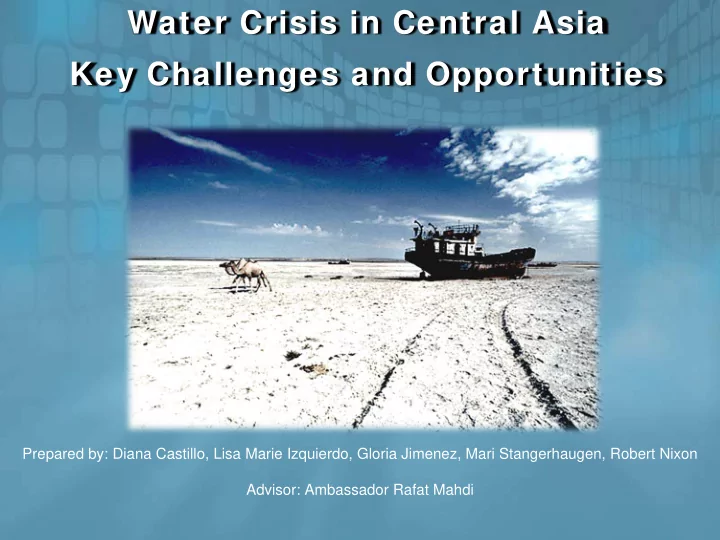
Water Crisis in Central Asia Key Challenges and Opportunities Prepared by: Diana Castillo, Lisa Marie Izquierdo, Gloria Jimenez, Mari Stangerhaugen, Robert Nixon Advisor: Ambassador Rafat Mahdi
Introduction • Water is essential for survival and important resource for social and economic development • Water scarcity affects more than 40% of world globally; by 2025 1.8 billion people will be living in regions with absolute water scarcity • “Fierce competition for fresh water may well become a source of conflict and wars in the future.” -Former UN Secretary General, Kofi Annan • Water conflicts in Nile, Mekong, Euphrates, and Ganges rivers
Intro Cont’d. • No effective international arrangement • Global dimension of water: erosion, urbanization and biodiversity loss • Lack of attention from international community
Overview: Water crisis in Central Asia • Central Asia – Turkmenistan – Kyrgyz Republic – Kazakhstan – Uzbekistan – Tajikistan • Independence from U.S.S.R. in 1991 • Two main river basins: Amu Darya and Syr Darya • Conflicting interests between upstream and downstream countries Source: University of Texas, 2007
Upstream vs. Downstream Upstream: Tajikistan and Downstream: Uzbekistan, Kyrgyz Republic Kazakhstan, Turkmenistan Few natural resources Rich in oil, gas and coal Dependence on Irrigated agriculture downstream countries for energy supplies Water as a commodity Water as common good Dams and Hydropower Aral Sea crisis
Soviet Union Legacy • Centralized planning • Moscow’s “White Gold” • Water management systems – Water-energy exchange
Post Soviet-Era –Bilateral Agreements –Competing interests –New Great Game
Post Soviet-Era Cont’d. Source: SCO website, 2007 The leaders of Russia, China and several former Soviet republics met in Bishkek, Kyrgyzstan, for the Shanghai Cooperation Organization (SCO) 2007 summit.
Post Soviet-Era Cont’d. • Water’s role in the economy and social stability of Central Asia – 60 % of population live in rural areas – 45 % of workforce is employed in agriculture – 80 % of region’s arable land relies on irrigation systems
Post Soviet-Era Cont’d. • From command economy to market economy – Main trade partners: � Russia � European Union � China
Key Challenges for Water Cooperation 1. Regional Politics 2. Management of Water Resources 3. Aral Sea Crisis 4. Climate Change UN Secretary General Ban Ki-Moon visiting Aral Sea in April 2010
1. Regional Politics • Conflicting political/national interests • Widespread corruption • Divergent approaches to water management • Role of neighboring states – Russia � Collective Security Treaty Organization – China � Shanghai Cooperation Organization – Afghanistan
2. Management of Water Resources • 1992 Almaty Agreement - Only existing water agreement - Codification of existing practices - Left upstream countries with little access to the water generated on their territory - Left out Afghanistan Source: Columbia University, Earth Institute, 2009 (generates 6% of water flow in the Aral Sea Basin)
Management of Water Resources Cont’d. • Limitations of the 1992 Almaty Agreement – Unfair water allocation to downstream countries – Upstream countries expected to pay for upkeep of dams while downstream countries reap the benefits • Current developments – Agreement is not being adhered to. – Upstream countries are increasing domestic water usage and decreasing the amount to downstream countries
Management of Water Resources Cont’d. • Upstream countries’ need for hydropower -Struggling to meet energy needs - Using water to generate hydropower - Dispute over the pricing of water • Tajikistan and the Rogun Dam controversy -Decrease dependency on energy imports The Rogun Dam: If completed, it will be the tallest dam in the world -5 % of hydropower potential developed - Tajikistan vs. Uzbekistan - World Bank involvement
Management of Water Resources Cont’d. • Downstream countries and the need for irrigation - High dependence on water intensive cotton production - Inefficient use of scarce water resources - Water lost due to old infrastructure and pollution - Complex water management system - lack of coordination and interaction
Management of Water Resources Cont’d. • Cotton Industry in Uzbekistan – Monoculture crop – Poor irrigation practices – Tension between Uzbekistan and Tajikistan – International criticism for Source: Der Spiegel, 2010 its labor practices
3. Aral Sea Crisis Once world’s 4 th largest lake • • Today: Little Aral Sea and Big Aral Sea • Social, health and economic effects • Efforts to save it - Kokaralsk Dam: Kazakhstan and World Bank - International Fund for saving the Aral Sea (IFAS) • Lack of attention to the cotton industry Source: UNIMAPS, 2004
4. Climate Change • Rising temperatures - 20 % of glaciers in the region have melted • Falling agriculture yields • Extreme weather conditions and natural disasters • Opportunities for adaptation and international funding Source: CA.gov, 2010
Case Study: Indus Water Treaty • Key elements - Signed in 1961 between India and Pakistan - Negotiated and signed by a benign go-between: World Bank - Dispute settlement mechanism through neutral expert • Applicability to Central Asia - Overcome competing interests between states - Role of neutral mediator in crafting agreement - Economic incentive: funding from international community Source: Oregon State University, 2010
Regional and International Stakeholders Regional International • Chu-Talas Rivers Commission • UNDP Integrated Water Resources Management • International Fund for saving the (IWRM) Aral Sea (IFAS) • World Bank • Asian Development Bank (ADB) • European Union • United Nations Special Program for the Economies of Central Asia (SPECA)
Lessons Learned � Competing national interests: agriculture versus hydropower creates a zero sum game � The 1992 Almaty Agreement is outdated and ineffective in allocating water resources � Water infrastructure in Central Asia is extremely inefficient by international standards � The Indus Water Treaty shows third-party mediation in water disputes works in the long term � Major debate whether water should be treated as a public good versus a commodity creating challenge for cooperation
Recommendations For Central Asian States � Increase focus on regional, rather than bilateral agreements. � A neutral third-party or a group of experts as a mediator. � Promote reforms that balance economic growth with environmental rehabilitation. � The 1992 Almaty Agreement should be revisited, reviewed, and revised. � Regional financial resources should be harnessed to assemble a pool of technical experts to monitor and oversee existing water infrastructure.
Recommendations Cont’d. For International Community � Establish a new international fund to repair deteriorating water infrastructure. � Identify a benign go-between to assist the countries in negotiating a new water agreement. � Assemble an international group of experts to provide technical advice to policy makers. � Provide economic incentives to aid the downstream countries diversify their economies. � Russia should promote cooperation among the Central Asian states and provide technical assistance.
Thank You for Your Attention! Concluding Remarks
Recommend
More recommend
Explore More Topics
Stay informed with curated content and fresh updates.