water mold, related to Pythium and Phytophthora infection requires - - PowerPoint PPT Presentation

water mold related to pythium and phytophthora infection
SMART_READER_LITE
LIVE PREVIEW

water mold, related to Pythium and Phytophthora infection requires - - PowerPoint PPT Presentation

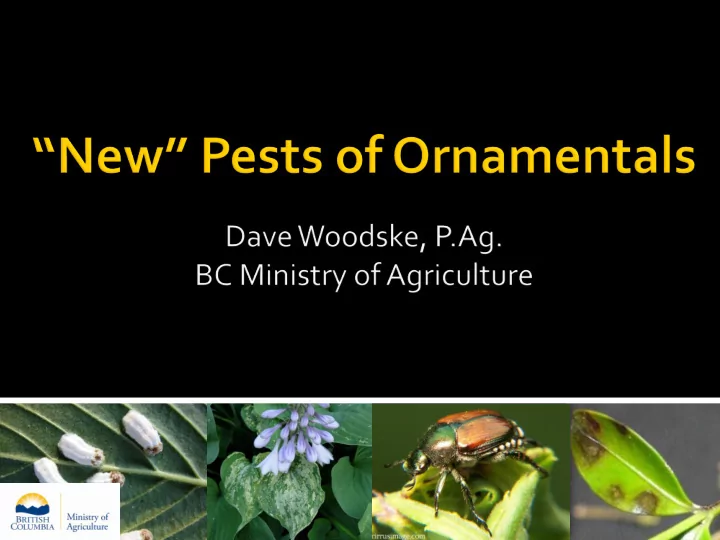
Downy Mildew on Impatiens ( Plasmopara obducens ) and Basil ( Peronospora belbahrii ) Box Blight ( Cylindrocladium buxicola ) European Pine Sawfly ( Neodiprion sertifer ) Green Immigrant Weevil ( Polydrusus sericeus ) Hellebore


slide-1
SLIDE 1
slide-2
SLIDE 2
  • Downy Mildew on Impatiens (Plasmopara
  • bducens) and Basil (Peronospora belbahrii)
  • Box Blight (Cylindrocladium buxicola)
  • European Pine Sawfly (Neodiprion sertifer)
  • Green Immigrant Weevil (Polydrusus sericeus)
  • Hellebore Leafminer (Phytomyza hellebori)?
  • Red Lily Leaf Beetle (Lilioceris lilii)?
  • European Fire Ant (Myrmica rubra)
slide-3
SLIDE 3
  • water mold, related to Pythium and Phytophthora
  • infection requires leaf wetness
slide-4
SLIDE 4

Host Pathogen Year

Boston Ivy Plasmopara viticola Oregon ’01 Virginia Creeper Plasmopara viticola Oregon ’01 Impatiens walleriana Plasmopara obducens California’04 Hellebores Peronospora pulveracea BC ’05 Rudbeckia

(Centaurea, Coreopsis, Erigeron, Helianthus, Verbena)

Plasmopara halstedii Virginia ’05 Coleus Peronospora belbahrii Oregon ’07 Basil Peronospora belbahrii Florida ’07

slide-5
SLIDE 5

Rudbeckia Basil Impatiens

slide-6
SLIDE 6
  • detected sporadically US

greenhouses in 2004

  • began to damage landscapes in

2011; detected in 33 US states by 2012

  • detected in Quebec and

Ontario, and for the first time in BC in June 2013

(Conway Lum)

slide-7
SLIDE 7
  • Hosts:
  • common garden impatiens (I. walleriana)
  • garden balsam (I. balsamina)
  • Symptoms:
  • leaf yellowing, downward curling margins
  • premature leaf drop and stunted growth
  • sporulation on underside of leaf

(Conway Lum)

slide-8
SLIDE 8
  • Cultivar Susceptibility:
  • B. sempervirens >> B.

microphylla

  • rhododendron, pieris,

azalea are not hosts

  • first detection Oct 2011  rapid loss >15,000

boxwood at a nursery in NC

  • detected in 10 U.S. states and 3 provinces
  • Hosts: Buxus spp., Sarcococca spp., and Pachysandra

terminalis and P. procumbens

slide-9
SLIDE 9
slide-10
SLIDE 10
slide-11
SLIDE 11
slide-12
SLIDE 12

 Inspect plants; isolate & test

suspect plants

 Do not co-mingle plants

from different suppliers

 Sanitation (debris, shears)  Preventive fungicides  Do not introduce new

boxwoods into gardens with mature boxwoods

slide-13
SLIDE 13
slide-14
SLIDE 14
  • overwinters in egg stage
  • eggs hatch in April-early May
  • feed on old needles until June,

then drop to the ground to pupate

  • adults emerge Sept-early Oct;

lay eggs in current-year needles

  • can consume all of old foliage
  • n a heavily-infested tree
slide-15
SLIDE 15

Hellebore Leafminer Red Lily Leaf Beetle Green Immigrant Weevil

slide-16
SLIDE 16

Green Immigrant Weevil Red Lily Leaf Beetle Hellebore Leafminer

Fraser Valley in 2011 Spring 2012 - Bellevue , WA ? birch ‘fruit and forest trees’ Lilium, Fritillaria, Polygonatum, Solanum, Smilax, Nicotiana Helleborus foetidus adults notch leaves larvae feed on roots adults feed on leaf margins larvae skeletonize leaves, may feed on flowers damage develops from late summer - early spring most of foliage can be disfigured by spring eggs laid in soil in summer

  • verwinter as larvae

pupate in spring; adults June-July adults overwinter in soil eggs (orange) laid in rows

  • n underside of leaves

eggs hatch in summer remove mined leaves before the adult flies emerge

slide-17
SLIDE 17
slide-18
SLIDE 18
  • introduced to NA ~1900 (Boston area)
  • North Vancouver (1 city block) – Sept ‘10
  • Burnaby (community garden) – June ‘11
  • Victoria (two residences) – July ‘11
  • Vancouver (2 locations 7 km apart) – Aug ’11
  • Chilliwack - ’12
  • likely introduced to new areas via potted

plants, soil, compost or other OM

slide-19
SLIDE 19

(Dr. Robert J. Higgins)

  • prefers to nest in moist areas, in cultivated

soil or under debris placed on lawn

  • swarm rapidly and sting when disturbed
  • allergic reaction to the sting
  • high density of nests (up to 4/m2)
  • attracted to discarded fruit; tend aphids
slide-20
SLIDE 20

Brown Marmorated Stink Bug Gypsy Moth Chilli Thrips Light Brown Apple Moth Longhorn Beetles False Codling Moth Dutch Elm Disease Sudden Oak Death Japanese Beetle

slide-21
SLIDE 21

If you come across a pest that is unfamiliar:

  • Submit to the Ministry’s

Plant Diagnostic Lab for identification

  • Contact a Ministry Plant

Health Specialist

  • Contact the Canadian

Food Inspection Agency @ 1-800-442-2342

slide-22
SLIDE 22

Questions?