Water Resources Division Protect and Monitor 4 Great Lakes 3,300 - - PowerPoint PPT Presentation

water resources division
SMART_READER_LITE
LIVE PREVIEW

Water Resources Division Protect and Monitor 4 Great Lakes 3,300 - - PowerPoint PPT Presentation

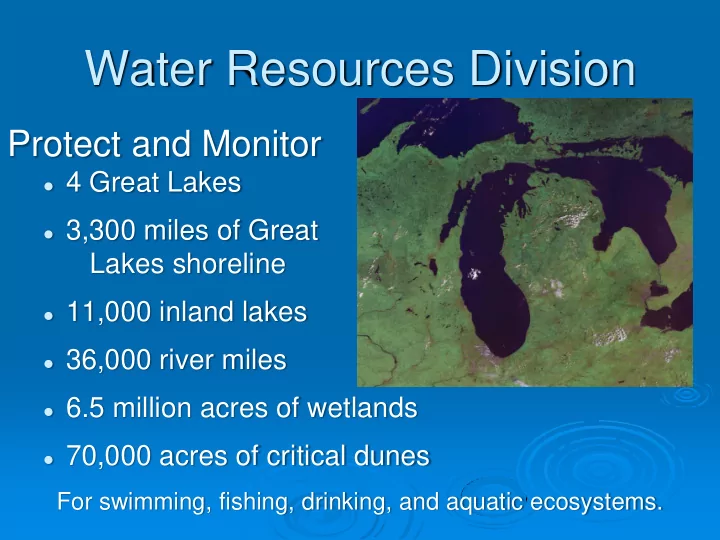
Water Resources Division Protect and Monitor 4 Great Lakes 3,300 miles of Great Lakes shoreline 11,000 inland lakes 36,000 river miles 6.5 million acres of wetlands 70,000 acres of critical dunes For swimming, fishing,


slide-1
SLIDE 1

Water Resources Division

Protect and Monitor

 4 Great Lakes  3,300 miles of Great

Lakes shoreline

 11,000 inland lakes  36,000 river miles  6.5 million acres of wetlands  70,000 acres of critical dunes

For swimming, fishing, drinking, and aquatic ecosystems.

slide-2
SLIDE 2

Michigan Nutrient Control

Phosphorus based Great Lakes driven

slide-3
SLIDE 3

Water Quality Standards

1.0 mg/L Narrative

slide-4
SLIDE 4

NPDES Permit Limits

  • 670 permits have some type of

phosphorus control

  • 350 permits contain numeric

limits

  • Watershed-based rotation
slide-5
SLIDE 5
slide-6
SLIDE 6

6

Western Basin Central Basin Eastern Basin

Lake Erie

slide-7
SLIDE 7

2012 GLWQA: Commitments to Develop New Phosphorus Targets & Action Plans

Charge to Annex 4 (Nutrients):

Starting with Lake Erie by 2016

  • Determine phosphorus concentration objectives

and loading targets for open waters and nearshore areas including embayments and tributaries.

  • Determine loading allocation by country and

identify priority watersheds for load reduction.

Starting with Lake Erie by 2018

  • Assess effectiveness of programs to achieve the

substance and lake ecosystem objectives.

  • Develop domestic action plans and strategies to

control nutrients.

slide-8
SLIDE 8

Annex 4 Objectives for Lake Erie

1.

Minimize the extent of hypoxia zones associated with excessive phosphorus loading, with emphasis on Lake Erie.

2.

Maintain algal biomass below nuisance conditions.

3.

Maintain algal species consistent with healthy ecosystems in nearshore waters.

4.

Maintain cyanobacteria biomass at levels that do not produce toxin concentrations that pose a threat to human or ecosystem health.

5.

Maintain mesotrophic conditions in the open waters of the Western Lake Erie Basin.

slide-9
SLIDE 9

Michigan’s 5 Point Plan to Correct Harmful Algal Blooms in the Western Lake Erie Basin

Optimize total phosphorus removal at 5 key wastewater treatment plants Reduce agricultural and nonpoint source total phosphorus in Maumee River watershed Cease the open water disposal of dredged Toledo Harbor sediments Implement the phosphorus control activities checklist to best

  • f ability

Understand the role

  • f invasive mussels in

Western Lake Erie Basin and support the evaluation of new technologies

Michigan’s 5 Point Plan

slide-10
SLIDE 10
  • 1. Optimize total phosphorus removal at

5 key wastewater treatment plants.

Detroit, Downriver, and YCUA WWTPs in MI;

Fort Wayne WWTP in IN; and Toledo WWTP in OH

slide-11
SLIDE 11

Summary of Point Source Loads (MT)

slide-12
SLIDE 12

Detroit WWTP Total Phosphorus Load Sources

2011 % Total 2012 % Total Secondary Treated 756590 70 751110 94 Primary Treated (WWTP/CSO facilities) 275780 26 48250 6 Untreated CSO 42090 4 2240 Total 1074460 100 801600 100

slide-13
SLIDE 13
  • 4. Implement the phosphorus control activities

checklist to best of ability.

  • Water pollution control programs:

 Limiting municipal and industrial discharges to a

total phosphorus limit of 1 mg/l

 Combined sewer overflow correction programs  Sanitary sewer overflow correction programs  Municipal storm water and construction storm

water programs

 Concentrated animal feeding operation permitting

and regulation

 Eliminating phosphorus in detergents and turf

grass fertilizers

slide-14
SLIDE 14

Invasive Mussels

  • Promote harmful algal blooms:

Filter feeding and excretion stimulate nutrient releases into water column

Selectively feeding on phytoplankton

Reject blue-greens

Photo credit: Paul Skawinski, Golden Sands RC&D Council

slide-15
SLIDE 15

Zequanox

  • Biopesticide:

 Dead cells of a common soil bacterium  Causes mortality of zebra and quagga mussels  Destroys the inner gut lining of invasive mussels

  • Not harmful to other aquatic organisms and does

not have lasting impacts on water quality

  • Previous open water trials in Illinois and Minnesota
slide-16
SLIDE 16

2014 Lake Erie Zequanox Pilot

Feasible in Lake Erie?

Things to consider -

  • Depth
  • Substrate
  • Location of actual mussels
  • Wave action
slide-17
SLIDE 17

Partners: Marrone Bio Innovations, PLM Lake and Land Management, and USGS

  • La Plaisance Bay
  • November 2014
  • 800 m2 Treatment Plot
slide-18
SLIDE 18

18

  • Application technique = successful
  • Concentrations not maintained
  • Application technique = successful
  • Concentrations not maintained
slide-19
SLIDE 19

Water Resources Division

Protect and Monitor

 4 Great Lakes  3,300 miles of Great

Lakes shoreline

 11,000 inland lakes  36,000 river miles  6.5 million acres of wetlands  70,000 acres of critical dunes

For swimming, fishing, drinking, and aquatic ecosystems.