WATER SCARCITY Examining Impacts Around the World INTRODUCTION - - PowerPoint PPT Presentation

water scarcity
SMART_READER_LITE
LIVE PREVIEW

WATER SCARCITY Examining Impacts Around the World INTRODUCTION - - PowerPoint PPT Presentation

WATER SCARCITY Examining Impacts Around the World INTRODUCTION Introduction Common Issues and Impacts Case Study: Yemen Case Study: Australia Case Study: Spain Case Study: Canada 1 ABOUT


slide-1
SLIDE 1

¡ ¡

Examining Impacts Around the World
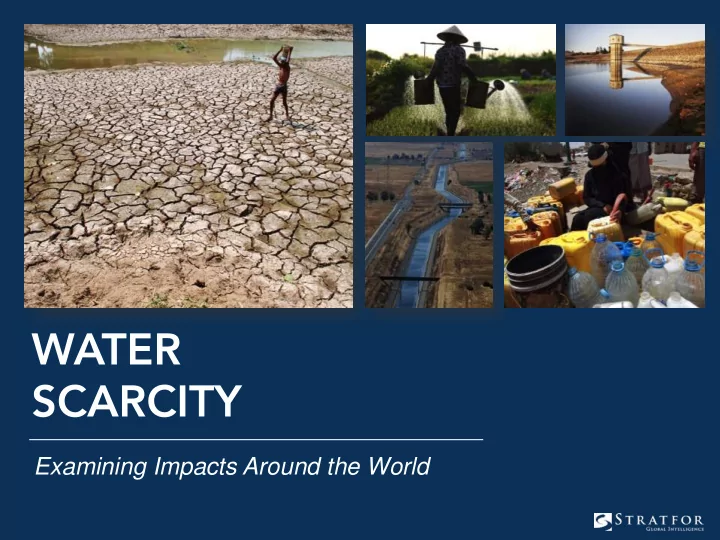
WATER SCARCITY

slide-2
SLIDE 2

¡ ¡

  • Introduction
  • Common Issues and Impacts
  • Case Study: Yemen
  • Case Study: Australia
  • Case Study: Spain
  • Case Study: Canada

INTRODUCTION

¡ ¡

1

slide-3
SLIDE 3

¡ ¡

2

¡ ¡

ABOUT THIS STUDY

  • This presentation provides partial highlights from an occasional

series of analyses that began to appear on Stratfor.com in December 2014.

  • This study examines a few of the widely occurring contributors to

water stress and water scarcity in various parts of the world, as well as selected case studies.

  • More information about the series as a whole can be found at the

end of this presentation. ¡ ¡

slide-4
SLIDE 4

¡ ¡

3

Water! What is it good for?

¡ ¡

INTRODUCING WATER

“ ¡ ” ¡

¡ ¡ To borrow a phrase from Edwin Starr: ¡ Absolutely everything! I’ll say it again … ¡

slide-5
SLIDE 5

¡ ¡

4

Water! What is it good for?

¡ ¡

INTRODUCING WATER

“ ¡ ” ¡

¡ ¡ Water is essential for:

  • Manufacturing
  • Agriculture
  • Commerce
  • Many types of energy
  • Economies
  • The existence of human and
  • ther life forms

¡

slide-6
SLIDE 6

¡ ¡

5

¡ ¡

WATER – PROS AND CONS

¡ ¡ It can also be:

  • Polluted
  • Desalinated
  • Recycled
  • A force of life or destruction ¡
slide-7
SLIDE 7

¡ ¡

6

¡ ¡

WATER – PROS AND CONS

¡ ¡ One thing water can never be:

  • Manufactured.

(Cloud seeding technology still has some distance to go.) ¡

slide-8
SLIDE 8

¡ ¡

7

¡ ¡

WATER AND GEOPOLITICS

¡ ¡ Clearly, water – and more specifically, the issues of water stress and water scarcity – are key forces in geopolitics. ¡

slide-9
SLIDE 9

¡ ¡

8

¡ ¡

WATER AND GEOPOLITICS

¡ ¡ When areas are under water stress, effects can include:

  • Reduced food and livestock

production

  • Population movements
  • Additional costs of living
  • Famine/starvation
  • Political stress
  • Other problems ¡
slide-10
SLIDE 10

¡ ¡

A Closer Look at Issues

slide-11
SLIDE 11

¡ ¡

9

¡ ¡

ONE PIECE AT A TIME

Let’s break this down a little more, by focusing on a few key concepts:

  • Definition of terms
  • Common issues affecting water availability
  • Common effects of water stress or scarcity
  • Case studies

¡ ¡

slide-12
SLIDE 12

¡ ¡

10

¡ ¡

DEFINITION OF TERMS

  • Groundwater resources: Water found in underground aquifers.
  • Land subsidence: The settling or sinking of land stemming from

movement of underground material.

  • Water scarcity: Less than 500 cubic meters of water per person per

year (500 m3/capita/year).

  • Water stress: Situations in which water availability poses a serious

constraint on human activity. By some definitions, this amount equals less than 1,000 cubic meters per capita per year (1,000 m3/capita/ year). ¡ ¡

slide-13
SLIDE 13

Many factors can influence the amount of fresh water available to communities and populations. These include, but are not limited to:

TERRAIN INFRASTRUCTURE FARMING PRACTICES GOVERNMENT PUBLIC ATTITUDES CLIMATE

¡ ¡

11

¡ ¡

WATER AVAILABILITY: COMMON ISSUES

¡ ¡

slide-14
SLIDE 14

¡ ¡

12

¡ ¡

WATER AVAILABILITY: COMMON ISSUES

  • Geographic terrain and climate are interrelated but separate issues:
  • Terrain refers to the topography of an area – with features such

as mountains or rivers that can naturally supply or absorb freshwater supplies

  • Climate refers to factors like average temperatures and annual

precipitation, which can shape not only flora and fauna, but also human culture within a region

  • Public infrastructure – Does the area have strong infrastructure --

such as reservoirs, dams or aqueducts for storing and distributing water, or desalination plants to increase the amount of water available for consumption? ¡ ¡

slide-15
SLIDE 15

¡ ¡

13

¡ ¡

WATER AVAILABILITY: COMMON ISSUES

  • Strength of political institutions – In countries with weak political

institutions or warfare, water distribution or accessibility can be challenging issues. Where conflict exists, control of water sources is a strategic advantage.

  • Farming practices and water management techniques – The types
  • f crops grown for food or cash can drastically impact the amounts of

water available for other uses. Whether irrigation or other techniques are used to raise crops, and how water is conserved or managed, also are key factors.

  • Public attitudes: Does the populace of a region view water as a

“common right” for the public? Or do commercial attitudes prevail, suggesting that water is more of a commodity that can be traded or sold for profit? ¡ ¡

slide-16
SLIDE 16

¡ ¡

14

¡ ¡

WATER AVAILABILITY: OTHER FACTORS

Other factors can also have short- and long-term impacts on water

  • availability. These include:
  • Population growth – high birth rates and/or migration levels
  • Public health issues – pollution and disease epidemics, such as

cholera, can also lead to problems with water availability and distribution

  • Industrial growth – Oil and natural gas production, high

technology manufacturing and other industries can be highly water-intensive ¡ ¡

slide-17
SLIDE 17

The effects of water stress and water scarcity can be felt in many ways, both immediate and long-term:

HIGHER COSTS REDUCED OUTPUTS MIGRATION POLITICAL STRESS

¡ ¡

15

¡ ¡

WATER SCARCITY: COMMON EFFECTS

¡ ¡

FAMINE

slide-18
SLIDE 18

¡ ¡

16

¡ ¡

WATER SCARCITY: COMMON EFFECTS

  • In many cases, conditions leading to water stress and scarcity emerge

slowly, and effects are felt incrementally

  • Common Effects:
  • Reduced production of crops or livestock for market
  • Higher costs for goods and commodities, which can result from

market shortages, increased need for imports or other logistical factors

  • Political stresses can become evident where consumers are

impacted by shortages or economic pressures ¡ ¡

slide-19
SLIDE 19

¡ ¡

17

¡ ¡

WATER SCARCITY: COMMON EFFECTS

  • Extreme Effects:
  • In prolonged droughts, mass migrations might be seen to areas

where jobs or agriculture are more plentiful (example: United States “Dust Bowl”)

  • Famine and starvation are also potential outcomes in poverty-

stricken areas or in cases of severe water scarcity ¡ ¡

slide-20
SLIDE 20

¡ ¡

Yemen: A Worst-Case Scenario

slide-21
SLIDE 21

¡ ¡

IRRIGATION IN YEMEN

¡ ¡ ¡ ¡

18

slide-22
SLIDE 22

¡ ¡

19

¡ ¡

YEMEN IN HISTORY

  • Yemen – now one of the world’s poorest countries – was once a

paragon of water engineering.

  • Advanced irrigation and water management techniques from

times of antiquity

  • Great Dam of Marib – an engineering marvel of the ancient world
  • Water supply is entirely internal – no external dependencies
  • Transition period in recent history:
  • 1970s: Agricultural expansion required more groundwater for

irrigation

  • 1980s: Yemen became oil-producing country, leading to creation
  • f cash economy
  • 1980s: With cash economy, demand for qat – a highly water-

intensive narcotic grown in Middle East – shot upward ¡ ¡

slide-23
SLIDE 23

¡ ¡

20

¡ ¡

YEMEN BY THE NUMBERS

  • ~2.1 billion m3 of renewable water resources per year available
  • Groundwater: About 70% of Yemen’s overall water supply
  • Groundwater recharged by irregular surface flows of wadis
  • Most important source of water
  • Water deficit: Yemen withdraws 3.5 billion m3 in freshwater

sources/year

  • Most aquifers overexploited
  • Saltwater intrusion and pollution in many areas

¡ ¡

slide-24
SLIDE 24

¡ ¡

21

¡ ¡

YEMEN TODAY

  • Extreme water scarcity: Population lives on only 86 m3/capita/year
  • High annual population growth – from 3% in 2001 down to

about 2.3% in 2014

  • Agriculture commands nearly 90% of all water withdrawals
  • Qat accounts for about 20% of all irrigated acres
  • By some estimates, qat takes up half of all agricultural

withdrawals

  • Conclusion: Large parts of the country could literally run out of

water within the next decade if stay the current course ¡ ¡

slide-25
SLIDE 25

¡ ¡

YEMEN’S CONFLICT AREAS

¡ ¡ ¡ ¡

22

slide-26
SLIDE 26

¡ ¡

23

¡ ¡

YEMEN’S SECTARIAN CONFLICT

  • Yemen today is perhaps best known for the civil conflict raging

within its borders.

  • Conflict is not the source of – but adds to – water stresses in

the country.

  • Control of water resources is now a strategic asset for warring

parties.

  • Political instability further strains country’s ability to maintain

existing water infrastructure or invest in new water sources. ¡ ¡

slide-27
SLIDE 27

¡ ¡

24

¡ ¡

OUTLOOK FOR YEMEN

  • Increasing strains on municipal water supplies to support growing

population

  • Water supplies lost to dilapidated infrastructure and inefficient

irrigation

  • Constraints on water supplies will hurt industrial growth – particularly

in energy sector

  • Economic impacts of failure to address water management issues will

become more evident

  • Estimated 1.5% of GDP lost to groundwater depletion
  • ~2.4% of GDP is lost due to poor water sanitation (U.N. Development

Program)

  • Outlook for political stability: Poor

¡ ¡

slide-28
SLIDE 28

¡ ¡ ¡ ¡ ¡ ¡

25

Key solutions available for Yemen: Update infrastructure Control well drilling/management Implement conservation policies Invest in/implement desalination

POTENTIAL OPTIONS

THEORETICALLY POSSIBLE? WITHIN GOV/ ECON MEANS?

√ √ √ √

slide-29
SLIDE 29

¡ ¡

26

¡ ¡

WHAT TO EXPECT

  • Dire outlook for Yemen:
  • Onus for change falls to local governments – often corrupt,

inefficient and poorly funded

  • Water withdrawals likely to exceed annual renewable inputs
  • Water scarcity contributing to unrest
  • Other countries to watch (withdrawals exceed annual renewable

inputs):

  • Jordan
  • Egypt
  • Parts of Palestinian Territories
  • Prolonged instability would damage ability to implement water

management strategies

  • Near-term changes needed for long-term impact

¡ ¡

slide-30
SLIDE 30

¡ ¡

Australia: Virtual Water Exporter

slide-31
SLIDE 31

¡ ¡

MURRAY-DARLING BASIN

¡ ¡ ¡ ¡

27

slide-32
SLIDE 32

¡ ¡

28

¡ ¡

CHALLENGES AHEAD FOR AUSTRALIA

  • Arid climate – already driest inhabited continent
  • Domestic water consumption levels
  • Crop exports – mainly to China
  • Virtual water exporter
  • Water intensive agriculture and trade goals

¡ ¡

slide-33
SLIDE 33

¡ ¡

29

¡ ¡

WORKING IN ITS FAVOR

  • High water availability per capita
  • Comparatively efficient water usage
  • Strong water management policies
  • Public awareness of water usage
  • Low population reduces overall impact of domestic consumption

¡ ¡

slide-34
SLIDE 34

¡ ¡

30

¡ ¡

AUSTRALIA BY THE NUMBERS

  • 21,077 m3/capita/year – relatively high, but not evenly distributed
  • Overall consumption - roughly 1,200 m3/year
  • Total withdrawals = ~23 billion m3/year
  • Agriculture - ~74% of the total
  • Uses more water as percentage of total use than other

developed countries, although is comparatively efficient

  • Uzbekistan – 56 billion m3/year – 90% agriculture
  • Pakistan – 184 billion m3/year – 94% agriculture
  • Areas with high agricultural output = greater water stress
  • Murray-Darling Basin = >40% value of country’s agricultural

production ¡ ¡

slide-35
SLIDE 35

¡ ¡

AUSTRALIAN AGRICULTURE

¡ ¡ ¡ ¡

31

slide-36
SLIDE 36

¡ ¡

32

¡ ¡

AGRICULTURE IN FOCUS

  • Murray-Darling Basin:
  • New South Wales+Victoria produce:
  • 48% of Australia’s corn
  • 31% beef
  • 43% wheat
  • 75% dairy cattle productions
  • Water resources highly stressed:
  • Groundwater strains showed mid-1990s
  • Severe drought, 2001-2007
  • Environmental degradation of rivers
  • 1/3 of rivers substantially modified

¡ ¡

slide-37
SLIDE 37

¡ ¡

33

¡ ¡

CORRECTIONS THROUGH POLICY

  • National Water Initiative – blueprint for water reform, over 10 years old
  • Cooperative management system
  • Goal: Correct inefficient, sometimes unregulated overuse of

groundwater and surface water – resulting in economic, efficient and sustainable water practices for entire country

  • Address over-allocation of stressed systems
  • Improve water pricing
  • Responsibilities rest with each state/territory
  • Emphasis on accurate data
  • Trading rules within Murray-Darling Basin:
  • Irrigators can buy and sell water allocations and entitlements as

needed to level distribution

  • July 2014 – Inter-state water trading rules implemented (encouraging

efficient usage)

  • Staple crops might suffer

¡ ¡

slide-38
SLIDE 38

¡ ¡

34

¡ ¡

CHINA’S FARM TEAM SYSTEM

  • China is destination for ~1/3 of Australia’s food exports
  • Growing relationship: FTA terms agreed November 2014, “Most

Favored Nation” trade status secured March 2015

  • Geographic proximity makes Australia key food supplier
  • Removal of beef and dairy tariffs gives Australia additional advantages

¡ ¡

slide-39
SLIDE 39

¡ ¡

35

¡ ¡

CHINA’S FARM TEAM SYSTEM

  • China invests heavily in food security strategies:
  • Land ownership abroad
  • Northern Territory, Queensland – highest percentages and volumes
  • f foreign-owned land in Australia
  • Mostly not dependent on Murray-Darling Basin
  • Focus of Chinese investments in Australia:
  • Beef and veal
  • Sugar mills
  • Seed companies
  • Grocery distributors
  • Australia is “virtual water exporter” due to significance of food/crop

exports ¡ ¡

slide-40
SLIDE 40

¡ ¡

THE ‘VIRTUAL WATER’ CONCEPT

¡ ¡ ¡ ¡

36

slide-41
SLIDE 41

¡ ¡

37

¡ ¡

WHAT TO EXPECT

  • Australia will face consistent challenges in coming years:
  • Drought conditions more prevalent
  • Reduced water resources to supply domestic population
  • Growth of food exports = virtual water exports
  • Continued focus on water management policies vital for

Australia ¡ ¡

slide-42
SLIDE 42

¡ ¡

Spain: A Study in Desalination

slide-43
SLIDE 43

¡ ¡

38

¡ ¡

THE RAIN IN SPAIN ….

  • …makes it one of Europe’s driest countries, on the whole
  • 20th century - Limited water resources encouraged infrastructure

development

  • Hydropower for electricity (some resources shared with Portugal)
  • Irrigation for agriculture
  • 1,300 dams – world’s highest percentage of reservoirs per million

people

  • Snapshot today:
  • Agriculture = 64% all freshwater withdrawals
  • Irrigation key to farming sector
  • Irrigated acres produce disproportionate yields to total agricultural
  • utput – and ratio likely continue to grow

¡ ¡

slide-44
SLIDE 44

¡ ¡

IRRIGATION IN SPAIN

¡ ¡ ¡ ¡

39

slide-45
SLIDE 45

¡ ¡

40

¡ ¡

SPAIN UNDER STRESS

  • Hotter, drier climate expected in coming years
  • Water exploitation index = “moderate stress”
  • 20% on index = stress
  • 40% = severe stress, conditions not sustainable
  • 34% = Spain’s index reading
  • Severe stress in some regions:
  • Andalusia – 164% withdrawals over replenish rate
  • Segura – 127% withdrawals over replenish rate
  • Declining groundwater levels in southern Guadiana Basin
  • Saltwater intrusion = poorer quality aquifer water in some coastal

areas

  • Net result: Additional strain on remaining resources, or find

alternatives ¡ ¡

slide-46
SLIDE 46

¡ ¡ ¡ ¡ ¡ ¡

41

Potential solutions available for Spain: Update/expand infrastructure Water conservation strategies Invest in global desalination

ALTERNATIVE OPTIONS

THEORETICALLY POSSIBLE? POLITICAL OR FINANCIALLY FEASIBLE?

√ √ √ √

slide-47
SLIDE 47

¡ ¡

42

¡ ¡

WHAT DOESN’T WORK

  • Investment in water infrastructure:
  • Needed to prevent water loss from leaks
  • Moderate losses (~16% for Spain as a whole)
  • More severe in some regions (20-25% loss in Cantabria,

Extremadura and Castilla-La Mancha)

  • Infrastructure investment strong prior to 2008 financial crisis
  • Spain hard-hit by crisis, significant drop in public spending
  • Infrastructure investments out for next several years

¡ ¡

slide-48
SLIDE 48

¡ ¡

43

¡ ¡

WATER CONSERVATION STRATEGIES

  • Goal: Encourage sustainable use in stressed and other areas
  • Tactic: Raise prices to encourage use reductions
  • Current prices for some irrigators don’t cover cost of

transporting water to crops, let alone address amounts used

  • Public attitudes swing against private ownership of water

infrastructure

  • EU Water Framework – “not a commodity like any other”
  • A “common good” or “heritage” to be protected and

defended

  • Conclusion: Privatization/substantial price increases unlikely
  • Political backlash possible

¡ ¡

slide-49
SLIDE 49

¡ ¡

44

¡ ¡

THE PROMISE OF DESALINATION

  • Desalination holds promise for many countries that are or will be faced

with water scarcity issues

  • Significant promise to supplement existing sources of fresh water in

urban coastal areas

  • Spain home to many world leaders in desalination technology
  • ~700 desalination plants
  • Daily production sufficient for 8 million people
  • Spanish companies = largest % of competitors in global

desalination market

  • Research
  • Design/engineering
  • Construction and plant operation
  • More than 50 members of Spanish Desalination and

Reutilization Association ¡ ¡

slide-50
SLIDE 50

¡ ¡

45

¡ ¡

OUTLOOK FOR SPAIN

  • Global demand for desalination will yield market opportunities for

Spanish companies in regions around the world, including the Middle East and California ¡ ¡

slide-51
SLIDE 51

¡ ¡

Canada: ‘…Nor any drop to sell’

slide-52
SLIDE 52

¡ ¡

46

¡ ¡

EVEN THE RICH HAVE PROBLEMS

  • Canada is “water-rich” – at least on paper:
  • Home to ~7% of world’s renewable freshwater resources
  • <1% of world’s population
  • 80,000 M3/capita/year – much more than other countries not

considered “water stressed”

  • United Kingdom – slightly over 2,300 M3/capita/year
  • United States – a bit over 9,500 M3/capita/year
  • What’s the problem with “wealth on paper”?
  • Low water prices (among lowest in OECD) encourage over-use
  • Unequal distribution:
  • Majority of population in south
  • 60% of rivers drain to the north
  • Some areas experiencing a degree of water stress as a

result ¡ ¡

slide-53
SLIDE 53

¡ ¡

THREATS TO AVAILABILITY

¡ ¡ ¡ ¡

47

slide-54
SLIDE 54

¡ ¡

48

¡ ¡

STRESSORS IN FOCUS

  • Prairie provinces: Alberta, Manitoba, Saskatchewan
  • More arid than most others
  • Expanding agricultural, industrial production
  • Growing population in recent decades
  • Some areas under higher water stress than others, expected to

increase in coming decades

  • Changing climate:
  • River headwaters fed by glaciers
  • Glaciers shrank by ~25% in last century
  • Forecast: Higher temperatures, more frequent droughts

¡ ¡

slide-55
SLIDE 55

¡ ¡

49

¡ ¡

THE BIG PICTURE

  • Although pressures on water supplies are growing in some areas,

Canada’s stresses are dwarfed by those in other regions:

  • California
  • United States’ Ogallala Aquifer
  • Colorado River Basin
  • Middle East
  • South Asia
  • Etc.

¡ ¡

slide-56
SLIDE 56

¡ ¡

50

¡ ¡

SO WHY NOT SHARE?

  • “Water export” schemes for U.S. markets have come up perennially for

more than 50 years

  • Technical challenges:
  • Water is heavy
  • Energy-intensive pumping required to move it through changing

elevations

  • Long-distance transfer costs can be more than 5x cost of local

desalination or recycling

  • Market challenges
  • Water prices don’t usually reflect typical supply-demand dynamics
  • Limited profit potential = limited investor potentials

¡ ¡

slide-57
SLIDE 57

¡ ¡

51

¡ ¡

PROPOSALS FROM HISTORY

  • North American Water and Power Alliance – most extensive transfer

project proposed

  • Dates from 1950s
  • Use existing waterways and a series of new canals, pumps,

reservoirs and other elements to redistribute water in North America

  • Never gained much traction
  • Great Recycling and Northern Development Canal of North America
  • Also dates from mid-century
  • Would reroute freshwater runoff from James Bay south to Great

Lakes

  • Projected cost: $100 billion (1960) – more than $800 billion (today)

to build

  • $1 billion/year to operate

¡ ¡

slide-58
SLIDE 58

¡ ¡

52

¡ ¡

CHECK THE ATTITUDE

  • Political attitudes likely to prevent Canada from trading water in the

same way as oil or natural gas:

  • Even if economically viable
  • Despite its friendship with United States
  • Aversion to market-based conservation techniques
  • Would market pricing of Canadian water open door to legal action

from NAFTA partners?

  • Desire to protect water resources in era of growing scarcity

¡ ¡

slide-59
SLIDE 59

¡ ¡

53

¡ ¡

THE POLICY DEBATE

  • Is water a tradable good?
  • Protectionist sentiment strong within Canada
  • “Public right” vs. “commercial good” perceptions prevail

¡ ¡

slide-60
SLIDE 60

¡ ¡

54

¡ ¡

THE POLICY DEBATE

  • Federal policy typical against large-scale water transfers
  • Free trade agreements – 1980s and early 1990s – ignited

debates

  • British Colombia water export plans failed to materialize in face
  • f pubic resistance
  • 1999 – Federal government proposed voluntary accord to ban

withdrawal and transfer of water in quantities that could damage environment

  • Great Lakes-St. Lawrence River Basin Water Resources

Compact, 2005

  • Cooperative management of water resources between 8

U.S. states, 2 Canadian provinces bordering Great Lakes

  • Limited most bulk water transfers

¡ ¡

slide-61
SLIDE 61

¡ ¡

55

¡ ¡

CONCLUSIONS

  • Geography will constrain access to useable freshwater resources for

many countries in future

  • Exports from water-rich to water-stressed regions will not follow same

path as energy exports

  • Economic constraints
  • Public attitude constraints
  • Water viewed as more of a right than a good
  • Even countries with water abundance will seek to protect their

resources in coming years and decades ¡ ¡

slide-62
SLIDE 62
  • Pixabay – Slides 3-8, 11, 15, 56
  • Stratfor Creative Department – Slides 18, 22, 27, 31, 36, 39, 47
  • Creative Commons images:
  • Arsenie Coseac, “Food and non-food items at waystation,” Slide

15

  • https://www.flickr.com/photos/sidelife/5364072538
  • Image used under terms of the Creative Commons

Attribution-NoDerivs 2.0 Generic license. It has not been modified in any way.

  • Public Domain:
  • Slide 15 - “Okie migration car, Dust Bowl era” and “Children

affected by famine in Berdyansk, Ukraine,” 1922 ¡ ¡

56

¡ ¡

IMAGE CREDITS

¡ ¡

slide-63
SLIDE 63

¡ ¡

57

¡ ¡

INTERESTED IN THIS SUBJECT?

¡ ¡ There’s more from this series available on Stratfor.com. Explore factors at work and impacts on:

  • California
  • South Africa
  • Indonesia
  • The Mesopotamian Region
  • India
  • Brazil
  • Mexico
  • China

And more!

slide-64
SLIDE 64

¡ ¡ facebook.com /Stratfor @Stratfor linkedin.com/ company/ stratfor STRATFORvideo

www.stratfor.com 221 West 6th Street, Suite 400 Austin, TX 78701 512.744.4300 stratfor.com/contact

Stay Connected With Us