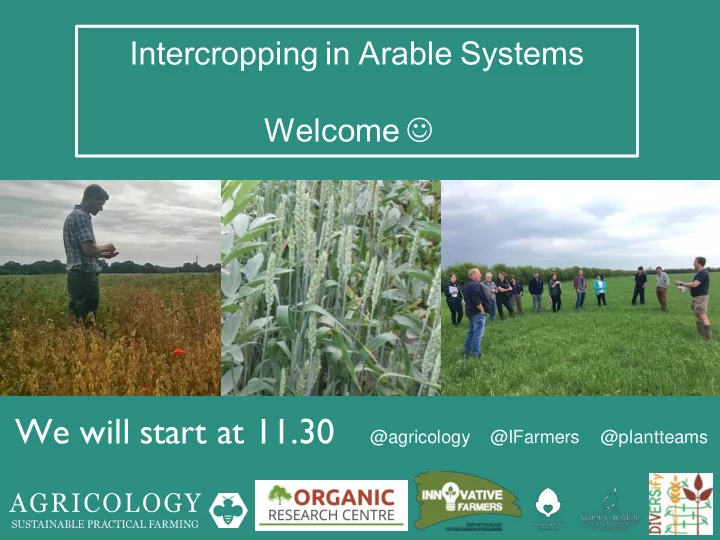
SLIDE 1
Intercropping in Arable Systems Welcome ☺
@agricology @IFarmers @plantteams
We will start at 11.30
SLIDE 2
Agenda
11.30: Katie Bliss - Intro and welcome 11.35: David Casebow - Farm tour: Including: Wheat legacy / Winter intercrop / Spring intercrop / Diverse forages / Diverse rotations Clarifying questions and comments 12.10: Insights from on farm trials in IF Field Lab Andy Howard, Bockhanger Farms Adrian Hares, Roundhill Farm 12.35: Others to give brief update on intercropping trials 12.45: Comments, questions and discussions
SLIDE 3
- Share experiences
- Collaborative research
- On farm trials
Intercropping in Arable Systems Field Lab
SLIDE 4 What is intercropping?
Facilitation, resource sharing and complementarity (Brooker et al, 2015)
“The growing of two or more crop species where part or all of their crop cycle
- verlaps temporally and/or
spatially, where one or more
- f the component species is
taken to harvest” Andy Howard – Nuffield Report 2016
SLIDE 5
https://www.uorcropsresearchunit.com/
SLIDE 6 Linseed and oats, Bockhanger Farm, Kent 18/19
Motivations: Oats to aid linseed establishment via reduction of pest pressure. Establishment:Linseed and oats drilled with cross slot in one pass on 27/03/19;
- Linseed at 700 seeds/m2 / Oats at 0, 70 and 140 seeds/m2
SLIDE 7 Linseed and oats, Bockhanger Farm, Kent,18/19
Results
linseed yield in treatments with oats
presence of flax flea beetle although in low abundance
had a slightly lower pest damage score (NS)
SLIDE 8
Linseed and oats 2019/20
SLIDE 9 OSR, Peas and oats, Bockhanger Farm, Kent 18/19
Motivations: a) Aid OSR establishment via reduction in pest pressure; b) OSR in supporting the pea crop and reducing lodging.
Establishment: Marrowfat peas drilled at 70 seeds/m2 with and without OSRand an oat companion on 30/03/19. The treatments were:
- Monoculture peas;
- Peas + OSR at 35 seeds/m2;
- peas + OSR at 50 seeds/m2;
- peas + OSR at 50 seeds/m2 plus oats at 70 seeds/m2.
These were replicated twice in strips across the field with monocrop replicated three times to assay in-field heterogeneity.
SLIDE 10 OSR, Peas and oats, Bockhanger Farm, Kent 18/19
Results
damage T2 ‘Peola’ was higher in strips without oats (NS)
- Two cabbage stem flea beetle
pests were trapped across the entire trial
- Poor establishment of the OSR
- No detrimental effect on the pea
in terms of nutrition or yields across treatments
SLIDE 11 Spring beans and oats, Bockhanger Farm, Kent (PGRO) 18/19
Results
- Bruchid infestation: Highest in low bean seed rates. Lowest in 45/45
plants/m²
- LER: All intercrop mixtures gave a LER >1.0. Highest LER was from the
mixture of Bean45/Oat70 (LER 1.30)
- Gross Output- variable cost: Highest in Bean45/Oat70 mixture
SLIDE 12
DIVERSify trials, Bockhanger Farm, Kent 19/20
SLIDE 13
Peas and oats, Bockhanger Farm, Kent 19/20
Motivations: Trellis and weed suppression effects of oats Establishment:
SLIDE 14
ConyerPeas and Oats Plot 3: 70 plants/m2 Pea and 35 plants/m2 Oats
SLIDE 15
Lentils and oats, Bockhanger Farm, Kent 19/20
Motivations:Trellis and weed suppression effects of oats Establishment:
Plot 1 Lentil plants/m2 Oat plants/m2 1 (0.14ha) 90 70 1b (0.14ha) 90 30 2 (0.2ha) 90 50 2b (0.2ha) 90 3 (0.25ha) 90 30 3b (0.25) 90 70 4 (0.34ha) 90 4b (0.34ha) 90 50
SLIDE 16
ConyerLentils and Oats Plot 3: 90 plants/m2 Lentils and 30 plants/m2 Oa
SLIDE 17 1 2 3 4 5
Plot Oats Bean 1 (0.87ha) 250 2 (0.88ha) 50 3 (0.88ha) 250 25 4 (0.87ha) 125 25 5 (0.87 ha) 80 15
SLIDE 18
Conyer Bean and Oats Plot 3 (RIGHT): 25 plants/m2 Beans and 250 plants/m2 Oats Plot 4 (LEFT) 25 plants/m2 Beans and 125 plants/m2 Oats
SLIDE 19 5 4 3 2 1
Plot Beans Oats 1 (0.50ha) Alternating 3m strips: 50 plants m2 Alternating 3m Strips: 250 plants m2 2 (0.52ha) Alternating 6m strips: 50 plants m2 Alternating 6m strips: 50 plants m2 3 (0.54ha) Alternating Rows: 50 plants m2 Alternating Rows: 70 plants m2 4 (0.54ha) Alternating Rows: 50 plants m2 Alternating Rows: 125 plants m2 5(0.54ha) Mixed Rows 50 plants m2 Mixed Rows 50 plants m2
SLIDE 20
Chilston Plot 2 Beans and Oats: Alternating 6m strips: 50 plants m2
SLIDE 21
Chilston Plot 4 Beans and Oats: Alternating rows: 50 plants m2
SLIDE 22 1 2 3 4 5
Plot Herbicide Undersown 1 (0.35 ha) No No 2 (0.35 ha) Yes No 3 (0.35 ha) Yes 2kg/ha Microclover 4 (0.35 ha) No 2kg/ha Microclover 5 (0.35 ha) No 4kg/ha Microclover
SLIDE 23
Cowhouse Plot 5: No herbicide and 4kg/ha microclover
SLIDE 24 Wheat and beans, Roundhill Farm, Wiltshire
Motivations: Weed suppression (especially wild oat), increase wheat protein? Establishment: 1ha strips, wheat and beans in two passes 2018 Tundra Mulika 2019 Tundra Mulika Processing and use: Harvested together and used on farm as a mixed feed for livestock.
Wheat 174kg/ha Beans 125kg/ha Beans 125kg/ha Wheat 100kg/ha Beans 200kg/ha Beans 200kg/ha
SLIDE 25 Results:
– Weeds: 74% less dry weed biomass in intercrop than monocrop – Yield: Small bean yield penalty in intercrop (wheat rate too high?)
– Weeds: 73% less dry weed biomass in intercrop than monocrop – Yield: Monoculture crop destroyed due to high weed burden
Wheat and beans, Roundhill Farm, Wiltshire
Some indication of improved wheat quality in intercrop in 2019 with protein content
monocrop.
SLIDE 26
DIVERSify @ James Hutton Institute
SLIDE 27
DIVERSify @ James Hutton Institute
SLIDE 28
- If Ali sends something...
DIVERSIFY
SLIDE 29
REMIX @ Scotland's Rural College
SLIDE 30
SLIDE 31
- No silver bullet – find what works on your farm
- Set key objectives for mixture
- Priority crop? Focus on yield of this crop
- Try different seed rates / varieties on small area
- Be clear about the end use and how to separate if needed
- Speak to others who are doing it – join the Intercropping Field Lab!
In summary....
SLIDE 32
Find out more….www.agricology.co.uk @agricology and YouTube channel! ☺