Web Data Representation Web Graph, Text, Images, Metadata, Search - - PowerPoint PPT Presentation

web data representation
SMART_READER_LITE
LIVE PREVIEW

Web Data Representation Web Graph, Text, Images, Metadata, Search - - PowerPoint PPT Presentation

Web Data Representation Web Graph, Text, Images, Metadata, Search spaces Web Search 1 The Web corpus No design/coordination Distributed content creation, linking, democratization of publishing Content includes truth, lies, obsolete


slide-1
SLIDE 1

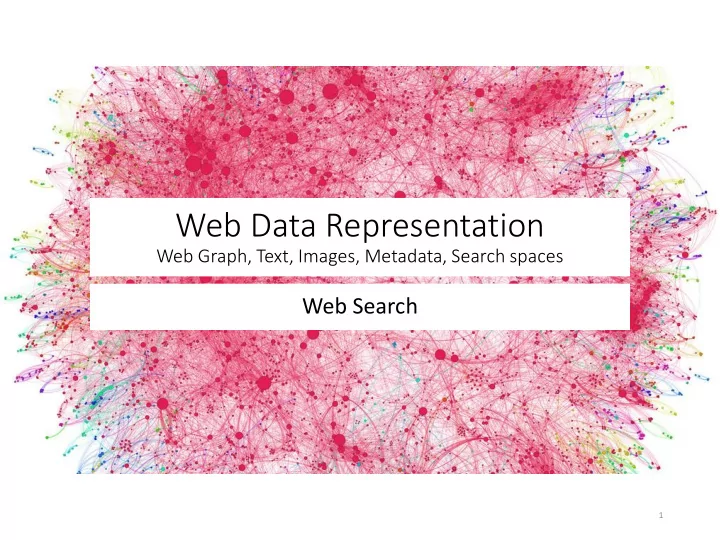
Web Data Representation

Web Graph, Text, Images, Metadata, Search spaces

Web Search

1
slide-2
SLIDE 2

The Web corpus

  • No design/coordination
  • Distributed content creation, linking,

democratization of publishing

  • Content includes truth, lies,
  • bsolete information, contradictions …
  • Unstructured (text, html, …), semi-structured (XML, annotated

photos), structured (Databases)…

  • Scale much larger than previous text corpora… but corporate records

are catching up.

  • Content can be dynamically generated

2

slide-3
SLIDE 3

Web data

3

5 1 2 3 4 8 7 6 9

Lorem ipsum dolor sit amet, consectetur adipiscing elit, sed do eiusmod tempor incididunt ut labore et dolore magna aliqua. Ut enim ad minim…

Links Images/videos Text Preferences

slide-4
SLIDE 4

The Web graph

5 1 2 3 4 8 7 6 9

4

  • Generally, the links can be explicit or computed

by some function.

  • The links can also be weighted by the similarity

between pages (i.e. graph nodes in this case)

  • Graphs are generally represented as a sparse

matrix.

  • There are many applications: page importance,

recommendation, reputation analysis.

1 1 1 1 1 1 1 1 1 1 1 1

slide-5
SLIDE 5

Graphs on the Web

  • There are many types of graphs, besides hyperlinks.
  • Graphs can capture the named entities that are mentioned and

talked about on the Web.

5

slide-6
SLIDE 6

Web pages

  • Web pages are divided into different parts (title, abstract, body, etc)
  • Each part has a specific relevance to the main content
  • A Web page can be divided by its HTML structure (e.g., <div> tags) or

by its visual aspect.

6

slide-7
SLIDE 7

Web page segmentation methods

  • Segmenting visually
  • Cai, D., Yu, S., Wen, J. R., & Ma, W. Y. (2003). VIPS: A vision-based page

segmentation algorithm.

  • Linguistic approach
  • Kohlschütter, C. , Fankhauser, P., and Nejdl, W. (2010). Boilerplate detection

using shallow text features. ACM Web Search and Data Mining.

  • Densitometric approach
  • Kohlschütter, C., and Nejdl, W., (2008). A densitometric approach to web

page segmentation. ACM Conference on Information and Knowledge Management (CIKM '08).

7

https://boilerpipe-web.appspot.com/ https://github.com/kohlschutter/boilerpipe

slide-8
SLIDE 8

Text data

  • Instead of aiming at fully understanding a text document, IR takes a

pragmatic approach and looks at the most elementary textual patterns

  • e.g. a simple histogram of words, also known as “bag-of-words”.
  • Heuristics capture specific text patterns to improve search

effectiveness

  • Enhances the simplicity of word histograms
  • The most simple heuristics are stop-words removal and stemming

8

slide-9
SLIDE 9

Character processing and stop-words

  • Term delimitation
  • Punctuation removal
  • Numbers/dates
  • Stop-words: remove words that are present in all documents
  • a, and, are, as, at, be, but, by, for, if, in, into, is, it, no, not, of, on, or, such,

that, the, their, then, there, these, they, this, to, was, will…

9

Chapter 2: “Introduction to Information Retrieval”, Cambridge University Press, 2008

slide-10
SLIDE 10

Stemming and lemmatization

  • Stemming: Reduce terms to their “roots” before indexing
  • “Stemming” suggest crude affix chopping
  • e.g., automate(s), automatic, automation all reduced to automat.
  • http://tartarus.org/~martin/PorterStemmer/
  • http://snowball.tartarus.org/demo.php
  • Lemmatization: Reduce inflectional/variant forms to base form, e.g.,
  • am, are, is  be
  • car, cars, car's, cars'  car

10

Chapter 2: “Introduction to Information Retrieval”, Cambridge University Press, 2008

slide-11
SLIDE 11

N-grams

  • An n-gram is a sequence of items, e.g. characters, syllables or words.
  • Can be applied to text spelling correction
  • “interactive meida” >>>> “interactive media”
  • Can also be used as indexing tokens to improve Web page search
  • You can order the Google n-grams (6DVDs):
  • http://googleresearch.blogspot.com/2006/08/all-our-n-gram-are-belong-to-you.html
  • N-grams were under some criticism in NLP because they can add

noise to information extraction tasks

  • ...but are widely successful in IR to infer document topics.

11

slide-12
SLIDE 12

“Bag of Words” representation

  • After the text analysis steps, a document (e.g. Web page) is

represented as a vector of terms and n-grams.

  • More complex low-level representations can be used

12

𝑒 = 𝑥1, … , 𝑥𝑀, 𝑜𝑕1, … , 𝑜𝑕𝑁

Lorem ipsum dolor sit amet, consectetur adipiscing elit, sed do eiusmod tempor incididunt ut labore et dolore magna aliqua. Ut enim ad minim…

slide-13
SLIDE 13

Visual data

  • Visual information also needs to

be processed and analysed.

  • A compact representation of the

image/video content is computed from it.

  • This compact representation is

then used to accomplish several tasks, e.g. search, categorization.

13

slide-14
SLIDE 14

Histograms of colors

  • Marginal color histograms consider color

channels independently

  • The number of bins define the dimensionality of

the space

  • 3D colour histograms divide the space into

small 3D boxes

  • The numbers of bins per dimension define the

number of 3d bins

14

slide-15
SLIDE 15

Color moments

  • Color moments measure the statistical properties of the histogram:
  • Mean and variance (1st and 2nd moments)
  • Skewness (3rd moment)
  • Kurtosis (4th moment)

15

slide-16
SLIDE 16

Example

( )

2 2 2

, , , , ,

cm R R G G B B

d m s m s m s =

( )

1 2 16

, ,...,

hR

d bin bin bin =

( )

1 2 16

, ,...,

hG

d bin bin bin =

( )

1 2 16

, ,...,

hB

d bin bin bin =

Color moments Marginal color histograms

16

slide-17
SLIDE 17

Textures

17

slide-18
SLIDE 18

Psychological based textures (Tamura)

  • Coarseness measures the size of the primitive elements forming the

texture

  • Contrast measures variation in gray levels between black and white
  • Directionality measures the orientation of the texture
  • Line-likeliness measures the similarity of the texture to lines
  • Regularity measures the repetetiveness of the texture pattern
  • Roughness “we do not have any good ideas for describing the tactile

sense of roughness”

Tamura, H., Mori, S., Yamawaki, T., “Textural features corresponding to visual perception,” IEEE Trans on Systems, Man and Cybernetics 8 (1978) 460–472

18

slide-19
SLIDE 19

Psychological based textures (Tamura)

Tamura, H., Mori, S., Yamawaki, T., “Textural features corresponding to visual perception,” IEEE Trans on Systems, Man and Cybernetics 8 (1978) 460–472

19

slide-20
SLIDE 20

Comparing psychological relevance to algorithms

20

Humans Algorithm Ranked relevance metrics

slide-21
SLIDE 21

Frequency based textures

  • Frequency based texture decompose images according to their

frequencies

  • Similar to audio filtering or color filter lenses
  • The number of repetitions per area in a texture is related to the

frequency of a texture

  • Based on the Fourier Transform
  • A set of 2 dimensional filters will decompose images into their

natural frequencies

Manjunath, B., Ma, W., “Texture features for browsing and retrieval of image data,” IEEE Trans on Pattern Analysis and Machine Intelligence 18 (1996) 837–842

21

slide-22
SLIDE 22

Edge detection

  • J. Canny, “A Computational Approach to Edge Detection”, IEEE Transactions on Pattern

Analysis and Machine Intelligence, Vol. 8, No. 6, Nov. 1986.

22

slide-23
SLIDE 23

Edge detection

  • Filter image with a low pass filter
  • Apply vertical and horizontal filters to compute Gx and Gy:
  • Compute the gradients as
  • Reduce it to one of the 4 possible directions (0º, 45º, 90º, 135º)
  • Compute the orientation of the edges as:
  • J. Canny, “A Computational Approach to Edge Detection”, IEEE Transactions on Pattern

Analysis and Machine Intelligence, Vol. 8, No. 6, Nov. 1986.

  • 1

+1

  • 2

+2

  • 1

+1 +1 +2 +1

  • 1
  • 2
  • 1

23

slide-24
SLIDE 24

Gabor filters

Manjunath, B., Ma, W., “Texture features for browsing and retrieval of image data,” IEEE Trans on Pattern Analysis and Machine Intelligence 18 (1996) 837–842

24

slide-25
SLIDE 25

25

slide-26
SLIDE 26

Gabor texture feature

  • Images are convolved (operator *) with each filter individually:

* = A widely used descriptor corresponds to the mean and variance of the output of each filter:

Manjunath, B., Ma, W., “Texture features for browsing and retrieval of image data,” IEEE Trans on Pattern Analysis and Machine Intelligence 18 (1996) 837–842

𝑒𝑢𝑓𝑦𝑢𝑣𝑠𝑓 = 𝑛1, 𝑤1, … , 𝑛𝑙, 𝑤𝑙

26

slide-27
SLIDE 27

Multiple representations of the same data

  • Documents are represented as the set of vectors

each one for a different search space: text data, visual data, and keyword data respectively.

  • Other search spaces can be used.

Page 27

windmill, sky, sea,buildings Colour Texture Region Semantic Date: 7 Dec 06 Author: Joao, Place: Portugal Metadata

𝑒 = 𝑒𝑚𝑗𝑜𝑙𝑡, 𝑒𝑢𝑓𝑦𝑢, 𝑒𝑑𝑝𝑚𝑝𝑠, 𝑒𝑢𝑓𝑦𝑢𝑣𝑠𝑓, 𝑒𝑛𝑓𝑢𝑏𝑒𝑏𝑢𝑏, 𝑒𝑢𝑏𝑕𝑡, …

slide-28
SLIDE 28

Data representations

  • Link data
  • High-dimensional data
  • Sparse
  • Bag of words
  • Dense
  • Color histograms and moments
  • Textures and edges

𝑒𝑐𝑝𝑥 = 𝑥1, … , 𝑥𝑀, 𝑜𝑕1, … , 𝑜𝑕𝑁 𝑒𝑢𝑓𝑦𝑢𝑣𝑠𝑓 = 𝑛1, 𝑤1, … , 𝑛𝑙, 𝑤𝑙 𝑒𝑑𝑝𝑚𝑝𝑠 = 𝑐𝑗𝑜1, 𝑐𝑗𝑜2, … , 𝑐𝑗𝑜𝑙 𝑒𝑚𝑗𝑜𝑙𝑡 = 0,0, … , 0,1,0, … , 0,1,0, … , 0

28

slide-29
SLIDE 29

Search high-dimensional spaces

windmill, sky, sea,buildings Colour Texture Region Semantic Date: 7 Dec 06 Author: Joao, Place: Portugal Metadata

Query image Ranked results Search spaces

29

slide-30
SLIDE 30

Definition: metric spaces

  • Let 𝔈 be an n dimensional space, where each data point is defined as

𝑒 ∈ 𝔈: 𝑒 = 𝑒1, … , 𝑒𝑜 , 𝑒𝑗∈ ℝ

  • The n dimensional space 𝔈 is a metric space iff exists a distance

function 𝑒𝑗𝑡𝑢 𝑏, 𝑐 in 𝔈.

  • A distance function has the following properties:
  • Non-negative: 𝑒𝑗𝑡𝑢 𝑏, 𝑐

∀𝑏, 𝑐 ∈ 𝔈

  • Indentity: if 𝑒𝑗𝑡𝑢 𝑏, 𝑐 = 0

𝑢ℎ𝑓𝑜 𝑏 = 𝑐

  • Symmetry: 𝑒𝑗𝑡𝑢 𝑏, 𝑐 = 𝑒𝑗𝑡𝑢 𝑐, 𝑏

∀𝑏, 𝑐 ∈ 𝔈

  • Triangle inequality 𝑒𝑗𝑡𝑢 𝑏, 𝑐 ≤ 𝑒𝑗𝑡𝑢 𝑏, 𝑑 + 𝑒𝑗𝑡𝑢 𝑑, 𝑐

∀𝑏, 𝑐, 𝑑 ∈ 𝔈

30

slide-31
SLIDE 31

Distance vs similarity

  • Distances in a given search space must be meaningful.
  • Distances are used as proxies for similarity.
  • distance = 1-similarity
  • Vector spaces and probability spaces are common spaces in Web

search.

  • The goal is that the similarity/distance between a query and

candidate documents will reflect the relevance of the document to the user query.

31

slide-32
SLIDE 32

Example: Distance in the RGB vs HSV color spaces

  • Euclidean distance in the HSV color space is more meaningful!
  • Hue (H), the color type (such as red, green). It ranges from 0 to 360 degree.
  • Saturation (S) of the color ranges from 0 to 100%. Also sometimes it called

the "purity".

  • Value (V), the Brightness (B) of the color ranges from 0 to 100%.

32

slide-33
SLIDE 33

Minkowski distance

  • The Minkowsky distance function generalizes many well known distance

functions:

  • Minkowski distances distorts the space as shown in the figure

𝑒𝑗𝑡𝑢𝑞 𝑏, 𝑐 =

1/𝑞

𝑗=1 𝑜

𝑏𝑗 − 𝑐𝑗 𝑞

Manhattan Euclidean Chebychev

33

slide-34
SLIDE 34

Euclidean distance

  • The euclidean distance function is very effective many color spaces

for comparing specific colors for example.

  • When comparing compact descriptors of data other distances are

more effective.

t1 d2 d1 d3 d4 d5 t3 t2

𝑒𝑗𝑡𝑢2 𝑏, 𝑐 = ෍

𝑗=1 𝑜

𝑏𝑗 − 𝑐𝑗 2

34

slide-35
SLIDE 35

Cosine similarity

  • Distance between vectors d1 and d2 captured by the cosine of the

angle x between them.

  • Vectors pointing in the same direction
  • Note – this is similarity, not distance
  • No triangle inequality for similarity.

35

t1 d2 d1 d3 d4 d5 t3 t2

θ φ

slide-36
SLIDE 36

Cosine similarity

  • Cosine of angle between two vectors
  • The denominator involves the lengths of the vectors.

36

Chapter 6: “Introduction to Information Retrieval”, Cambridge University Press, 2008

𝑡𝑗𝑛 𝑟, 𝑒𝑗 = cos 𝑟, 𝑒𝑗 = 𝑟 ⋅ 𝑒𝑗 𝑟 𝑒𝑗 𝑡𝑗𝑛 𝑟, 𝑒𝑗 = cos 𝑟, 𝑒𝑗 = σ𝑢 𝑟𝑢 ⋅ 𝑒𝑗,𝑢 σ𝑢 𝑟𝑢

2

σ𝑢 𝑒𝑗,𝑢

2

slide-37
SLIDE 37

Hamming distance

  • The Hamming distance between two vectors indicate the number of

positions that are diferent.

  • If a and b is a sequence of n bits, then the Hamming distance is

defined as:

1 1 1 1 1 1 1 1 1 1 1 1

𝑒𝑗𝑡𝑢ℎ𝑏𝑛 𝑏, 𝑐 = ෍

𝑗=1 𝑜

𝑏𝑗𝑐𝑗 a = b = 𝑏𝑐 = 𝑒𝑗𝑡𝑢ℎ𝑏𝑛 𝑏, 𝑐 = 2

37

slide-38
SLIDE 38

Hamming distance

  • Initially developed in the field of information theory to measure bit

transmission coding errors.

  • The Hamming distance is useful for comparing binary codes.
  • e.g. binary hashcodes
  • It can also be seen as an edit distance between two strings of the

same length.

  • Levenshtein distance also measures the number insertions and deletions (not

just replacement)

38

slide-39
SLIDE 39

Searching Web content

  • Processing real-world information is challenging!!!
  • The aim is to search any unstructured data by its content
  • Textual, visual, audio, semantic, etc.
  • Data contains very complex information patterns.
  • Information needs can be very complex.
  • Queries can be keywords, examples or questions.
  • Finding related trends (consumption patterns)
  • Search images with text and vice-versa

39

slide-40
SLIDE 40

The semantic gap

40

Known visual objects/categories Named entities

slide-41
SLIDE 41

Semantic search spaces

41

slide-42
SLIDE 42

External models

Web Search course scope

Documents Low-level data representations Web search Learning and mining algorithms Semantic data representations

Taxonomy

42

slide-43
SLIDE 43

Semantic data representations

  • External models of relevant
  • Fully parses the document data looking for the occurrence of

relevant classes.

  • Examples: named entities (e.g., “Microsoft”, “Donald Trump”) and

and visual objects, (e.g., face, Eiffel tower)

43

slide-44
SLIDE 44

Summary and readings

  • Web data representation:
  • Graph data
  • Textual data
  • Visual data
  • Metric spaces and distance functions
  • References:
  • Chapter 2: C. D. Manning, P. Raghavan and H. Schütze, “Introduction to

Information Retrieval”, Cambridge University Press, 2008.

  • Hassaballah, M., Abdelmgeid, A. A., & Alshazly, H. A. (2016). Image features

detection, description and matching. In Image Feature Detectors and Descriptors (pp. 11-45). Springer, Cham.

44

slide-45
SLIDE 45

Gabor filters

Manjunath, B., Ma, W., “Texture features for browsing and retrieval of image data,” IEEE Trans on Pattern Analysis and Machine Intelligence 18 (1996) 837–842

   

2 2 2 2

2 2 2

1 , cos 2 2

x y

x y x y

g x y Wx e

 

  

 

  

       

, ', ' ' cos sin ' sin cos

m m m m

g x y a g x y x a x y y a x y

   

  

     

45