Wednesday, September 21, 2016 3:30p.m. 5:30p.m. Toepfer Room, - - PDF document

wednesday september 21 2016 3 30p m 5 30p m toepfer room
SMART_READER_LITE
LIVE PREVIEW

Wednesday, September 21, 2016 3:30p.m. 5:30p.m. Toepfer Room, - - PDF document

Faculty Senate Meeting Wednesday, September 21, 2016 3:30p.m. 5:30p.m. Toepfer Room, Adelbert Hall, 3:30 p.m. Approval of Minutes from the April 28, 2016, Faculty Peter Harte Senate Meeting, attachment 3:35 p.m. President and


slide-1
SLIDE 1

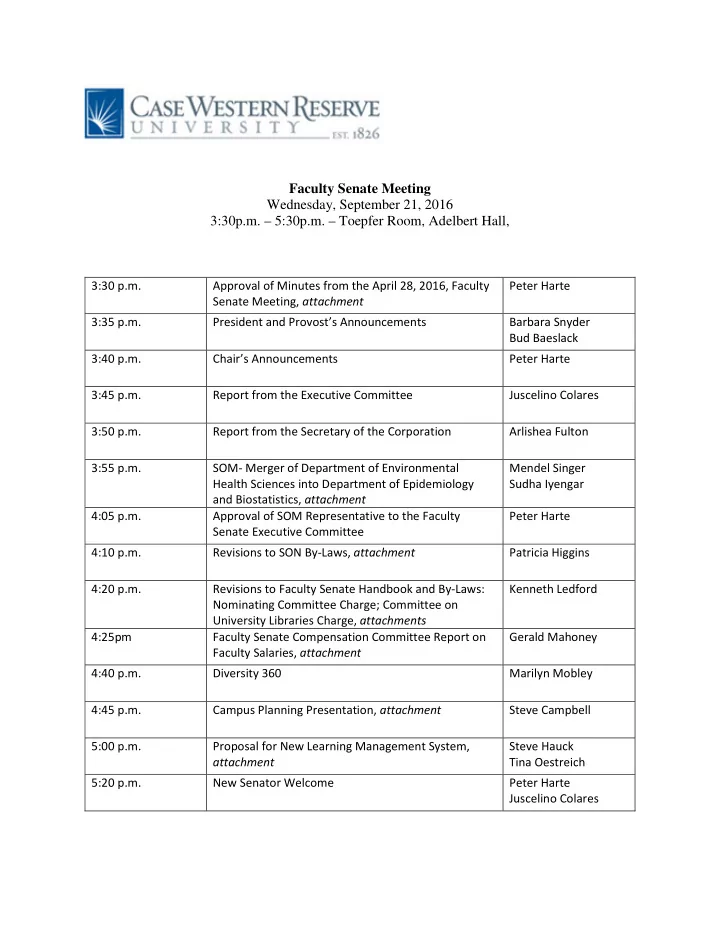
Faculty Senate Meeting Wednesday, September 21, 2016 3:30p.m. – 5:30p.m. – Toepfer Room, Adelbert Hall,

3:30 p.m. Approval of Minutes from the April 28, 2016, Faculty Senate Meeting, attachment Peter Harte 3:35 p.m. President and Provost’s Announcements Barbara Snyder Bud Baeslack 3:40 p.m. Chair’s Announcements Peter Harte 3:45 p.m. Report from the Executive Committee Juscelino Colares 3:50 p.m. Report from the Secretary of the Corporation Arlishea Fulton 3:55 p.m. SOM- Merger of Department of Environmental Health Sciences into Department of Epidemiology and Biostatistics, attachment Mendel Singer Sudha Iyengar 4:05 p.m. Approval of SOM Representative to the Faculty Senate Executive Committee Peter Harte 4:10 p.m. Revisions to SON By-Laws, attachment Patricia Higgins 4:20 p.m. Revisions to Faculty Senate Handbook and By-Laws: Nominating Committee Charge; Committee on University Libraries Charge, attachments Kenneth Ledford 4:25pm Faculty Senate Compensation Committee Report on Faculty Salaries, attachment Gerald Mahoney 4:40 p.m. Diversity 360 Marilyn Mobley 4:45 p.m. Campus Planning Presentation, attachment Steve Campbell 5:00 p.m. Proposal for New Learning Management System, attachment Steve Hauck Tina Oestreich 5:20 p.m. New Senator Welcome Peter Harte Juscelino Colares

slide-2
SLIDE 2

Faculty Senate Meeting Wednesday, September 21, 2016 3:30-5:30 p.m. – Adelbert Hall, Toepfer Room Members Present

  • W. A. "Bud" Baeslack III

Neetu Gulati Aaron Perzanowski Jennifer Barrord Peter Harte Roger Quinn Cynthia Beall Steven Hauck Mary Quinn Griffin Karen Beckwith Megan Holmes Vasu Ramanujan Matthias Buck Paul Iversen Roy Ritzmann Cathy Carlin Sudha Iyengar Barbara R. Snyder Gary Chottiner Kathleen Kash Glenn Starkman Juscelino Colares Thomas Kelly Robert Strassfeld Christopher Cullis Kenneth Ledford Ibrahim Tulunoglu Lisa Damato Gerald Mahoney Horst von Recum Robin Dubin Maureen McEnery Rebecca Weiss Kimberly Emmons Frank Merat Gillian Weiss Carol Fox David Miller Stuart Youngner Archishman Ghosh Christian Zorman Members Absent Anita Aminoshariae Michael Harris Andres Pinto Jeremy Bendik-Keymer Ronald Hickman

  • R. Mohan Sankaran

Mitch Drumm Lee Hoffer Usha Stiefel Evelyn Duffy Kurt Koenigsberger Jo Ann Wise Scott Fine Paul MacDonald Amy Zhang Faye Gary Thomas Montagnese Angela Graves Leena Palomo Others Present Amy Backus Don Feke John Sideras Katie Brancato Arlishea Fulton Lynn Singer Jonathan Carlson Arnold Hirshon Jeff Wolcowitz Joseph Custer Marilyn Mobley Victoria Wright Donna Davis Reddix Sue Rivera Call to Order Professor Peter Harte, chair, Faculty Senate, called the meeting to order at 3:30 p.m.

slide-3
SLIDE 3

Approval of Minutes The Senate approved the minutes from the April 28th, 2016 Faculty Senate meeting. Attachment President’s Announcements The President welcomed senators to the new academic year. The President also reported on the following:

  • The MSASS building renovation has been completed. The renovations were fully funded

with donor dollars.

  • Anthony Doerr, author of the freshman common reading book “All The Light We Cannot

See” gave an excellent address at Convocation.

  • Peter Eigen, founder of Transparency International, is the recipient of the 2016 Inamori

Ethics Prize, which was awarded to him on September 8th by Provost Baeslack.

  • CWRU maintained its position at 37 in the current U.S. News & World Report “Best

College” rankings. The Case School of Engineering’s ranking moved up 4 positions to 37. The Weatherhead School of Management’s undergraduate program moved up one position to 38.

  • The new affiliation agreement between CWRU and University Hospitals is effective as of

September 1st. UH will no longer be the primary affiliate with CWRU and is changing its name to the UH Cleveland Medical Center. The university will receive less funding from UH, and as a result, the university’s operating budget will have to be adjusted. There are a number of uncertainties at this time. More information will follow in the upcoming days.

  • The Benelect open enrollment period begins in November. Premiums for the

university’s self-insured plans have increased due to more claims and higher expenses last year. The one fully-insured plan, Healthspan, has ceased operations and is being replaced by CLEVECARE, a partnership between Medical Mutual and MetroHealth. Premiums for this new plan will remain the same at least through the end of the calendar year.

  • The university’s undergraduate financial aid policy is changing from need-blind to need-
  • aware. Many students are unable to afford the difference between what they receive in

financial aid and the cost of tuition. This policy will be effective for the fall of 2017 and will not affect current students. The university will not be participating in the Coalition Application at this time but will reconsider this decision in the future.

  • Homecoming is the weekend of October 14th. President Snyder encouraged all faculty

to attend. Provost’s Announcements The Provost reported that the Provost’s Commission on the Undergraduate Experience is making progress and working groups are being formed.

slide-4
SLIDE 4

Chair’s Announcements

  • Prof. Harte reported that the special/annual meeting of the University Faculty will be held on

Friday, October 7th. There will be receptions for all who attend Faculty Senate meetings after the October and February Faculty Senate meetings. At the end of today’s meeting there will be a new senator welcome. Report from Secretary of the Corporation Arlishea Fulton, senior counsel, reported on the meetings of the CWRU Board of Trustees Executive Committee from May 10, 2016, July 12, 2016 and August 16th, and the full Board meeting from June 3-4th. Among other matters, the Board of Trustees approved a major in Chinese from the CAS, a minor in Sports Nutrition from the SOM, a Master of Military Ethics, and a Bachelor in Science in Data Science and Analytics from the CSE. Attachment Report from the Executive Committee Professor Juscelino Colares, vice chair of the Senate, reported on the September 6th Executive Committee meeting:

  • 1. iClickers have been purchased to allow for electronic voting in Senate meetings. The

Faculty Senate By-Laws provision regarding methods of voting at Senate meetings does not include electronic voting. The Senate By-Laws Committee drafted a new provision last year to allow for electronic voting and the proposed revisions were presented to the Executive Committee. The Executive Committee discussed a number of issues including whether voting should be open or anonymous. The consensus of the Committee was that the default position should be open voting since currently senators can see who votes for or against a particular issue just by looking around the room. Profs. Harte and Colares agreed to draft a statement addressing the issues discussed at the Executive Committee meeting and to send the statement to the By-Laws Committee for review.

  • 2. CAS By-Laws- Professor Kimberly Emmons presented minor revisions to the CAS By-
  • Laws. The Executive Committee voted to forward the CAS By-Laws to the Senate By-

Laws Committee for review.

  • 3. Prof. Emmons also gave a brief update on the Provost’s Commission on the

Undergraduate Experience. The Commission met over the summer and is in the process

  • f developing working groups. They expect to have a draft framework of the plan by

early October and will submit it to the UPF schools for review. They hope to have a final plan by the end of the calendar year. SOM- Merger of Department of Environmental Health Sciences into Department of Epidemiology and Biostatistics Professor Jonathan Haines, interim chair of the Environmental Health Sciences department and chair of the Epidemiology and Biostatistics department, discussed the proposed merger of Environmental Health Sciences into Epidemiology and Biostatistics. Currently there are no primary faculty in the Environmental Health Sciences department, the masters and PhD programs have been suspended and no students remain in the programs. The missions of these

slide-5
SLIDE 5

two departments have become increasingly interconnected and the department of Epidemiology and Biostatistics is a logical home. The Environmental Health education programs will be offered through the new department and the Swetland Center will be administered there also. The Faculty Senate voted to approve the proposed merger with one abstention. Attachments Approval of SOM Representative to the Faculty Senate Executive Committee The Faculty Senate approved Professor Cathleen Carlin as the SOM representative to the Faculty Senate Executive Committee. Revisions to the SON By-Laws Professor Patricia Higgins, SON, presented proposed revisions to the SON By-Laws. The revisions are intended to codify current practice and to clarify memberships on a number of SON committees. The Faculty Senate voted to approve the proposed revisions. Attachment Revisions to Faculty Senate Handbook and By-Laws Professor Ken Ledford, chair of the Faculty Senate By-Laws Committee, presented minor revisions to the charge for the Faculty Senate Nominating Committee located in Chapter 2 of the Faculty Handbook (to officially add a representative from PHED to the committee membership) and the charge for the Faculty Senate Committee on University Libraries contained in the Senate By-Laws (to correct an error in the charge that refers to nine faculty members when there are 10). The revisions had been approved by the Senate By-Laws Committee last spring. The Faculty Senate voted to approve the proposed revisions. Attachments Faculty Senate Compensation Committee Report on Faculty Salaries Professor Jerry Mahoney, chair of the Faculty Senate Committee on Faculty Compensation, presented a proposal on faculty salaries. Prof. Mahoney presented 2014-2015 data from the Office of Institutional Research that compared the average salaries of CWRU faculty (by school and rank) with that of AAU schools who participated in the salary exchange. Salary comparisons of tenure/tenure-track as well as non-tenure track faculty were reviewed. Approximately 85% of CWRU tenure/tenured track faculty receive salaries that are at, or below, the 15th percentile of AAU comparison schools. Approximately 40% of non-tenured track faculty receive salaries that are at, or below, the 30th percentile of AAU comparison schools. The general pattern reflected in the comparisons has not changed substantially over the past three

  • years. Despite this data, CWRU national rankings are in the mid-level of AAU rankings and

CWRU tuition is in the mid-range of AAU private universities. This is a major discrepancy that is negatively affecting faculty recruitment, retention and morale. There are no real targets for faculty compensation other than those related to promotion and tenure. Without targets and goals it is difficult for the Faculty Compensation Committee to satisfy its charge. Also, there is little transparency about faculty salaries and salaries are established at the school level. The committee made the following recommendations:

slide-6
SLIDE 6
  • a. Academic units should produce and publish annual reports in which faculty salaries are

benchmarked against AAU peer institutions.

  • b. CWRU administration should establish a university-wide goal of compensating faculty at

a level that is at or above the AAU 50th percentile.

  • c. Central administration, in collaboration with the deans, should establish a five-year plan

to address faculty compensation.

  • d. Faculty compensation should no longer be tethered solely to the budgetary status of the

individual units. President Snyder said that the goal of compensating faculty at or above the AAU 50th percentile is a worthy one and that they would like to develop a plan for the next 5 years. They will report back to the Senate once the plan has been completed. Attachments Diversity 360 Marilyn Mobley, Vice President for Inclusion, Diversity and Equal Opportunity, reminded all senators that they had approved a resolution last year agreeing to participate in Diversity 360 training by the end of the academic year. Dr. Mobley asked for senators’ opinions on whether to schedule separate customized training session just for senators or whether the standalone sessions already scheduled would suffice. A member of the Senate suggested that the schedule

  • f standalone sessions be sent to all of the senators and that by the end of the calendar year, if

some senators still have not participated, that a separate session(s) be scheduled. The Senate concurred with this approach. Dr. Mobley said that she would also like to see faculty serve as facilitators for Diversity 360 training. Campus Planning Presentation Steve Campbell, Vice President for Campus Planning and Administration, presented a facilities

  • update. He provided information on the recent renovations of Tomlinson dining hall and

MSASS; the status of the Health Education Campus (to be completed in the summer of 2019) and the Linsalata Alumni Center (will be completed in November of this year and can be used beginning in January of 2017). In 2017 there will be several plant renewal projects: the building envelope of Clark Hall; the HVAC system in the Veale Athletic Center; and the building envelope for the Wood building. The design for the Lucia Smith Nash Walkway will be completed at the end of the calendar year and construction will begin in the summer of 2017. The regulatory reviews for the Nord Family Greenway, which connect the campus to the Maltz Performing Arts Center, should be completed this fall and the Greenway constructed by the fall of 2017. A concern was expressed about how information on new buildings is communicated to

  • students. Students need to know that these new projects are donor-financed and not coming
  • ut of the university’s operating budget.

A senator expressed concern about contractors who smoke while working on buildings and the impact this has on those working inside the buildings. Attachment

slide-7
SLIDE 7

Proposal for New Learning Management System Professor Steven Hauck, chair of FSCICT, introduced a proposal for a new learning management system (LMS). Currently Blackboard is being used in only 43% of for-credit courses at CWRU. Faculty and students have expressed dissatisfaction with Blackboard and students have been frustrated with its variable use by faculty. UTech is proposing that the university use a new LMS known as Canvas. Canvas was piloted by approximately 17 CWRU faculty and 1500 students and general impressions were positive. The Learning Management System Faculty and Staff Advisory Committee is recommending that the transition to Canvas begin in the spring of 2017 and be completed by fall of 2017. FSCICT and UTech would like an endorsement from the Faculty Senate. Tina Ostreich, Senior Director, Teaching and Learning Technology, UTech, responded to a question about the advantages of Canvas over Blackboard. Faculty who piloted the system found it easier to use and many of our peer institutions are using it. Canvas has more streamlined applications so that when students go from one course to another they have a more consistent experience. For most faculty the migration of materials from Blackboard to Canvas won’t be difficult, but for those who use more extensive functions in Blackboard, it may require assistance. UTech will be available to help faculty with this transition. There will be faculty supporters of Canvas in all departments and UTech representatives are willing to train faculty within the schools and departments. The Senate discussed the fact that the use of Canvas is not being mandated for faculty but should be encouraged. The following motion was made and seconded: The Faculty Senate endorses adoption of Canvas and encourages faculty to use Canvas in preference to other ways of communicating with students. The Senate voted to adopt this motion. Attachment New Senator Welcome

  • Profs. Harte and Colares provided new senators with information on the Senate process.

The meeting was adjourned at 5:25pm

slide-8
SLIDE 8

Secretary Report of the Board of Trustees to the Faculty Senate September 21, 2016 The Executive Committee met on May 10, 2016, July 12, 2016, and August 16, 2016. The full board

  • f Trustees met on June 3 and 4, 2016. The next meeting is October 7-8, 2016. As is the usual

practice, we will be submitting a written report to the Faculty Senate. The trustees approved new endowments totaling $8,620,647 which includes $558,600 for scholarships at Nursing, MSASS, the College of Arts and Sciences, Medicine and Engineering. There were Endowments of $5,500,000 to establish three new professorships and gifts to support the November Meeting Center at the Squire Valleevue Farm, Tinkham Veale University Center and Toby’s Plaza were approved by the Trustees. The Trustees approved amendments to rename and repurpose thirteen endowments. The Trustees approved all Junior, Senior and Emeritus faculty Appointments. There were 14 faculty appointments and 10 reappointments to professorships that were approved. Of the 14 new appointments, three were inaugural appointments. The Trustees approved the following:  Modification of the terms of 1) the reappointment of Anthony J. Pearson to the Rudolph and Susan Rense Professorship in Chemistry and 2) the appointment of Malcolm E. Kennedy to the Hurlbut Professorship in Chemistry  The award of degrees August 2016: 59 undergraduate and 256 graduate – total 315  To change the manner in which the date is displayed on diplomas issued by the University  The naming of the residence hall located at 1576 East 115th Street near Wade Avenue which

  • pened in the fall of 2015 and is in the community and neighborhood that Congresswoman

Stephanie Tubbs Jones served, the Stephanie Tubbs Jones Hall.  A Tobacco-Free Campus Resolution  To amend the Employees’ Retirement Plan B to allow an Immediate Lump Sum and Annuity Window Option under which certain deferred vested participants in the Plan will have the

  • pportunity to elect an immediately commencing benefit.

 The Appointments as Distinguished University Professors: Mary D. Barkley, David Cooperrider, Krzysztof Palczewski, and Glenn Starkman  Major in Chinese at the College of Arts and Sciences  Minor in Sports Nutrition at the School of Medicine  Master of Arts in Military Ethics  Bachelor of Science in Data Science and Analytics  Resolution of Appreciation for Long-Term Staff – 1 staff with 45 years of service and 20 staff with 35 years of service  Resolution of Gratitude in memory of Patricia Kilpatrick  Project in Concept for the Lucia Smith Nash Walkway  Appointment of Independent Auditors for the Fiscal Year Ending June 30, 2015  Fiscal Year 2017 Operating Budget  The Refinance of bonds through the OHEFC Report provided by Arlishea Fulton, senior counsel, Office of General Counsel

slide-9
SLIDE 9

William P. Schilling, Ph.D Professor Department of Physiology & Biophysics Case Western Reserve University 10900 Euclid Avenue Cleveland, Ohio 44106-4970 Office 216.778.8965 Email: wschilling@metrohealth.org http://physiology.case.edu

MEMORANDUM

To: Pamela B. Davis, MD, PhD Dean, School of Medicine Case Western Reserve University From: William Schilling, PhD Chair, Faculty Council Re: Merging the Department of Environmental Health Department into the Department of Epidemiology and Biostatistics Date: March 18, 2016 At its February 15, 2016, meeting, the Faculty Council voted to recommend approval to merge the Department of Environmental Health Sciences into the Department of Epidemiology and Biostatistics. Dr. Jonathan Haines, PhD, brought this motion to Faculty Council. He is the Chair of the Department of Epidemiology and Biostatistics and the interim Chair of the Department of Environmental Health Sciences.

  • Dr. Haines’ proposal letter provides a summary of environmental health sciences in the School of

Medicine from the late 1960’s through the formation of the Center for the Study of Environmental Health in 1982, the establishment of the Department in Environmental Health Sciences in 1985 and the creation

  • f the Mary Ann Swetland Center for Environmental Health in 2003. The letter also summarizes the

current status of the Department of Environmental Health Sciences in which there are no primary faculty appointments in the Department, the Master’s and PhD programs have been suspended, and there are no current students in those programs. During the meeting, Dr. Haines discussed that after Dr. Dearborn’s retirement in 2014, there are no primary faculty, the secondary faculty are not active in any role in the department, and only one educational course taken by MPH students within Epidemiology and Biostatistics. He also mentioned that the family of the donor (Mary Ann Swetland) are interested in pursuing a dual mission of research and community improvement with a special focus on the interaction of cancer and the environment, something that aligns with current projects and activities with the Department of Epidemiology and Biostatistics. After Dr. Haines’ presentation, the Faculty Council asked questions and discussed the request. A motion was made to support the merging of the departments and send to the Dean for consideration and transmittal to the Faculty Senate. The motion was seconded, and a vote was called. All members voted in favor, there were no vote against the motion, and no one abstained.

slide-10
SLIDE 10

After your review, I hope you will join me in recommending approval of the proposal to merge the Department of Environmental Health Sciences into the Department of Epidemiology and Biostatistics by the Faculty Senate and Board of Trustees as required by the Faculty Handbook. Please let me know if I can provide any additional information. Thank you for your consideration. Sincerely, William P. Schilling, Ph.D. Faculty Council Chair Professor of Physiology and Biophysics Case Western Reserve University School of Medicine cc: Nicole Deming, JD, MA

slide-11
SLIDE 11

September 28, 2015 Pamela B. Davis, M.D., Ph.D. Dean, School of Medicine Case Western Reserve University Cleveland, OH 44106 Dear Pam: With this letter I am formally requesting that the Department of Environmental Health Sciences, of which I am interim chair, be merged into the Department of Epidemiology & Biostatistics, of which I am the permanent chair. As discussed below, I strongly believe this is in the best interests of both departments, the faculty, our students, the School of Medicine, and the University. Background: Interest in environmental health sciences in the School of Medicine dates back at least to the late 1960s when David and Mary Ann Swetland catalyzed programming on this topic. The Swetlands met with Dean Fred Robbins to express their interest in “the ecology of man” and to discuss the types of programs they might consider supporting with an endowment. The Swetlands’ major 1969 contribution to CWRU, establishing the Mary Ann Swetland Trust, supported programming around environmental health. Incremental growth in the following years included lectureships by visiting scholars in 1970. The discipline of environmental health science received national recognition by the establishment of the National Institute of Environmental Health Sciences as part of the NIH in 1969. Environmental health in the School of Medicine garnered its first important dedicated faculty member in 1971 with the recruitment

  • f Samuel S. Epstein, MD, from the Children’s Cancer Research Foundation and Harvard Medical
  • School. Dr. Epstein, with research interests in carcinogenesis and toxicology, was named the David and

Mary Ann Swetland Professor of Environmental Health and Human Ecology in 1971. Epstein gave lectures and seminars at CWRU and spent considerable time building environmental health’s profile nationally through his outside lectures. Epstein left CWRU in 1977, and environmental health activity subsided for the next four years. In 1981, Herbert S. Rosenkranz was recruited to be Professor of Epidemiology and Community Health based on his international reputation in toxicology and microbiology. The school established a Center for the Study of Environmental Health problems and risk evaluation in 1982 with Dr. Rosenkranz appointed as director. In the early 1980s, the center established a number of educational programs geared to medical students, graduate students, the academic community, and regional business and public interest

  • groups. Research programs were also established, some of them truly interdisciplinary, receiving

national and international recognition. Faculty in the center demonstrated their ability to compete successfully for support from federal agencies and private foundations. Academic departments in the discipline were established in a number of medical schools, and the discipline experienced rapid growth

  • f professional societies and scientific journals.

Jonathan L. Haines, PhD Professor and Chairman Department of Epidemiology and Biostatistics Mary W. Sheldon, MD Professor of Genomic Sciences Director, Institute for Computational Biology Wolstein Research Building Suite 2-529 2103 Cornell Avenue Cleveland, Ohio 44106 Phone 216.368.3197

slide-12
SLIDE 12

With these national trends taking place and five faculty (including Dr. Rosenkranz) holding appointments in the Department of Epidemiology and Community Health but with a focus on environmental heath, the realignment of faculty to permit a free-standing department was appropriate. A proposal to realign faculty to establish a separate Department of Environmental Health Sciences was approved by the university’s Board of Trustees effective January 1, 1985. Five faculty members moved their primary appointment from the Department of Epidemiology and Community Health to the Department of Environmental Health Sciences, while the remaining epidemiology-related components of the department joined with the formerly independent Department of Biometry to form the Department of Epidemiology and Biostatistics, effective July 1, 1985. The faculty of the new department grew to include eight full time faculty and succeeded in garnering research and training grant support. Dr. Rosenkrantz left CWRU in the early 1990’s and the department was under interim leadership for a substantial time before Dr. Dorr Dearborn was named permanent chair in July 2006. In 2003 the Mary Ann Swetland Center for Environmental Health was established to support research, education, and clinical service. This provided a platform for continued activity of the department, and allowed it to successfully compete for external funding (primarily for Dr. Dearborn) including participation in the National Children’s study (now closed by the NIH). Over this time several faculty moved to other positions and others retired, making continued active research and teaching

  • difficult. Only Dr. Dearborn was an active investigator, and the Master’s and Ph.D. programs were

suspended in 2011. Current Status: Environmental Health Sciences: With the retirement of Dr. Dearborn in July 2014, there are no primary faculty appointed in the Department. The Master’s and Ph.D. programs have been suspended and no students remain in these programs. Remaining teaching activities are restricted to one course taken primarily by MPH students (a program within Epidemiology & Biostatistics) by a part-time faculty

  • member. The only remaining research is completing current grant-funded efforts by Dr. Dearborn, who is

conducting these studies through his emeritus status. The existing secondary faculty do not perform any activities for the department. Thus, from the point of view of the faculty, no departmental activities would be lost by merging the department into the Department of Epidemiology and Biostatistics. The Mary Ann Swetland Center for Environmental Health, formerly led by Dr. Dearborn, has evolved in a different direction. The family of the donor is most interested in a dual mission of research and community improvement. The research has a special focus on the interaction of the environment with the endocrine system and with cancer. The community improvement has a focus on education, increasing the knowledge of the public about environmental hazards in the broadest sense, and improving health by improving the environment. To this end, Li Li, M.D., Ph.D. was named the Swetland Professor and Director of the Mary Ann Swetland Center for Environmental Health. Dr. Li has his primary appointment in the Department of Family Medicine and Community Health, and a secondary appointment in the Department of Epidemiology and Biostatistics, through which he also manages a new PhD program in clinical investigation. Dr. Li is an expert in the epidemiology of gastrointestinal cancers and has large studies in the U.S. and in China in which he investigates environmental influences on

  • cancer. He has committed to a larger public presence for environmental health, through the NetWellness

website and through ideastream, as well as academic and public symposia. However, his base is not in the Department of Environmental Health Sciences. Epidemiology & Biostatistics: Under the chairmanship of Drs. Rimm and Elston, the Department has substantially grown, provided national and international leadership in multiple related disciplines, developed and extended educational programs at both the Master’s and Ph.D. level, and provided a strong collaborative environment across the School of Medicine and the University. Under Dr. Haines, the Department has embraced a unifying theme of big data generation, integration, and analysis. This spans the more traditional disciplines already represented in the Department including epidemiology,

slide-13
SLIDE 13

biostatistics, public and community health, health services research, and genetic epidemiology, but it also includes expertise in bioinformatics and medical informatics. However, the data collected and analyzed in these disciplines cannot be put into complete context without understanding the environmental context of these data. There is substantial enthusiasm in the Department to include environmental health research as part of its integrated portfolio. At present this environmental thrust is represented by Dr. Li, a secondary appointee, and by the Prevention Research Center for Healthy Neighborhoods (PRCHN), directed by Elaine Borawski, Ph.D., and populated by Erica Trapl, Ph.D, and Darcy Freedman, Ph.D., all with primary appointments in the

  • Department. These investigators study the impact of the environment in the broad sense on health. For

example, an environment in which there is a scarcity of fresh fruits and vegetables and an abundance of empty calorie foods predisposes to obesity in children, and corner stores that sell flavored little cigars encourages teenage smoking. Drs. Borawski and Trapl have been leaders in community gardens and

  • ther strategies to combat the toxic environment. Dr. Freedman is a leader in tracking the use of

farmer’s markets through mobile devices and social media. In addition, the PRCHN has sought to investigate lack of availability of safe places to play and to exercise, and how that might be ameliorated. Jim Spilsbury, Ph.D., another primary appointee, has several grants to study the environment of violence and its impact on sleep disturbance in children. These programs can be greatly enhanced in the Department by the coming opening of the secure database CLEARPATH, which will allow synchronization and integration of multiple different data types and streams. CLEARPATH is a resource being developed by the Institute for Computational Biology, which Dr. Haines also directs. CLEARPATH will enable the integration of both biological and environmental data, such as those from the MSASS databases on community foreclosures, water shutoffs, etc., with health statistics, disease patterns and

  • ther available information on the impact of environment on health.

Proposal: The research, teaching, and service missions and goals of the Department of Environmental Health Sciences have become increasingly connected and integrated with the mission and goals of the Department of Epidemiology & Biostatistics. With the retirement of Dr. Dearborn, the Department of Environmental Health Sciences has no active faculty and no prospect of independently continuing its mission and goals. The active and growing programs within Epidemiology & Biostatistics represent an excellent foundation on which to build a sustainable environmental health program. Thus we propose merging the goals, activities, and resources of the Department of Environmental Health Science into the Department of Epidemiology & Biostatistics. The Mary Ann Swetland Center for Environmental Health would be administered through the Department of Epidemiology & Biostatistics, along with the additional small endowments. The Master’s and Ph.D. programs would also be moved to the Department, so that they can be reviewed, revised, and revitalized. This will be done to identify the focus of expertise and need in the broad area of Environmental Health, and will be coordinated with existing Departmental programs, such as our Master’s in Public Health (MPH). Summary: The Department of Environmental Health Sciences has made a number of important contributions to the School of Medicine and the University, but this has been episodic in nature, dependent primarily on individuals, rather than a critical mass of faculty, and has been difficult to sustain. The Department currently has no primary faculty and few secondary faculty, is responsible for virtually no teaching, and with the exception of wrapping-up of the final funded research of Dr. Dearborn, no research activities. The Department of Epidemiology & Biostatistics, with it growing interest in integrating data and expertise across disciplines and particularly its interest in integrating environmental exposure data with biological and clinical data, is the most logical home for continuing the tradition of excellence that each of the previous chairs brought to the Department of Environmental Health Sciences.

slide-14
SLIDE 14

Sincerely, Jonathan L. Haines, PhD Professor and Chair Department of Epidemiology and Biostatistics Director, Institute for Computational Biology Interim Chair, Department of Environmental Health Sciences Mary W. Sheldon, MD Professor of Genomic Sciences Case Western Reserve University School of Medicine

slide-15
SLIDE 15

March 24, 2016 Roy Ritzmann, PhD Chair, Faculty Senate c/o Rebecca Weiss, Secretary of the University Faculty Adelbert Hall 7001 Dear Professor Ritzmann: As noted in the accompanying memo from Professor Bill Schilling, Chair of the School of Medicine’s Faculty Council, the Faculty Council has recommended approval of a proposal to merge the Department of Environmental Health Sciences into the Department of Epidemiology and Biostatistics. Professor Jonathan Haines is the chair of the Department of Epidemiology and Biostatistics and the interim chair of the Department of Environmental Health Sciences. There are currently no faculty with primary appointments in the Department of Environmental Health Sciences, no active education programs and students enrolled in these programs. At the same time, the programs in the Department of Epidemiology and Biostatistics are active and expanding. New

  • pportunities will arise by integrating the missions of these departments including a review and

revisualization of the graduate programs currently dormant in the Department of Environmental Health Sciences. Professor Haines presented this proposal to Faculty Council in February. The proposal was then voted on and unanimously approved by the Faculty Council. I concur with the Faculty of Medicine and recommend approval of this merger. Please submit the proposed merger of the Department of Environmental Health Sciences into the Department of Epidemiology and Biostatistics to the appropriate committees for their review at their earliest opportunity. I would be pleased to answer any questions that might arise during the review process. Thank you. Sincerely, Pamela B. Davis, MD, PhD c: Bill Schilling, Chair, Faculty Council Nicole Deming, Assistant Dean for Faculty Affairs and Human Resources, SOM enclosures

Pamela B. Davis, M.D., Ph.D. Dean Senior Vice President for Medical Affairs Office of the Dean 10900 Euclid Avenue Cleveland, Ohio 44106-4915 Visitors and Deliveries Biomedical Research Bldg., - Rm. 113 Phone 216-368-2825 Fax 216-368-2820 http://casemed.case.edu

slide-16
SLIDE 16

1978 – 79 1979 – 80 1980 – 81 1981 – 82 1982 – 83 1985 – 86 amended 5/92 approved by faculty senate 5/92 amended 1/95 approved by faculty senate 4/95 corrections to the 11/02 amendments 12/12/02 approved by faculty senate 1/03 amended 4/04 approved by faculty senate 5/04 amended 2/07 amended 5/09 amended 1/10 amended 4/10 approved by faculty senate 1/11 approved by faculty senate 10/11 approved by faculty senate 4/12 approved by faculty senate 10.25.12 approved by faculty senate 1/14 approved by faculty senate 12.17.14 CASE WESTERN RESERVE UNIVERSITY FRANCES PAYNE BOLTON SCHOOL OF NURSING BYLAWS OF THE FACULTY ARTICLE I PURPOSE OF THE BYLAWS These bylaws of the Frances Payne Bolton School of Nursing of Case Western Reserve University (1) define the duties of the Faculty of Nursing, committees and officers, (2) provide for establishment of committees and (3) provide for election of representatives of the Faculty

  • f

Nursing to the Faculty Senate, and to university assemblies as requested. ARTICLE II RESPONSIBILITIES OF THE FACULTY OF NURSING Section 1: This faculty shall have responsibility to:

  • a. Adopt rules to govern its procedures, provide for its committees and make

recommendations to the dean for such organization of the teaching staff as it may determine.

  • b. Organize and execute the educational program of the School of Nursing including

admission and progression policies, curriculum content, degree requirements, instruction, and establishment and dissolution of academic programs, other than degree programs which require additional review and approval procedures as noted in the Faculty Handbook

  • c. Make recommendations to the dean of initial appointments to the ranks
  • f

instructor, assistant professor, associate professor and professor.

  • d. Establish policies relating to appointment, re-appointment, promotion and tenure for

voting faculty and policies for appointment and promotion for special faculty members.

  • e. Make recommendations to the dean for tenure and promotion of faculty.
  • f. Elect members to the Faculty Senate and to university assemblies as requested.
slide-17
SLIDE 17

ARTICLE III MEMBERSHIP Section 1 Exception to Rule In Faculty Handbook Because of the practice nature of the discipline, the Provost has granted the School of Nursing an exception to the Faculty Handbook provision requiring that a majority of the voting faculty shall be tenured or te nure

  • track. The goal of the School of Nursing is to reach such a

majority. Section 2 Voting members The president and the chief academic officer of the university next in rank to the president and all persons holding full-time tenured/tenure track and full-time non-tenure track appointments to Faculty of Nursing at the rank of professor, associate professor, assistant professor, and instructor shall be voting members of the faculty. Section 3 Special Faculty (Non-voting members) Special faculty shall consist of faculty members who are appointed by the dean of the school and 1.) hold full-time academic appointments but have specific, limited responsibilities for the duration of a specific project or for a limited duration, or 2.) hold part-time academic appointments. Special faculty shall have voice but no vote except as noted in Article VII, Section I b. Subject to approval by the provost, the types and titles of special faculty are as follows: a. Lecturer All persons designated as lecturer are those:

  • 1. Who have responsibility for teaching one or more courses included in the

school’s curricula; and

  • 2. Whose academic qualifications and competencies are other than those for

established university ranks. b. Clinical Faculty Includes all persons designated at the ranks of clinical professor, clinical associate professor, clinical assistant professor, and clinical instructor, and whose primary appointments are in service agencies whose resources provide settings, by agreement, for students and faculty to have opportunities to engage in education, research and service in accordance with policy and procedures of the School of Nursing. c. Preceptor All persons designated as preceptor are those:

  • 1. Whose academic qualifications and competencies are other than those for

established university ranks

  • 2. Whose primary appointments are in service agencies whose resources

provide settings, by agreement, for students and faculty to have opportunities to engage in education, research and service in accordance with policy and procedures of the School of Nursing. d. Adjunct Appointments Persons designated at university ranks of adjunct professor, adjunct associate professor, adjunct assistant professor, and adjunct instructor are those:

  • 1. Whose special competencies can provide a desired complement for some

designated service, activity or development of the School of Nursing; and

  • 2. Whose academic qualifications meet criteria established for appointees at the

same ranks and tracks as shown in Attachment A.

slide-18
SLIDE 18

e. Research Faculty Persons designated at university ranks of research assistant professor, research associate professor, or research professor are those whose primary responsibilities are related to the research mission of the school and university. Neither teaching nor service (other than that related to the research mission) is part of the responsibilities of the research faculty member. 1. Research experience and qualifications are comparable to those of tenured/tenure track faculty at corresponding ranks. 2. Appointment as a research faculty member is contingent upon the availability of research funds to totally cover costs of the research and

  • compensation. The appointment will terminate either prior to or at the

end

  • f the current appointment period in the absence of sufficient funds to

cover these costs. 3. In the case of new appointments and promotions, the Committee on Appointment, Reappointment, Promotion and Tenure will provide a full review, comparable for that done for appointments and promotions of regular faculty to the ranks of assistant professor, associate professor, and full professor. SELECTION OF TRACK ARTICLE IV Tenure or non-tenure track must be identified at the time of appointment or promotion to assistant professor

  • r higher. The pre-tenure period in the School of Nursing begins at the rank of assistant professor or higher

in the tenure track and is nine (9) years in length. Tenured and tenure track faculty member obligations to the university include 1) teaching, 2) research, and 3) service to the university community. Non-tenure track faculty member obligations include two of the three. OFFICERS ARTICLE V Section 1 Chairperson – The president of the university shall preside at faculty meetings. In the president’s absence, the chair of the Executive Committee shall chair the meeting; in the absence

  • f the Executive Committee chair, the dean’s designee shall preside.

Section 2 Secretary – The secretary shall be appointed annually by the Executive Committee. The functions of the secretary are: a. Monitoring the preparation of the minutes of the faculty meetings. Signing the official copy of the minutes. b. Being responsible for distribution of these minutes to the faculty. c. Serving on the Executive Committee. MEETINGS ARTICLE VI Section 1. Regular Meetings – At least four (4) regular meetings shall be held between September 1 and May 31. Section 2. Special Meetings – Special meetings may be called by the president, by the dean or upon request of three members of the voting faculty. Section 3. Executive Committee Meetings – At least four (4) meetings shall be held between September 1 and May 31. Section 4. Quorum –Twenty five percent of the voting members of the faculty shall

slide-19
SLIDE 19

constitute a quorum.

slide-20
SLIDE 20

Section 5. Voting Body – See Article III, Sections 2 and 3 of these bylaws. Section 6. Notice - The Chair, or, on the Chair's designation, the Secretary shall notify each member

  • f the faculty at least one week before each regular and special meeting. Such notification

shall be in writing and shall specify the time and place of the meeting. ARTICLE VII STANDING COMMITTEES Section 1 Membership and Voting Privileges

  • a. The president of the university and the dean of the School of Nursing shall serve as

members ex-officio of all faculty committees. Ex-officio status here and in subsequent sections of the bylaws carries with it voting privileges.

  • b. Persons holding appointments as special faculty may serve on committees and may vote in

committees unless otherwise indicated in these bylaws.

  • c. Students serving on standing committees of this faculty may vote in

committees unless otherwise indicated by these bylaws.

  • d. A faculty member may serve in no more than two (2) elected positions per year
  • n

standing committees of these bylaws.

  • e. An elected member shall be eligible for no more than two (2) consecutive terms on

the same committee. An appointment to fill a vacancy on a committee does not constitute a term.

  • f. An administrative person serving as an ex-officio member of a standing

committee shall convene the first meeting of the year, assist with administrative functions of the committee and provide continuity in the committee activities.

  • g. A quorum of any standing committee shall be one half the voting members unless specifically stated in

the by-laws. Section 2 Election and Appointment – The members of all standing committees shall be elected by the voting faculty or appointed as specifically stated. Faculty nominate themselves for positions on the ballot prepared by the Executive Committee. Committee vacancies will be filled by Executive Committee appointment. Elections will be held spring semester with newly elected and appointed members assuming duties beginning fall semester. Section 3 Term of Office – The members shall serve for a specified term on each appointed

  • r elected committee as designated in Article VII, Sections 6-15 of these

bylaws. Section 4 Chairperson – When the chairperson of a standing committee is not designated, and an ex-officio member is not regularly a member of the committee, a faculty member selected by the Executive Committee shall convene the first meeting of the academic year. The chairperson of each standing committee shall be elected annually in the fall by committee members, unless otherwise specified. Section 5 Reporting – Each standing committee shall submit a written report at least one time per semester and following each regularly scheduled meeting if they occur more often . Section 6 Executive Committee of the Faculty a. Membership – The committee shall be composed of:

  • 1. Seven (7) faculty members: six (6) members shall be voting faculty; one (1)

shall be special faculty.

  • 2. The dean of the School of Nursing – ex-officio.
  • 3. The Associate Dean for Academic Affairs or an administrative officer who has academic status,

appointed by the dean – ex-officio.

slide-21
SLIDE 21
  • 4. The associate dean for research – ex-officio.
  • 5. The secretary of the faculty – ex-officio.
  • 6. School representative to Faculty Senate Executive Committee – ex-officio

b. Term - Faculty shall be elected for a term of two (2) years. Four (4) faculty members shall be elected in even years and four (4) faculty members elected in odd years. c. Functions

  • 1. Identify immediate and long-range issues needing faculty study and action.
  • 2. Provide all faculty the opportunity for discussion of proposals for

faculty action.

  • 3. Prepare the agenda for each faculty meeting.
  • 4. Prepare and submit proposed changes in the bylaws to all faculty.
  • 5. Prepare a ballot and conduct an election for all elected positions within

the school and university. Electronic ballots are permissible.

  • 6. Appoint ad hoc committees of the faculty. The Executive Committee shall

provide each such ad hoc committee with a specific charge stated in writing and the ad hoc committee shall confine itself to the fulfillment of this charge unless otherwise authorized in writing by the Executive Committee. The maximum term of any such ad hoc committee shall be twelve months, subject to extension at the discretion of the Executive Committee.

  • 7. Act on behalf of the faculty between regular meetings of the faculty. Such

action shall be reported by the chairperson of the Executive Committee at the next regular meeting of the faculty.

  • 8. Make appointments to fill vacancies on standing and ad hoc committees unless
  • therwise stated in these bylaws.
  • 9. Make recommendations to the dean on faculty-requested academic leaves of absence.
  • 10. Evaluate specific cases of student progression/retention as requested by

program directors ,students, or academic integrity board. Section 7 Budget Committee a. Membership – The committee shall be composed of:

  • 1. Six (6) voting faculty members three (3) of whom are elected and three (3) of whom are
  • appointed. Appointments are made by the Executive Committee.
  • 2. The Dean of the School of Nursing – ex-officio

b. Term – Voting faculty are elected or appointed for a three (3) year term with one (1) faculty elected and

  • ne (1) faculty appointed each year.

c. Functions

  • 1. Review proposed budgets for consistency with strategic plan priorities.
  • 2. Review fiscal reports biannually and as needed.
  • 3. Advise the Dean on fiscal matters.
  • 4. Advise the Dean on the number and type of faculty and staff positions.
  • 5. Recommend to the Dean allocation of resources to faculty.
slide-22
SLIDE 22

Section 8 Committee on Curricula a. Membership – The committee shall be composed of:

  • 1. Four (4) voting faculty members and one (1) special faculty member.
  • 2. No more than four (4) and a minimum of one (1) student from any of the following programs: BSN,

MSN, GENP, or DNP.

  • 3. Program directors for the BSN, GENP , MSN and DNP programs – ex-officio.
  • 4. The Associate Dean for Academic Affairs – ex-officio.
  • 5. The Registrar for the School of Nursing will serve in an advisory (non-voting) capacity.

b. Term – Voting faculty shall be elected for a term of two (2) years. Two (2) voting faculty members shall be elected in even years and two (2) voting and one (1) special faculty member shall be elected in odd years. Students are selected by the appropriate student association and serve for one (1) year. The Associate Dean for Academic Affairs will work with the USNA and GSNA student associations and Program Directors to recruit students. c. Functions

  • 1. Evaluate the curricula and courses in the BSN, GENP, MSN, and DNP programs,

and

  • ther approved academic programs..
  • 2. Recommend to faculty changes to existing programs or courses, creation of new

programs, specialties, majors or courses, and deletion of current programs, specialties, majors or courses. . Section 9 Committee on Admission to the Graduate Entry Nursing Program (GENP). a. Membership – The Committee shall be composed of:

  • 1. Five (5) elected and up to three (3) appointed faculty members all of whom must be

voting faculty.

  • 2. Director of the GENP Program who shall serve as chair.

b. Term – Faculty shall be elected for a term of two (2) years; three (3) members shall be elected in even years and two (2) members elected in odd years. Up to three (3) faculty shall be appointed annually by the director of the GENP program. c. Functions

  • 1. Evaluate GENP program admission policies and criteria and recommend

changes to the faculty.

  • 2. Interview non-nurse, post-baccalaureate applicants to the GENP program.
  • 3. Admit applicants to the GENP program.

Section 10 Committee on Admission to the Doctor of Nursing Practice Program (DNP) a. Membership – The committee shall be composed of:

  • 1. Three (3) elected and two (2) appointed faculty members all of whom must be

voting faculty.

  • 2. Director of the DNP program who shall serve as chair.

b. Term – Faculty shall be elected for a term of two (2) years; two (2) members shall be elected in even years and one (1) member elected in odd years. Two (2) faculty shall be appointed annually for one (1) year terms by the Director of Post-Master’s DNP Program . c. Functions

  • 1. Evaluate DNP program admission criteria and policies and recommend changes

to the faculty. Deleted: A Deleted: and no more than four (4) students Deleted: shall Deleted: Deleted: ¶ Recommend policies to the faculty regarding the progression and graduation of students Formatted: Indent: Left: 1.07", No bullets or numbering

slide-23
SLIDE 23
  • 2. Interview applicants for admission to the DNP program.
  • 3. Admit qualified applicants to the DNP program.

Section 11 Committee on Admission to the Master of Science in Nursing (MSN) Program a. Membership – The Committee shall be composed of:

  • 1. Four (4) members; all must be voting faculty.
  • 2. Director of the MSN Program, who shall serve as chair.

b. Term – Faculty shall be elected for a term of two (2) years; two (2) members shall be elected in even years and two (2) members elected in odd years. c. Functions

  • 1. Evaluate admission policies and criteria, for the MSN Program and recommend changes to the

faculty.

  • 2. Admit qualified applicants for admission to the MSN program.
  • 3. Interview applicants, if appropriate.

Section 12 Bachelor of Science in Nursing (BSN) Program Admission and Progression Committee a. Membership – The committee shall be composed of:

  • 1. Two (2) elected and two (2) appointed faculty members all of whom must be

voting faculty. Faculty shall be appointed by the director of the BSN program.

  • 2. Director of the BSN Program, who shall serve as chair.

b. Term – One (1) faculty shall be elected and one (1) shall be appointed in even years;

  • ne(1) faculty shall be elected and one (1) faculty shall be appointed in odd years; elected

and appointed faculty shall serve two (2) year terms. Faculty shall be appointed by the director of the BSN program. c. Functions

  • 1. Evaluate Bachelor of Science in Nursing admission policies and criteria

and recommend changes to the Office of Undergraduate Admission.

  • 2. Evaluate applications as requested by the Office of Undergraduate Admission.
  • 3. Advise the director of the BSN program on issues of admission and progression
  • f

individual undergraduate nursing students. Section 13 Grievance Board The Grievance Board will hear matters related to School of Nursing-related grievances which may include, but are not necessarily limited to; (1) All aspects of the educational process, involving student performance, evaluation, grading, status, and/or progression; (2) Data pertaining to student records, grades, etc., which are not covered by the Federal Family Educational Rights and Privacy Act regulations and procedures; (3) Questions of professional conduct by or toward students; and (4) Actions perceived by students as unfair, discriminatory, or intimidating. a. Membership

  • 1. Three (3) voting members of the faculty shall be elected. Two (2) student representatives shall be

appointed as needed by the student group affiliated with the student who initiated the grievance.

  • 2. One (1) of the elected faculty members will be designated as chairperson by the

dean.

  • 3. A Chair, two faculty members and two students will constitute a quorum for the

committee meeting.

  • 4. If for any reason there are not at least two (2) faculty and two (2) student

members of the Grievance Board available to hear the grievance, the Executive Committee of the faculty shall designate faculty member(s) as replacements and the Executive Committees of the Student Associations designate student Deleted: Up to three Deleted: 3 Commented [PH1]: PA Higgins changes 9/6/16 Deleted: Equal number of students and faculty. Deleted: ¶ Three (3) voting members of the faculty shall be

  • elected. Student representatives shall

be appointed as needed from each of the three (3) student groups (Undergraduate Student Nurses Association for BSN, Graduate Student Nurses Association for MSN, MN, DNP, and PhD Student group for PhD). Each student group will appoint at least

  • ne student member to serve on the Board.

Deleted: T

slide-24
SLIDE 24

member(s) as replacements. b. Term – Faculty shall be elected for a term of two (2) years. Two (2) shall be elected in

  • dd-numbered years and one (1) in even-numbered years.

c. Functions

  • 1. Schedule and conduct hearings according to policy and procedure after notification of

an official notice of a grievance.

  • 2. Submit recommendations to the dean upon adequate deliberations following

the hearing. Section 14 Academic Integrity Board The Academic Integrity Board will hear matters related to any activity that compromises the academic integrity of the University, or subverts the educational process; as described in the student handbook. To the extent that the matter relates to student standing or promotion, it shall be considered by the Executive Committee instead. a. Membership

  • 1. Three (3) voting members of the faculty shall be elected. An equal number of students and faculty will

be selected to serve on the Academic Integrity Board. Student representatives shall be appointed as needed from the Graduate Student Nurses Association. All will serve as voting members.

  • 2. One (1) of the elected faculty members will be designated as Chairperson by the Dean or designee.
  • 3. Two faculty members and two students will constitute a quorum for the committee meeting.
  • 4. If for any reason there are not at least two (2) faculty and two (2) student members of the Academic

Integrity Board available to serve, the Executive Committee of the faculty shall designate faculty member(s) as replacements and the Executive Committee of the Graduate Student Nurses Association designate student member(s) as replacements.

  • 5. Associate Dean for Academic Affairs – ex officio (non-voting).
  • 6. Administrator from Student Services – ex officio (non-voting).

b. Term Faculty shall be elected for a term of two (2) years. Two (2) faculty shall be elected in odd numbered years and one (1) in even numbered years. c. Functions

  • 1. Undergo training regarding Academic Integrity policies and processes.
  • 2. Schedule and conduct hearing according to policy and procedure after official notification of a

potential violation of academic integrity for which the School of Nursing has jurisdiction.

  • 3. Submit recommendations to the Associate Dean for Academic Affairs upon adequate deliberations

following the hearing. Section 15 Committee on Faculty Appointment, Reappointment, Promotion and Tenure a. Membership

  • 1. The Dean of the school who serves as chairperson.
  • 2. All voting members of the faculty holding rank of professor with tenure.
  • 3. Additional members may be appointed from among the tenured faculty at the discretion of the Dean so

long as the number does not exceed the number of professors with tenure. b. Functions

  • 1. Recommend to the faculty revisions or changes in the definitions of

faculty appointments to the School of Nursing. (see attachment A)

  • 2. Make recommendations for emeritus status.

Deleted: Three (3) student representatives (one each from the MN, MSN, and DNP programs) shall be appointed as needed by the Graduate Student Nurses Association. Deleted: A quorum is defined as four (4) voting members.

slide-25
SLIDE 25
  • 3. Review university and school policies relevant to faculty appointments,

reappointments, promotion and tenure and to make recommendations for needed change through appropriate channels to the faculty of nursing and to the Faculty Senate.

  • 4. Review procedures relevant to faculty appointments, reappointments, promotion and

tenure and make recommendations for needed change through appropriate channels to the faculty of nursing and to the Faculty Senate.

  • 5. Recommend appointments, reappointments, promotions and tenure for the

voting faculty.

  • 6. Review the resources and time (taking into account rank and type of faculty

appointment) needed for scholarly growth, academic achievement and professional development including the commitment of resources that accompanies an award

  • f

tenure, and recommend changes to the faculty of nursing and administration. Section16 Committee for Evaluation of Programs a. Membership The committee shall be composed of:

  • 1. Four (4) voting faculty members and one (1) special faculty member.
  • 1. A minimum of one (1) student and no more than four (4) students from any of the following programs:

BSN, MSN, GENP, DNP or PhD. The Associate Dean for Academic Affairs will work with the USNA and GSNA student associations and Program Directors to recruit students.

  • 2. The program directors for the BSN, MSN, GENP , DNP and PhD Programs – ex officio.
  • 3. The Associate Dean for Academic Affairs – ex officio.
  • 4. The Director of Institutional Research for the School of Nursing – ex officio.

b. Term Faculty shall be elected for a term of two (2) years; two (2) members to be elected in even years, and two (2) members elected in odd years. Student members shall be selected by the respective student associations annually. c. Functions

  • 1. Develop forms and procedures to evaluate educational process, course and

program

  • utcome criteria. Individual faculty members and program directors will be responsible for

evaluating courses and teaching effectiveness.

  • 2. Implement, monitor and revise an ongoing system for evaluation.
  • 3. Report its findings and recommendations to the faculty for action.

Section 17 PhD Council of the School of Nursing a. Membership

  • 1. Eleven (11) elected members with voting privileges.
  • a. Eligible for election:
  • i. Research doctorate (e.g., PhD, DNSc, EdD).

And

  • ii. Eligible to chair PhD dissertations as defined by the School of Graduate Studies (SGS)

(i.e. tenured, tenure-track, or special approval from the SGS) Or

  • iii. Currently teaching a course in the PhD nursing program
  • b. Composition:
  • i. Full professors = 3
  • ii. Associate professors = 4
  • iii. Assistant professors = 4

Deleted: The student(s) will be selected by the appropriate student association. Deleted: --one (1) will serve as chair of the admissions committee

slide-26
SLIDE 26
  • 2. Ex officio members (with voting privileges) will include:

1. Dean of the School of Nursing 2. Director of PhD program in nursing program 3. Associate Dean for Academic Affairs 4. Associate Dean for Research. 5. Chairperson of the PhD admissions committee (if not already serving as an elected member of PhD Council)

  • 3. One PhD student representative (non-voting)

b. Elections

  • 1. Faculty members will nominate themselves or be nominated by colleagues. Members

will be elected from the pool of nursing faculty members who meet the eligibility criteria defined above.

  • 2. Eligibility for placement on the ballot will be verified by a two (2) to three (3) member subcommittee of the PhD

Council. c. Terms of office

  • 1. Terms of office will be staggered with elections held in the Spring semester each year with

the following rotating schedule:

  • a. Year A: election of 1 full professor, 1 associate professor, and 2 assistant professors.
  • b. Year B: election of 1 full professor, 2 associate professors, and 1 assistant professor.
  • c. Year C: election of 1 full professor, 1 associate professor, and 1 assistant professor.
  • 2. Members may serve for not more than two (2) consecutive terms (unless otherwise

deemed necessary by the PhD council).

  • 3. If a Council member is unable to fulfill his or her term for any reason, the

remaining members

  • f the PhD Council will appoint another eligible faculty member to fulfill

the term. d. Functions

  • 1. Establish and maintain criteria for appointment of PhD Council.
  • 2. Establish and maintain all policies for admission, progression, candidacy, and graduation of

students in accordance with the policies governing requirements for the PhD in Nursing and the School of Graduate Studies.

  • 3. Develop, evaluate, and change the curricular requirements of the PhD in nursing program.

.4.. Provide advice to the program director on issues related to admission, progression, and evaluation of courses and PhD program.

  • 5. Collaborate with the Office of Student Services at the School of Nursing in

PhD student recruitment.

  • 6. Communicate with and obtain feedback from the pool of nursing faculty

members who hold research doctorates (e.g., PhD, DNSc, EdD).

  • 7. Monitor the progress of the PhD program in meeting quality indicators.

e. Meetings

  • 1. Monthly meetings will be held during the academic year and as needed during

the summer months.

  • 2. Meetings will be open to all nursing faculty members with research doctorates

(e.g., PhD, DNSc, EdD Section 18 Committee on Admission to the PhD Program a. Membership

  • 1. Six (6) members; all voting faculty members with research doctorates (e.g., PhD,

DNSc, EdD). Deleted: Four (4) e Deleted: , Formatted: Font: (Intl) Arial Deleted: , Formatted: Font: (Intl) Arial Deleted: , and Formatted: Font: (Intl) Arial Deleted: ; these members will have voting privileges Formatted: Font: (Intl) Arial

slide-27
SLIDE 27
  • a. Eligibility for election:
  • i. Research doctorate (e.g., PhD, DNSc, EdD).

And

  • ii. Eligible to chair PhD dissertations as defined by the School of Graduate Studies (SGS) (i.e. tenured,

tenure-track, or special approval from the SGS) Or

  • iii. ently teaching a course in the PhD nursing program
  • 2. Chairperson elected from the PhD admissions committee (will serve as Ex-officio member of PhD

Council if not already serving as an elected member).

  • 3. Director of the PhD program is a member Ex-officio.
  • 4. Ad hoc members – in the event of increased workload or unavailability of elected members, members
  • f the PhD Council may serve as interviewers and cast a ballot.

b. Election Faculty members will nominate themselves or be nominated by colleagues; members will be elected by the pool of nursing faculty members who meet the eligibility criteria to serve on the PhD Council as defined above. c. Terms of office

  • 1. Faculty shall be elected in the Spring semester of each academic year for a term of

two (2) years; three (3) members shall be elected in even years and three (3) members elected in odd years.

  • 2. If a committee member is unable to fulfill his or her term for any reason, the

remaining members of the PhD Council will appoint another eligible faculty member to fulfill the term. d. Function Recommend to the Director of PhD Program and School of Graduate Studies qualified applicants for admission to the PhD in nursing program and for scholarships or fellowship ARTICLE VIII SPECIAL COMMITTEES Special committees may be designated to carry on faculty business not otherwise specified in these bylaws. Members shall be appointed by the dean. Special committees shall submit regular reports to the faculty. ARTICLE IX UNIVERSITY FACULTY SENATE Section 1 Representation

  • a. The faculty of nursing shall elect senators to the Faculty Senate. The number of senators

shall be in accordance with the Constitution of the University Faculty.

  • b. The student body of the School of Nursing may have elected members on the

Faculty Senate in accordance with the Constitution of the University Faculty. Section 2 Election

  • a. The senatorial elections shall be held in the spring term.
  • b. Faculty Senators from the School of Nursing shall be voting members of the

faculty. These senators shall be elected to serve three (3) year terms; one-third of them shall complete their term of office on commencement day each year. A Senator shall not be seated unless at least 40% of the voting members have returned ballots in the election. Deleted: Council.

slide-28
SLIDE 28

ARTICLE X REVISION OF BYLAWS These bylaws may be amended by a two-thirds affirmative vote of the voting members present at any meeting, provided copies of proposed changes have been distributed to all members, both voting and nonvoting, at least two (2) weeks before the meetings at which the vote is taken. If changes have not been distributed at least two (2) weeks in advance, these bylaws may be amended by a 95% affirmative vote by the voting members of the faculty present at any meeting. ARTICLE XI PARLIAMENTARY AUTHORITY Robert’s Rules of Order Newly Revised (most recent revision)

slide-29
SLIDE 29

13 Case Western Reserve University Frances Payne Bolton School of Nursing Bylaws Attachment A (Effective July 1, 2005) Criteria for Appointment, Reappointment, Promotion and Tenure for Voting Tenured/tenure Track, and Nontenure Track and Special Faculty Members Full-Time Tenured/tenure Track Full-Time Nontenure Track Special Obligations: teaching, research and 2 of the 3 listed for tenure track 1 of the 3 listed for tenure track service to the University community Lecturer criteria not applicable criteria not applicable Academic qualifications and competencies are other than those for established University ranks. Instructor criteria not applicable

  • 1. Master’s degree in nursing or
  • 1. Master’s degree in nursing or

Master’s degree in a field of special masters degree in a field of special need. need.

  • 2. Evidence of competence in

teaching

  • 2. Evidence of competence in

teaching and in the practice of nursing and in the practice of nursing

  • r in a field of special need.
  • r in a field of special need.
  • 3. Recognized professional expertise
  • 3. Recognized professional expertise

and leadership in a specialty area. and leadership in a specialty area. Assistant

  • 1. Earned doctorate.
  • 1. Earned doctorate.
  • 1. Earned doctorate.

Professor

  • 2. Experience in teaching

and

  • 2. Excellence in clinical practice
  • 2. Excellence in clinical practice

research in area of expertise. and teaching. and teaching.

  • 3. Scholarly productivity as
  • 3. Scholarly productivity as
  • 3. Scholarly productivity as

evidenced by research, publications evidenced by publications in clinical evidenced by publications in clinical in refereed journals, presentations, and professional journals, presentations, and professional journals, presentations, school/professional committee school/professional committee school/professional committee memberships, and state and local memberships, and state and local memberships, and state and local recognition. recognition. recognition.

slide-30
SLIDE 30

14 Associate

  • 1. Excellence in teaching.
  • 1. Expertise in clinical practice.
  • 1. Expertise in clinical practice.

Professor

  • 2. Evidence of academic leadership.
  • 2. Evidence of academic and

clinical

  • 2. Evidence of academic and

clinical leadership. leadership.

  • 3. Research productivity and scholarship
  • 3. Clinical scholarship
  • 3. Clinical scholarship
  • 4. Contribution to international
  • 4. National and international

recognition

  • 4. National and international

recognition scholarship through publications and in the profession. in the profession. presentations.

  • 5. University, School, and

professional

  • 5. University, School, and

professional

  • 5. University, School, and professional
  • rganization committee

membership.

  • rganization committee

membership.

  • rganization committee

membership.

  • 6. Contributions to national
  • rganizations.
  • 6. Contributions to national
  • rganizations.
  • 6. Contributions to national
  • rganizations.

Professor

  • 1. Major University, School and
  • 1. Major University, School and
  • 1. Major University, School and

professional organization committee professional organization committee professional organization committee leadership. leadership. leadership.

  • 2. Substantive scholarly contributions
  • 2. Substantive scholarly contributions
  • 2. Substantive scholarly contributions

nationally and internationally. nationally and internationally. nationally and internationally.

  • 3. Influence in public policy on a
  • 3. Influence the development of
  • 3. Influence the development of

national and international level. professional policies through professional policies through national or international leadership national or international leadership activities. activities.

slide-31
SLIDE 31

From Chapter 2 of the Faculty Handbook Article VI, Sec. B. Nominating Committee

  • Par. 1. The Nominating Committee shall consist of the chair-elect of the Faculty Senate, ex officio, and

nine voting members of the University Faculty, (if possible, those who serve or those who have served as senators or members of faculty senate standing committees), one representing each of the eight constituent faculties, to be selected by the faculty senators representing that faculty, and ,also including

  • ne representative from the Department of Physical Education and Athletics. The term of membership
  • n the Nominating Committee shall be two years. A member of the Nominating Committee may serve no

more than two terms consecutively. Members shall serve overlapping two-year terms.

  • Par. 2. The Nominating Committee shall nominate candidates for the position of chair-elect and for

membership of the standing and ad hoc committees of the Faculty Senate, unless otherwise specified. The Faculty Senate shall elect a chair-elect and members of such standing and ad hoc committees from the nominees named by the Nominating Committee, except that additional nominations shall be invited from the floor. No nominations shall be valid unless the proposed nominee shall have signified in advance a willingness to serve.

Deleted: eight Deleted: y Deleted: . The Committee shal Deleted: l Deleted: e

slide-32
SLIDE 32

Faculty Senate By-Law VII. Committees Item i. Committee on the University Libraries. 1) The Committee on the University Libraries shall consist of the Vice President for Information Technology Services, the University Librarian, the Director of the Cleveland Health Sciences Library, the Director of the Library of the School of Law, and Director of the Library of the Mandel School for Applied Social Sciences, ex officiis; three members from the faculty of the College of Arts and Sciences; one member each from the faculties of the Mandel School of Applied Social Sciences, The Case School of Engineering, the School of Law, and the Weatherhead School of Management; one each from the faculties of the schools of Dental Medicine, Medicine, and Nursing; and one undergraduate student elected by the Undergraduate Student Government, one graduate student elected by the Graduate Student Senate, and one postdoctoral scholar/fellow elected by the Post Doctoral Researchers

  • Association. The ten faculty members shall be elected by the Faculty Senate. The term of

membership for faculty on the Committee on the University Libraries shall be three years; three members shall be elected each year. Each elected faculty member of the Committee shall be eligible for re-election only after the lapse of at least one year following the expiration of two consecutive three-year terms of membership. The term of membership for student and postdoctoral scholar/fellow members shall be one year, beginning immediately upon their election to the Committee at the first regular meeting of the Faculty Senate subsequent to Commencement each year. Student and postdoctoral scholar/fellow members shall be eligible for re-election annually. The Chair or the designee of the Committee on Information & Communication Technology shall sit ex officio on the Committee on University Libraries, and the Chair or the designee of the Committee on University Libraries shall sit ex officio on the Committee on Information & Communication Technology. 2) The Committee on the University Libraries shall advise the University Librarian and the University administration on policies and procedures relating to the operations, facilities, and budget of the University Libraries. The Committee shall report regularly to the Senate, with recommendations as appropriate.

Deleted: nine

slide-33
SLIDE 33

Faculty Senate Compensation Committee Report On CWRU Faculty Salaries Approved by the Faculty Compensation Committee, March 22, 2016 For the past three years the Faculty Senate Compensation Committee has had the

  • pportunity to review reports comparing CWRU faculty salaries to AAU faculty

salaries which were prepared by the Institutional Research Office. These analyses had been authorized by the CWRU administration because CWRU is a member of AAU and competes with AAU institutions both for faculty and students. They compared CWRU faculty salaries to faculty salaries from institutions that participated in the AAU salary exchange for the years of 2012–13, 2013–14, and 2014–15. Beginning in 2013–14, salaries were reported by tenure status and in most instances included base salaries only. While comparative data for the School of Medicine and Dentistry have been reviewed previously by the Faculty Compensation Committee, concern has been expressed that these data may underestimate the relative compensation of faculty in these units because of the low number of AAU Medical and Dental schools reporting salary data. Because of this, comparison data from these two units are not presented in this report. Nonetheless, members of the Faculty Compensation Committee maintain that the proposals described in this report are university wide recommendations that are consistent with current status and aspirations of all academic units at Case Western Reserve University. Overall, results from the CWRU/AAU faculty salaries comparisons have not changed substantially across the three years in which they have been reported. For all three years, CWRUs salaries both for tenured and non-tenure-track faculty were substantially lower than the average faculty salaries reported for AAU institutions. To illustrate this, a summary of the data for the 2014 – 15 academic year is presented on Table 1 for tenured/tenured-track faculty, and on Table 2 for non- tenured track faculty. As indicated on Table 1, faculty salaries for two of six CWRU academic units were at

  • r above AAU averages (MSASS and Nursing). However, across the other three

academic units, which include 88 percent of the faculty whose salary data were used in this report, average salaries across faculty ranks were below the AAU 15th

  • percentile. The most alarming discrepancies were for faculty from CAS (Math and

Natural Sciences) and Engineering whose average salaries were at the AAU 5th percentile As summarized on Table 2, compensation was somewhat better for non-tenured track faculty. Two academic units reported salaries that were above AAU averages and two other units reported salaries that were within the 40th percentile range. Still, nearly 40% of non-tenured faculty were receiving salaries that were below the AAU 30th percentile.

slide-34
SLIDE 34

The Faculty Compensation Committee recognizes that there can be legitimate debate as to whether the AAU institutions that participated in the faculty exchange represent an equitable comparison group for each of the academic units at CWRU. Nonetheless, it is important to note that the national rankings for CWRU are in the mid-range of the AAU institutions that participated in the salary exchange. In addition, tuition rates at CWRU are also in the midrange of the private universities that participated in this study. The faculty compensation committee also observed that even though the majority of faculty at CWRU receive salaries that are below the AAU 25th percentile, there are substantial discrepancies across academic units within CWRU. These range from a high of the 76th percentile at MSASS to lows that are at or below the 15th percentile in Arts and Sciences, Engineering and Management. Furthermore, two of the highest nationally ranked academic units at CWRU (MSASS and Nursing) compensate tenured/tenure-track faculty at, or above, AAU averages and neither of these schools are currently experiencing budgetary crises. Discussion Points:

  • 1. The Compensation Committee maintains that there is a substantial

discrepancy between the vision and aspirations of CWRU with the average salaries paid to faculty. Although CWRU is currently ranked 37th among national universities, and aspires to even higher national rankings, faculty salaries are substantially lower than salaries paid at comparable prestigious universities.

  • 2. Faculty recruitment, retention and morale are associated partly with
  • compensation. Members of the Compensation Committee are familiar with

faculty who have left CWRU partly because of opportunities to obtain higher salaries at other universities. In addition, there are a number of candidates who have turned down faculty offers at CWRU at least partly due to compensation issues.

  • 3. There are no clear policies or targets for CWRU faculty salaries with the

exception of increases associated with promotion and tenure. Salaries are established at the school/college level at the discretion of the deans. Insofar as faculty salaries are tied to the financial well being of academic units, there is little likelihood that academic units experiencing budgetary shortfalls will develop and implement plans to achieve parity in faculty compensation.

  • 4. Across academic units, the highest salaries are paid to senior faculty. In the

2014-15 academic year, 19% of CWRU tenured/tenure-track faculty were 65 years and older and nearly 1/2 of these faculty were 70 and older. The average salaries for senior faculty are 30% higher than for tenured/tenure- track faculty who are younger than 65 years. CWRU does not currently offer a university wide retirement incentive program that could free up salaries being paid to this group of faculty. In addition, while options for reduced appointments are described in the faculty handbook, these options are neither incentivized nor marketed by the University. Reduced appointments

slide-35
SLIDE 35

have been reported to be interpreted differently across academic units with regard to workload, sometimes in ways that discourage faculty from choosing this option.

  • 5. The Faculty Compensation Committee is not aware of any long term plans by

the CWRU administration for addressing faculty compensation. This is in marked contrast to ambitious and visionary University plans for: campus building and development; instructional technology/infrastructure; academic strategic plans; and student recruitment. Proposal The Faculty Compensation Committee maintains that the CWRU/AAU faculty salary comparisons provide compelling evidence of a substantial gap between the salaries being paid to faculty at CWRU with the salaries paid to faculty at comparable

  • universities. CWRU is unlikely to sustain or improve its prestige and national

rankings without compensating faculty at levels that are at least commensurate with salaries being paid at peer institutions. As a result, there is an urgent need for the University to take bold steps to address this issue. We propose that the following steps be taken:

  • 1. Each academic unit should disseminate reports to the faculty annually in

which faculty salaries are benchmarked to AAU Institutions. Peer institutions could be a subset of AAU institutions that are similar to CWRU.

  • 2. CWRU central administration should establish a university wide goal of

compensating faculty at a level that is at, or above, the AAU 50th percentile.

  • 3. In collaboration with the deans, central administration should develop a five-

year plan for achieving parity in faculty compensation with peer institutions. At a minimum this plan should include:

  • Increased endowments for faculty salaries
  • Incentive programs for retirement and/or reduced appointments for

senior faculty

  • Commitment to compensate all new faculty hires at a level which, at a

minimum, is comparable to the 50th percentile of AAU universities.

  • 4. Faculty compensation should no longer be tethered solely to the budgetary

status of the individual academic units. The University should take an active role in subsidizing academic units to achieve faculty salary parity.

slide-36
SLIDE 36
slide-37
SLIDE 37
slide-38
SLIDE 38

AAU Salary Comparisons

March 22, 2016

slide-39
SLIDE 39

CWRU Institutional Research Office

  • Compared CWRU to AAU faculty salaries
  • 2014-15
  • 2013-14
  • 2012-13
  • Comparisons were made to show the percentile value for CWRU's

average salaries among AAU institutions participating in the salary exchange.

  • Starting with 2013-14, salaries are reported by tenure status, and in

most instances include base salary only.

  • CWRU salaries include incentive pay, where applicable.
  • In most cases AAU salaries are base only, but a small number of institutions

included academic year supplements.

  • Medicine and Dental Medicine excluded because of small number of

institutions in comparison groups.

slide-40
SLIDE 40

Table 1. CWRU/AAU Tenure/Tenure Track Salary Comparison

Academic Unit

N Average %tile Across Ranks %tile Assistant Professor CAS (CAS (Arts, Humanities and Social Sciences) 130 12.5 7 CAS (Math and Natural Sciences) 88 5.3 2 School of Engineering 113 5.5 9 School of Management 49 13.0 15 School of Nursing 24 50.0 46 School of Law 21 46.0 No Data School of Applied Social Sciences 17 76.0 No Data

slide-41
SLIDE 41

Table 2. CWRU/AAU Non-Tenure Track Salary Comparison

Academic Unit

N Average %tile Across Ranks CAS (CAS (Arts, Humanities and Social Sciences) 77 19.0 CAS (Math and Natural Sciences) 84 45.8 School of Engineering 8 55.0 School of Management 11 28.0 School of Nursing 62 41.0 School of Law 9 11.0 School of Applied Social Sciences 4 69.0

slide-42
SLIDE 42

Observations

  • CWRU authorized CWRU/AAU salary comparisons because CWRU is a member of

AAU and competes with AAU universities for faculty and students,

  • Approximately 85% of CWRU tenure/tenured track faculty receive salaries that

are at, or below, the 15th percentile of AAU comparison schools

  • Academic units with low salaries are also compensating assistant professors at a

rate that is at or below the 15th percentile of AAU comparison schools

  • Approximately 40% of non-tenured track faculty receive salaries that are at, or

below, the 30th percentile of AAU comparison schools.

  • The general pattern of CWRU/AAU salary comparisons has not changed

substantially over three years.

  • Preliminary AAU comparative salary data for the School of Medicine suggests that

numerous faculty may also receive salaries that are well below AAU averages

  • Despite AAU/CWRU salary discrepancies
  • CWRU national rankings are at the mid level of AAU rankings
  • CWRU tuition is in the middle range of AAU private universities
slide-43
SLIDE 43

Discussion Points

  • There is no transparency regarding CWRU faculty salaries
  • Salaries are established at the school/college level.
  • Highly associated with the budgetary status of administrative units.
  • There are substantial discrepancies across CWRU schools and colleges in

AAU comparison salaries ranging from a high of 76 %tile (MSASS) to lows that are at, or below, the 15thth %tile (CAS, Engineering, Management)

  • Two of the highest nationally ranked academic units within CWRU (MSASS and

Nursing) compensate tenure/tenure track faculty at, or above, AAU averages.

  • CWRU Schools/Colleges with highest comparative salaries are not currently

experiencing financial deficits

slide-44
SLIDE 44

Discussion Points

  • There is a discrepancy between the vision and aspirations of CWRU with the average salaries paid to

faculty.

  • Faculty recruitment, retention and morale are associated with faculty compensation.
  • CWRU is unlikely to sustain or improve its prestige and national rankings without compensating

faculty at a level commensurate with its peer institutions.

  • There are no clear policies or targets for CWRU salaries with the exception of increases associated

with promotion and tenure.

  • Across academic units, highest average salaries are paid to senior faculty
  • 19% of tenured/tenure track faculty are 65 and older (2014-15)
  • 8.5% of tenured/tenure track faculty are 70 and older
  • Average salaries for senior faculty is 30% higher than for tenured/tenure track faculty younger than 65.
  • CWRU does not currently offer retirement incentive programs
  • Options for tenured faculty to reduce to part-time appointments are described in the faculty handbook. These:
  • appear to be interpreted differently across academic units with regard to workload, sometimes in ways that discourage reduced

appointments

  • are neither incentivized nor marketed by the university
  • CWRU ADMINISTRATION HAS NO LONG TERM PLANS FOR ADDRESSING FACULTY COMPENSATION!!!
  • This is in marked contrast to ambitious and visionary plans for:
  • Campus building/development
  • Instructional Technology/Infrastructure
  • Academic strategic plans
  • Student recruitment
slide-45
SLIDE 45

Resolution/Proposal

  • Each academic unit should produce and publish annual reports in which

faculty salaries are benchmarked to AAU peer institutions.

  • Peer institutions could be a subset of AAU institutions that are similar to CWRU
  • Central administration should establish a university wide goal of

compensating faculty at a level that is at, or above, the AAU 50th %tile.

  • In collaboration with the deans, central administration should develop a 5

year plan for addressing faculty compensation.

  • At a minimum this plan should include:
  • Increased endowments for faculty salaries
  • Incentive programs for retirement and/or reduced appointments for senior faculty
  • Immediate corrective actions with newly hired faculty.
  • Faculty compensation should no longer be tethered solely to the budgetary

status of individual colleges or schools.

slide-46
SLIDE 46

Average Faculty Salaries by School and Rank, AY 2014-15

Case Western Reserve University Compared to the Association of American Universities Report for the Faculty Senate Compensation Committee CONFIDENTIAL: Subject to AAU Data Exchange Sharing Policies ▪ Salaries are reported as nine-month equivalents; 12-month salaries are converted using the AAUP conversion factor of 9/11. ▪ CWRU averages are not provided if there are fewer than four faculty at a given rank. ▪ Comparisons in Medicine and Dental Medicine are excluded because of the relatively small number of institutions in the comparison group. TENURED and TENURE-TRACK FACULTY CWRU AAU n Fac CWRU Average Salary Percentile Rank among AAU n Insts AAU Average Salary Minimum 25th Percentile Median 75th Percentile Maximum CAS: Arts, Humanities, and Social Sciences Professor 51 110,833 15% 55 144,063 103,210 119,770 134,836 155,497 211,543 Associate 50 77,708 13% 54 88,804 68,832 81,491 88,471 100,541 125,267 Assistant 29 63,424 7% 55 74,881 58,793 70,675 74,190 81,886 95,318 CAS: Math and Natural Sciences Professor 47 115,116 5% 55 150,688 114,161 129,378 145,728 158,856 218,428 Associate 17 85,409 11% 54 96,270 78,988 89,191 96,234 103,470 142,398 Assistant 24 74,239 2% 55 87,111 72,481 81,551 85,944 91,130 120,740 Case School of Engineering Professor 65 137,073 2% 55 161,575 136,925 150,086 158,516 174,633 227,820 Associate 29 102,803 11% 53 111,592 96,101 105,732 112,031 117,736 144,886 Assistant 19 88,509 9% 55 96,901 83,724 92,101 97,694 101,848 118,039 ▪ CWRU salaries are base only. AAU salaries in most cases are base only, but a small number of institutions include academic year supplements in reporting salaries. ▪ The table shows both percentile and actual values for CWRU's average salaries among AAU institutions participating in the salary exchange. The longer the blue bar, the higher the average salary at CWRU in comparison to AAU peers. ▪ AAU data can only be shared if there are at least five peer schools and 15 faculty at a given rank. There were too few institutions for comparisons at some ranks, particularly for non-tenure-track faculty.

slide-47
SLIDE 47

CONFIDENTIAL: CWRU-AAU Salary Comparisons 2014-15 page 2 of 3 CWRU AAU n Fac CWRU Average Salary Percentile Rank among AAU n Insts AAU Average Salary Minimum 25th Percentile Median 75th Percentile Maximum School of Law Professor 21 193,511 46% 35 231,034 156,650 180,209 205,239 252,822 350,694 Associate 2 26 143,145 112,410 131,456 142,040 163,840 223,500 Assistant 3 21 150,635 97,742 117,188 145,145 170,560 223,490 Mandel School of Applied Social Sciences Professor 10 157,487 76% 25 149,975 86,600 113,526 139,383 153,093 204,556 Associate 7 102,705 76% 25 96,848 70,505 83,292 90,342 99,415 123,531 Assistant 2 25 79,392 65,881 71,200 75,796 84,220 95,564 Weatherhead School of Management Professor 26 185,737 15% 55 247,833 159,880 199,527 227,053 268,217 339,506 Associate 12 139,196 8% 53 177,376 119,527 153,644 171,654 192,118 244,327 Assistant 11 140,820 15% 55 160,954 117,825 145,490 157,932 169,350 190,673 School of Nursing Professor 8 139,435 55% 22 143,324 105,528 116,790 133,782 154,874 205,531 Associate 8 98,152 52% 23 100,476 79,815 88,961 97,719 108,329 127,897 Assistant 8 79,201 43% 23 82,329 70,564 76,106 80,729 85,804 101,714 NON-TENURE-TRACK FACULTY CWRU AAU n Fac Average Salary Percentile Rank among AAU n Insts Average Salary Minimum 25th Percentile Median 75th Percentile Maximum CAS: Arts, Humanities, and Social Sciences Instructor 15 53,382 75% 12 51,008 28,857 41,423 45,290 52,022 80,000 Lecturer 52 41,206 3% 32 53,251 39,359 47,421 53,279 59,566 76,354 CAS: Math and Natural Sciences Instructor 15 59,729 77% 13 54,306 35,726 48,600 54,971 58,958 80,629 Lecturer 12 48,098 7% 30 59,333 30,000 54,108 58,765 70,018 87,168

slide-48
SLIDE 48

CONFIDENTIAL: CWRU-AAU Salary Comparisons 2014-15 page 3 of 3 CWRU AAU n Fac CWRU Average Salary Percentile Rank among AAU n Insts AAU Average Salary Minimum 25th Percentile Median 75th Percentile Maximum Case School of Engineering Associate 4 97,644 67% 18 93,441 69,872 88,440 92,839 101,268 118,113 Assistant 4 72,062 43% 21 70,428 54,779 66,904 76,938 83,299 97,470 School of Law Professor 9 96,923 11% 16 154,965 89,484 113,986 119,922 159,082 239,463 Assistant 3 12 83,974 55,432 64,483 75,191 87,408 162,550 Instructor 4 93,441 5 Mandel School of Applied Social Sciences Assistant 4 71,924 69% 13 60,986 50,679 55,915 65,065 72,565 88,836 Instructor 3 4 Weatherhead School of Management Professor 4 126,418 30% 25 184,732 61,672 120,240 133,747 192,350 266,772 Associate 7 101,858 27% 11 123,125 89,672 102,534 118,062 141,867 199,784 Assistant 1 19 110,681 75,277 95,735 110,314 135,409 162,170 School of Nursing Associate 9 87,769 70% 15 88,625 63,329 76,328 87,735 92,404 114,964 Assistant 14 71,514 45% 16 73,953 62,304 65,392 74,429 79,356 89,467 Instructor 39 60,624 33% 12 65,225 53,389 62,424 67,709 74,161 87,003 Office of Planning and Institutional Research March 7, 2016

slide-49
SLIDE 49

Stephen Campbell Vice President Campus Planning & Facilities Management September 21, 2016

Facilities Update

slide-50
SLIDE 50

Tomlinson Hall

slide-51
SLIDE 51

MSASS Renovation

slide-52
SLIDE 52

Health Education Campus

slide-53
SLIDE 53
slide-54
SLIDE 54
slide-55
SLIDE 55

Linsalata Alumni Center

slide-56
SLIDE 56

FY17 Plant Renewal Projects

Clark Hall College of Arts & Sciences Building Envelope

Removal and replacement of brick

  • facade. Slate roof repair. Window
  • replacement. Stone restoration.

Wood Building School of Medicine Building Envelope

Removal and replacement of exterior cast iron panels. Window replacement. Lead paint abatement.

Veale Athletic Center University General HVAC System

Replace air rotation units.

slide-57
SLIDE 57

Lucia Smith Nash Walkway

slide-58
SLIDE 58

Nord Family Greenway

slide-59
SLIDE 59

September 21, 2016 Steven A. Hauck, II Professor, Earth, Environmental, & Planetary Sciences Tina Oestreich, Sr. Director, Teaching and Learning Technology Team, University Technology

Seeking endorsement of Faculty Senate for the adoption

  • f Canvas
slide-60
SLIDE 60

Why change from Blackboard to Canvas?

  • Blackboard Learn 9.1 is used for only 43% of for-credit courses at CWRU
  • Faculty and student dissatisfaction with Blackboard’s complexity, appearance,

and overall usability (based on survey and other data.)

  • Variability in faculty usage of Blackboard Learn 9.1 is a source of frustration

for students

slide-61
SLIDE 61

Why change from Blackboard to Canvas?

  • A switch to Canvas offers the opportunity to adopt a single enterprise

solution across learning environments and work with schools and departments to think about how they use the LMS to potentially improve students’ learning experiences.

  • Canvas is less expensive than Blackboard
  • Most pilot faculty and students find it to be easier to use than Blackboard

(1500 person pilot conducted courses in Fall and Spring 2015-16)

slide-62
SLIDE 62

Transition from Blackboard to Canvas

  • The LMS Faculty and Staff Advisory Committee recommends an LMS transition

beginning in Spring 2017 and ending by Fall 2017. In order to meet this timeline, implementation would need to begin in October 2016.

  • A complete transition to Canvas by Fall 2017 will be of great benefit to

students, allowing the incoming class to have one system.

  • The School of Medicine, which currently uses a homegrown LMS solution, and
  • ther academic departments are very eager to begin using the new system to

meet their accreditation requirements.

slide-63
SLIDE 63

Learning Management System Exploration: Potential Transition

Potential Transition Timeline

slide-64
SLIDE 64

Presented to the Faculty Senate

September 21, 2016 Steve Hauck, Professor Earth, Environmental, & Planetary Sciences Tina Oestreich, Sr. Director Teaching and Learning Technologies, University Technology

Seeking endorsement of Faculty Senate for the adoption

  • f Canvas
slide-65
SLIDE 65

Why change from Blackboard to Canvas?

  • Blackboard Learn 9.1 is used for only 43% of for-credit courses at CWRU
  • Faculty and student dissatisfaction with Blackboard’s complexity, appearance,

and overall usability (based on survey and other data.)

  • Variability in faculty usage of Blackboard Learn 9.1 is a source of frustration

for students

slide-66
SLIDE 66

Why change from Blackboard to Canvas?

  • Our current environment includes multiple learning management systems

(LMSs) used across campus, creating challenges for faculty and students who are asked to use two systems

  • A switch to Canvas offers the opportunity to adopt a single enterprise

solution across learning environments and work with schools and departments to think about how they use the LMS to potentially improve students’ learning experiences.

slide-67
SLIDE 67

Why change from Blackboard to Canvas?

  • Canvas has been adopted by many of our peer institutions and there is a

robust network of schools that are influencing its development

  • Canvas is less expensive than Blackboard
  • Most pilot faculty and students find it to be easier to use than Blackboard
  • Canvas meets our requirements for an LMS and offers new benefits including

integration with Google Apps, mobile grading and an improved mobile experience, and streamlined course messaging and email.

slide-68
SLIDE 68

Canvas Pilot Faculty

  • Canvas was piloted by 19 volunteer faculty and approximately 1500 students

from Schools across CWRU and throughout two semesters

  • Participating faculty include:

College of Arts and Sciences Tim Beal – RLGN 299 (4 students) Bill Deal – COGS 202 (50 students) Gusztav Demeter – FSCS 150 (33 students) Rich Drushel – BIOL 346 (80 students) Rolfe Petschek – PHYS 352 (23 students)

slide-69
SLIDE 69

Canvas Pilot Faculty

  • Participating faculty, continued:

College of Arts and Sciences Jonathan Sadowsky – HSTY 113 (51 students) Genevieve Sauve – CHEM 335 (32 students) Lee Thompson – FSNA 144 (17 students) Weatherhead School of Management Mariana Cararra – ECON 330 (74 students) Jenny Hawkins – ECON 102 (60 students); ECON 364 (27)

slide-70
SLIDE 70

Canvas Pilot Faculty

  • Participating faculty, continued:

Case School of Engineering Sunniva Collins – EMAE 260 (127 students) Mark De Guire – ENGR 145 (401 students) Mohan Sankaran – ENGR 225 (160 students) Sree Sreenath – EECS 216 (12 students) Frances Payne Bolton School of Nursing Mary Franklin – NURS 454 (10 students) Carol Kelley – NURS 459 (9 students)

slide-71
SLIDE 71

Canvas Pilot Faculty

  • Participating faculty, continued:

School of Law Jessica Berg – MPHP 439 (40 students) School of Dental Medicine Ben Schecter – HIPAA training Mandel School of Applied Social Science Marjorie Edguer – SASS 530 (9 students)

slide-72
SLIDE 72

Data from Blackboard Survey and Canvas Pilots

  • A survey was sent through Blackboard in Fall 2015 to gather input from our

campus community, revealing that there is room to improve the LMS experience.

  • All students and faculty who piloted Canvas in the 2015-16 academic year

were given a survey to determine their level of satisfaction with Canvas and to compare Canvas with Blackboard. The majority of students and faculty preferred Canvas over Blackboard.

  • The following slides provide a summary of the data collected.
slide-73
SLIDE 73

Learning Management System Exploration: Pilot Surveys

slide-74
SLIDE 74

Learning Management System Exploration: Pilot Surveys

slide-75
SLIDE 75

Learning Management System Exploration: Pilot Surveys

slide-76
SLIDE 76

Learning Management System Exploration: Pilot Surveys

slide-77
SLIDE 77

Transition from Blackboard to Canvas

  • The transition from Blackboard to Canvas should provide faculty with enough

time to learn Canvas and move their courses.

  • Due to the confusion and difficulty students will experience during a

transition, it is recommended that the transition be as brief as possible, while allowing the time needed for faculty to adjust to a new system.

  • The LMS Faculty and Staff Advisory Committee recommends an LMS transition

beginning in Spring 2017 and ending by Fall 2017. In order to meet this timeline, implementation would need to begin in October 2016.

slide-78
SLIDE 78

Learning Management System Exploration: Potential Transition

Potential Transition Timeline

slide-79
SLIDE 79

Need for a timely transition

“If you tell me in October that you would like me to try a new system in the spring, I will do it. If you tell me in November, I won’t be able to do so.” (paraphrased from Jonathan Sadowsky, Theodore J. Castele Professor, Associate Professor, Department of History)

  • Ability to have faculty and students to use Canvas in the Spring will require a

decision early in the Fall semester.

slide-80
SLIDE 80

“...The data looks pretty clear in support of Canvas — and I loved it. I was hoping to use it this semester, but I am not finding my fall course (RLGN 206) in my Canvas login. Is there a way to add it? I’m quite invested in Canvas at this point and don’t want to do without it!” (Timothy Beal, Florence Harkness Professor of Religion, Chair, Department of Religious Studies)

  • Canvas piloters are ready to use the new system.

Need for a timely transition

slide-81
SLIDE 81

Need for a timely transition

  • A complete transition to Canvas by Fall 2017 will be of great benefit to

students, allowing the incoming class to have one system. Students surveyed as part of the LMS pilots expressed dissatisfaction in having to go to two different systems for their courses.

  • The School of Medicine, which currently uses a homegrown LMS solution, and
  • ther academic departments are very eager to begin using the new system to

meet their accreditation requirements.

slide-82
SLIDE 82

Faculty and Student Support During Transition

  • Faculty will be supported learning Canvas and moving their content from

Blackboard in multiple ways, including: ○ Departmental and other campus-wide workshops conducted by CWRU staff ○ One-on-one faculty support as needed ○ Drop in support across campus ○ 24/7 online assistance via Canvas help (chat, phone, email)

  • A website will be designed to help students determine which LMS their classes

will be in during Spring and Summer 2017

slide-83
SLIDE 83

Faculty members of the Faculty and Staff Advisory Committee

* Members with an asterisk next to their name voted unanimously to move to Canvas in a meeting on August 19, 2016, or provided their vote via email prior to the meeting. All members had the opportunity to provide feedback before and after the meeting. No committee members voted against the proposal to transition to Canvas.

  • A separate Student Advisory Committee indicated a preference for Canvas.

Amy Wilson-Delfosse, Medicine* Jessie Hill, Law Carol Kelley, Nursing Cassandra Robertson, Law Catherine Demko, Nursing Evanne Juratovac, Nursing* Frank Merat, CSE* Fred Collopy, WSOM Gary Chottiner, CAS* Gusztav Demeter, CAS* Jenny Hawkins, WSOM* Kristin Victoroff, Dentistry LaShon Sawyer, MSASS* Marc Buchner, CSE* Mariana Carrera, WSOM Mary Terhaar, Nursing Megan Holmes, MSASS Mohan Sankaran, CSE Molly Berger, CAS Patricia Thomas, Medicine* Peter Yang, CAS Richard Drushel, CAS* Rolfe Petschek, CAS* Sharon Milligan, MSASS Sree Sreenath, CSE Stephen Haynesworth, CAS Sunniva Collins, CSE William Doll, CAS Yasuhiro Shirai, CAS Zoe Wood, MSASS

slide-84
SLIDE 84

September 21, 2016 Steven A. Hauck, II Professor, Earth, Environmental, & Planetary Sciences Tina Oestreich, Sr. Director, Teaching and Learning Technology Team, University Technology

Seeking endorsement of Faculty Senate for the adoption

  • f Canvas
slide-85
SLIDE 85

Why change from Blackboard to Canvas?

  • Blackboard Learn 9.1 is used for only 43% of for-credit courses at CWRU
  • Faculty and student dissatisfaction with Blackboard’s complexity, appearance,

and overall usability (based on survey and other data.)

  • Variability in faculty usage of Blackboard Learn 9.1 is a source of frustration

for students

slide-86
SLIDE 86

Why change from Blackboard to Canvas?

  • A switch to Canvas offers the opportunity to adopt a single enterprise

solution across learning environments and work with schools and departments to think about how they use the LMS to potentially improve students’ learning experiences.

  • Canvas is less expensive than Blackboard
  • Most pilot faculty and students find it to be easier to use than Blackboard

(1500 person pilot conducted courses in Fall and Spring 2015-16)

slide-87
SLIDE 87

Transition from Blackboard to Canvas

  • The LMS Faculty and Staff Advisory Committee recommends an LMS transition

beginning in Spring 2017 and ending by Fall 2017. In order to meet this timeline, implementation would need to begin in October 2016.

  • A complete transition to Canvas by Fall 2017 will be of great benefit to

students, allowing the incoming class to have one system.

  • The School of Medicine, which currently uses a homegrown LMS solution, and
  • ther academic departments are very eager to begin using the new system to

meet their accreditation requirements.

slide-88
SLIDE 88

Learning Management System Exploration: Potential Transition

Potential Transition Timeline

slide-89
SLIDE 89

Professor P Peter Har Harte ( (SO SOM), c chair air Professor Juscelino Colares (LAW), vice chair Professo ssor Roy Ritzmann (CAS), past chair Rebecca Weiss, Secretary of the University Faculty

FACULTY S SENA ENATE 2 E 2016-17

slide-90
SLIDE 90

The CWRU Faculty Senate

 “The Board of Trustees has delegated to the University Faculty

certain powers and responsibilities concerning the University’s educational, research and scholarly activities.”

 “All powers of the University Faculty not reserved for the

University Faculty itself are exercised by the Faculty Senate, which is elected by the constituent faculties.”

– CWRU Faculty Handbook, Ch. 2, Introduction, p.13

slide-91
SLIDE 91

Organization of the Senate

Chair Vice Chair Past Chair Secretary of Faculty Senators 45 elected in their schools Faculty Committees 12 Standing Executive Committee 8 senators, 1 from each school

slide-92
SLIDE 92

Delegations

School Number of Senators

CAS 10 SOM 10 CSE 5 SON 5 SODM 5 WSOM 3 MSASS 3 LAW 3 PHED 1

slide-93
SLIDE 93

Executive Committee 2016-17

Name Title Department School Horst von Recum Professor Biomedical Engineering Case School of Engineering Kimberly Emmons Associate Professor English College of Arts and Sciences Amy Zhang Associate Professor N/A Frances Payne Bolton School of Nursing Gerald Mahoney Professor N/A Mandel School of Applied Social Sciences Ibrahim Tulunoglu Associate Professor Comprehensive Care School of Dental Medicine Robert Strassfeld Professor N/A School of Law Cathleen Carlin Professor Molecular Biology School of Medicine Vasudevan Ramanujam Associate Professor Design and Innovation Weatherhead School of Management

slide-94
SLIDE 94

Standing Committee Chairs 2016-17

COMMITTEE CHAIR TITLE DEPARTMENT Finance Glenn Starkman Professor Physics, CAS Bylaws Ken Ledford Associate Professor History, CAS Faculty Compensation Gerald Mahoney Professor MSASS Faculty Personnel Jeremy Bendik-Keymer Associate Professor Philosophy, CAS Graduate Studies Paul MacDonald Associate Professor Pharmacology, SOM Information & Communication Technology Steven Hauck Professor Earth, Environmental & Planetary Science, CAS Minority Affairs Ronald Hickman Associate Professor English, CAS Nominating Committee Maureen McEnery Associate Professor Neurology, Neuroscience SOM Research Lee Hoffer Associate Professor Anthropology, CAS Undergraduate Education Robin Dubin Professor Economics, WSOM University Libraries Paul Iversen Associate Professor Classics, CAS Women Faculty Leena Palomo Associate Professor Periodontics, SOD

slide-95
SLIDE 95

Meeting Schedule 2016-17

Month Senate Meeting Ex Com Meeting Agenda Planning Meeting September September 21 September 6 September 1 October October 20 October 10 October 5 November November 29 November 14 October 27 December December 20 December 5 December 1 January January 31 January 20 January 9 February February 27 February 13 February 7 March March 22 March 7 March 2 April April 27 April 20 April 4

slide-96
SLIDE 96

Flow of action in Faculty Senate

Requests for action by Senate (from schools, committees, groups, individuals)

 1.

Senate Chair (via the Secretary of the University Faculty, Rebecca Weiss)

 2.

Senate Executive Committee (may also initiate proposals)

 3. 

Senate Committee(s)  4.

Faculty Senate

  • 5. 

6.

University Faculty

Board of Trustees