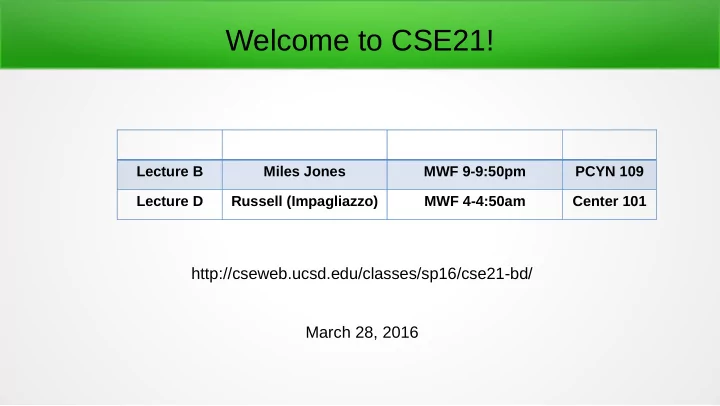
SLIDE 1 Welcome to CSE21!
Lecture B Miles Jones MWF 9-9:50pm PCYN 109 Lecture D Russell (Impagliazzo) MWF 4-4:50am Center 101
http://cseweb.ucsd.edu/classes/sp16/cse21-bd/ March 28, 2016
SLIDE 2
About this course
Formulate & solve problems Describe data Analyze algorithms
Using math
SLIDE 3
About this course
Why is math part of the CS curriculum? Proofs: key to convincing arguments, but also key part of software engineering Vocabulary: basic language of Computer Science Quantitative Analysis: are our solutions / programs / algorithms good enough? How much computational resources (time, memory, power) does our solution use?
SLIDE 4 About you
Have you used iClickers before?
PCYN 109: ?? Center 101: ?? To change your remote frequency
- 1. Press and hold power button until flashing
- 2. Enter two-letter code
- 3. Checkmark / green light indicates success
SLIDE 5 About you
Did you take CSE 20 at UC San Diego?
- A. Yes
- B. No, I took Math 15A instead
- C. No, I took an equivalent course
- D. No, for some other reason.
PCYN 109: ?? Center 101: ?? To change your remote frequency
- 1. Press and hold power button until flashing
- 2. Enter two-letter code
- 3. Checkmark / green light indicates success
SLIDE 6 About you
What other CSE class are you taking this quarter?
- A. None.
- B. CSE 12.
- C. CSE 11.
- D. CSE 8B.
- E. Some other CSE class.
PCYN 109: ?? Center 101: ?? To change your remote frequency
- 1. Press and hold power button until flashing
- 2. Enter two-letter code
- 3. Checkmark / green light indicates success
SLIDE 7
Introductions
SLIDE 8 What do we assume you know?
Short answer: HW 1. Longer answer: Rosen Chapters 1, 2, some of 5, some of 9. Longest answer: You can describe algorithms and their correctness using precise mathematical terminology and techniques. For example:
- Sets, relations (equivalence relations, orders)
- Logical equivalence, conditionals, hypotheses, conditionals, contrapositives
- Universal and existential quantifiers
- Proof by contradiction (indirect proof)
- Proof by induction
- Algorithm invariants
SLIDE 9
Logistics, part 1
Textbook: Rosen 7th Edition Participation: Class times (iClicker questions) https://tritoned.ucsd.edu Discussion (quizzes) https://sections.ucsd.edu Exams: First Exam: Friday, April 22 Second Exam: Friday, May 20 Final Exam: B00: Wednesday, June 8 (8-11 AM) D00: Thursday, June 9 (3-6 PM)
SLIDE 10
Logistics, part 2
Websites: Class Website: http://cseweb.ucsd.edu/classes/sp16/cse21-bd/ Homework assigments, calendar, announcements, study guides, contact info, lecture slides (avail. Day after lecture.) Gradescope: gradescope.com Homework submission and exam return. TritonEd (Ted): https://tritoned.ucsd.edu Participaton scores. Piazza: Announcements and Q&A. Contact instructors here! No HW questions on Piazza. Office hours: Instructors and tutors. Discuss HW questions here!
SLIDE 11
Logistics, part 2
Exams (60%), HW (35%), Participation (5%)
* Details on class website: http://cseweb.ucsd.edu/classes/sp16/cse21-bd/ * Drop lowest HW score * Drop lowest midterm score if do better on final * Can use note sheet for exams * Participation earned via class participation, discussion quizzes, and piazza * Credit for participation if answer 80% of clicker question in that day's class * HW and exams answers evaluated not only on the correctness of your answers, but on your ability to effectively communicate your ideas and convince the reader of your conclusions through proofs and logical reasoning.
SLIDE 12 Academic Integrity Scenarios
You’re working on a homework question and run across a definition you don’t understand. You Google the term and the first hit includes a full solution to the homework question. You avoid reading the solution and close the browser. You keep working on the solution and hand in the assignment, without mentioning the Google search since you didn’t use the result. Is this acceptable?
SLIDE 13 Academic Integrity Scenarios
You’re not sure if you are interpreting a homework problem correctly. You write a post on Piazza showing what you did to answer it, and asking if this is the correct way of interpreting the question. Is this acceptable?
SLIDE 14 Academic Integrity Scenarios
You form a study group with two friends and start working on the next homework. Since there are 6 questions you each pick two questions, think about them, and write out your solutions in a shared Google
- doc. You glance over each other's work before
turning in the assignment. Is this acceptable?
SLIDE 15 Goals
- 1. Learn concepts which computer science relies upon:
Algorithms Asymptotic notation Recurrence relations Graphs Enumeration and data representation Probability
SLIDE 16
An example of CS vocabulary: Trees
Data structure: Binary search trees Stay tuned: Chapter 11 in Rosen, Week 6
SLIDE 17
An example of CS vocabulary: Trees
Algorithm: parsing
SLIDE 18
An example of CS vocabulary: Trees
Model: possible paths of computation
SLIDE 19
An example of CS vocabulary: Trees
Model: Phylogenetic (evolutionary) tree
SLIDE 20
An example of CS vocabulary: Trees
State space: possible configurations of a game
SLIDE 21 An example of CS vocabulary: Trees
Conclusion: Many different applications but same underlying idea.
- How do we define a tree?
- What properties are guaranteed by this definition?
- What algorithms can exploit these properties?
SLIDE 22 Goals
- 2. Solve problems.
- Come up with *new* algorithms
- Think of the homework questions as puzzles that you
need to unravel: the solution or even the approach won't be clear right away.
- You can work on homework in groups of 1-3 students.
SLIDE 23
Sorting (or Ordering)
vs. * Assume elements of the set to be sorted have some underlying order Section 3.1 in Rosen
SLIDE 24 Sorting (or Ordering)
Which of the following collections of elements is listed in sorted order?
- A. 42, 10, 30, 25
- B. 10, 25, 30, 40
- C. 40, 30, 25, 10
- D. All of the above
- E. None of the above
SLIDE 25
Why sort?
A TA facing a stack of exams needs to input all 400 scores into a spreadsheet where the students are listed in alphabetical order. OR You want to find all the duplicate values in a long list.
SLIDE 26 Why sort?
A TA facing a stack of exams needs to input all 400 scores into a spreadsheet where the students are listed in alphabetical order. OR You want to find all the duplicate values in a long list.
I t ' s e a s i e r t
c c e s s d a t a w h e n i t i s s
t e d b e c a u s e y
k n
e x a c t l y w h e r e t
i n d i t .
SLIDE 27 DIY: Sorting Algorithms
- 1. Find a group of about 20 people nearby. Write your first names on
separate papers.
- 2. Sort the names of the people in your group alphabetically by first name.
- 3. Discuss as a group the strategy you used to sort the papers, and how
you might describe it to someone else.
- 4. Write a clear English description of the strategy your group used (each
person should do this.)
- 5. Select one representative to describe your group's strategy on the board.
SLIDE 28
Discussion of Sorting Algorithms
Is the strategy clear? Will the strategy always work? Does the strategy scale well to bigger groups?
SLIDE 29
General questions to ask about algorithms
1) What problem are we solving? 2) How do we solve the problem? 3) Why do these steps solve the problem? 4) When do we get an answer?
SLIDE 30
General questions to ask about algorithms
1) What problem are we solving? PROBLEM SPECIFICATION 2) How do we solve the problem? ALGORITHM DESCRIPTION 3) Why do these steps solve the problem? CORRECTNESSS 4) When do we get an answer? RUNNING TIME PERFORMANCE
SLIDE 31
Given a list a1, a2, ..., an rearrange the values so that a1 <= a2 <= ... <= an
Sorting: Specification: WHAT
Values can be any type (with underlying total order). For simplicity, use integers. Rosen page 196
SLIDE 32
Your approaches: HOW
SLIDE 33
Selection Sort (Min Sort)
"Find the first name alphabetically, move it to the front. Then look for the next one, move it, etc.''
SLIDE 34
Selection Sort (MinSort) Pseudocode
Rosen page 203, exercises 41-42 procedure selection sort(a1, a2, ..., an: real numbers with n >=2 ) for i := 1 to n-1 m := i for j:= i+1 to n if ( aj < am ) then m := j interchange ai and am { a1, ..., an is in increasing order}
SLIDE 35
Bubble Sort
"Compare the first two cards, and if the first is bigger, keep comparing it to the next card in the stack until we find one larger than it. Repeat until the stack is sorted.''
SLIDE 36
Bubble Sort Pseudocode
procedure bubble sort(a1, a2, ..., an: real numbers with n >=2 ) for i := 1 to n-1 for j:= 1 to n-i if ( aj > aj+1 ) then interchange aj and aj+1 { a1, ..., an is in increasing order} Rosen page 197
SLIDE 37
Insertion Sort
"We passed the cards from right to left, each individual inserting their own card in the correct position as they relayed the pile."
SLIDE 38
Insertion Sort Pseudocode
procedure insertion sort(a1, a2, ..., an: real numbers with n >=2 ) for j := 2 to n i := 1 while aj > ai i := i+1 m := aj for k := 0 to j-i-1 aj-k := aj-k-1 ai := m { a1, ..., an is in increasing order} Rosen page 198
SLIDE 39
Bucket Sort
"Call out from A to Z, collecting cards by first letter. If there are more than one with the same first letter, repeat with the second letter, and so on.''
SLIDE 40 Bucket Sort – Pseudo pseudo code
- Create empty buckets that have an ordering.
- Put each of the elements of the list into the correct bucket.
- Sort within each bucket.
- Concatenate the buckets in order.
SLIDE 41 Merge Sort
"We split into two groups and organized each of the groups, then got back together and figured out how to interleave the groups in
SLIDE 42 Merge Sort – Pseudo pseudo code
- If the list has just one element, return.
- Otherwise,
- Divide list into two pieces:
- L1 = a1 ... an/2 and L2 = an/2+1 ...
an
- M1 = Merge sort ( L1 )
- M2 = Merge sort ( L2 )
- Merge the two (sorted) lists M1 and M2
Rosen page 196, 367-370
SLIDE 43
Others?
Bogo sort Quick sort Binary search tree traversal
https://en.wikipedia.org/wiki/Sorting_algorithm
SLIDE 44
Why so many algorithms?
SLIDE 45
Why so many algorithms?
Practice for homework / exam / job interviews. Some algorithms are better than others. Wait, better?
SLIDE 46 Reminders
- Read syllabus on class website.
- Enroll in Piazza and Gradescope.
- Register iClicker.
- Sign up for discussion section. Discussion sections start today.
HW 1 due Wednesday 11:59pm.