Economist
Welcome to the University of Strathclyde The Place of Useful Learning - - PowerPoint PPT Presentation
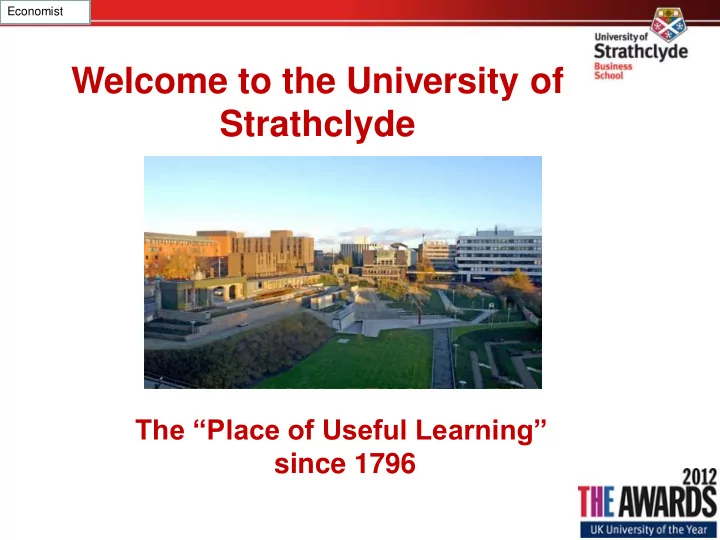
Economist Welcome to the University of Strathclyde The Place of Useful Learning since 1796 Economist The Current Situation The universal mandate for government funded Universities has been to provide good quality undergraduate education
Economist
The universal mandate for government funded Universities has been to provide good quality undergraduate education at a relatively low cost, regulated by the state:
- There has been continual lobbying for more state funding to add more
courses, expand enrolment, build more classrooms and facilities and increase faculty salaries
- Cost per student has risen dramatically – in the US cost has risen x5 the
rate of inflation since 1983
- In most cases, there has not been a corresponding rise in quality
- Governments almost everywhere are being forced to reduce state funding
- f education
- In the UK some institutions are now increasing their fees substantially.
The Current Situation
Economist
Having followed the progress of several thousand students in more than two dozen diverse colleges and universities over 4 years, we found that:
- Large numbers of students progress through college with minimal exposure to
rigorous coursework, a modest investment of effort and little/no improvement in writing and reasoning skills
- In a typical semester 32% did not take a single course with more than 40 pages
- f reading p/week; 50% did not take any course requiring more than 20 pages of
writing over the semester.
- The average student spent 12 hours per week studying, half the time a full-time
student in 1960 spent studying, according to Babcock & Marks.
Arum & Roksa, New York Times, May 14, 2011
Economist
The limited learning is consistent with the accounts of students who report that they:
- Spend increasing numbers of hours on non-academic activities, including
working, rather than on studying.
- Enroll in courses that do not require substantial reading or writing
assignments;
- Rarely if ever, interact with their professors outside of classrooms
- Define their college experiences as being focused more on social than on
academic development
The Consequence:
A large number of the students showed no significant progress on tests of critical thinking, complex reasoning and writing that were administered when they began college, and again at the end of their sophomore and senior years.
Economist
Why is the overall quality of undergraduate learning so poor?
- In some cases it is due to a lack of resources - students are taught by
fewer full-time tenured faculty members and more by „adjuncts‟
- The situation reflects a larger cultural change in the relationship between
students and universities. The authority of educators has diminished, and students are increasingly thought of, by themselves and their colleges, as “clients” or “consumers.”
- When 18-year-olds are emboldened to see themselves in this manner,
many look for ways to attain an educational effortlessly; and they are catered to accordingly. The customer is always right.
Economist
The Business Environment:
Employers across the globe are facing a serious challenge---a critical shortage of
- workers. According to a recent study by AMA Enterprise (AMAE) reports that over
two-thirds of employers in the United States are concerned about gaps in their
- rganizations' management ranks.
When the economy recovers/the job market improves, employee turnover will inevitably increase.
- 54% of respondents believed their bench strength is "uneven and that some
management gaps have been hard to fill“
- 18% think they have "inadequate bench strength and serious management
gaps". Many employers are finding difficulty filling their talent pipelines.
- Only 19% of employers characterize themselves as "well prepared to deal
with either rising turnover or management departures".
Economist
The Future
Major „drivers of change‟ include:
- Inability of governments to fund education to required levels and standards
- Burden of funding shifting from the state to the individual
- MDICS – Mobile, Demanding, Informed, Connected, Savvy students
- SATCOS - Second and Third Career Older Students
- MOOCS – Massive, Open, Online, Courses (Cousersa, EdX,Udacity and
FutureLearn in the UK)
- Ubiquitous technology
- Demographic changes - aging versus young populations
Economist
- Unbundling and personalisation of conventional education programmes
- Shorter degrees (reduced campus attendance) & online formulaic learning
- Combined and dual degrees
- Participatory pedagogy and global trade in pedagogy
- Rationalisation of conventional educational institutes
- Explosion of learning agents
- Increased focus on practical/vocational education
- Outsourcing of teaching
- Shift in focus from systems to services
- Loss of cross-subsidy between teaching and research
Universities as the key to growth of an innovation-driven economy
Implications
Economist
What is Strathclyde doing?
Economist
Technology & Innovation Centre (£85 million investment)
Bringing together multidisciplinary teams to combine strengths in engineering, science, business, humanities and social sciences in a new landmark facility housing specialist, shared and flexible laboratory facilities where world-class researchers respond to real problems in 9 focused areas in partnership with industry, government agencies and other organisations – enhancing the student experience and providing more opportunities for students to interact with external agencies
- Advanced Engineering & Manufacturing
- Advanced Science & Technology
- Bionanotechnology
- Business Engagement
- Continuous Manufacturing & Crystallisation
- Energy
- Health Technologies
- Photonics
- Senor & Asset Management
Economist
Hunter Centre for Entrepreneurship
A department in the Business School endowed by Sir Tom Hunter for the study, research and encouragement of entrepreneurship within Scotland. A research focus to develop a better understanding of how entrepreneurs can more successfully create new value for both business and society, and to provide practical recommendations to business leaders, policy makers, and entrepreneurship-support organizations, and the role of entrepreneurship in national economic growth Modules on undergraduate/postgraduate programmes designed to enhance:
- Practical, applied, real world skills
- Interaction with real entrepreneurs
- Entry into entrepreneurial networks
- Opportunities to establish businesses
- Engagement with companies & social enterprises
Economist
Strathclyde 100
A network of entrepreneurial alumni and business people who, through a series
- f events, support emerging Strathclyde entrepreneurs.
Entrepreneurs and businesses pitch their ideas to the audience with a view to securing help with specific asks . Chaired by the University Principal, Professor Sir Jim McDonald, Strathclyde 100 events have been running in Glasgow since 2003 with impressive results:
- Introductions to CEOs, Directors and Board members
- Mentor relationships and advice from industry experts
- Substantial grant funding and financial investment secured
- Introductions to global wide contacts