
SLIDE 1
Wellness 4A: Nutrition for the Student
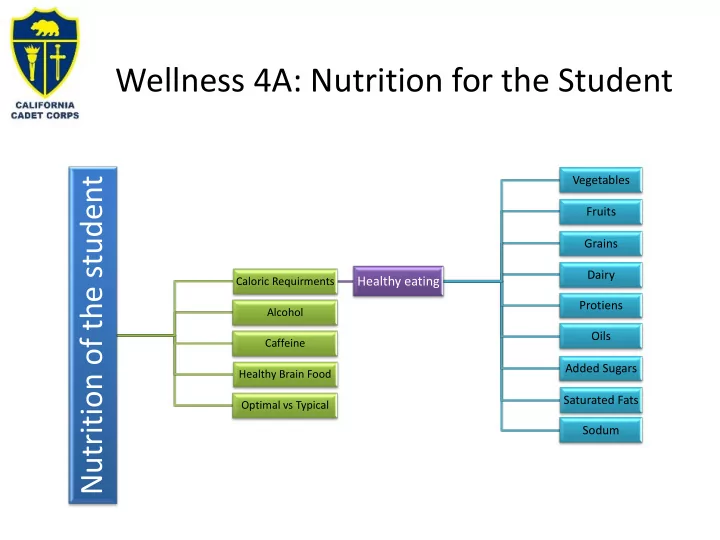
Nutrition of the student
Caloric Requirments
Healthy eating
Vegetables Fruits Grains Dairy Protiens Oils Added Sugars Saturated Fats Sodum
Alcohol Caffeine Healthy Brain Food Optimal vs Typical
Wellness 4A: Nutrition for the Student Vegetables Nutrition of the - - PowerPoint PPT Presentation
Wellness 4A: Nutrition for the Student Vegetables Nutrition of the student Fruits Grains Dairy Caloric Requirments Healthy eating Protiens Alcohol Oils Caffeine Added Sugars Healthy Brain Food Saturated Fats Optimal vs Typical Sodum
Caloric Requirments
Healthy eating
Vegetables Fruits Grains Dairy Protiens Oils Added Sugars Saturated Fats Sodum
Alcohol Caffeine Healthy Brain Food Optimal vs Typical
The desired outcome of this unit is for students to learn various nutritional facts, proper diets of nutrition, and planning for specific activities in a student cadet's life.
1. Understand caloric requirements for sustainment 2. Define and apply estimated energy requirements (EER). 3. Define Basal Metabolic Rate (BMR) 4. Compare and contrast and apply macronutrients and micronutrients. 5. Define carbohydrates, simple and complex carbohydrates. 6. Apply Recommended Dietary Allowance (RDA) 7. Understand empty calories and apply steps to avoid them 8. Understand and apply the FIT nutrition model, and its role in “meal prepping” 9. Compare the difference between a portion and a serving size
daily diet.
enriched refined grains
role/functions in the body
disaccharides, polysaccharides, and glycogen
hyperglycemic, and hypoglycemic.
syndrome, and cirrhosis.
energy maintenance factoring in height, weight, age, and sex.
burned) of a person after they have slept for 8 hours and fasted for 12 hours in the supine (laying down) position in a hospital or laboratory setting, essentially it’s the “do nothing” but breathe for 16 hours metabolic rate.
require the patient to stay at the hospital because the values were identical
proteins.
Objectives: Cadets will be able to
prepping”
Essential Question: How do intake amounts (caloric, and physical amounts) have precise
sugar, fructose sugar from fruit, and sucrose, mostly found in soft drinks, they are the quick fuel.
longer to digest because their chemical structure is harder to break down, such as bread, beans, and vegetables.
amounts of such as vitamins and minerals.
Objectives: Cadets will be able to
their daily diet. Essential Question: How are vegetables crucial to human body chemistry and overall health?
There are 6 categories of Vegetable:
tomatoes
green peas
those are, black beans, pinto beans, and kidney beans
as onions, artichokes, celery, cucumbers, and many others
taste or texture of certain vegetables
stores not carrying quality produce, or the money it costs to buy fresh veggies
negative interaction with some or all veggies as a younger child
part of their daily routine
vegetables in someone’s diet
cruelty-free element makes some vegetables inaccessible for those who follow that ideal, due to them being grown using animal products
– Some fruits are high in water content, sometimes containing between 80%-99% of water. Examples are watermelons, cantaloupes, strawberries, apples, grapes, oranges, pears, and pineapples
Potassium is an element which is needed for the human body to function, impacting the body systems that involve the kidneys, blood plasma, and intracellular fluid. An imbalance of potassium can cause issues such as muscle weakness, cramps, breathing issues, and constipation.
– Hypokalemia is an insufficient amount of potassium in the
abnormally contract, leading to death. – Hyperkalemia is high levels of potassium in the blood, usually disrupting the electrical impulses and signals and mostly a result of a kidney dysfunction.
Potassium can be found in fruits like bananas, apples, and apricots
Objectives: Cadets will be able to
and enriched refined grains Essential Question: How are different types of grains needed for overall health and what are the benefits of each?
– amylose contains hundreds of glucose units – amylopectin contains thousands of glucose units
The following minerals and vitamins are laid out by function:
– Zinc’s major functions include protein along with DNA production, healing wounds, boosting the immune system, and assisting in growth. – Iron is carries oxygen and supports in energy production – Magnesium produces protein, aiding in muscle contraction and nerve transmissions. – Niacin is a vitamin that assists in energy metabolism
grains with whole kernels.
the
–
bran (outside/shell) – the germ( the innermost segment), – the endosperm (the largest inside portion)
buckwheat, whole cornmeal, quinoa, and brown rice.
body chemistry
– triglycerides make up 95% of lipids ingested, found in fried food, cheeses, whole milk, and vegetable oil – phospholipids only makes up 2% of lipids found in foods, and their job is to enclose fat cells while in transport through the bloodstream – sterols are the least common but the most known lipid because their full name is cholesterol and their major function is producing sex hormones (testosterone, estrogen, etc.), vitamin D, and bile salts.
– Probiotics are lactic acid bacteria, also known as lactobacilli. They are added as a live culture bacteria to food items that go through a fermentation process, such as yogurt and Kefir – Prebiotics are soluble fibers that fuel the growth of select bacteria to grow in the large intestinal tract
Dairy is full of vitamins and minerals the body needs to maintain function.
– Calcium the chemical element that builds and maintains bones, aids in blood clotting, and aids in muscular and nerve functions. – Phosphorous aids in the maintenance of teeth and bones, and supports the release of energy from nutrients. – Vitamin B2 also known as riboflavin, breaks down proteins and carbohydrates. – Vitamin B12 chemical name cobalamin, is the element that supports in the formation of nucleic and amino acids. – Vitamin D helps the body absorb calcium and phosphorous
Proteins are a class of nitrogen-containing biomolecule composed of amino acids.
– Proteins are the main component of the cell, used to grow, repair and maintain muscles and connective tissues, assist in the production of hemoglobin, enzymes, and hormones, control acid to base balance, maintain osmotic pressure in the blood, support the formation of antibodies/disease protection and produce energy. – Amino acids are components of proteins that the body needs to either self- create or acquire from a diet source. They are considered the building blocks because of the connection to growing and building muscles and other body tissues – Nonessential amino acids are produced by the body, but the body does not rely
– Essential Amino acids are the 8-9 (adults/children) amino acids that the body cannot self-create/synthesize and must be part of daily food intake.
– Meats consist of beef, ham, lamb, bison, rabbit, venison, and pork – Poultry includes chicken, duck, goose, and turkey – Beans and peas are lentils, pinto beans, black beans, kidney beans, and edamame, among others – Soy products include tempeh, tofu, and veggie burgers – Eggs include chicken eggs and duck eggs – Nuts and Seeds include almonds, peanuts, pecans, pumpkin seeds, sunflower seeds, and walnuts – Seafood is a misleading name, as not all items in the category come from the
– Some oils are primarily used in a manner to flavor food such as walnut oil and sesame seed oil. Some foods naturally have oils in them such as various nuts, certain fish, and avocadoes. Condiments like mayonnaise, salad dressings, and squeeze margarine are mostly made up of oils
plant-based items, vegetables, and fruits.
(LDL) cholesterol levels in the blood supply.
reproduction, and the health of your blood, brain and
against cancer and other diseases.
– The everyday name for monosaccharide is simple sugar or glucose
example of a disaccharide is sucrose.
glycogen) whose molecules consist of a number of sugar molecules bonded together
– The simple way to imagine how the process goes is that the blood vessels are a highway and blood is the vehicle on the
The brain's key fuel to function comes from sugar, but it’s not an excuse to overdo it on sugary sodas. Both too much sugar and not enough sugar in the body are bad for organs and the brain
and is characterized by the blood glucose levels being high, also known as hyperglycemia.
insulin due to a malfunction in the pancreas. This is known as Type 2 diabetes.
dependent diabetes mellitus (NIDDM), simply put does not produce enough insulin or is insulin resistant.
not respond to insulin. This causes hyperglycemia.
with being obese or overweight
Objectives: Cadets will be able to
Essential Question: What are the types of fats and what is their connection to cardiovascular health?
with hydrogen atoms combined.
carbon atom has 4 single bonds. – Saturated fats are normally solids at room temperature. They are found in food like beef, lamb, pork, lard, cream butter, and cheese.
double bonds making it easier to metabolize/absorb – Unsaturated fats (mono or poly) are oils and liquid at room temperature.
140−159 90−99 , stage 2 at greater than or equaled to 160+ 100+.
– Hypertension causes the heart to work harder than it should and over time it can lead to scarring of the heart and losing its elasticity, which may lead to stroke.
120−139 80−89 .
– An average/normal blood pressure at rest is usually
120 80 , can be
defined as less than 120 over 80
Objectives: Cadets will be able to
fetal alcohol syndrome, and cirrhosis.
Essential Question: How is alcohol destructive to the human body, vital organs, and damaging to the brain?
substance is volatile and is also known as liquor or its chemical name of ethanol.
ingested it crosses the blood-brain barrier affecting the actions of the body, altering the mood, thinking, decision making, memory, motor control, and social behavior.
– Drinking alcohol is detrimental to the overall health of a human;
function is to filter or metabolize the substance.
more alcoholic drinks, and a female consumes four or more alcoholic drinks by volume. This type of behavior is extremely dangerous and will lead to degrading health complications
chemical, or drug, and is widely consumed
energy, ability to concentrate, reaction time, and prolonging endurance.
–
Through studies, the proven effect was as follows: increased alertness, concentration, elevated mood, but decreased reaction time and fatigue. – Even though it’s widely accessible and not regulated consuming it with risks such as nervousness, restlessness, insomnia, headaches, gastrointestinal problems, & tremors – a withdrawal of intake can result in distress of the gastrointestinal tract, fatigue, and irritability.
such as test day, academic presentations, and other tasks that take a large amount of concentration.
particular foods, but only that eating healthy can encourage emotional response-control in humans.
symbolic in traditions, cultures, and special events; birthdays, weddings, funerals, graduations, sporting events, festivals, etc.
grams of glucose per hour from the blood, in order to not slide into a state of confusion, coma, or death.
– Carbohydrates with caloric limits – Digestible carbohydrates – Water – Vitamins – Minerals
supplement source found in fish, poultry, and grain-fed animals.
energy source and in charge of manufacturing neurotransmitters required for RNA, DNA, and ATP; deficiency in this vitamin can cause brain and heart issues.
fish.
is to increase fruit and vegetable intake
– Moderation in eating and in taking nutritional rich foods. This is completed through the following: fill half the plate with vegetables and fruits, one quarter with lean meat/protein, poultry or fish, one quarter with a grain/rice, one serving of dairy
– The USDA did a longitudinal study spanning from 1970-2005, it tracked what individuals in the United States were consuming over a protracted period.
1. The typical health perspective represents a nutritious diet ( T/F) 2. What slogan does the government use for health guidance for planning meals? 3. Using context clues, what does longitudinal mean?