SLIDE 1 WESTMAN & ASSOCIATES PRESENTATIONS/WORKSHOPS
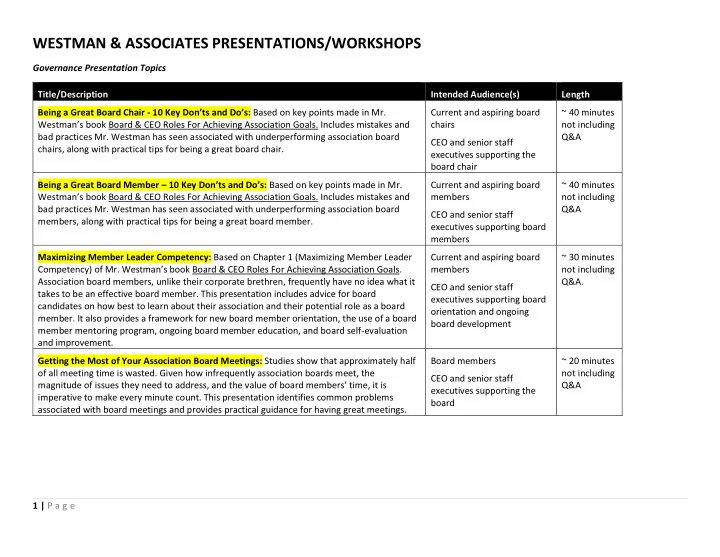
1 | P a g e Governance Presentation Topics Title/Description Intended Audience(s) Length Being a Great Board Chair - 10 Key Don’ts and Do’s: Based on key points made in Mr. Westman’s book Board & CEO Roles For Achieving Association Goals. Includes mistakes and bad practices Mr. Westman has seen associated with underperforming association board chairs, along with practical tips for being a great board chair. Current and aspiring board chairs CEO and senior staff executives supporting the board chair ~ 40 minutes not including Q&A Being a Great Board Member – 10 Key Don’ts and Do’s: Based on key points made in Mr. Westman’s book Board & CEO Roles For Achieving Association Goals. Includes mistakes and bad practices Mr. Westman has seen associated with underperforming association board members, along with practical tips for being a great board member. Current and aspiring board members CEO and senior staff executives supporting board members ~ 40 minutes not including Q&A Maximizing Member Leader Competency: Based on Chapter 1 (Maximizing Member Leader Competency) of Mr. Westman’s book Board & CEO Roles For Achieving Association Goals. Association board members, unlike their corporate brethren, frequently have no idea what it takes to be an effective board member. This presentation includes advice for board candidates on how best to learn about their association and their potential role as a board
- member. It also provides a framework for new board member orientation, the use of a board
member mentoring program, ongoing board member education, and board self-evaluation and improvement. Current and aspiring board members CEO and senior staff executives supporting board
board development ~ 30 minutes not including Q&A. Getting the Most of Your Association Board Meetings: Studies show that approximately half
- f all meeting time is wasted. Given how infrequently association boards meet, the
magnitude of issues they need to address, and the value of board members’ time, it is imperative to make every minute count. This presentation identifies common problems associated with board meetings and provides practical guidance for having great meetings. Board members CEO and senior staff executives supporting the board ~ 20 minutes not including Q&A
SLIDE 2 WESTMAN & ASSOCIATES PRESENTATIONS/WORKSHOPS
2 | P a g e Governance Presentation Topics (continued) Title/Description Intended Audience(s) Length Can I Make That Decision?: Based on Chapter 2 (Assign Roles to Those Best Suited) of Mr. Westman’s book Board & CEO Roles For Achieving Association Goals. Board leadership typically changes every year. With each new set of leaders, expectations can change in terms
- f who does what relative to individual officers, governance entities, and staff. Staff can be
whiplashed and, unfortunately, can get into trouble if they take on roles and make decisions that were fine the previous year, but are now viewed as the prerogative to the Chair or board. This presentation outlines a methodology member and staff leaders can utilize to clarify and codify decision-making roles to minimize the whiplash, improve the efficiency and effectiveness of decision-making, and assure everyone is in sync with who does what. Board members CEO and senior staff executives supporting the board ~ 15 minutes not including Q&A. Additional hour if practice exercise is included Committees – When to Form Them/When to Sunset Them: There is no “cookie cutter” formula for determining which committees an association should have to help undertake various strategic and operational duties. Some associations operate with only a handful of committees, whereas others are overrun with 20, 30, or more of them. A few committees are found in almost all associations (e.g., Nominating and Finance/Audit committees). This presentation provides guidance on how best to determine which other committees an association should have, including recommended criteria for establishing and sunsetting committees. Board members CEO and senior staff executives supporting the board ~ 9 minutes not including Q&A Strategic Planning Best Practices?: Based on Chapter 7 (Plan For Future Success) of Mr. Westman’s book Board & CEO Roles For Achieving Association Goals. There are many different approaches to strategic planning – ranging from a bare bones half-day discussion to comprehensive multi-faceted environmental scanning/data gathering, followed by numerous committee and/or board meetings. This presentation addresses the pros and cons of various approaches while providing a set of “best practices” for consideration regardless of the approach taken. Board members CEO and senior staff executives supporting the board ~ 20 minutes not including Q&A.
SLIDE 3
WESTMAN & ASSOCIATES PRESENTATIONS/WORKSHOPS
3 | P a g e Governance Presentation Topics (continued) Title/Description Intended Audience(s) Length CEO Management – The Dreaded Board Fiduciary Duty?: Based on Chapter 5 (Nurture the Board/CEO Working Relationship) of Mr. Westman’s book Board & CEO Roles For Achieving Association Goals. Very few supervisors enjoy undertaking activities related to subordinate performance and compensation management. In many associations, CEOs can go years without performance feedback, and compensation adjustments are made haphazardly. This presentation, drawing upon Mr. Westman’s 15+ years of experience as a human resources consultant, conveys the importance of this fiduciary duty and outlines a template process for boards to follow in establishing performance expectations, assessing performance achieved, and tying results to salary adjustments and incentive compensation. Board members CEOs ~ 25 minutes not including Q&A. Risk Management – The Overly Delegated Board Fiduciary Duty: Based on Chapter 8 (Identify and Manage Risks) of Mr. Westman’s book Board & CEO Roles For Achieving Association Goals. In many associations the board delegates risk management to the Treasurer, Finance Committee, external auditor, and/or the CFO. Although some delegation is appropriate, full delegation can be a BIG mistake. This presentation highlights the role all board members should play in risk management. It also introduces the “balanced scorecard” approach to risk management, including various categories of risk that should be considered and methodology for identifying, prioritizing, and mitigating risks in associations. Board members Senior staff executives ~ 25 minutes not including Q&A. Additional hour if practice exercise is included Succession Planning – The Forgotten Board Fiduciary Duty: Ties to Chapter 8 (Identify and Manage Risks) of Mr. Westman’s book Board & CEO Roles For Achieving Association Goals. Relatively few associations have a formal or informal succession plan applicable to their CEO and other top executive positions. As a result, many boards find themselves scrambling when the CEO departs suddenly, with the staff in chaos, progress on key initiatives stalled, and general members questioning the organization’s future viability. This presentation conveys the purposes served by a formal succession planning process, the board’s oversight role, along with a proposed methodology and forms for developing and refreshing succession plans. Board members CEO ~ 20 minutes not including Q&A
SLIDE 4 WESTMAN & ASSOCIATES PRESENTATIONS/WORKSHOPS
4 | P a g e Governance Presentation Topics (continued) Title/Description Intended Audience(s) Length Preparing for Your New Staff Leader: Most association boards pay minimal attention to effectively onboarding their new CEO. There are numerous topics that should be addressed, including:
- Role definition and clarification
- Communication protocols
- CEO orientation
- CEO performance & compensation management
- Organizational assessments
- Staff relations
Within each of these topics, there are scores of specific issues to consider. This program includes a combination of presentation by Mr. Westman, small group breakout discussions utilizing the world café approach, and full group discussion – incorporating numerous templates Mr. Westman has developed to facilitate consideration and decision-making associated with transition topics. Board members – as soon as possible after the transition event occurs Half or full- day workshop
SLIDE 5 WESTMAN & ASSOCIATES PRESENTATIONS/WORKSHOPS
5 | P a g e New/Aspiring CEO Presentation Topics – Note: These three presentations were developed by Mr. Westman for an American Society of Association Executives’ webinar program. If interested in presenting at the state level, ASAE’s permission will need to be secured. Alternatively, some or all of the comment could be reformatted to avoid such a need. Title/Description Intended Audience(s) Length The CEO’s First 30 Days – What to Do and What to Accomplish: It is critical for a new CEO to
get off to a good start. Several initial suggested priorities (e.g., undertaking various
- rganizational assessments) are addressed in another W&A program. Key priorities addressed
during this program include:
- Jump starting the working relationship with your primary supervisor – the Board chair.
- Assessing the overall level of staff engagement.
- Introductions to key member leaders and external stakeholders.
- Clarifying decision-making roles between staff and various governance entities and
leaders.
- Establishing ground rules for board/staff interactions.
New and aspiring CEOs ~ 30 minutes not including Q&A Key Initial Assessments a New CEO Should Undertake: As an incoming CEO, it is critical that
you have a pulse of the current operating environment. This presentation describes the purpose, methodologies, and results typically associated with the following assessments:
- Governance assessment
- Staff assessment
- Member satisfaction assessment
- Corporate partner satisfaction assessment
- Advocacy partner satisfaction assessment
- Education content/delivery partner assessment
- Key vendor assessment
- Enterprise risk assessment
New and aspiring CEOs ~ 45 minutes not including Q&A What I Wish I Knew Then: Nearly every association CEO can look back on his/her early days
in the role with at least a twinge of regret. “If only I had known…….I would have said or acted differently to better serve the organization and increase my personal effectiveness.” This presentation includes case studies illustrating tough lessons they learned during the first year in their new role.
New and aspiring CEOs ~ 30 minutes not including Q&A
SLIDE 6
WESTMAN & ASSOCIATES PRESENTATIONS/WORKSHOPS
6 | P a g e Association Staff Presentation Topics Title/Description Intended Audience(s) Length Building a Rock-Solid Board/CEO/Staff Partnership: Based on Chapter 5 (Nurture the CEO/Board Working Relationship) of Mr. Westman’s book Board & CEO Roles For Achieving Association Goals. Associations are unique in terms of the continual turnover of board officers and other board directors, and how involved many board members are in the nuts n bolts of running an association. These realities make it imperative for CEOs and other senior executives to develop strong partnerships with board members individually and collectively. This presentation identifies best practices for building such partnerships, starting well before volunteers ascend into top board leadership positions. Senior staff through managerial staff ~ 30 minutes not including Q&A Building Win-Win Stakeholder Relationships for Association Success: Based on Chapter 6 (Strive for Win/Win Stakeholder Relationships) of Mr. Westman’s book Board & CEO Roles For Achieving Association Goals. Most associations are too small, with too few staff and monetary resources, to accomplish their vision, mission, and strategic plan milestones without help. This presentation focuses on four key stakeholder groups that almost all associations rely on to at least some extent to help them succeed (members, corporate partners, advocacy/education partners, and staff) – what is important to each group and specific strategies to increase their loyalty and engagement with your association. Senior staff executives ~ 30 minutes not including Q&A The Power of Benchmarking – No Need to Reinvent the Wheel: Based on Chapter 9 (Share With and Learn from Your Colleagues) of Mr. Westman’s book Board & CEO Roles For Achieving Association Goals. Associations, compared to most other entities, are ideally suited to incorporate benchmarking as a tool to drive innovation and minimize the “reinventing the wheel” syndrome. This presentation conveys the value of benchmarking, including case studies of how benchmarking has been effectively used by association executives. It also addresses benchmarking best practices and the benchmarking Code of Conduct. Senior staff through managerial staff ~ 30 minutes not including Q&A Is a BEO Right For You?: Associations are not renowned for moving at the speed of business. The traditional association model has always lacked something fundamentally. The missing key is agility - the capability to rapidly and cost effectively adapt to changes. This presentation introduces the concept of a Business Excellence Office (BEO). It includes a deep dive into Stage Gate as a core methodology utilized by many BEOS. CEOs and other C-Suite executives ~ 30 minutes not including Q&A
SLIDE 7 WESTMAN & ASSOCIATES PRESENTATIONS/WORKSHOPS
7 | P a g e Association Staff Presentation Topics (continued) Title/Description Intended Audience(s) Length Best Practices in Monetary Compensation Administration: Monetary compensation is defined as base salary, incentive compensation, and bonuses. Most associations are too small to have in-house expertise in developing and effectively administering related compensation
- plans. Mr. Westman, drawing on over 15 years of compensation consulting experience,
conveys “best practices” for association leaders to consider, including an introduction to a proprietary tool (Association EasyComp) to facilitate administration of an association’s base salary plan. CEOs and Human Resource Department staff ~ 40 minutes not including Q&A How Will You Keep Them Down on the Farm? – Best Practices for Employee Retention As the United States moves towards a full-employment economy it is becoming harder for associations to attract and retain the best and brightest employees. A competitive salary alone is not the answer. Associations need to be creative and open to a wide range of non- monetary elements of “compensation” – which should be defined as anything an employee values from her/his relationship with an employer. This presentation reinforces the value of non-monetary compensation and provides examples of what organizations are doing to attract and retain their best employees. CEOs and Human Resource Department staff ~ 30 minutes not including Q&A Succession Planning and Career Management – It’s Not Just for the Big Boys and Girls: Ties to Chapter 8 of Mr. Westman’s book Board & CEO Roles For Achieving Association Goals. – Identify and Manage Risks. Many for-profit and non-profit entities like associations have formal or informal succession planning programs applicable to their CEO and top executive
- positions. The program either doesn’t address or tends to fizzle out at mid to lower
- rganizational levels. That doesn’t have to be the case! One of the basic cores of succession
planning, developing and preparing staff to undertake new and expanded roles, can and should apply to every level of the organization. This presentation provides a structured approach to prepare staff at even the lowest organizational levels to experience career growth either within or outside the organization. CEOs and Human Resource Department staff ~ 50 minutes not including Q&A