Wh What is a list comprehension? Concise way to create a list from - - PowerPoint PPT Presentation

wh what is a list comprehension
SMART_READER_LITE
LIVE PREVIEW

Wh What is a list comprehension? Concise way to create a list from - - PowerPoint PPT Presentation

2/11/20 Wh What is a list comprehension? Concise way to create a list from another list Syntax: L2 = [expression(i) for i in L1 if condition(i)] cubes = [] cubes = [i**3 for i in range(10)] for i in range(10): cubes.append(i**3)


slide-1
SLIDE 1

2/11/20 1

Class #08: List Comprehension

CS 224 Introduction to Python Spring 2020

Wh What is a list comprehension?

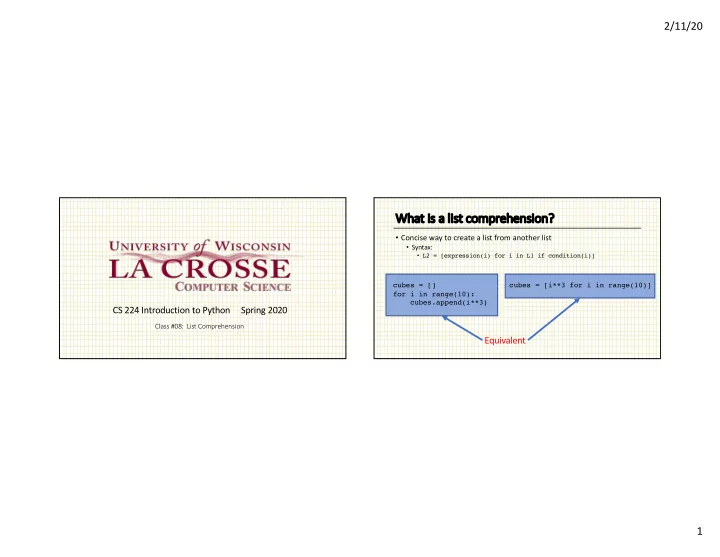
  • Concise way to create a list from another list
  • Syntax:
  • L2 = [expression(i) for i in L1 if condition(i)]

cubes = [] for i in range(10): cubes.append(i**3) cubes = [i**3 for i in range(10)]

Equivalent

slide-2
SLIDE 2

2/11/20 2

Ex Example using files

The existing list in a comprehension can be ad hoc:

path = my_dir files = [path + ‘/’ + i for i in os.listdir(path)] for f in files: fn = open(f, ‘r’) do something with fn fn.close() returns a (Python) list of files

What does this code do?

elements in that list are used to create a new list in which each element also includes the path

Yo Your turn:

Use a list comprehension to create a list of Fahrenheit temperatures from a list of Centigrade temperatures. dF = [1.8 * c + 32 for c in dC] What does this comprehension do: dF = [1.8 * c + 32 for c in [randint(0, 100) for i in range(10)]]

slide-3
SLIDE 3

2/11/20 3

Fi Filtering

We can choose which elements in the existing list are used to create the new list: roots = [math.sqrt(i) for i in nums if i > 0] avoids math domain error (sqrt of negative number) Note: len(roots) <= len(nums)

Yo Your turn again:

Use a list comprehension to create a list of the odd values in a list of data.

  • dds = [i for i in data if i % 2 == 1]
slide-4
SLIDE 4

2/11/20 4

Mu Multiple Lists

You can use multiple existing lists to create the new list: pairs = [(x, y) for x in xcoords for y in ycoords] What are the elements of pairs?

  • each is an (x, y) pair in the cross-product of xcoords and ycoords
  • this works even if the two input lists have different lengths

What if you want elements paired by position? pairs = [(xcoords[i], ycoords[i] for i in range(len(xcoords))] Can use min if the input lists have different lengths.

Us Using a function

Let coords be a list containing 2-element lists of GPS coordinates: [[(lat1, lon1), (lat2, lon2)], [(lat3, lon3), (lat4, lon4)] …] Create a list of distances between the pair of cities in each sublist. def distance(city1, city2): # compute and return distance dists = [distance(x, y) for x, y in coords] Function definition

slide-5
SLIDE 5

2/11/20 5

On One more turn for you…

Staying with the setup from the previous slide, create a list of the pairs of cities that are closer than threshold d: close = [[x, y] for x, y in coords if distance(x, y) < d] function in the filter