What A CPU Does All Day Fetch from memory the instruction whose - - PowerPoint PPT Presentation

what a cpu does all day
SMART_READER_LITE
LIVE PREVIEW

What A CPU Does All Day Fetch from memory the instruction whose - - PowerPoint PPT Presentation

What A CPU Does All Day Fetch from memory the instruction whose address is given in the PC. Increment the PC. Execute the instruction. Repeat. Chapter 3


slide-1
SLIDE 1

Chapter 3

CSc 314 · T W Bennet · Mississippi College

1

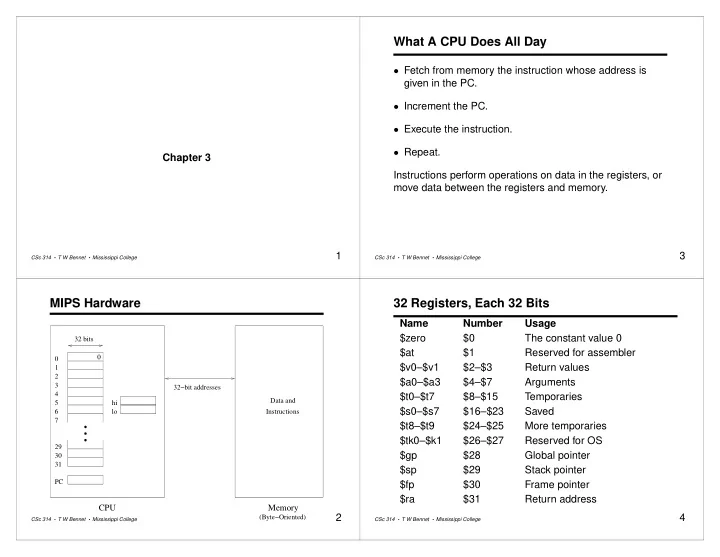
MIPS Hardware

  • ✂✁
✁ ✄ ✄ ✄ ✄✂☎ ☎ ☎ ☎ ✆ ✆ ✆ ✆✂✝ ✝

1 2 3 4 5 6 7 31 30 29 32 bits PC 32−bit addresses hi lo

CPU

(Byte−Oriented)

Memory

Data and Instructions

CSc 314 · T W Bennet · Mississippi College

2

What A CPU Does All Day

  • Fetch from memory the instruction whose address is

given in the PC.

  • Increment the PC.
  • Execute the instruction.
  • Repeat.

Instructions perform operations on data in the registers, or move data between the registers and memory.

CSc 314 · T W Bennet · Mississippi College

3

32 Registers, Each 32 Bits

Name Number Usage $zero $0 The constant value 0 $at $1 Reserved for assembler $v0–$v1 $2–$3 Return values $a0–$a3 $4–$7 Arguments $t0–$t7 $8–$15 Temporaries $s0–$s7 $16–$23 Saved $t8–$t9 $24–$25 More temporaries $tk0–$k1 $26–$27 Reserved for OS $gp $28 Global pointer $sp $29 Stack pointer $fp $30 Frame pointer $ra $31 Return address

CSc 314 · T W Bennet · Mississippi College

4

slide-2
SLIDE 2

Instruction Types

Arithmetic and Logical

  • Regular and immediate.
  • With and without overflow.
  • Bitwise logical operations.

Shift Compare-and-Set Jump and Branch Load and Store Floating Point Described in Appendix A

CSc 314 · T W Bennet · Mississippi College

5

Arithmetic Instructions

Perform operations on 32-bit values stored in registers. Operate on any two registers and store the result in a third. Register names need not be unique. The first register is the destination. sub $s1, $t3, $t7 mul $s1, $s1, $t2 addu $t5, $t5, $t5 The u means “unsigned.”

CSc 314 · T W Bennet · Mississippi College

6

Immediate Arithmetic Instructions

Perform operations on a 32-bit register and a 16-bit constant. May operate on any register and store in any other. They may be the same register. The first register is the destination. addi $t7, $s5, 17 addi $t2, $10, 0x493 addi $a1, 99 The last one assumes a1 is both source and destination.

CSc 314 · T W Bennet · Mississippi College

7

Logical Instructions

Take the same forms as arithmetic operations. Perform bitwise operations. 1 0 1 1 0 1 0 1 and 0 1 1 0 1 1 0 0 0 0 1 0 0 1 0 0 1 0 1 1 0 1 0 1

  • r

0 1 1 0 1 1 0 0 1 1 1 1 1 1 0 1

  • r $s2, $a0, $t1

andi $t2, $t1, 0x45ab

CSc 314 · T W Bennet · Mississippi College

8

slide-3
SLIDE 3

Shift Instructions

Shift moves the bits over to the left or right. Bits moved past either end are discarded. Evacuated bit positions are filled with zeros for left shifts and logical shifts. Right arithmetic shift fills with copies of the sign bit. Effect is to multiply or divide by a power of two, if the result fits. sra $5, $t4, 3 sllv $s1, $s5, $t1

CSc 314 · T W Bennet · Mississippi College

9

Shift Examples

These are 8-bit examples. The MIPS performs 32-bit shifts. Number Left 3 bin dec bin dec 00001110 14 01110000 112 11110100

  • 12

10100000

  • 96

01111001 121 11001000

  • 56

Number

  • Log. Right 2
  • Arith. Right 2

bin dec bin dec bin dec 00010110 22 00000101 5 00000101 5 11011000

  • 40

00110110 54 11110110

  • 10

01101100 108 00011011 27 00011011 27

CSc 314 · T W Bennet · Mississippi College

10

Compare-and-Set Instructions

Compare registers. Produce a result value which is 1 or 0 (C-style boolean). Take the same forms as arithmetic operations. sgt $s2, $t6, $t5 slti $t5, $a2, 10

CSc 314 · T W Bennet · Mississippi College

11

Jump and Branch Instructions

Move execution to another point in the program. Jump and branch set the pc. Branch instructions are conditional. j fred beq $s1, $t1, barney

CSc 314 · T W Bennet · Mississippi College

12

slide-4
SLIDE 4

Load and Store Instructions

Move (copy) data between register and memory. Memory address is the sum of a register and a constant

  • ffset.

lw $7, 12($s1) sb $t3, 0($t4) Come in one-, two- and four-byte sizes. Address must be a multiple of the size. Store is the only MIPS assembler instruction where data moves from left to right.

CSc 314 · T W Bennet · Mississippi College

13

Immediate Load Instructions

Load a constant into a register. Do not access memory, other than the instruction itself. li $a2, 123 la $22, fred

CSc 314 · T W Bennet · Mississippi College

14

Other Instructions

Copy A Register move $10, $t1 Floating Point Instructions We do not study these. Real Computer Scientists Don’t Do Floating Point.

CSc 314 · T W Bennet · Mississippi College

15

Count Down From Ten

. . . top: li $t1, 10 # Set $t1 to 10. beqz $t1, out # Leave when not 0. addi $t1, $t1, -1 # Decr. $t1 j top # Repeat

  • ut:

. . .

CSc 314 · T W Bennet · Mississippi College

16

slide-5
SLIDE 5

Find Zero In An Array

. . . next: la $t1, arr # Get array addr. lw $t2, 0($t1) # Get word beqz $t2, found # Leave when not 0. addi $t1, $t1, 4 # Incr. address j next # Repeat found: . . . .data .align 2 arr: .word 17, 23, 34, 11, 873, 0 . . .

CSc 314 · T W Bennet · Mississippi College

17

Stack

Running programs have a stack for general storage and function calls.

  • Stored in memory.
  • Top denoted by $sp.
  • Top is at the smallest address.
  • MIPS has no special stack operations.

CSc 314 · T W Bennet · Mississippi College

18

Stack

Lower Memory Addresses $sp 8($sp) 12($sp) 16($sp) 20($sp) 4($sp) 0($sp) Grows

CSc 314 · T W Bennet · Mississippi College

19

Pushing Values

Pushing one value: addiu $sp, $sp, -4 # Make space. sw $s1, 0($sp) # Store value there. Pushing several values: addiu $sp, $sp, -12 # Make space for all. sw $s1, 8($sp) # Store each value. sw $s2, 4($sp) sw $ra, 0($sp) Note: subu $sp, $sp, n abbreviates addiu $sp, $sp, -n.

CSc 314 · T W Bennet · Mississippi College

20

slide-6
SLIDE 6

Popping Values

Popping one value: lw $s1, 0($sp) # Recover value. addiu $sp, $sp, 4 # Release space. Popping several values: lw $s1, 8($sp) # Recover each value. lw $s2, 4($sp) lw $ra, 0($sp) addiu $sp, $sp, 12 # Release all space.

CSc 314 · T W Bennet · Mississippi College

21

Calling

Call and return:

  • jal name places address of next instruction in $ra and

transfers to name.

  • jr $ra returns by transferring to the address given in

$ra. . . . jal fred # Go to fred after putting . . . # this addr in $ra. fred: . . . # Do something useful jr $ra # Go to instr after jal

CSc 314 · T W Bennet · Mississippi College

22

Passing Arguments

  • Arguments are passed in $a0 through $a3.
  • Return value(s) are left in $v0 and $v1.

. . . move $a0, . . . # Give argument. jal fred . . . # Use $v0. fred: . . . # Use $a0. move $v0, . . . # Produce return value. jr $ra

CSc 314 · T W Bennet · Mississippi College

23

Use Of Registers By Functions

Caller and callee share a single set of registers.

  • Caller expects $sn registers to be preserved across a

call.

  • Caller may not expect other registers to be preserved.
  • Callee usually saves $sn registers it uses on the stack.

Performing a call always uses $ra.

  • A function which calls another must preserve $ra for its
  • wn return.
  • Functions often save $ra on the stack.

CSc 314 · T W Bennet · Mississippi College

24

slide-7
SLIDE 7

Typical Function Form

Functions generally have the following form: funcname: addiu $sp, -16 # Make enough space. sw $ra, 0($sp) # Save return addr. sw $s0, 4($sp) # Save s regs we use. sw $s1, 8($sp) sw $s4, 12($sp) . . . # Do whatever. done: lw $s4, 12($sp) # Restore s regs. lw $s1, 8($sp) lw $s0, 4($sp) lw $ra, 0($sp) # Restore $ra. addiu $sp, 16 # Release space. jr $ra # Return.

CSc 314 · T W Bennet · Mississippi College

25

Other Stack Uses

Functions may use the stack for general storage.

  • Local variables.
  • Compiler temps.

Functions may wish to store $an registers to free them for its own calls. If more than four arguments are passed, they are pushed

  • n the stack by the caller.

CSc 314 · T W Bennet · Mississippi College

26

Calling the Operating System

Uses a special instruction syscall. Available functions depend on OS. For SPIM, See p. A-48, 49. Printing an integer: li $a0, 17 # Integer to print li $v0, 1 # Code for print int syscall # Call OS

CSc 314 · T W Bennet · Mississippi College

27

Instruction Coding

Instructions are coded in binary for storage in memory. In MIPS, every instruction is represented by a 32-bit number. Three different formats are used depending on the instruction type.

CSc 314 · T W Bennet · Mississippi College

28

slide-8
SLIDE 8

Coding Format R

32 bits

R

sreg2 destreg

  • p

shft amt sreg1 funct 6 6 5 5 5 5

add $10,$4,$5

0x20 4 5 10 0x00855020

sll $8,$9,7

0x000941c0 9 7 8

CSc 314 · T W Bennet · Mississippi College

29

Coding Format I

32 bits

  • p

6 5 5

I

Rdest Rbase Offset 16

lw $8, 25($11)

8 25 11 0x23 0x8d680019 7 4 5 104 0x10a70068

beq $5,$7, fred # fred is 104 instrs (416 bytes) ahead addi $10,$6,245

8 6 10 245 0x20ca00f5

CSc 314 · T W Bennet · Mississippi College

30

Coding Format J

  • p

address 32 bits 6 26

J

j fred # fred is located at address 0x568ab7c 2 0x15a2adf Low two bits of target address are implied; not stored 0x095a2adf

CSc 314 · T W Bennet · Mississippi College

31

Multiplies and Divides

Additional 32-bit registers hi and lo. Multiply two 32-bit registers into 64-bit combination hi, lo. mult r1, r2 Quotient in lo, remainder in hi. div r1, r2: Move from hi (or lo) into a regular register r. mfhi r mflo r

CSc 314 · T W Bennet · Mississippi College

32

slide-9
SLIDE 9

Compiler Directives

.data .text .ascii .asciiz .space n .word n1, ..., nk

CSc 314 · T W Bennet · Mississippi College

33

Pseudo-Operations

move Rd, Rsrc add Rd, Rsrc, $0 neg Rd, Rsrc sub Rd,$0,Rsrc li Rd, Small

  • ri Rd, $0, Small

li Rd, Large lui Rd, Hi Large

  • ri Rd, Rd, Lo Large

CSc 314 · T W Bennet · Mississippi College

34

More Pseudo-Operations

mul Rd,Rs,Rt mult Rs,Rt mflo Rd rol Rd,Rs,Rt subu $1, $0, Rt srlv $1, Rs, $1 sllv Rd, Rs, Rt

  • r Rd, Rd, $1

CSc 314 · T W Bennet · Mississippi College

35

Pseudo-Addressing Mode

lw Rd, fred ... fred: .word 100 gives lui $1, hi_addr_fred lw Rd, low_addr_fred($1) ... fred: .word 100

CSc 314 · T W Bennet · Mississippi College

36

slide-10
SLIDE 10

Translating If

if (e) s b!e skip s skip:

CSc 314 · T W Bennet · Mississippi College

37

Translating If

if(a < b) { a = a + b; b = 0; } bge $s0, $s1, skip add $s0, $s0, $s1 move $s1, $zero skip:

CSc 314 · T W Bennet · Mississippi College

38

Translating If Else

if (e) s1 else s2 b!e epart s1 j

  • ut

epart: s2

  • ut:

CSc 314 · T W Bennet · Mississippi College

39

Translating If Else

if(a < b) { a = a + b; b = 0; } else { b = b + a; a = 0; } bge $s0, $s1, epart add $s0, $s0, $s1 move $s1, $zero j

  • ut

epart: add $s1, $s1, $s0 move $s0, $zero

  • ut:

CSc 314 · T W Bennet · Mississippi College

40

slide-11
SLIDE 11

Translating While

while (e) s top: b!e

  • ut

s j top

  • ut:

CSc 314 · T W Bennet · Mississippi College

41

Translating While

while (a > 0) { b = b + a;

  • -a;

} top: blez $s0, out add $s1, $s1, $s0 addi $s0, -1 j top

  • ut:

CSc 314 · T W Bennet · Mississippi College

42

Sometimes a Bottom Test will Do

/* a is known positive */ while (a > 0) { b = b + a;

  • -a;

} top: add $s1, $s1, $s0 addi $s0, -1 bgtz $s0, top

CSc 314 · T W Bennet · Mississippi College

43

VAX: Addressing modes

16 Registers, including PC. 32-bit memory addresses. Each instruction

  • Two or three arguments
  • Many ways to specify

CSc 314 · T W Bennet · Mississippi College

44

slide-12
SLIDE 12

VAX: Addressing modes

Ways to specify what data an instruction operates on

  • Literal, #v: 6-bit constant v
  • Immediate, #v: Larger constant v
  • Register, r: r itself
  • Register Dereferenced, (r): mem[r]
  • Displaced, offset(r): mem[r + offset]

CSc 314 · T W Bennet · Mississippi College

45

VAX: More Addressing modes

  • Displaced Deferred, @offset(r): mem[mem[r + offset]]
  • Indexed, base [r]: Adds r × data size to another mode.
  • Autoincrement, (r)+: mem[r]; r = r + d
  • Autodecrement, -(r): r = r - d; mem[r]
  • Autoincrement Dereferenced, @(r)+:

mem[mem[r]]; r = r + d Offsets and immediates may by 8, 16, or 32 bits

CSc 314 · T W Bennet · Mississippi College

46

VAX: Coding

Op Code 8 bits Op Code 8 bits Arg 1 Arg 2 Arg 1 Arg 2 Arg 3

Each arg specifies its addressing mode, and the specifications may vary in size.

CSc 314 · T W Bennet · Mississippi College

47

VAX: Arguments

Register

Reg.

8 bits

Code

16-bit displacement

8 bits Offset 16 bits

Reg. Code

Generally, one byte plus any displacement or immediate.

CSc 314 · T W Bennet · Mississippi College

48

slide-13
SLIDE 13

VAX and MIPS

MIPS requires about twice as many instructions. VAX takes about three times as many clock cycles.

CSc 314 · T W Bennet · Mississippi College

49

80x86

Runs in all standard PC’s. Variable-Length Instructions. Register-Register, Register-Memory Instructions. Special-Purpose Registers Victim of Success: Putting the “backward” in backward compatible.

CSc 314 · T W Bennet · Mississippi College

50

80x86 History

1978: The Intel 8086 is an- nounced (16 bit architecture). 1980: The 8087 floating point coprocessor is added. 1982: The 80286 increases address space to 24 bits, adds instructions. 1985: The 80386 extends to 32 bits, new addressing modes. 1989-1995: The 80486, Pentium, Pentium Pro add a few instructions to improve performance. 1997: MMX is added. The “golden handcuffs” of compatibility.

CSc 314 · T W Bennet · Mississippi College

51

80386 Registers

CSc 314 · T W Bennet · Mississippi College

52

slide-14
SLIDE 14

80x86 Instructions

CSc 314 · T W Bennet · Mississippi College

53

80x86 Instruction Coding Examples

CSc 314 · T W Bennet · Mississippi College

54