What does monitoring look like? A VSP Primer Monitoring - HRCD - - PowerPoint PPT Presentation

what does monitoring look like a vsp primer
SMART_READER_LITE
LIVE PREVIEW

What does monitoring look like? A VSP Primer Monitoring - HRCD - - PowerPoint PPT Presentation

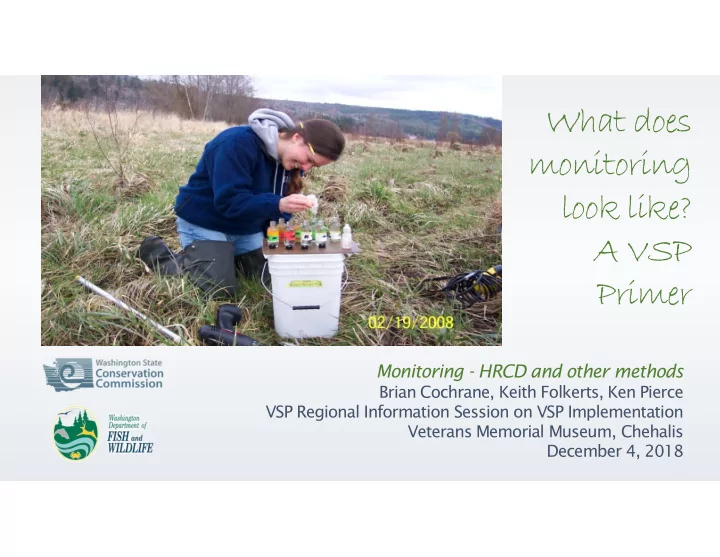
What does monitoring look like? A VSP Primer Monitoring - HRCD and other methods Brian Cochrane, Keith Folkerts, Ken Pierce VSP Regional Information Session on VSP Implementation Veterans Memorial Museum, Chehalis December 4, 2018

slide-1
SLIDE 1

Monitoring - HRCD and other methods

Brian Cochrane, Keith Folkerts, Ken Pierce VSP Regional Information Session on VSP Implementation Veterans Memorial Museum, Chehalis December 4, 2018

What does monitoring look like? A VSP Primer

slide-2
SLIDE 2

Monitoring basics:

  • Hypothesis formulation …
  • Sampling
  • Types of error
  • How good does your data need to be?
  • What to measure?
  • Sampling for rare events …
  • Validating models …
  • HRCD as an example.
slide-3
SLIDE 3

Question?

How good of an answer?

Monitoring Toolbox Monitoring plan

Cost

Number of samples Method Time

Lets start with the a conversation …

slide-4
SLIDE 4

Another way of looking at it…

slide-5
SLIDE 5

Question?

How good of an answer?

Monitoring plan

Co$t Co$t

slide-6
SLIDE 6
  • Hypothesis formulation …

“If [variable], then [result], (due to [rationale]).”

  • The question comes first.
  • A hypothesis is a statement, not a question. The

hypothesis is an educated, testable prediction about what will happen.

  • Make it clear.
  • Keep the variables in mind.
  • Make sure your hypothesis is "testable."
  • Do your homework.
  • Don't bite off more than you can chew!
slide-7
SLIDE 7

H0: x indicator of critical area function is the same in 2016 compared to 2011. Ha: x indicator of critical area function is different in 2016 compared to 2011.

Null:

  • a statement about the value of a

population parameter that is assumed to be true for the purpose of testing.

  • always includes an equals sign

(2016 = 2011) Alternative:

  • a statement about the

value of a population parameter that is assumed to be true if the null hypothesis is rejected during testing.

  • always the opposite of the

null hypothesis.

slide-8
SLIDE 8

H0: the sample of x variable in 2016 is drawn from the same population in as

  • bserved in 2011.

Ha: the sample of x variable in 2016 is from a different population as observed in 2011.

slide-9
SLIDE 9
  • Sampling
slide-10
SLIDE 10
slide-11
SLIDE 11
slide-12
SLIDE 12

These two samples have the same mean. Are they drawn from the same population?

Mean Variable-> Number of observations

slide-13
SLIDE 13

Types of error as told by the story of the boy who cried wolf: H0: there is no wolf Ha: there is a wolf Villagers believe the boy when there is no wolf – type 1 error Villagers don’t believe the boy when there actually is a wolf – type 2 error

KUOW.org

slide-14
SLIDE 14
slide-15
SLIDE 15
  • How good does your data need to be?

Answer = POWER!

  • Statistical power is the

likelihood that a study will detect an effect when there is an effect there to be detected.

  • Power is the probability that the

test correctly rejects a false null hypothesis (H0).

  • It avoids Type I error.
slide-16
SLIDE 16
  • How good does your data need to be?
slide-17
SLIDE 17
  • How good does your data need to be?

A statistically significant difference indicates only that the difference is unlikely to have occurred by chance.

slide-18
SLIDE 18
  • How good does your data need to be?
slide-19
SLIDE 19
  • How good does your data need to be?
slide-20
SLIDE 20

What to measure?

  • Keep the variables in mind.
  • Make sure your hypothesis is

"testable."

  • What are the functions of x critical area?
  • Which of these are of greatest interest

(biologically?, economically?, politically?)

  • Which of these are measurable at the scale

and time frame of interest?

  • Can I use surrogates?

Ask yourself:

slide-21
SLIDE 21

What are the functions?

  • Wetlands
  • CARAs
  • Geologically

Hazardous Areas

  • Frequently Flooded

Areas

  • Fish and Wildlife

Habitat Conservation Areas

  • Assist in the reduction of erosion,

siltation, flooding;

  • Ground and surface water

pollution;

  • Provide wildlife, plant, and

fisheries habitats (perhaps seasonally);

  • Storage of water
  • Transformation of nutrients
  • Growth of living matter, diversity
  • f wetland and/or rare plants
slide-22
SLIDE 22

Which of these are of greatest interest? Which of these are measurable at the scale and time frame of interest?

  • Assist in the reduction of erosion,

siltation, flooding;

  • Ground and surface water

pollution;

  • Provide wildlife, plant, and

fisheries habitats (perhaps seasonally);

  • Storage of water;
  • Transformation of nutrients;
  • Growth of living matter, diversity
  • f wetland and/or rare plants.

Some Wetland Functions Ideas for Measurement

  • Diversity of plant species
  • Number and types of

species of large invertebrates

  • Range of water-level

fluctuation

  • Sedimentation rates
slide-23
SLIDE 23

Can I use surrogates?

Ideas for Measurement

  • Diversity of plant species
  • Number and types of

species of large invertebrates

  • Range of water-level

fluctuation

  • Sedimentation rates

Surrogate Ideas

  • Total sediment in/out
  • Suspended sediment in/out
  • Turbidity in/out
  • Change in RUSLE in watershed
  • Change in open water area due

to sediment and emergent plant colonization

slide-24
SLIDE 24

Can I use surrogates?

Surrogates assume a relationship between the measurement and the real parameter of interest.

slide-25
SLIDE 25

This number is not the same measurement as this number. Images are not same thing as the object you are trying to measure!! It’s a model.

Can I use surrogates?

slide-26
SLIDE 26

Can I use surrogates?

Tagestad, JD, Downs, JL. 2007. Landscape Measures of Rangeland Condition in the Bureau of Land Management Owyhee Pilot Project: Shrub Canopy Mapping, Vegetation Classification, and Detection of Anomalous Land Areas. Prepared for the U.S. Department of Interior, Bureau of Land Management & U.S. Department of Energy, Contract DE-AC05-76RL01830 Jones, M. O., B. W. Allred, D. E. Naugle, J. D. Maestas, P. Donnelly, L. J. Metz, J. Karl, R. Smith, B. Bestelmeyer,

  • C. Boyd, J. D. Kerby, and J. D. McIver. 2018. Innovation in rangeland monitoring: annual, 30 m, plant functional

type percent cover maps for U.S. rangelands, 1984–2017. Ecosphere 9(9):e02430. 10.1002/ecs2.2430

slide-27
SLIDE 27
  • Sampling for rare events
  • Clumped distributions (spatially)
  • Rare (uncommon)
  • Temporal

Typically use stratified sampling to narrow area of interest or use a model predict where the event will occur, then look in those areas, then refine the model.

slide-28
SLIDE 28

Transition from concepts to specific monitoring example using HRCD.

slide-29
SLIDE 29

Thank you!

Contact:

Keith Folkerts

Priority Habitats and Species Section Manager | Land Use Policy Lead

keith.Folkerts@dfw.wa.gov Office (360) 902-2390 | Cell (360) 628-6757

Kenneth B. Pierce Jr. PhD

Landscape Spatial Analytics Section Lead kenneth.PierceJr@dfw.wa.gov Office (360) 902-2564 | Cell (360) 529-2606

Brian Cochrane

Habitat and Monitoring Coordinator bcochrane@scc.wa.gov Office (360) 407-7103

Photo: Dean White, Lincoln CD