What Drives Genetics Research? Scientific objectives: Pursuit of - - PDF document

what drives genetics research
SMART_READER_LITE
LIVE PREVIEW

What Drives Genetics Research? Scientific objectives: Pursuit of - - PDF document

Genetics Research in Communities and Across Cultures Columbia University, May 19, 2006 Victor B. Penchaszadeh, MD, MSPH Mailman School of Public Health Columbia University New York What Drives Genetics Research? Scientific objectives:


slide-1
SLIDE 1

1

Genetics Research in Communities and Across Cultures

Columbia University, May 19, 2006

Victor B. Penchaszadeh, MD, MSPH Mailman School of Public Health Columbia University New York

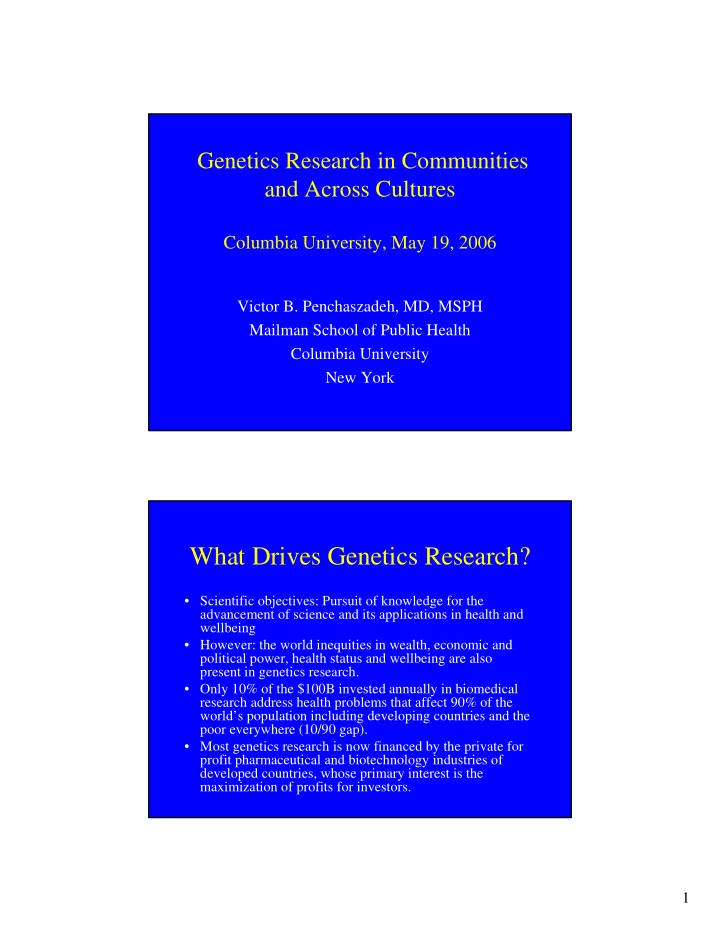
What Drives Genetics Research?

  • Scientific objectives: Pursuit of knowledge for the

advancement of science and its applications in health and wellbeing

  • However: the world inequities in wealth, economic and

political power, health status and wellbeing are also present in genetics research.

  • Only 10% of the $100B invested annually in biomedical

research address health problems that affect 90% of the world’s population including developing countries and the poor everywhere (10/90 gap).

  • Most genetics research is now financed by the private for

profit pharmaceutical and biotechnology industries of developed countries, whose primary interest is the maximization of profits for investors.

slide-2
SLIDE 2

2

Diverse Communities and Population Genetics Research I

  • “Diverse” communities are targets for

genetic research when they present a higher burden of disease. While the evidence overwhelmingly shows that these health disparities are largely due to socioeconomic reasons, research keeps looking for genetic reasons, giving the message to those communities that something genetic is wrong with them.

Diverse Communities and Population Genetics Research II

  • The interaction between researchers and

communities targeted for research is affected by different life experiences and world views, as well as by an asymmetry of power

  • Reductionism with overemphasis in genetic causes

is not only unscientific, but leads to stigmatization

  • f targeted communities constituted by the poor

and people of color.

slide-3
SLIDE 3

3

International Research

  • The developing world attracts genetics research:
  • lower costs
  • lesser regulations
  • large families
  • special genetic traits
  • study of human genetic variation
  • Communities in developing countries are

generally poor, with different languages, culture and world views.

Special Concerns in International Research

  • Suspicion toward outsiders due to previous

colonizing experiences and current experiences of exploitation

  • Does the research address the community’s

priorities?

  • How will results be used?
  • Will research participants and their communities

benefit from the research and in which way?

  • The responsibility of conducting research among

poor, uneducated, destitute populations

slide-4
SLIDE 4

4

Special Concerns in Genetics Research Across Diverse Communities

  • Confusion of biological and socio-political

constructs of categories of race and ethnicity

  • Overemphasis in genetic causation of disease

rather than in environmental factors amenable to interventions

  • Reinforcement of genetic reductionism and

determinism

  • Stereotyping population groups with respect to

genetic disease

Possible Risks and Harms of Genetic Research

a) group harms

  • generate or perpetuate discrimination and

stigmatization of population groups

  • lack of access to the benefits of research
  • exploitation
  • fatalism derived from misconstrued interpretation of

the genetic factors involved in causation

b) individual harms

  • stigmatization
  • insurance or employment discrimination
  • familial disruption
  • psychological distress
slide-5
SLIDE 5

5

Informed Consent in International Research in Genetics

  • Is informed consent the only ethical safeguard?
  • Substance versus form
  • Education tool versus legal protection for

researchers

  • Patient versus research subject
  • Physician versus researcher
  • Asymmetries of power between researcher and

research participants

Issues in Informed Consent in Genetics Research

  • How to avoid subtle coercion and ensure

genuine consent

  • How to ensure educational approaches to

informed consent: language, understanding, relevance to cultural mores, issues of power

  • How to ensure protection from

stigmatization and discrimination

  • Individual, family and community consent
slide-6
SLIDE 6

6

Factors That Influence Community Perceptions of Benefits and Risks of Genetics Research

  • Historical experience: benefits and harms

associated with past research

  • Researchers perceived as outsiders to the

community and representing foreign (powerful) interests

  • Health system values: health as a human right and

a public good versus a market commodity

  • Current discourse on genetics factors in

community identity and prevalence of disease

Strategies to improve interaction between genetic researchers and participant communities I

  • Make sure that your intended research is in line with the

priorities of the community

  • Respect the community’s culture, world views,

expectations

  • Involve the community from the beginning, in the

discussion of the relevance, goals, risks and benefits of your intended research in the light of their world view and needs

  • Involve indigenous researchers as equal partners and

contribute to research capacity building in the community

slide-7
SLIDE 7

7

Strategies to improve interaction between genetic researchers and participant communities II

  • Make good faith efforts in reducing the

asymmetry of power. Everything should be on the table: priorities, political issues, use of results, data ownership, publication of results, intellectual property, benefit to the community, privacy, protections from stigmatization and discrimination

  • Develop partnerships between researchers and

communities, where sharing of benefits and risks are clearly defined from the start