
SLIDE 1
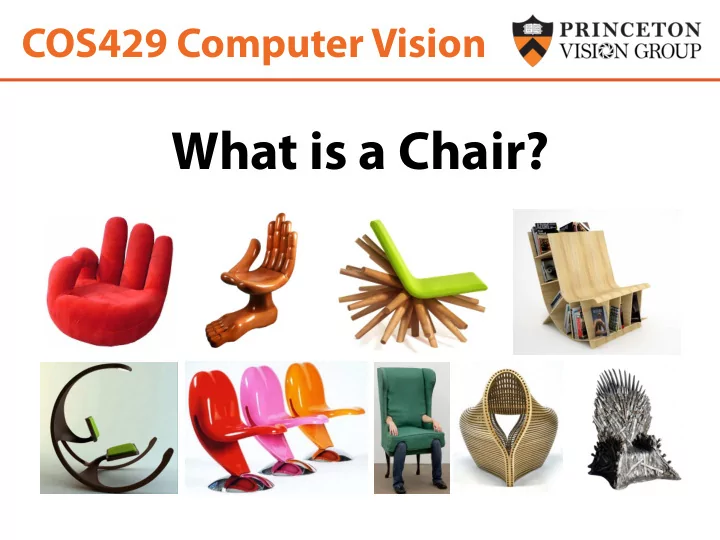
What is a Chair? The object The texture The object The texture - - PowerPoint PPT Presentation
COS429 Computer Vision What is a Chair? The object The texture The object The texture The scene The object Instances vs. categories Instances Find these two toys Categories Find a bottle: Cant do Can nail it unless you do not care
The object
The object The texture
The object The texture The scene
Find a bottle:
Categories
Can’t do unless you do not care about few errors…
Instances Find these two toys
Can nail it
Perception of function: We can perceive the 3D shape, texture, material properties, without knowing about objects. But, the concept of category encapsulates also information about what can we do with those objects.
“We therefore include the perception of function as a proper –indeed, crucial- subject for vision science”, from Vision Science, chapter 9, Palmer.
Flat surface Horizontal Knee-high … Sittable upon Chair Chair Chair? Flat surface Horizontal Knee-high … Sittable upon Chair
Some aspects of an object function can be perceived directly
indicate to a function (“sittable-upon”, container, cutting device, …)
Sittable-upon Sittable-upon Sittable-upon It does not seem easy to sit-upon this…
Some aspects of an object function can be perceived directly
dependent
From http://lastchancerescueflint.org
The functions are the same at some level of description: we can put things inside in both and somebody will come later to empty them. However, we are not expected to put inside the same kinds of things…
Objects of similar structure might have very different functions
Not all functions seem to be available from direct visual information only.
Propulsion system Strong protective surface Something that looks like a door Sure, I can travel to space on this object
Visual appearance might be a very weak cue to function
This is a chair Find the chair in this image Output of normalized correlation
My biggest concern while making this slide was: how do I justify 50 years of research, and this course, if this experiment did work? Find the chair in this image Pretty much garbage Simple template matching is not going to make it
Find the chair in this image A “popular method is that of template matching, by point to point correlation of a model pattern with the image pattern. These techniques are inadequate for three- dimensional scene analysis for many reasons, such as occlusion, changes in viewing angle, and articulation of parts.” Nivatia & Binford, 1977.
Challenges 1: view point variation
Michelangelo 1475-1564
Slides: course object recognition ICCV 2005
Challenges 2: illumination
slide credit: S. Ullman
Challenges 3: occlusion
Magritte, 1957
Slides: course object recognition ICCV 2005
Challenges 4: scale
Slides: course object recognition ICCV 2005
Challenges 5: deformation
Xu, Beihong 1943
Slides: course object recognition ICCV 2005
Challenges 6: intra-class variation
Slides: course object recognition ICCV 2005
Brady, M. J., & Kersten, D. (2003). Bootstrapped learning of novel objects. J Vis, 3(6), 413-422
Challenges 7: background clutter
Car is an object composed of: a few doors, four wheels (not all visible at all times), a roof, front lights, windshield If you are thinking in buying a car, you might want to be a bit more specific about your categorization.
?
(Jolicoeur, Gluck, Kosslyn 1984)
are categorized at the expected level
a subordinate level.
A bird An ostrich
A new class can borrow information from similar categories
Yes, object recognition is hard…
(or at least it seems so for now…)
Nice framework to develop fancy math, but too far from reality…
Object Recognition in the Geometric Era: a Retrospective. Joseph L. Mundy. 2006
Object Recognition in the Geometric Era: a Retrospective. Joseph L. Mundy. 2006
Irving Biederman Recognition-by-Components: A Theory of Human Image Understanding. Psychological Review, 1987.
The fundamental assumption of the proposed theory, recognition-by-components (RBC), is that a modest set
can be derived from contrasts of five readily detectable properties of edges in a two-dimensional image: curvature, collinearity, symmetry, parallelism, and cotermination. The “contribution lies in its proposal for a particular vocabulary of components derived from perceptual mechanisms and its account of how an arrangement of these components can access a representation of an
1) We know that this object is nothing we know 2) We can split this objects into parts that everybody will agree 3) We can see how it resembles something familiar: “a hot dog cart” “The naive realism that emerges in descriptions of nonsense objects may be reflecting the workings of a representational system by which objects are identified.”
components that constitute the primitive elements of the
be relevant to the generation of the volumetric primitives have the desirable properties that they are invariant over changes in orientation and can be determined from just a few points on each edge.”
entities with specified boundaries.” (count nouns) – this limitation is shared by many modern object detection algorithms.
Constraints on possible models of recognition
1) Access to the mental representation of an
judgments of quantitative detail 2) The information that is the basis of recognition should be relatively invariant with respect to
3) Partial matches should be computable. A theory
principled means for computing a match for
category.
“Parsing is performed, primarily at concave regions, simultaneously with a detection of nonaccidental properties.”
Certain properties of edges in a two-dimensional image are taken by the visual system as strong evidence that the edges in the three-dimensional world contain those same properties. Non accidental properties, (Witkin & Tenenbaum,1983): Rarely be produced by accidental alignments of viewpoint and object features and consequently are generally unaffected by slight variations in viewpoint. ?
image
Examples:
The high speed and accuracy of determining a given nonaccidental relation {e.g., whether some pattern is symmetrical) should be contrasted with performance in making absolute quantitative judgments of variations in a single physical attribute, such as length of a segment or degree of tilt or curvature. Object recognition is performed by humans in around 100ms.
“If contours are deleted at a vertex they can be restored, as long as there is no accidental filling-in. The greater disruption from vertex deletion is expected on the basis
Recoverable Unrecoverable
“From variation over only two or three levels in the nonaccidental relations of four attributes of generalized cylinders, a set of 36 GEONS can be generated.” Geons represent a restricted form of generalized cylinders.
Mezzanotte & Biederman
Introduced in computer vision by A. Pentland, 1986.
The notion of geometric structure. Although they were aware of it, the previous works put more emphasis on defining the primitive elements than modeling their geometric relationships.
With a different perspective, these models focused more on the geometry than on defining the constituent elements:
Figure from [Fischler & Elschlager 73]
– Generative representation
– Relative locations between parts – Appearance of part
– How to model location – How to represent appearance – Sparse or dense (pixels or regions) – How to handle occlusion/clutter
We will discuss these models more in depth later
But, despite promising initial results…things did not work out so well (lack of data, processing power, lack of reliable methods for low-level and mid- level vision) Instead, a different way of thinking about object detection started making some progress: learning based approaches and classifiers, which ignored low and mid-level vision. Maybe the time is here to come back to some of the earlier models, more grounded in intuitions about visual perception.
Fukushima (1980). Hierarchical multilayered neural network S-cells work as feature-extracting cells. They resemble simple cells of the primary visual cortex in their response. C-cells, which resembles complex cells in the visual cortex, are inserted in the network to allow for positional errors in the features of the stimulus. The input connections of C-cells, which come from S-cells of the preceding layer, are fixed and invariable. Each C-cell receives excitatory input connections from a group
C-cell responds if at least one of these S-cells yield an output.
Learning is done greedily for each layer
The output neurons share all the intermediate levels Le Cun et al, 98
Mukherjee, Poggio (2001)
Poggio 95]
using Gaussian distributions and PCA
Poggio 95]
Training Database 1000+ Real, 3000+ VIRTUAL 50,0000+ Non-Face Pattern
arbitrate a decision among all outputs [Rowley et al. 98]
59 http://www.marcofolio.net/imagedump/faces_everywhere_15_images_8_illusions.html
Paul Viola Michael J. Jones Mitsubishi Electric Research Laboratories (MERL) Cambridge, MA
Most of this work was done at Compaq CRL before the authors moved to MERL
Rapid Object Detection Using a Boosted Cascade of Simple Features
http://citeseer.ist.psu.edu/cache/papers/cs/23183/http:zSzzSzwww.ai.mit.eduzSzpeoplezSzviolazSzresearchzSzpublicationszSzICCV01-Viola-Jones.pdf/viola01robust.pdf
Manuscript available on web:
Bag of words models Voting models Constellation models Rigid template models
Sirovich and Kirby 1987 Turk, Pentland, 1991 Dalal & Triggs, 2006 Fischler and Elschlager, 1973 Burl, Leung, and Perona, 1995 Weber, Welling, and Perona, 2000 Fergus, Perona, & Zisserman, CVPR 2003 Viola and Jones, ICCV 2001 Heisele, Poggio, et. al., NIPS 01 Schneiderman, Kanade 2004 Vidal-Naquet, Ullman 2003
Shape matching Deformable models
Csurka, Dance, Fan, Willamowski, and Bray 2004 Sivic, Russell, Freeman, Zisserman, ICCV 2005 Berg, Berg, Malik, 2005 Cootes, Edwards, Taylor, 2001
(The lousy painter)
10 20 30 40 50 60 70 0.05 0.1
x = data
10 20 30 40 50 60 70 0.5 1
x = data
10 20 30 40 50 60 70 80
1
x = data
(The artist)
Object detection and recognition is formulated as a classification problem.
Bag of image patches
Decision boundary
… and a decision is taken at each window about if it contains a target object or not.
Computer screen Background
In some feature space
Where are the screens?
The image is partitioned into a set of overlapping windows
106 examples
Nearest neighbor Shakhnarovich, Viola, Darrell 2003 Berg, Berg, Malik 2005 … Neural networks LeCun, Bottou, Bengio, Haffner 1998 Rowley, Baluja, Kanade 1998 … Support Vector Machines and Kernels Conditional Random Fields McCallum, Freitag, Pereira 2000 Kumar, Hebert 2003 … Guyon, Vapnik Heisele, Serre, Poggio, 2001 …
+1
x1 x2 x3 xN
… …
xN+1 xN+2 xN+M
? ? ? …
Training data: each image patch is labeled as containing the object or background Test data Features x = Labels y = Where belongs to some family of functions
(Not that simple: we need some guarantees that there will be generalization)
Explicit 3D models: use volumetric
the 3D geometry of the object.
Appealing but hard to get it to work…
Implicit 3D models: matching the input 2D view to view-specific representations.
Not very appealing but somewhat easy to get it to work…
Experiment ¡1: ¡draw ¡a ¡horse ¡(the ¡en3re ¡body, ¡ not ¡just ¡the ¡head) ¡in ¡a ¡white ¡piece ¡of ¡paper. ¡ ¡ ¡ Do ¡not ¡look ¡at ¡your ¡neighbor! ¡You ¡already ¡know ¡ how ¡a ¡horse ¡looks ¡like… ¡no ¡need ¡to ¡cheat. ¡
Experiment ¡2: ¡draw ¡a ¡horse ¡(the ¡en3re ¡body, ¡ not ¡just ¡the ¡head) ¡but ¡this ¡3me ¡chose ¡a ¡ viewpoint ¡as ¡weird ¡as ¡possible. ¡ ¡
Despite we can categorize all three pictures as being views of a horse, the three pictures do not look as being equally typical views of
recognizable with the same easiness.
From Vision Science, Palmer
Examples of canonical perspective: In a recognition task, reaction time correlated with the ratings. Canonical views are recognized faster at the entry level. Experiment (Palmer, Rosch & Chase 81): participants are shown views of an object and are asked to rate “how much each one looked like the objects they depict” (scale; 1=very much like, 7=very unlike)
Clocks are preferred as purely frontal
[Navneet ¡Dalal ¡and ¡Bill ¡Triggs, ¡2005] ¡
CVPR 2005
¡2. ¡Training ¡with ¡posi3ve ¡and ¡nega3ve ¡(linear ¡SVM) posi3ve ¡training ¡examples ¡ nega3ve ¡training ¡examples ¡
¡2. ¡Training ¡with ¡posi3ve ¡and ¡nega3ve ¡(linear ¡SVM) ¡
¡Binary ¡classifica3on ¡on ¡each ¡loca3on ¡
Problem ¡: ¡ Bounding ¡box ¡size ¡is ¡different ¡for ¡the ¡same ¡ ¡
¡ Solu3on ¡1: ¡ Resize ¡the ¡box ¡and ¡do ¡mul3ple ¡convolu3on? ¡ Not ¡ideal ¡: ¡ It ¡will ¡change ¡the ¡feature ¡dimension, need ¡ to ¡retrain ¡the ¡SVM ¡for ¡each ¡scale. ¡
Solu3on ¡2: ¡ Resize ¡the ¡image ¡and ¡do ¡mul3ple ¡convolu3on?-> ¡image ¡pyramid ¡ Image ¡is ¡smaller ¡~ ¡box ¡is ¡bigger ¡ Image ¡is ¡larger ¡~ ¡box ¡is ¡smaller ¡
¡2. ¡Training ¡with ¡posi3ve ¡and ¡nega3ve ¡(linear ¡SVM) ¡
¡Binary ¡classifica3on ¡on ¡each ¡loca3on ¡
¡2. ¡Training ¡with ¡posi3ve ¡and ¡nega3ve ¡(linear ¡SVM) ¡
Final ¡Boxes ¡ Detector ¡response ¡map ¡ A]er ¡thresholding ¡ ¡ A]er ¡non-‑maximum ¡suppression ¡
greatest ¡magnitude ¡ ¡as ¡final ¡gradient ¡ ¡
gradient ¡ ¡orienta3ons ¡ ¡
– Bilinearly into spatial cells – Linearly into orientation bins
Cell ¡ Cell ¡ Current ¡cell ¡: ¡1x18 ¡histogram ¡ ¡ Block: ¡2x2 ¡cell ¡ ¡overlapping ¡with ¡current ¡cell ¡
Normalize ¡4 ¡3mes ¡by ¡its ¡neighbor ¡blocks, ¡and ¡average ¡them ¡ ¡ ¡
3me,not ¡average ¡-‑> ¡4 ¡dim ¡ ¡ ¡ In ¡total ¡each ¡cell ¡: ¡18+9+4 ¡dimension ¡of ¡feature ¡ ¡
¡ Visualiza3on: ¡
1. Compute ¡gradients ¡on ¡an ¡image ¡ region ¡of ¡64x128 ¡pixels ¡ 2. Compute ¡histograms ¡on ¡‘cells’ ¡of ¡ typically ¡8x8 ¡pixels ¡(i.e. ¡8x16 ¡cells) ¡ ¡ 3. Normalize ¡histograms ¡within ¡
¡ 4. Concatenate ¡histograms ¡ It ¡is ¡a ¡typical ¡procedure ¡of ¡ ¡feature ¡extrac8on ¡! ¡ ¡
lot ¡of ¡engineering ¡
– Tes3ng ¡of ¡parameters ¡(e.g. ¡size ¡of ¡cells, ¡blocks, ¡ number ¡of ¡cells ¡in ¡a ¡block, ¡size ¡of ¡overlap) ¡ – Normaliza3on ¡schemes ¡ ¡
make ¡these ¡design ¡desicca3ons ¡
engineering ¡effort ¡
Single, ¡rigid ¡template ¡usually ¡not ¡enough ¡to ¡ represent ¡a ¡category. ¡
different ¡viewpoints, ¡or ¡style ¡ ¡ ¡ ¡
have ¡parts ¡that ¡can ¡vary ¡in ¡configura3on ¡ ¡
¡
for ¡Object ¡Detec3on ¡and ¡Beyond ¡
for ¡each ¡posi3ve ¡instance ¡
For ¡each ¡category ¡it ¡can ¡has ¡exemplar ¡with ¡different ¡size ¡aspect ¡ra3o ¡
without ¡using ¡complicated ¡model. ¡
make ¡use ¡of ¡nega3ve ¡data ¡and ¡train ¡a ¡ discrimina3ve ¡object ¡detector ¡
to ¡training ¡exemplar ¡ ¡
to ¡training ¡exemplar ¡ ¡
We ¡not ¡only ¡know ¡it ¡is ¡train,but ¡also ¡its ¡orienta3on ¡ and ¡type! ¡
We ¡can ¡do ¡even ¡more ¡ ¡
Objec3ve ¡Func3on: ¡ ¡ Learn ¡the ¡w ¡that ¡minimize ¡the ¡ ¡objec3ve ¡ func3on, equivalent ¡to ¡maximize ¡the ¡margin ¡ ¡ ¡ ¡ ¡
h(x) ¡=0 ¡
Windows ¡from ¡images ¡not ¡containing ¡any ¡in-‑ class ¡instances: ¡but ¡there ¡is ¡too ¡many! ¡ 2,000 ¡images ¡x ¡10,000 ¡windows ¡per ¡image ¡= ¡ 20M ¡nega3ves ¡ ¡ ¡ Find ¡ones ¡that ¡you ¡get ¡wrong ¡by ¡a ¡search, ¡and ¡train ¡
While ¡: ¡ i ¡!= ¡m ¡or ¡Nhard ¡not ¡empty ¡ ¡for ¡i= ¡1to ¡n ¡do ¡ ¡ ¡ D ¡= ¡detect(b,w,Ji) ¡ ¡ ¡ ¡ Ni= ¡D.conf ¡> ¡threshold ¡& ¡D ¡not ¡overlap ¡with ¡Bi ¡
¡ ¡ ¡ ¡ ¡ Add ¡Ni ¡to ¡Nhard ¡
¡ ¡ ¡ ¡if ¡|Nhard| ¡> ¡memory-limit, ¡then ¡break; ¡
¡end ¡
¡[SVnew,bnew,wnew]=trainSVM(E, ¡[Nrandom,SV]) ¡ ¡SV ¡= ¡[SV; ¡SVnew] ¡ end ¡ Input ¡: ¡Posi3ve ¡: ¡exemplar ¡E ¡ ¡ ¡ ¡Nega3ve ¡: ¡images ¡and ¡bounding ¡boxes ¡for ¡this ¡category ¡ ¡ ¡ ¡ N={(J1,B1), ¡(J2,B2),…(Jm,Bm)} ¡ Ini)alize: random ¡pick ¡m ¡patches ¡Nrandom ¡from ¡N ¡that ¡not ¡overlap ¡with ¡ ¡ ¡ ¡ ¡[SV,b,w]=trainSVM(E, ¡Nrandom) ¡ Hard ¡nega)ve ¡mining ¡ ¡ ¡
Objects ¡are ¡represented ¡by ¡features ¡of ¡parts ¡and ¡ spa3al ¡rela3ons ¡between ¡parts ¡
category ¡ ¡
rela3ons ¡to ¡obtained ¡the ¡final ¡detec3on ¡
Voting models Constellation models Deformable models
From wikipedia: Perhaps the most famous part of the work is chapter XVII, "The Comparison of Related Forms," where Thompson explored the degree to which differences in the forms of related animals could be described by means of relatively simple mathematical transformations.
Voting models Constellation models Deformable models
B a g
w
d s
Slide credit: Fei fei
Of all the sensory impressions proceeding to the brain, the visual experiences are the dominant ones. Our perception of the world around us is based essentially on the messages that reach the brain from our eyes. For a long time it was thought that the retinal image was transmitted point by point to visual centers in the brain; the cerebral cortex was a movie screen, so to speak, upon which the image in the eye was projected. Through the discoveries of Hubel and Wiesel we now know that behind the origin of the visual perception in the brain there is a considerably more complicated course of events. By following the visual impulses along their path to the various cell layers of the optical cortex, Hubel and Wiesel have been able to demonstrate that the message about the image falling on the retina undergoes a step- wise analysis in a system of nerve cells stored in columns. In this system each cell has its specific function and is responsible for a specific detail in the pattern of the retinal image.
sensory, brain, visual, perception, retinal, cerebral cortex, eye, cell, optical nerve, image Hubel, Wiesel
China is forecasting a trade surplus of $90bn (£51bn) to $100bn this year, a threefold increase on 2004's $32bn. The Commerce Ministry said the surplus would be created by a predicted 30% jump in exports to $750bn, compared with a 18% rise in imports to $660bn. The figures are likely to further annoy the US, which has long argued that China's exports are unfairly helped by a deliberately undervalued yuan. Beijing agrees the surplus is too high, but says the yuan is only one factor. Bank of China governor Zhou Xiaochuan said the country also needed to do more to boost domestic demand so more goods stayed within the
yuan against the dollar by 2.1% in July and permitted it to trade within a narrow band, but the US wants the yuan to be allowed to trade
it will take its time and tread carefully before allowing the yuan to rise further in value.
China, trade, surplus, commerce, exports, imports, US, yuan, bank, domestic, foreign, increase, trade, value
Slide credit: Fei fei
Object ¡Detec3on ¡with ¡Discrimina3vely ¡Trained ¡Part ¡Based ¡Models, ¡PAMI ¡32(9), ¡ 2010 ¡
DPM ¡: ¡Object ¡Detec8on ¡with ¡ Discrimina8vely ¡Trained ¡Part ¡Based ¡Models ¡
deformable ¡part ¡models ¡(components) ¡
deformable ¡parts ¡
(Latent ¡SVM) ¡
component ¡ ¡for ¡different ¡aspect ¡ra3o ¡(handle ¡ intra-‑class ¡variance) ¡
Model encodes local appearance + pairwise geometry
Source: Deva Ramanan
Source: Deva Ramanan
Source: Deva Ramanan
PASCAL Visual Object Challenge
5000 training images 5000 testing images 20 everyday object categories
aeroplane bike bird boat bottle bus car cat chair cow table dog horse motorbike person plant sheep sofa train tv
Source: Deva Ramanan
5 years of PASCAL people detection
average precision
Discriminative mixtures of star models 2007-2010 Felzenszwalb,
McAllester, Ramanan CVPR 2008 Felzenszwalb, Girshick, McAllester, and Ramanan PAMI 2009
1% to 45% in 5 years
Source: Deva Ramanan
Precision = TP / (TP + FP) Recall = TP / (TP + FN)
Object No Object Truth Object No Object Algorithm Prediction
True Positive True Negative False Positive False Negative
Truth Prediction
Intersection Over Union =
Table