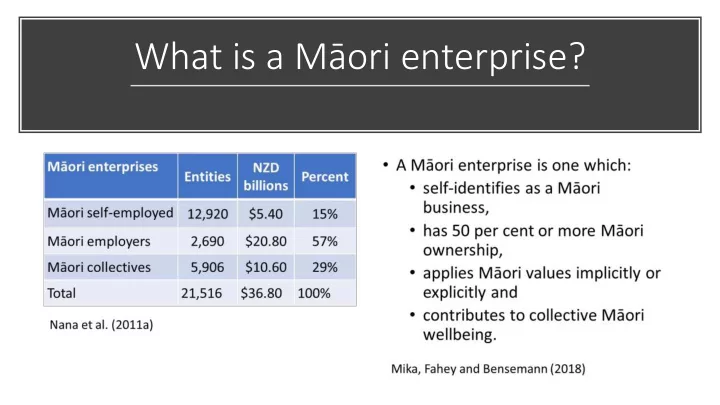
What is a Mori enterprise? Economy An economy is a system Mori - - PowerPoint PPT Presentation

what is a m ori enterprise economy
SMART_READER_LITE
LIVE PREVIEW

What is a Mori enterprise? Economy An economy is a system Mori - - PowerPoint PPT Presentation

What is a Mori enterprise? Economy An economy is a system Mori economy is What is an of actors (organisations, highly integrated economy? institutions, individuals withy the New etc) which interacts to Zealand economy produce


slide-1
SLIDE 1

What is a Māori enterprise?

slide-2
SLIDE 2

Economy

slide-3
SLIDE 3

What is an economy?

  • An economy is a system
  • f actors (organisations,

institutions, individuals etc) which interacts to produce and distribute goods and services.

  • Economies traditionally

have a geography, governance systems, institutions and an asset base.

  • Māori economy is

highly integrated withy the New Zealand economy

  • Structure, dynamics

and institutions of the Māori economy are not well defined.

  • Māori view economy

as integrating human, social, cultural, environmental and spiritual dimensions

21

slide-4
SLIDE 4

What is the Māori economy?

“the assets owned and income earned by Māori – including collectively-owned trusts and incorporations, Māori-owned businesses (e.g., tourism, broadcasting, and the self-employed), service providers (especially in health and education), and the housing owned by Māori [and the] wages and salaries earned by Māori workers.”

(NZIER, 2003, p. 7)

20-Aug-20 22

slide-5
SLIDE 5

Māori economy: Selected literature

slide-6
SLIDE 6

Is Māori economic growth sufficient?

20-Aug-20 24

slide-7
SLIDE 7

Sustainable development

slide-8
SLIDE 8

Treaty of Waitangi Feb 6, 1840

20-Aug-20 26

slide-9
SLIDE 9

The rights of Indigenous peoples

20-Aug-20

27

slide-10
SLIDE 10

Sustainable development

Environmental development Economic development Social development

slide-11
SLIDE 11

Policy context

slide-12
SLIDE 12

Role of government in enterprise assistance

  • In theory
  • Non-neutral (hands-on)

policy

  • Neutral (hands-off) policy
  • Private-public good

elements

  • Evidence of market

failure

  • Benefits outweigh costs
  • Evidence intervention will

work

  • National or local support
  • Objective or subjective

exchange

  • In practice
  • There is a role for

government

  • Provider-funder split

remains

  • Rationale for Māori

assistance

  • Rights-based (treaty)
  • Equity-based

(disparities)

  • Efficiency-based

(efficacy)

  • Growth-based

(outputs)

slide-13
SLIDE 13

Māori marine economy

slide-14
SLIDE 14

Māori agribusiness

slide-15
SLIDE 15

Māori tourism

slide-16
SLIDE 16

Conclusion

  • Indigenous entrepreneurship expression of self-

development

  • This occurs within a development context and

process

  • Balancing cultural and commercial imperatives is a

key challenge

  • Sustainable development relies on managerialism

and efficiency

  • No satisfactory principle exists to balance tensions in

sustainability

  • Māori entrepreneurs are developing kaitiaki

business models

  • Role of government is to support indigenous

entrepreneurs to be self-determining and sustainable.