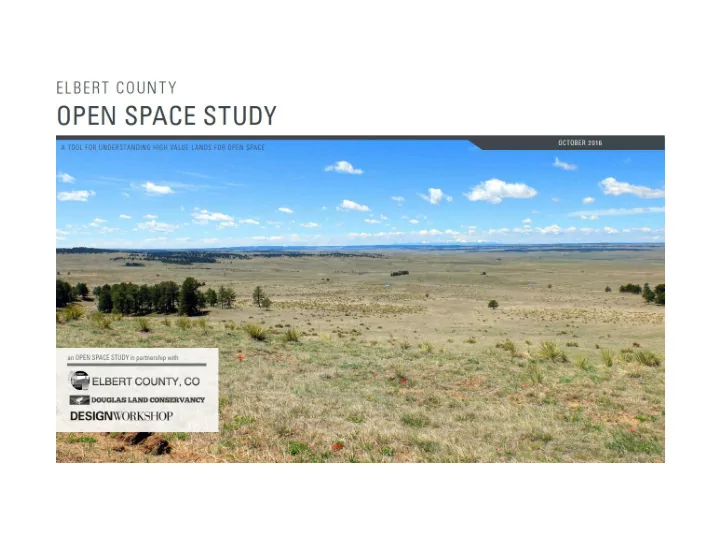
SLIDE 1
SLIDE 2 OVERVIEW
- What is an Open Space Study and Why Now
- Who Was Involved and Process
- The Case for Open Space
- Layer Upon Layer
- Priorities and Approaches
- Q & A
SLIDE 3 It is a …
- Tool for Elbert County to better understand
areas that contain high open space value in
- rder to protect your region’s rural character
- Method of identifying opportunities and
guidance for future open space conservation, habitat protection, and recreation connectivity
- Resource for landowners to understand
- ptions in face of changing economies and
growth pressures
WHAT IS AN OPEN SPACE STUDY?
SLIDE 4 WHAT IS AN OPEN SPACE STUDY?
It is not a …
- Plan for public acquisition of private lands
- Method of identifying individual parcels
- Means of restricting private property rights or
development potential
SLIDE 5
- Community development pressures
- Predicted to be fastest growing county in Colorado over
next 5 years – potentially doubling in population by 2030
- Residential subdivision development serving Denver,
Parker, Castle Rock, and Colorado Springs
- Energy development pressures
- Largest wind energy project in Colorado – 300-400
turbines (440 ft tall) and 90 miles of transmission lines (130 ft tall) – approximately half in eastern Elbert County
- Traditional oil and gas exploration (southern end of
Niobrara / Denver-Julesburg Basin)
- Opens new funding opportunities and aligned
with Comprehensive Plan update process
WHY NOW?
SLIDE 6
- Elbert County Planning Department
- Douglas Land Conservancy (non-profit 501(c)3)
- Design Workshop (planning consultant)
- Stakeholder Focus Groups
WHO WAS INVOLVED
SLIDE 7
- Douglas Land Conservancy
- Non-partisan, non-profit land trust dedicated to the protection
and conservation of the natural character, habitat, and open space of the central front range region of Colorado, including Douglas County and surrounding areas
- Made up of concerned citizens and based in Castle Rock
since 1987
- Recognizing the importance of a regional approach in land
conservation has recently broadened its focus to support surrounding counties, including Jefferson and Elbert
- In 2014, awarded a grant by a local family foundation to help
develop the open space vision study
WHO WAS INVOLVED
SLIDE 8
- Recreation, Education, and Activities
- Peaceful Valley Scout Ranch, Magness Adventure Camp, Plains
Conservation Center, Douglas/Elbert Horse Council, 4H
- Agricultural Working Lands and Natural Resources
- Colorado Cattleman’s Association, Farm Bureau, Colorado
Open Lands, Colorado Parks and Wildlife, U.S. Soil Conservation Service, NRCS, Conservation Fund, Malone Foundation, Nature Conservancy, Kiowa Conservation Board
- Community Development
- Town of Elizabeth (Parks and Recreation, Community
Development), Kiowa Public Works, Simla Public Works
FOCUS GROUP MEETINGS (JUNE 2016)
SLIDE 9
- Data Gathering and Preliminary Analysis
- County Tour and Reconnaissance
- Stakeholder Engagement (Focus Group Meetings)
- Revised Analysis and Development of Priorities
- Documentation of the Study
PROCESS
SLIDE 10
THE CASE FOR OPEN SPACE
RECREATION SCENIC QUALITY WILDLIFE / HABITAT AGRICULTURAL WORKING LANDS
SLIDE 11 THE CASE FOR OPEN SPACE
- Economic
- Preserve existing agricultural economies
- Build on equine facilities ($125M between Elbert and
Douglas Counties)
- Maintain or enhance property values (10-15%)
- Capitalize on recreation/tourism economy ($21B statewide)
- Community
- Identity and continuation of rural way of life
- Citizen’s health and wellness
- Connection to nature for children
- Environmental
- Wildlife habitat
- Water resources protection (surface and aquifer)
- Scenic value (open plains, pine forests, Pikes to Longs)
SLIDE 12 LAYER UPON LAYER
- Gather and analyze multiple layers of GIS
data and information from local, state, and federal sources
- Natural Features and Agricultural Working Lands
- Scenic Quality and Visibility
- Character of Parcel (size and adjacency)
- Assign ranking of Low, Medium, or High to
different characteristics
- Example: Wildlife Nesting/Calving Sites = High,
Winter Range = Medium, Overall Range = Low
- Each layer is individually weighted and
“sandwiched” with the others to equal 100%
SLIDE 13
LAYER UPON LAYER | natural features and agricultural working lands
SLIDE 14
LAYER UPON LAYER | natural features and agricultural working lands
SLIDE 15
LAYER UPON LAYER | scenic quality and visibility
SLIDE 16
LAYER UPON LAYER | scenic quality and visibility
SLIDE 17
LAYER UPON LAYER | character of parcel
SLIDE 18
LAYER UPON LAYER | character of parcel
SLIDE 19
LAYER UPON LAYER | open space suitability composite
SLIDE 20 PRIORITIES AND APPROACHES
- Categories of conservation priorities were
evaluated and assigned to each area of high value (not exclusive of each other)
- Various suggested approaches to achieve the
priorities are recommended
SLIDE 21
PRIORITIES AND APPROACHES
SLIDE 22
PRIORITIES AND APPROACHES
SLIDE 23
PRIORITIES AND APPROACHES
SLIDE 24
PRIORITIES AND APPROACHES
SLIDE 25
PRIORITIES AND APPROACHES
SLIDE 26
PRIORITIES AND APPROACHES
SLIDE 27
PRIORITIES AND APPROACHES
SLIDE 28
Thank You! Questions?