What is Linepack? Linepack describes the total of volume of gas - - PowerPoint PPT Presentation

what is linepack
SMART_READER_LITE
LIVE PREVIEW

What is Linepack? Linepack describes the total of volume of gas - - PowerPoint PPT Presentation

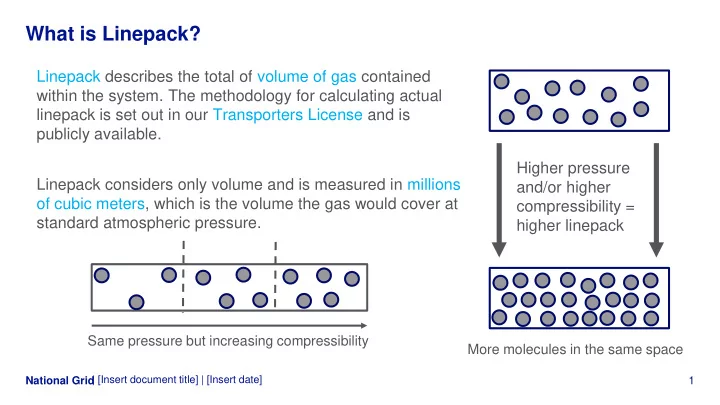
What is Linepack? Linepack describes the total of volume of gas contained within the system. The methodology for calculating actual linepack is set out in our Transporters License and is publicly available. Higher pressure Linepack considers


slide-1
SLIDE 1

1 National Grid

| [Insert document title] | [Insert date]

What is Linepack?

Linepack describes the total of volume of gas contained within the system. The methodology for calculating actual linepack is set out in our Transporters License and is publicly available. Linepack considers only volume and is measured in millions

  • f cubic meters, which is the volume the gas would cover at

standard atmospheric pressure. Higher pressure and/or higher compressibility = higher linepack

More molecules in the same space Same pressure but increasing compressibility

slide-2
SLIDE 2

2 National Grid

As linepack is analogous to average pressure across the network, it is key to the physical operation of the network.

Physical considerations for Linepack

| [Insert document title] | [Insert date]

Increasing Linepack

Higher entry risk but greater flexibility Lower entry risk but reduced flexibility

slide-3
SLIDE 3

3 National Grid

Lower in the summer, higher in the winter

Seasonal Variation in Linepack

| [Insert document title] | [Insert date]

Linepack Demand

Winter Winter Summer

With winter comes:

  • Higher demands
  • Changing diurnal demand

profiles

  • Increased pressure drops
  • Larger daily linepack swings

To protect exit pressures we must maximise flexibility of the NTS

slide-4
SLIDE 4

4 National Grid

Summer Linepack

| [Insert document title] | [Insert date]

Context? Maximum flow is achieved when one end

  • f a pipe is at its max

pressure and the other end is at its minimum. The range of maximum to minimum pressures can be as high as 45 bar in the winter but only around 20 bar in the summer.

40 60 80 100

Typical Pressure Drop

Winter Summer

Lower demands result in:

  • Lower pressure drops
  • Lower natural flow rates
  • Compression to manage high entry flows
slide-5
SLIDE 5

5 National Grid

Winter Linepack

| [Insert document title] | [Insert date]

Context? The differential between supply and demand at tea time on a cold winters can result in as much as 5 mcm being lost from linepack every hour. This is enough gas to supply 4000 households for a year!

150 350 550

Instantaneous Demand over the Day

Winter Summer

High demands and strong diurnal profile results in:

  • Large pressure drops
  • Large linepack swings
  • Lower extremity pressure due to frictional losses
  • Requirement to maintain higher pressures in the

middle of the network

slide-6
SLIDE 6

6 National Grid

Manging the transition

| [Insert document title] | [Insert date]

D D-1 D-2 D-3 D-4

Start Position Desired End Position Transitions <2.8 mcm

  • Requires PCLP to be

different from OLP

  • Avoid sharp changes

within an ‘efficiency’ zone

  • Large transitions could

be required if stock level has drifted over a period

  • f days
  • Balance safety, efficiency

and minimise entry into market

slide-7
SLIDE 7

7 National Grid

Trading behaviour Very simply when we buy gas we need more linepack, when we sell gas we need less linepack. This is normally because we are transitioning between desired linepack regions (for efficiency) or need to arrest a steady increase or decline in linepack. But how much more/less gas do you need? We don’t publish ‘target’ as to minimise our influence in the market but….

  • Trends on OLP, PLCP and Demand can give an indication
  • Just because PCLP is largely different to OLP doesn’t

indicate a trade

Transparency

| [Insert document title] | [Insert date]