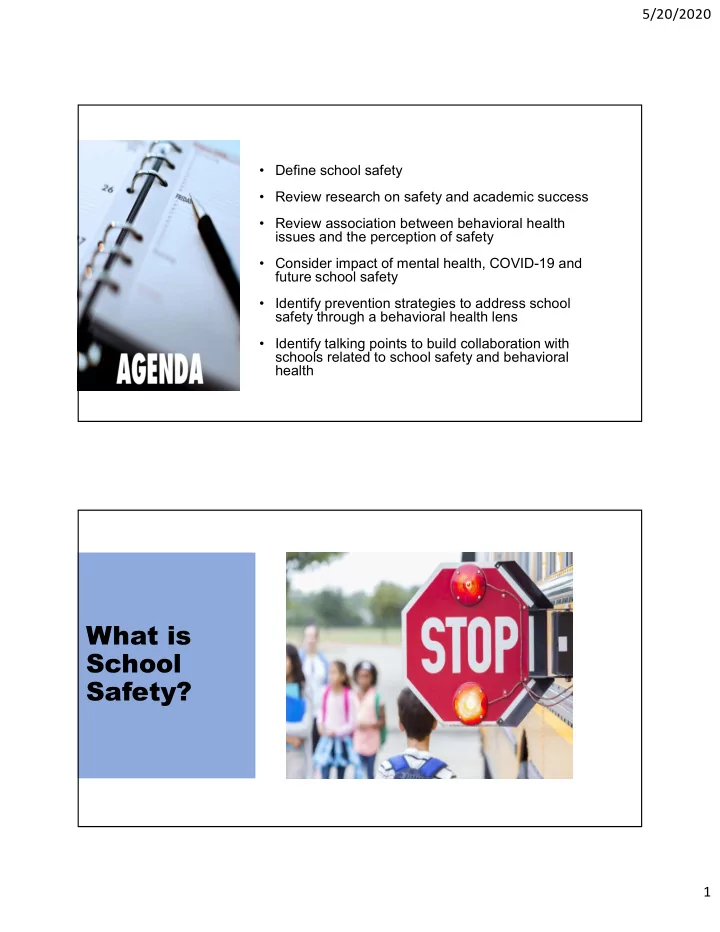
What is School Safety? 1 5/20/2020 What is School Safety is a - - PDF document

what is school safety
SMART_READER_LITE
LIVE PREVIEW

What is School Safety? 1 5/20/2020 What is School Safety is a - - PDF document

5/20/2020 Define school safety Review research on safety and academic success Review association between behavioral health issues and the perception of safety Consider impact of mental health, COVID-19 and future school safety


slide-1
SLIDE 1

5/20/2020 1

  • Define school safety
  • Review research on safety and academic success
  • Review association between behavioral health

issues and the perception of safety

  • Consider impact of mental health, COVID-19 and

future school safety

  • Identify prevention strategies to address school

safety through a behavioral health lens

  • Identify talking points to build collaboration with

schools related to school safety and behavioral health

What is School Safety?

slide-2
SLIDE 2

5/20/2020 2

What is School Safety?1-12

  • Safety is a basic human need
  • Safety includes:
  • Physical safety
  • Emotional safety
  • Effective policies and procedures
  • Caring adults
  • Safety balances physical and psychological needs
  • Safety reflects current events

What is School Safety?13-18

 About 6% of students feel unsafe  Perception of safety > presence of physical safety measures  Fear at school increases psychological distress, likelihood of carrying a gun to school  Suspension = disconnection = perception that school isn’t safe  Younger students’ fear correlated with substance use and personal victimization  Perception that school isn’t safe increased among those who were non-white

slide-3
SLIDE 3

5/20/2020 3

What is School Safety?

2,5, 10, 19-43

  • Physical safety measures:
  • Increase feelings of being unsafe
  • Decrease school climate
  • Reduce student empowerment
  • Increase problem behaviors/student alienation
  • No impact on academic success
  • Staff believe physical measures effective
  • Mixed results related to SROs, cameras
  • Absence of weapons, substance use, treated

mental health issues

POLL QUESTION In the U.S. from 2018-2020, how many people were injured

  • r died in a school shooting?
  • A. 802
  • B. 67

C . 171

  • D. 357
slide-4
SLIDE 4

5/20/2020 4

POLL QUESTION

In the U.S., how many students experience behavioral health issues in a single school year?

  • A. 7.6 million
  • B. 11.3 million

C . 3.8 million

  • D. 12.1 million

Connection Between School Safety and Academic Success 44-45

slide-5
SLIDE 5

5/20/2020 5

Connection Between School Safety and Academic Success 28, 46-

61

 Perception of safety =

 Improved academic

  • utcomes

 Higher commitment to learning  Increased confidence, motivation  Higher attendance and grades  Fewer classroom disruptions

 School violence =

 Lower academic performance  Lower self-esteem  Less sense of connectedness  Increased feelings of helplessness, fear and insecurity  Increased truancy  Increased classroom disruptions

Connection Between School Safety and Behavioral Health62-64

slide-6
SLIDE 6

5/20/2020 6

School safety & substance use 2, 28, 42, 45, 62, 66-70

DATA SOURCE: KIP 2018 8.7% 15.3% 10.2% 7.5% 13.9% 22.9% 16.6% 13.4%

0.0% 5.0% 10.0% 15.0% 20.0% 25.0%

Cigarettes Alcohol Marijuana Binge Drinking

Percent who used substance in past 30 days

School Safety and Substance Use Among KY 10th Graders - 2018 KIP Data

Feel safe at school Feel unsafe at school

Among students who...

School safety, mental health & suicide

65, 71-77

DATA SOURCE: KIP 2018 17.3% 12.7% 6.4% 43.8% 28.9% 17.1%

0.0% 10.0% 20.0% 30.0% 40.0% 50.0%

Serious psychological distress Suicide ideation in past year Suicide attempt in past year Percent who reported risk factor

School Safety, Mental Health, and Suicide Among KY 10th Graders - 2018 KIP Data

Feel safe at school Feel unsafe at school

Among students who...

slide-7
SLIDE 7

5/20/2020 7

School safety & bullying

6, 8-9, 14, 78-87

DATA SOURCE: KIP 2018 16.6% 12.7% 39.3% 30.1%

0.0% 10.0% 20.0% 30.0% 40.0% 50.0%

Bullied Cyberbullied

Percent who reported risk behavior

School Safety and Bullying Among KY 10th Graders - 2018 KIP Data

Feel safe at school Feel unsafe at school

Among students who...

Connection Between Mental Health, COVID-19 & Future School Safety

slide-8
SLIDE 8

5/20/2020 8

Answer the following question by typing the correct answer in the Chat box:

What are some prevention efforts you can implement this summer that will reduce student distress and increase their sense of being safe at school when we return?

Behavioral Health Prevention Strategies to Address School Safety

slide-9
SLIDE 9

5/20/2020 9

Behavioral Health Prevention Strategies to Address School Safety

Programs

Student curriculum Staff training Parent education

Practices

Consistent referral of at-risk youth to resources Consistent enforcement of policies, ordinances, regulations, laws

Policies

Early identification and referral of at-risk youth Handle With Care

Behavioral Health Prevention Strategies to Address School Safety

slide-10
SLIDE 10

5/20/2020 10

Behavioral Health Prevention Strategies to Address School Safety

Individual Family School/ Community Society

Multiple Contexts

Behavioral Health Prevention Strategies to Address School Safety

1-4, 62, 67-69, 82, 88-117

  • Address mental health first
  • Review policies and update as

needed

  • Consider school bonding strategies
  • Don’t wait until

middle school

  • Be consistent

with policy enforcement

slide-11
SLIDE 11

5/20/2020 11

Behavioral Health Prevention Strategies to Address School Safety113-122

  • Understand current context
  • Think universally
  • Engage community stakeholders
  • Provide professional development
  • Don’t stop too soon

Steps to Building Collaboration

slide-12
SLIDE 12

5/20/2020 12

In the Chat box: Share some words, acronyms or concepts you think someone in the education field might not understand about prevention and mental health. (remember the first time you heard “SPF”? )

Steps to Building Collaboration

  • Define acronyms
  • Translate sector specific jargon
  • Do your research
  • Don’t rush in
  • Listen to each other
  • Recognize you both want the same

thing – healthy, thriving communities/students

slide-13
SLIDE 13

5/20/2020 13

https://ttc-gpra.org/P?s=772993 Prevention TTC

https://ttc-gpra.org/P?s=217939

Mental Health TTC

Q&A

Patti M. Clark, Ed.D, MBA, CPS

Program Manager, Prevention & Promotion

KY Dept. of Behavioral Health, Developmental & Intellectual Disabilities patti.clark@ky.gov

Contact Info

slide-14
SLIDE 14

5/20/2020 14

Mark Your Calendar

Leading From the Head and the Heart - The Pyramid of Success

12:30pm - June 3, 2020 | Timezone: US/Eastern

Presented by: David Anderson, Ph.D., Professor

Emeritus of Education and Human Development at George Mason University Register at http://pttcnetwork.org/southeast

How to Contact Us

T: 336-713-1137 facebook.com/PTTCSoutheast @PTTCSoutheast pttcnetwork.org/southeast southeast@pttcnetwork.org

https://pttcnetwork.org/centers/southeast-pttc/southeast-webinars Access all PTTC webinars here:

slide-15
SLIDE 15

5/20/2020 15

References

1. Maslow, A. H., Frager, R., Fadiman, J., McReynolds, C., & Cox, R. (1970). Motivation and personality (Vol. 2). 2. Bosworth, K., Ford, L., & Hernández, D. (2011). School climate factors contributing to student and faculty perceptions of safety in select Arizona schools. Journal of School Health, 81(4), 194-201. doi: 10.1111/j.1746-1561.2010.00579.x 3. Wang, M. T., & Degol, J. L. (2016). School climate: A review of the construct, measurement, and impact on student outcomes. Educational Psychology Review, 28(2), 315-352. doi:10.1007/s10648-015-9319-1 4. Cowan, K. C., Vaillancourt, K., Rossen, E., & Pollitt, K. (2013). A framework for safe and successful schools [Brief]. Bethesda, MD: National Association of School Psychologists. 5. Booren, L. M., Handy, D. J., & Power, T. G. (2011). Examining perceptions of school safety strategies, school climate, and violence. Youth Violence and Juvenile Justice, 9(2), 171-187. doi: 10.1177/1541204010374297 6. Gottfredson, G. D., Gottfredson, D. C., Payne, A. A., & Gottfredson, N. C. (2005). School climate predictors of school disorder: Results from a national study of delinquency prevention in schools. Journal of Research in Crime and Delinquency, 42(4), 412-444. doi: 10.1177/0022427804271931 7. Osher, D., Bear, G. G., Sprague, J. R., & Doyle, W. (2010). How can we improve school discipline?. Educational Researcher, 39(1), 48-58. doi: 10.3102/0013189X09357618 8. Kuperminc, G. P., Leadbeater, B. J., & Blatt, S. J. (2001). School social climate and individual differences in vulnerability to psychopathology among middle school students. Journal of School Psychology, 39(2), 141-159. doi: 10.1016/S0022-4405(01)00059-0 9. Kuperminc, G. P., Leadbeater, B. J., Emmons, C., & Blatt, S. J. (1997). Perceived school climate and difficulties in the social adjustment of middle school students. Applied Developmental Science, 1(2), 76-88. doi: 10.1207/s1532480xads0102_2 10. Mennis, J., & Mason, M. J. (2011). People, places, and adolescent substance use: Integrating activity space and social network data for analyzing health behavior. Annals of the Association of American Geographers, 101(2), 272-291. doi: 10.1080/00045608.2010.534712 11. Swearer, S. M., Espelage, D. L., Vaillancourt, T., & Hymel, S. (2010). What can be done about school bullying? Linking research to educational practice. Educational Researcher, 39(1), 38-47. doi: 10.3102/0013189X09357622 12. Kentucky Center for School Safety (KCSS). (2016) Kentucky Center for School Safety 18th annual report 2016. Frankfort, KY. Retrieved from http://www.kycss.org/clear/2016ANNUALREPORT.pdf 13. Centers for Disease Control and Prevention (CDC). (2012). Trends in the prevalence of behaviors that contribute to violence on school property national YRBS: 1991–2011. Retrieved from http://eric.ed.gov/?id=ED532811 14. Sanders, D.H., Illback, R.J., Crabtree, L., Sanders, D., McGeeney, T., Luther, E. (2018). KIP Survey 2018: Statewide trends related to substance abuse, school safety, and gambling (2004-2018). 15. Janosz, M., Archambault, I., Pagani, L. S., Pascal, S., Morin, A. J., & Bowen, F. (2008). Are there detrimental effects of witnessing school violence in early adolescence?. Journal of Adolescent Health, 43(6), 600-608. 16. Robers, S., Kemp, J., & Truman, J. (2013). Indicators of School Crime and Safety: 2012. NCES 2013-036/NCJ 241446. National Center for Education Statistics. 17. Dinkes, R., Kemp, J., & Baum, K. (2009). Indicators of School Crime and Safety: 2009. NCES 2010-012/NCJ 228478. National Center for Education Statistics. Retrieved from https://files.eric.ed.gov/fulltext/ED507417.pdf 18. Hyman, I., Weiler, E., Perone, D., Romano, L., Britton, G., & Shanock, A. (1997). Victims and victimizers: The two faces of school violence. School violence intervention: A practical handbook, 426-459. 19. Tanner-Smith, E. E., & Fisher, B. W. (2016). Visible school security measures and student academic performance, attendance, and postsecondary aspirations. Journal of Youth and Adolescence, 45(1), 195-210. doi: 0.1007/s10964-015-0265-5 20. Steinka-Fry, K. T., Fisher, B. W., & Tanner-Smith, E. E. (2016). Visible school security measures across diverse middle and high school settings: Typologies and predictors. Journal of Applied Security Research, 11(4), 422-436. doi: 10.1080/19361610.2016.1210482 21. Wilson-Brewer, R., & Spivak, H. (1994). Violence prevention in schools and other community settings: the pediatrician as initiator, educator, collaborator, and advocate. Pediatrics, 94(4), 623-630. 22. Gastic, B. (2011). Metal detectors and feeling safe at school. Education and Urban Society, 43(4), 486-498. doi: 10.1177/0013124510380717 23. Mayer, M. J., & Leone, P. E. (1999). A structural analysis of school violence and disruption: Implications for creating safer schools. Education and Treatment of Children, 333-356. Retrieved from jstor.org/stable/42899578 24. Perumean-Chaney, S. E., & Sutton, L. M. (2013). Students and perceived school safety: The impact of school security measures. American Journal of Criminal Justice, 38(4), 570-588. doi: 10.1007/s12103-012-9182-2 25. Hirschfield, P. (2010). ‘School Surveillance in America (pp. 38-54). New Brunswick: Rutgers University Press. 26. Kupchik, A., & Monahan, T. (2006). The new American school: Preparation for post-industrial discipline. British Journal of Sociology of Education, 27(5), 617-631. doi: 10.1080/01425690600958816 27. Na, C., & Gottfredson, D. C. (2013). Police officers in schools: Effects on school crime and the processing of offending behaviors. Justice Quarterly, 30, 619–650. doi:10.1080/07418825.2011.615754 28. Hyman, I. A., & Perone, D. C. (1998). The other side of school violence: Educator policies and practices that may contribute to student misbehavior. Journal of School Psychology, 36(1), 7-27. doi: 10.1016/S0022-4405(97)87007-0 29. Milam, A. J., Furr-Holden, C. D. M., & Leaf, P. J. (2010). Perceived school and neighborhood safety, neighborhood violence and academic achievement in urban school children. The Urban Review, 42, 458–467. doi:10.1007/s11256-010-0165-7 30. Dinkes, R., Cataldi, E.F., and Lin-Kelly, W. (2007). Indicators of School Crime and Safety: 2007 (NCES 2008-021/NCJ 219553). National Center for Education Statistics, Institute of Education Sciences, U.S. Department of Education, and Bureau of Justice Statistics, Office of Justice Programs, U.S. Department of Justice. Washington, DC. Retrieved from https://nces.ed.gov/pubs2008/2008021.pdf 31. Goldstein, S. E., Young, A., & Boyd, C. (2008). Relational aggression at school: associations with school safety and social climate. Journal of Youth and Adolescence, 37(6). 641-654. doi: 10.1007/s10964-007-9192-4 32. Heinen, E., Webb-Dempsey, J., Moore, L., McClellan, C., & Friebel, C. (2007). Safety matters: How one district addressed safety concerns. Journal of school violence, 6(3), 113-130. 33. Reingle Gonzalez, J. M., Jetelina, K. K., & Jennings, W. G. (2016). Structural school safety measures, SROs, and school-related delinquent behavior and perceptions of safety: A state-of-the-art review. Policing: An International Journal of Police Strategies & Management, 39(3), 438-454. doi: 10.1108/PIJPSM-05-2016-0065 34. Zullig, K. J., Ghani, N., Collins, R., & Matthews-Ewald, M. R. (2017). Preliminary development of the student perceptions of school safety officers scale. Journal of School Violence, 16(1), 104-118. doi: 10.1080/15388220.2015.1116994 35. Garcia, C. A. (2003). School safety technology in America: Current use and perceived effectiveness. Criminal Justice Policy Review, 14(1), 30-54. doi: 10.1177/0887403402250716 36. Blosnich, J. & Bossarte, R. (2011), Low-level violence in schools: is there an association between school safety measures and peer victimization?, Journal of School Health, Vol. 81 No. 2, pp. 107-113, doi: 10.1111/j.1746-1561.2010.00567.x. 37. Addington, L. A. (2009). Cops and cameras: Public school security as a policy response to Columbine. American Behavioral Scientist, 52(10), 1426-1446. doi: 10.1177/0002764209332556 38. Beger, R. R. (2003). The" worst of both worlds": School security and the disappearing fourth amendment rights of students. Criminal Justice Review, 28(2), 336-354. doi: 10.1177/073401680302800208 39. Fuentes, A. (2013). Lockdown high: When the schoolhouse becomes a jailhouse. Verso Books. 40. Noguera, P. (1995). Preventing and producing violence: A critical analysis of responses to school violence. Harvard Educational Review, 65(2), 189-213. doi: 10.17763/haer.65.2.e4615g5374044q28 41. Fletcher, A., Bonell, C., Sorhaindo, A., & Strange, V. (2009). How might schools influence young people’s drug use? Development of theory from qualitative case-study research. Journal of Adolescent Health, 45(2). 126–132. doi: 10.1016/j.jadohealth.2008.12.021 42. Rothon, C., Head, J., Clark, C., Klineberg, E., Cattell, V., & Stansfeld, S. (2009). The impact of psychological distress on the educational achievement of adolescents at the end of compulsory education. Social Psychiatry and Psychiatric Epidemiology, 44(5), 421-427. doi: 10.1007/s00127-008-0452-8 43. Fisher, B.W., Nation, M., Nixon, C. T., & McIlroy, S. (2017). Students’ perceptions of safety at school after Sandy Hook. Journal of School Violence, 16(4). 349-360. doi: 10.1080/15388220.2015.1133310 44. Elliott, D. S., Hamburg, B. A., & Williams, K. R. (Eds.). (1998). Violence in American schools: a new perspective. Cambridge, NY: Cambridge University Press. 45. Kitsantas, A., Ware, H. W., & Martinez-Arias, R. (2004). Students’ perceptions of school safety: Effects by community, school environment, and substance use variables. The Journal of Early Adolescence, 24(4), 412-430. 46. Allen, K., Kern, M. L., Vella-Brodrick, D., Hattie, J., & Waters, L. (2018). What schools need to know about fostering school belonging: a meta-analysis. Educational Psychology Review, 30(1), 1-34. doi: 10.1007/s10648-016-9389-8

References

47. Akiba, M. (2010). What predicts fear of school violence among US adolescents?. Teachers College Record. Retrieved from http://www.tcrecord.org/Content.asp?ContentId=15769 48. DuRant, R. H., Kahn, J., Beckford, P. H., & Woods, E. R. (1997). The association of weapon carrying and fighting on school property and other health risk and problem behaviors among high school students. Archives of Pediatrics & Adolescent Medicine, 151(4), 360-366. doi: 10.1001/archpedi.1997.02170410034004 49. Flannery, D., Wester, K. L., & Singer, M. (2004). Impact of exposure to violence in school on child and adolescent mental health and behavior. Journal of Community Psychology, 32(5). 559-573. doi: 10.1002/jcop.20019 50. Lacoe, J. (2013). Too Scared to Learn? The Academic Consequences of Feeling Unsafe at School. Working Paper# 02-13. Institute for Education and Social Policy. doi: 10.1177/0042085916674059 51. Schwartz, D., Gorman, A. H., Nakamoto, J., & Toblin, R. L. (2005). Victimization in the peer group and children's academic functioning. Journal of Educational Psychology, 97(3), 425. doi: 10.1037/0022-0663.97.3.425 52. Bowen, B. K., & Bowen, G. L. (1999). Effects of crime and violence in neighborhoods and schools on the school behaviors and performance of adolescents. Journal of Adolescent Research, 14(3), 319–342. doi: 10.1177/0743558499143003 53. Brown, B., & Benedict, W. R. (2004). Bullets, blades, and being afraid in Hispanic high schools: An exploratory study of the presence of weapons and fear of weapon-associated victimization among high school students in a border town. Crime & Delinquency, 50(3), 372-394. doi: 10.1177/0011128703254916 54. Card, N. A., & Hodges, E. V. (2008). Peer victimization among schoolchildren: Correlations, causes, consequences, and considerations in assessment and intervention. School Psychology Quarterly, 23(4), 451. doi:10.1037/a0012769. 55. Juvonen, J., Nishina, A., & Graham, S. (2000). Peer harassment, psychological adjustment, and school functioning in early adolescence. Journal of Educational Psychology, 92(2), 349. doi: 10.1037/0022-0663.92.2.349 56. Harris, J. R. (1995). Where is the child's environment? A group socialization theory of development. Psychological Review, 102(3), 458. doi: 10.1037/0033-295X.102.3.458 57. Zulu, B. M., Urbani, G., Van der Merwe, A., & Van der Walt, J. L. (2004). Violence as an impediment to a culture of teaching and learning in some South African schools. South African Journal of Education, 24(2), 170-175. Retrieved from https://hdl.handle.net/10520/EJC31982 58. Macmillan, R., & Hagan, J. (2004). Violence in the transition to adulthood: Adolescent victimization, education, and socioeconomic attainment in later life. Journal of Research on Adolescence, 14, 127–158. doi:10.1111/j.1532-7795.2004.01402001.x 59. McNally, R. J. (2003). Progress and controversy in the study of posttraumatic stress disorder. Annual Review of Psychology, 54(1), 229-252. doi: 10.1146/annurev.psych.54.101601.145112 60. Payne, A. A., Gottfredson, D. C., & Gottfredson, G. D. (2003). Schools as communities: The relationships among communal school organization, student bonding, and school disorder. Criminology, 41, 749–778. doi:10.1111/j.1745-9125.2003.tb01003.x 61. Gershenson, S., & Tekin, E. (2015). The effect of community traumatic events on student achievement: Evidence from the beltway sniper attacks. Education Finance and Policy, 1-54. doi: 10.1162/edfp_a_00234 62. Bond, L., Butler, H., Thomas, L., Carlin, J. B., Glover, S., Bowes, G., & Patton, G. (2007). Social and school connectedness in early secondary school as predictors of late teenage substance use, mental health and academic outcomes. Journal of Adolescent Health, 40(4), e9–
  • e18. doi: 10.1016/j.jadohealth.2006.10.013
63. Bonell, C., Fletcher, A., & McCambridge, J. (2007). Improving school ethos may reduce substance misuse and teenage pregnancy. British Medical Journal, 334(7594), 614–616. doi: 10.1136/bmj.39139.414005.AD 64. Flay, B. R. (2000). Approaches to substance use prevention utilizing school curriculum plus social environment change. Addictive Behaviors, 25(6). 861–885. doi: 10.1016/S0306-4603(00)00130-1 65. Nutbeam, D., Smith, C., Moore, L., & Bauman, A. (1993). Warning! Schools can damage your health: alienation from school and its impact on health behaviour. Journal of Paediatrics and Child Health, 29, S25-S30. 66. Mason, M. J., & Korpela, K. (2009). Activity spaces and urban adolescent substance use and emotional health. Journal of Adolescence, 32(4), 925-939. doi: 10.1016/j.adolescence.2008.08.004 67. Catalano, R. F., Oesterle, S., Fleming, C. B., & Hawkins, J. D. (2004). The importance of bonding to school for healthy development: Findings from the Social Development Research Group. Journal of School Health, 74(7), 252-261. doi: 10.1111/j.1746-1561.2004.tb08281.x 68. Henry, K. L. (2008). Low prosocial attachment, involvement with drug-using peers, and adolescent drug use: A longitudinal examination of mediational mechanisms. Psychology of Addictive Behaviors, 22(2), 302. doi: 10.1037/a0018946 69. Su, J., & Supple, A. J. (2014). Parental, peer, school, and neighborhood influences on adolescent substance use: Direct and indirect effects and ethnic variations. Journal of Ethnicity in Substance Abuse, 13(3), 227-246. doi: 10.1080/15332640.2013.847393 70. Whitaker, Shapiro, Shields 71. Nijs, M. M., Bun, C. J., Tempelaar, W. M., de Wit, N. J., Burger, H., Plevier, C. M., & Boks, M. P. (2014). Perceived school safety is strongly associated with adolescent mental health problems. Community Mental Health Journal, 50(2), 127-134. 72. Holmberg, L. I., & Hellberg, D. (2007). Health, health-compromising behavior, risk-taking behavior and sexuality in female and male high school students in vocational compared with theoretical programs in Sweden. International Journal of Adolescent Medicine and Health, 19(4), 459-472. 73. Kim, Y. S., Koh, Y. J., & Leventhal, B. (2005). School bullying and suicidal risk in Korean middle school students. Pediatrics, 115(2), 357-363. 74. Kshirsagar, V. Y., Agarwal, R., & Bavdekar, S. B. (2007). Bullying in schools: prevalence and short-term impact. Indian Pediatrics, 44(1), 25. 75. Park, H. S., Schepp, K. G., Jang, E. H., & Koo, H. Y. (2006). Predictors of suicidal ideation among high school students by gender in South Korea. Journal of School Health, 76(5), 181-188. 76. Saner, H., & Ellickson, P. (1996). Concurrent risk factors for adolescent violence. Journal of Adolescent Health, 19(2), 94-103. 77. Siziya, S., Muula, A. S., Kazembe, L. N., & Rudatsikira, E. (2008). Harmful lifestyles' clustering among sexually active in-school adolescents in Zambia. BMC pediatrics, 8(1), 6. 78. Goldweber, A., Waasdorp, T. E., & Bradshaw, C. P. (2013). Examining the link between forms of bullying behaviors and perceptions of safety and belonging among secondary school students. Journal of school psychology, 51(4), 469–485. https://doi.org/10.1016/j.jsp.2013.04.004 79. Swearer, S. M., Espelage, D. L., Vaillancourt, T., & Hymel, S. (2010). What can be done about school bullying? Linking research to educational practice. Educational Researcher, 39(1), 38-47. doi: 10.3102/0013189X09357622 80. Wilson, W. C., & Rosenthal, B. S. (2003). The relationship between exposure to community violence and psychological distress among adolescents: A meta-analysis. Violence and victims, 18(3), 335. 81. Shirley, E. L., & Cornell, D. G. (2012). The contribution of student perceptions of school climate to understanding the disproportionate punishment of African American students in a middle school. School Psychology International, 33(2), 115-134. doi: 10.1177/0143034311406815 82. McGeeney, T.J., Clark, P., Birkby, B. (2017). School anti-bullying policies and suicide risk. Paper presented at the American Public Health Association Conference, (2017, November). Atlanta, GA. 83. Schreck, C. J., Miller, J. M., & Gibson, C. L. (2003). Trouble in the school yard: A study of the risk factors of victimization at school. Crime & Delinquency, 49(3), 460-484. doi: 10.1177/0011128703049003006 84. Rosenfeld, L. B., Richman, J. M., Bowen, G. L., & Wynns, S. L. (2006). In the face of a dangerous community: The effects of social support and neighborhood danger on high school students' school outcomes. Southern Communication Journal, 71(3), 273-289. doi:10.1080/10417940600846045 85. Ozer, E. J., & Weinstein, R. S. (2004). Urban adolescents' exposure to community violence: The role of support, school safety, and social constraints in a school-based sample of boys and girls. Journal of Clinical Child and Adolescent Psychology, 33(3), 463-476. 86. Elsaesser, C., Gorman-Smith, D., & Henry, D. (2013). The role of the school environment in relational aggression and victimization. Journal of Youth and Adolescence, 42(2), 235-249. doi: 10.1007/s10964-012-9839-7 87. Steinberg, M. P., Allensworth, E., & Johnson, D. W. (2011). Student and Teacher Safety in Chicago Public Schools: The Roles of Community Context and School Social Organization. Consortium on Chicago School Research. 1313 East 60th Street, Chicago, IL 60637. Retrieved from https://files-eric-ed-gov.libproxy.eku.edu/fulltext/ED519414.pdf
slide-16
SLIDE 16

5/20/2020 16

References

88. Perry, A. (1908). The management of a city school. New York: Mamillan. Rugengande, J.(2008).Développement et diversification de l’Enseignement Privé au Rwanda, 145-153. 89. Pallas, A. M. (1988). School Climate in American High Schools. Teachers College Record, 89(4), 541-54. 90. Burdick-Will, J. (2013). School violent crime and academic achievement in Chicago. Sociology of Education, 86(4), 343-361. doi: 10.1177/0038040713494225 91. Johnston, L. D. (1985). Use of Licit and Illicit Drugs by America's High School Students, 1975-1984. 92. Mayberry, M. L., Espelage, D. L., & Koenig, B. (2009). Multilevel modeling of direct effects and interactions of peers, parents, school, and community influences on adolescent substance use. Journal of Youth and Adolescence, 38(8), 1038-1049. 93. Su, J., Supple, A. J., & Kuo, S. I. C. (2018). The Role of Individual and Contextual Factors in Differentiating Substance Use Profiles Among Adolescents. Substance Use & Misuse, 53(5), 734-743. doi: 10.1080/10826084.2017.1363237 94. Holmberg, M. B. (1985). Longitudinal studies of drug abuse in a fifteen-year-old population: 1. Drug career. Acta Psychiatrica Scandinavica, 71(1), 67-79. doi: 10.1111/j.1600-0447.1985.tb05051.x 95. Jessor, R. (1976). Predicting time of onset of marijuana use: A developmental study of high school youth. Journal of Consulting and Clinical Psychology, 44(1), 125. doi: 10.1037/0022-006X.44.1.125 96. Robins, L. N. (1980). The natural history of drug abuse. Acta Psychiatrica Scandinavica, 62, 7-20. doi: 10.1111/j.1600-0447.1980.tb10426.x 97. Smith, G. M., & Fogg, C. P. (1978). Psychological predictors of early use, late use, and nonuse of marijuana among teenage students. In D.B. Kandel (Ed.), Longitudinal research on drug use: Empirical findings and methodological issues (pp. 101-113). Washington. DC: Hempishpere-Wiley. 98. Daniel, S. S., Walsh, A. K., Goldston, D. B., Arnold, E. M., Reboussin, B. A., & Wood, F. B. (2006). Suicidality, school dropout, and reading problems among adolescents. Journal of Learning Disabilities, 39(6), 507-514. doi: 10.1177/00222194060390060301 99. McGeeney, T.J. (2019). School safety and behavioral health. Paper presented at the Kentucky Regional Prevention Center Directors’ meeting, (2019, October). Elizabethtown, KY.
  • 100. Eriksen, T. L. M., Nielsen, H. S., & Simonsen, M. (2014). Bullying in elementary school. Journal of Human Resources, 49(4), 839-871. doi: 10.3368/jhr.49.4.839
  • 101. Konishi, C., Hymel, S., Zumbo, B. D., & Li, Z. (2010). Do school bullying and student—teacher relationships matter for academic achievement? A multilevel analysis. Canadian Journal of School Psychology, 25(1), 19-39. doi: 10.1177/0829573509357550
  • 102. Nansel, T. R., Craig, W., Overpeck, M. D., Saluja, G., & Ruan, W. J. (2004). Cross-national consistency in the relationship between bullying behaviors and psychosocial adjustment. Archives of Pediatrics & Adolescent Medicine, 158(8), 730-736. doi: 10.1001/archpedi.158.8.730
  • 103. National Academies of Sciences, Engineering, and Medicine (NASEM). (2016). Preventing bullying through science, policy, and practice. National Academies Press.
  • 104. Klein, J. (2012) The bully society: School shootings and the crisis of bullying in America’s schools. NYU Press, New York.
  • 105. Carney, J. V. (2000). Bullied to death: Perceptions of peer abuse and suicidal behaviour during adolescence. School Psychology International, 21(2), 213-223. doi: 10.1177/0143034300212007
  • 106. Kaltiala-Heino, R., Rimpelä, M., Marttunen, M., Rimpelä, A., & Rantanen, P. (1999). Bullying, depression, and suicidal ideation in Finnish adolescents: school survey. British Medical Journal, 319(7206), 348-351. doi: 10.1136/bmj.319.7206.348
  • 107. Bond, L., Carlin, J. B., Thomas, L., Rubin, K., & Patton, G. (2001). Does bullying cause emotional problems? A prospective study of young teenagers. Britich Medical Journal, 323(7311), 480-484. doi: 10.1136/bmj.323.7311.480
  • 108. Duncan, R. D. (1999). Peer and sibling aggression: An investigation of intra-and extra-familial bullying. Journal of interpersonal violence, 14(8), 871-886.
  • 109. Hansen, B., & Lang, M. (2014). Bullying and youth suicide. Working Paper, University of Oregon.
  • 110. Juvonen, J., Wang, Y., & Espinoza, G. (2011). Bullying experiences and compromised academic performance across middle school grades. The Journal of Early Adolescence, 31(1), 152-173. doi: 10.1177/0272431610379415
  • 111. Seals, D., & Young, J. (2003). Bullying and victimization: prevalence and relationship to gender, grade level, ethnicity, self-esteem, and depression. Adolescence, 38(152). Retrieved from
http://search.ebscohost.com/login.aspx?direct=true&AuthType=ip,sso&db=a9h&AN=12547286&site=eds-live&scope=site&custid=s8356098
  • 112. Bachman, R., Randolph, A., & Brown, B. L. (2011c). Predicting perceptions of fear at school and going to and from school for African American and White students: The effects of school security measures. Youth & Society, 43(2), 705-726. doi: 10.1177/0044118X10366674
  • 113. Bandura, A. (2001). Social cognitive theory: An agentic perspective. Annual Review of Psychology, 52(1), 1-26. doi: 10.1146/annurev.psych.52.1.1
  • 114. Fan, W., Williams, C. M., & Corkin, D. M. (2011). A multilevel analysis of student perceptions of school climate: The effect of social and academic risk factors. Psychology in the Schools, 48(6), 632-647. doi: 10.1002/pits.20579
  • 115. Mok, M. M., & Mcdonald, R. P. (1994). Quality of school life: a scale to measure student experience or school climate?. Educational and Psychological Measurement, 54(2), 483-495. doi: 10.1177/0013164494054002023
  • 116. Florin, P., Friend, K. B., Buka, S., Egan, C., Barovier, L., & Amodei, B. (2012). The interactive systems framework applied to the strategic prevention framework: The Rhode Island experience. American journal of community psychology, 50(3-4), 402-414. doi: 10.1007/s10464-
012-9527-5
  • 117. Kentucky Department of Education (KDE). (2018). Kentucky Education Facts. Retrieved from https://education.ky.gov/comm/edfacts/Pages/default.aspx
  • 118. Stoolmiller, M., Eddy, J. M., & Reid, J. B. (2000). Detecting and describing preventive intervention effects in a universal school-based randomized trial targeting delinquent and violent behavior. Journal of Consulting and Clinical psychology, 68(2), 296. doi:10.1037//0022-
006X.68.2.296
  • 119. Tolan, P., Gorman-Smith, D., & Henry, D. (2004). Supporting families in a high-risk setting: proximal effects of the SAFEChildren preventive intervention. Journal of consulting and clinical psychology, 72(5), 855. doi: 10.1037/0022-006X.72.5.855
  • 120. Tolan, P. H., & Brown, C. H. (1998). Methods for evaluating intervention and prevention efforts. Violence against children in the family and the community, 439-464.
  • 121. Multisite Violence Prevention Project. (2014). Targeting High-Risk, Socially Influential Middle School Students to Reduce Aggression: Universal Versus Selective Preventive Intervention Effects. Journal of Research on Adolescence, 24(2), 364-382. doi: 10.1111/jora.12067
  • 122. Centers for Disease Control and Prevention. (2017b). Results from the school health policies and practices study. Atlanta: U.S. Department of Health and Human Services. Retrieved from https://www.cdc.gov/healthyyouth/data/shpps/pdf/shpps-results_2016.pdf