WHATS NEW IN POST-OP PAIN FOR GYNECOLOGIC SURGERY? October 16, - - PowerPoint PPT Presentation

what s new in post op pain for gynecologic surgery
SMART_READER_LITE
LIVE PREVIEW

WHATS NEW IN POST-OP PAIN FOR GYNECOLOGIC SURGERY? October 16, - - PowerPoint PPT Presentation

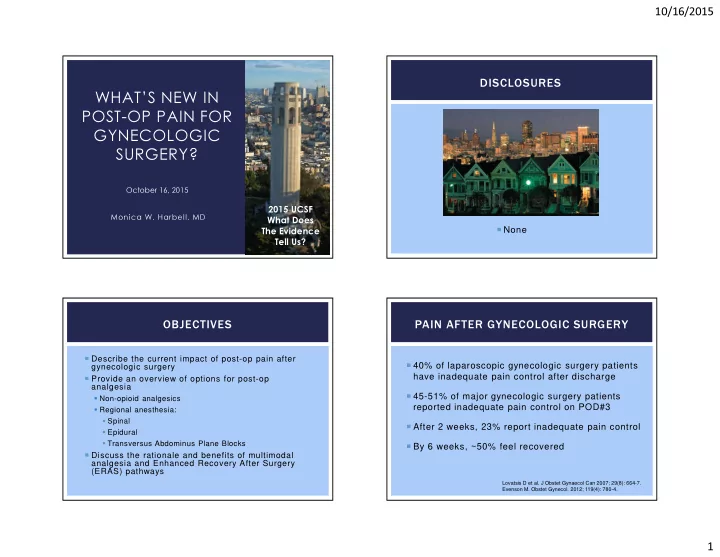
10/16/2015 DISCLOSURES WHATS NEW IN POST-OP PAIN FOR GYNECOLOGIC SURGERY? October 16, 2015 2015 UCSF Monica W. Harbell, MD What Does None The Evidence Tell Us? OBJECTIVES PAIN AFTER GYNECOLOGIC SURGERY Describe the current


slide-1
SLIDE 1

10/16/2015 1

Monica W. Harbell, MD

WHAT’S NEW IN POST-OP PAIN FOR GYNECOLOGIC SURGERY?

October 16, 2015

2015 UCSF What Does The Evidence Tell Us? None

DISCLOSURES

Describe the current impact of post-op pain after gynecologic surgery Provide an overview of options for post-op analgesia

Non-opioid analgesics Regional anesthesia: Spinal Epidural Transversus Abdominus Plane Blocks

Discuss the rationale and benefits of multimodal analgesia and Enhanced Recovery After Surgery (ERAS) pathways

OBJECTIVES

40% of laparoscopic gynecologic surgery patients have inadequate pain control after discharge 45-51% of major gynecologic surgery patients reported inadequate pain control on POD#3 After 2 weeks, 23% report inadequate pain control By 6 weeks, ~50% feel recovered

PAIN AFTER GYNECOLOGIC SURGERY

Lovatsis D et al. J Obstet Gynaecol Can 2007; 29(8): 664-7. Evenson M. Obstet Gynecol. 2012; 119(4): 780-4.

slide-2
SLIDE 2

10/16/2015 2

5-32% incidence of chronic pelvic pain 1 year after hysterectomy Chronic post-surgical pain (CPSP)

Lasts at least 2 months after surgery Most consistent patient factors are preoperative and postoperative pain

ACUTE CHRONIC PAIN

Brandsborg B et al. Acta Anaesthesiol Scand 2008; 52: 327-31. Brandsborg B et al. Anesthesiology 2007; 106: 1003-12.

RISK FACTORS FOR CPSP AFTER HYSTERECTOMY

Brandsborg B et al. Anesthesiology 2007; 106: 1003-12.

Surgical approach was not a risk factor Abdominal, vaginal, laparoscopic Total vs. subtotal abdominal hysterectomy Unclear effect of spinal vs. GA on CPSP Spinal associated with less pain than GA in a nonrandomized study (OR 0.42, CI: 0.21-0.85) No difference in pain scores after 12 weeks in

  • ne RCT

CHRONIC PAIN AFTER HYSTERECTOMY

Brandsborg B et al. Acta Anaesthesiol Scand 2008; 52: 327-31.

Respiratory Depression Respiratory Depression PONV PONV Paralytic ileus Paralytic ileus Delay of early mobilization Delay of early mobilization Immuno- suppresion Immuno- suppresion

OPIOIDS

slide-3
SLIDE 3

10/16/2015 3

Optimize additive effects of various agents Utilize different modes of analgesia Non-opioid analgesics Regional anesthesia Minimize side effects Facilitate patient recovery and ambulation

MULTIMODAL ANALGESIA

  • A. Always
  • B. Sometimes
  • C. Rarely
  • D. Never

HOW OFTEN DO YOUR PATIENTS HAVING GYNECOLOGIC SURGERY RECEIVE POST-OP NSAIDS?

Always Sometimes Rarely Never

93% 0% 0% 7%

NSAIDS and COX2 inhibitors have opioid-sparing activity 22-50% in patients undergoing gynecologic surgery NSAIDS reduce opioid-related side effects Undesirable side effects include platelet dysfunction, renal impairment, and GI irritation.

2.4% surgical-related bleeding vs. 0.4% with placebo Does ketorolac increase postoperative bleeding?

NSAIDS AND COX2-INHIBITORS

Maund E et al. Br J Anaesth 2011; 106: 292-7. Bauchat JR, Habib AS. Anesthesiology Clin 2015; 33: 173-207.

Effect of Ketorolac on perioperative bleeding

Gobble RM et al. Plast Reconstr Surg. 2014; 133(3): 741-55.

slide-4
SLIDE 4

10/16/2015 4

Fixed interval NSAID dosing provides more effective post-operative cesarean analgesia and results in higher patient satisfaction than on- demand dosing.

NSAIDS: ON DEMAND VS. FIXED INTERVAL

Jakobi P, et al. Am J Obstet Gynecol 187(4):1066-9. 2002

30-40% opioid-sparing effect in gynecologic surgery with 1g once or twice daily dosing regimen Max dosing 4g/day Equal efficacy as NSAIDS Improved analgesia and reduced PONV when combined with NSAIDS compared with either drug alone

ACETAMINOPHEN

Maund E et al. Br J Anaesth 2011; 106: 292-7. Ong CK et al. Anesth Analg 2010; 110: 1170-9.

Higher peak plasma concentrations Increased cost No current analgesic outcome benefit

IV VS. PO ACETAMINOPHEN

Jibril F et al. Can J Hosp Pharm 2015; 68(3): 238-47.

  • A. Always
  • B. Sometimes
  • C. Rarely
  • D. Never
  • E. Don’t know

HOW OFTEN DO YOUR PATIENTS HAVING GYNECOLOGIC SURGERY RECEIVE GABAPENTIN?

Always Sometimes Rarely Never Don’t know

1% 13% 16% 54% 16%

slide-5
SLIDE 5

10/16/2015 5

Structural analog to GABA Perioperative gabapentin reduces acute postop pain and opioid use.

35% reduction in total opioid use over 1st 24 hours post-op Reduces preop anxiety, PONV, pruritis Increases patient satisfaction

GABAPENTIN

Ho et al. Pain 2006; 126(1-3): 91-101. Peng PW et al. Pain Res Manag. 2007: 12(2): 85-92. Doleman B et al. Anaesthesia 2015; 70(10): 1185-204. Alayed N et al. Obstet Gynecol 2014; 123: 1221-9.

Side effects:

Sedation (RR 1.65) Dizziness (RR 1.4) Visual disturbances

Optimal dose unclear:

Most studies: Gabapentin 600-1200mg given 1-2 hours preop Minimal effective dose of Preop Gabapentin = 600mg

GABAPENTIN

Alayed N et al. Obstet Gynecol 2014; 123: 1221-9.

Reduced postoperative pain scores and opioid use in 1st 24 hours Optimal dose unclear: 100mg-300mg once or q8-12 hours

PREGABALIN

Yao Z et al. Clin Ther 2015; 37(5): 1128-35.

GABAPENTINOIDS REDUCE CPSP

Clarke H et al. Anesth Analg. 2012; 115(2): 428-42.

slide-6
SLIDE 6

10/16/2015 6

Spinal Epidural Transversus Abdominus Plane (TAP) Block

REGIONAL ANESTHESIA

Spinal anesthesia reduces postop opioid use for 48 hrs

Likely due to IT morphine

More cost-effective than GA ($969 savings/patient)

Shorter PACU stay (median 282 vs. 234 min) Improved quality of life scores

Unclear effect on hospital length of stay:

No difference for vaginal hysterectomy Shorter LOS in abdominal hysterectomy (2.2 vs. 3.3 days)

SPINAL ANESTHESIA

Bauchat JR, Habib AS. Anesthesiology Clin 2015; 33: 173-207. Borendal Wodlin et al. Am J Obstet Gynecol 2011; 205(326): e1-7. Sprung et al. Can J Anaesth 2006; 53: 690-700. Massicotte et al. Acta Anaesthesiol Scand 2009; 53: 641-7.

INTRATHECAL MORPHINE DOSES FOR POST-CESAREAN ANALGESIA

Analgesia Pruritus

  • Nausea and Vomiting 10% to 50%
  • Respiratory Depression < 0.25%

Palmer, CM, et al. Anesthesiology 90:437-44. 1999 Palmer, CM, Tech in Reg Anesth & Pain Mgmt 7(4):213-21. 2003

Lower pain scores than with PCA opioids Reduced opioid use Higher patient satisfaction Faster return of bowel function Did not reduce hospital length of stay

EPIDURAL ANALGESIA

Ferguson SE et al. Gynecol Oncol 2009; 114: 111-6. Katz J et al. Anesthesiology 2003; 98: 1449-60. Jorgenson H et al. Br J Anaesth 2001; 97: 577-83.

slide-7
SLIDE 7

10/16/2015 7

Epidurals may inhibit tumor spread and growth due to:

Intrinsic tumor suppression properties of local anesthetics Minimize opioid induced and surgically induced immunosuppression Suppression of adrenergic stimulation during surgery Avoidance of GA, which suppresses NK cell activity

RCT of women for ovarian CA: Patients with combined epidural + GA have higher antitumorigenic cytokines and NK cell cytotoxicity than those with GA alone

DO EPIDURALS IMPROVE SURVIVAL AFTER GYN CANCER SURGERY?

Hong JY , Lim KT. Reg Anesth Pain Med 2008; 33: 44-51. Dong H et al. J Int Med Res 2012; 40(5): 1822-9.

GA + Epidural associated with lower rate of ovarian cancer recurrence vs. GA alone (72 vs. 85%, p= 0.028) Longer DFS associated with >48h of epidural use Use of Desflurane vs. Sevoflurane associated with lower rate of recurrence (63 vs. 84%, p = 0.01)

EPIDURALS AND SURVIVAL

Elias KM et al. Ann Surg Oncol 2015; 22: 1341-8.

TRANSVERSUS ABDOMINIS PLANE (TAP) BLOCK

Figure from Ultrasound For Regional Anesthesia, 2008

  • A. Yes
  • B. No
  • C. Don’t know

ARE TAP BLOCKS ROUTINELY USED AT YOUR INSTITUTION FOR POST-OP ANALGESIA?

Yes No Don’t know

29% 22% 49%

slide-8
SLIDE 8

10/16/2015 8

Placed between subcostal margin and iliac crest Blind or US guided techniques 20-30mL of local anesthetic injected incrementally on each side Complications:

Intravascular injection Bowel perforation Liver trauma Intraperitoneal injection (18% with blind technique)

TAP BLOCK TECHNIQUE

McDonnell et al. Anesth Analg 2008; 106: 186-9. McDermott G et al. Br J Anesth 2012; 108: 499-502.

TAP BLOCK: US-GUIDED TECHNIQUE

Gray AT et al. Atlas of US-Guided Regional Anesthesia. 2nd Edition. Elsevier-Saunders, 2013

TAP BLOCK: US TECHNIQUE

Gray AT et al. Atlas of US-Guided Regional Anesthesia. 2nd Edition. Elsevier-Saunders, 2013

5 RCTs, n = 225 Reduced pain scores Reduced opioid use Limited effect to first 24 hours

TAP BLOCKS FOR ABDOMINAL HYSTERECTOMY

Champaneria R et al. Eur J Obstet Gynecol Reprod Biol 2013; 166: 1-9.

slide-9
SLIDE 9

10/16/2015 9

10 RCTs, n = 633 3 gynecologic TAP blocks reduce pain scores and opioid use. Preoperative TAP blocks had greater effects on early (0-4 hr) pain and opioid consumption

TAP BLOCKS FOR LAPAROSCOPIC SURGERY

De Oliveira GS Jr et al. Anesth Analg 2014; 118: 454-63. Calle GA et al. Acta Obstet Gynecol Scand 2014; 93(4): 345-50.

ENHANCED RECOVERY AFTER SURGERY (ERAS)

http://www.erassociety.org/index.php/eras-care-system/eras-protocol

Types of studies:

RCT (1), Nonrandomized prospective (2), Retrospective pre and post-intervention (6)

Types of cases:

Abdominal hysterectomy (5), vaginal hysterectomy (1), laparotomy for gynecologic cancer surgery (3)

ALL of these studies have found reduced hospital length of stay in ERAS group However:

High variation in ERAS interventions Lack of standardization of interventions

ERAS FOR MAJOR GYNECOLOGIC SURGERY

Bauchat JR, Habib AS. Anesthesiology Clin 2015; 33: 173-207.

2015 Retrospective cohort study (n=223):

Open gynecologic surgery for non-malignant lesions Increased POD1 discharges post-ERAS (34% vs. 7%)

HYSTERECTOMY ENHANCED RECOVERY PATHWAYS

Miller EC et al. Can J Anaesth 2015; 62(5): 451-60.

slide-10
SLIDE 10

10/16/2015 10

Control (n=26) ERAS (n=27)

Preop: Paracetamol, NSAID, COX2 inhibitor Paracetamol, NSAID, COX2 inhibitor Carbohydrate drink < 2h before surgery Intraop: GA (Nitrous + Volatile agent) Spinal bupivacaine + morphine 100mcg PONV PPx: Ondansetron Betamethasone + droperidol +

  • ndansetron

IV fluid restricted to 500mL/h Postop: Paracetamol + Morphine PCA Paracetamol + NSAID IV fluids stopped with oral intake

ERAS FOR HYSTERECTOMY - RCT

Kroon UB et al. Eur J Obstet Gynecol Reprod Biol 2010: 151(2): 203-7.

Lower rate of PONV (11% vs. 50%, p<0.01)

ERAS FOR HYSTERECTOMY - RCT

Kroon UB et al. Eur J Obstet Gynecol Reprod Biol 2010: 151(2): 203-7.

No bowel prep. Boost Breeze until 2 hours Gabapentin, APAP, NSAIDs periop Fluids <2L TAP blocks or lidocaine gtt Temperature >36 PONV PPx (decadron, zofran, scopolamine) Goals:

Foley out by 6hrs Regular diet on POD#0 Early mobilization Discharge by noon

UCSF ERAS FOR GYN-ONC LAPAROSCOPY

Improved pain scores Reduced opioid consumption Reduced PONV rate Higher rate of Regular diet on POD#0 Foleys removed 10 hours earlier 100% of patients discharged on POD#1 Future plans: Expansion to open gynecologic cancer surgery and benign gynecologic surgery

ERAS FOR GYN-ONC LAPAROSCOPIC SURGERY

slide-11
SLIDE 11

10/16/2015 11

Pain after gynecologic surgery affects quality

  • f life and can lead to chronic pain.

Improved acute pain management may help decrease development of CPSP. Multimodal analgesic techniques and ERAS pathways decrease opioid consumption, improve patient satisfaction, and can reduce length of stay. Use neuraxial analgesia when possible. TAP blocks for those who cannot have neuraxial.

SUMMARY