What we are trying to do Supporting Automatic Why software fails: - - PDF document

what we are trying to do
SMART_READER_LITE
LIVE PREVIEW

What we are trying to do Supporting Automatic Why software fails: - - PDF document

A Model-Based System What we are trying to do Supporting Automatic Why software fails: Self-Regeneration of Critical Software assumptions about the environment Software become invalid because of changes in the environment. Paul


slide-1
SLIDE 1

1

A Model-Based System Supporting Automatic Self-Regeneration of Critical Software

Paul Robertson & Brian Williams Model-Based and Embedded Robotic Systems http://mers.mit.edu

MIT Computer Science and Artificial Intelligence Laboratory

5/19/05 SelfMan 2005 2

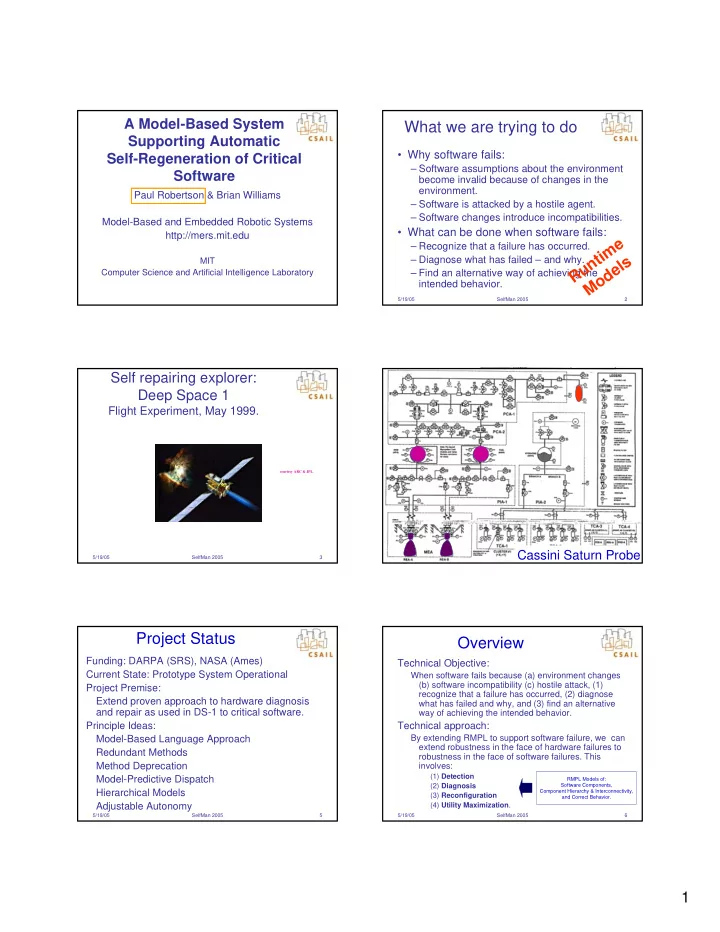
What we are trying to do

  • Why software fails:

– Software assumptions about the environment become invalid because of changes in the environment. – Software is attacked by a hostile agent. – Software changes introduce incompatibilities.

  • What can be done when software fails:

– Recognize that a failure has occurred. – Diagnose what has failed – and why. – Find an alternative way of achieving the intended behavior.

Runtime Models

5/19/05 SelfMan 2005 3

Self repairing explorer: Deep Space 1

Flight Experiment, May 1999.

courtesy ARC & JPL

Cassini Saturn Probe

5/19/05 SelfMan 2005 5

Project Status

Funding: DARPA (SRS), NASA (Ames) Current State: Prototype System Operational Project Premise: Extend proven approach to hardware diagnosis and repair as used in DS-1 to critical software. Principle Ideas: Model-Based Language Approach Redundant Methods Method Deprecation Model-Predictive Dispatch Hierarchical Models Adjustable Autonomy

5/19/05 SelfMan 2005 6

Overview

Technical Objective:

When software fails because (a) environment changes (b) software incompatibility (c) hostile attack, (1) recognize that a failure has occurred, (2) diagnose what has failed and why, and (3) find an alternative way of achieving the intended behavior.

Technical approach:

By extending RMPL to support software failure, we can extend robustness in the face of hardware failures to robustness in the face of software failures. This involves:

(1) Detection (2) Diagnosis (3) Reconfiguration (4) Utility Maximization.

RMPL Models of: Software Components, Component Hierarchy & Interconnectivity, and Correct Behavior.

slide-2
SLIDE 2

2

5/19/05 SelfMan 2005 7

Expected Benefits

  • Software systems that can operate

autonomously to achieve goals in complex and changing environments.

– Modeling environment

  • Software that detects and works around “bugs”

resulting from incompatible software changes.

– Modeling software components

  • Software that detects and recovers from

software attacks.

– Modeling attack scenarios

  • Software that automatically improves as better

software components and models are added.

5/19/05 SelfMan 2005 8

What can go wrong?

1. Hardware: A problem with robot hardware. 2. Software: A problem with the environment.

1. A mismatch between a chosen algorithm and the environment such as there not being enough light to support processing of a color image. 2. An unexpected imaging problem such as an

  • bstruction to the visual field (caused by a large
  • bscuring rock).

Solution to 2.2 Switch to a contingent plan: 1. Exception 2. Model Predictive Dispatch 3. Replanning Solution to 2.1 Reconfigure the software structure: 1. Redundant Methods 2. Mode Estimation 3. Mode Reconfiguration

5/19/05 SelfMan 2005 9

Test Bed Platform

Involves: Cooperative use of multiple robots. Timing critical software. Reconfiguration of Software Components. Multiple Redundant Methods Continuous Replanning Multiple Redundant Methods

5/19/05 SelfMan 2005 10

Science Target Search Scenario

  • Cooperatively search for targets in the predefined

regions

  • Search from predefined viewpoints
  • Search for the targets using stereo cameras and various

visualization algorithms

5/19/05 SelfMan 2005 11

Science Target Search Scenario

5/19/05 SelfMan 2005 12

Science Target Search Scenario

slide-3
SLIDE 3

3

5/19/05 SelfMan 2005 13

Science Target Search Scenario

5/19/05 SelfMan 2005 14

Method Regeneration: Exception Handling

  • A rock blocks the view

– Recover by taking the image from a different perspective (i.e. change the strategy)

  • The shadow cast by the rock fails the imaging code from

identifying the objects in view

– Reconfigure the imaging algorithm to work under these conditions

5/19/05 SelfMan 2005 15

Method Regeneration: Exception Handling

5/19/05 SelfMan 2005 16

Method Regeneration: Exception Handling

5/19/05 SelfMan 2005 17

Method Regeneration: Exception Handling

5/19/05 SelfMan 2005 18

Method Regeneration: Exception Handling

slide-4
SLIDE 4

4

5/19/05 SelfMan 2005 19

Overall Architecture

Planner Deductive Controller Plant Models Plan Runner Mode Estimation Mode Reconfiguration

Reconfigurable Vision for Robust Rover Mapping

5/19/05 SelfMan 2005 21

Reconfigurable Vision Plant Model

5/19/05 SelfMan 2005 22

Nominal Configuration

5/19/05 SelfMan 2005 23

Contingent Configuration

5/19/05 SelfMan 2005 24

Connection

Connected Unconnected

Command: Disconnect Command: Connect

Inputs: x Outputs: x class Connection () { RawImage image_in; SegmentedImage image_out; mode Connected (…) { primitive method disconnect () => Unconnected; } mode Unconnected (…) { primitive method connect () => Connected; } failure mode Failed (…) { … }; }

Models simplified for clarity in this and following slides

slide-5
SLIDE 5

5

5/19/05 SelfMan 2005 25

SegmentColor

Usable TooDark Inputs: RawImage Outputs: SegmentedImage class SegmentColor () { RawImage image_in; SegmentedImage image_out; mode Usable ((image_in = Nominal)) { … } mode TooDark ((image_in = Dark)) { … } }

5/19/05 SelfMan 2005 26

Block Diagram

TPN RMPL RMPL Compiler TPN Macro Library Algorithm Nexus Common Data Repository Suite of Algorithms FIFO SSSP SDSP APSP Kernel

Initialize Mission Temporal Consistency Check Tell Consistency Check Ask Consistency Check Location Consistency Check Macro Expansion Exception Handling

Executive

TPN updates plan updates exceptions processed TPN data TPN data TPN data

CSP

Variables and Domains Constraints

Dynamic CSP Solver

CSP problem updates partial solutions

5/19/05 SelfMan 2005 27

  • V8={ }

Tell(B=y)

Solution Analysis: Exception Handling

Start End

V1={ } VI={V1} V2={ , } V3={ , } V4={ , } V2 V3 V4

Initial Variables Variables Constraints

V5={ } V5 V6={ } V6

Tell(A=y) Tell(A=x)

V7={ , } V7

Tell(B=x) Ask(B=x)

V8

Ask Consistency Check

  • 1. Execution begins…
  • 2. An error occurs, and an exception is thrown

Partial Solution

V1={ } V4={ } V2={ } V5={ } V3={ } V8={ } EXCEPTION

5/19/05 SelfMan 2005 28

Solution Analysis: Exception Handling

Ask Consistency Check

  • 1. Execution begins…
  • 2. An error occurs, and an exception is thrown
  • 3. The exception-handling code is inserted

EXCEPTION

handler delay The handler is the TPN sub-process corresponding to the RMPL “catch” statement that matches the thrown exception The delay represents the amount of time spent in the original process before the exception was thrown, plus an upper-bound on replanning time

5/19/05 SelfMan 2005 29

  • V8={ }

Tell(B=y)

Solution Analysis: Exception Handling

Start End

V1={ } VI={V1} V2={ , } V3={ , } V4={ , } V2 V3 V4

Initial Variables Variables Constraints

V5={ } V5 V6={ } V6 V7={ , } V7

Tell(B=x) Ask(B=x)

V8

Ask Consistency Check

Partial Solution

V1={ } V4={ } V2={ } V5={ } V3={ } V8={ } EXCEPTION

  • 1. Execution begins…
  • 2. An error occurs, and an exception is thrown
  • 3. The exception-handling code is inserted
  • 4. Replanning begins, pre-selecting anything

that has already been executed

5/19/05 SelfMan 2005 30

Conclusions

  • Models of correct operation permits:

– Detection and Diagnosis of failed components. – Reconfiguration of Software/Hardware components to achieve high-level goals – Describe goals as abstract state trajectories.

  • Software can be handled by adding:

– Hierarchy to component organization – Models of the environment