What we will munch on today Turing Machines Church-Turing Thesis - - PDF document

what we will munch on today
SMART_READER_LITE
LIVE PREVIEW

What we will munch on today Turing Machines Church-Turing Thesis - - PDF document

What we will munch on today Turing Machines Church-Turing Thesis Unsolvable Problems Sections 12.5 and 3.1 in the text Guest appearance R. Rao, CSE 311 1 How do Turing Machines compute? f(current state, symbol under the


slide-1
SLIDE 1

1

  • R. Rao, CSE 311

What we will munch on today…

 Turing Machines  Church-Turing Thesis  Unsolvable Problems  Sections 12.5 and 3.1 in the text

Guest appearance

2

  • R. Rao, CSE 311

How do Turing Machines compute?

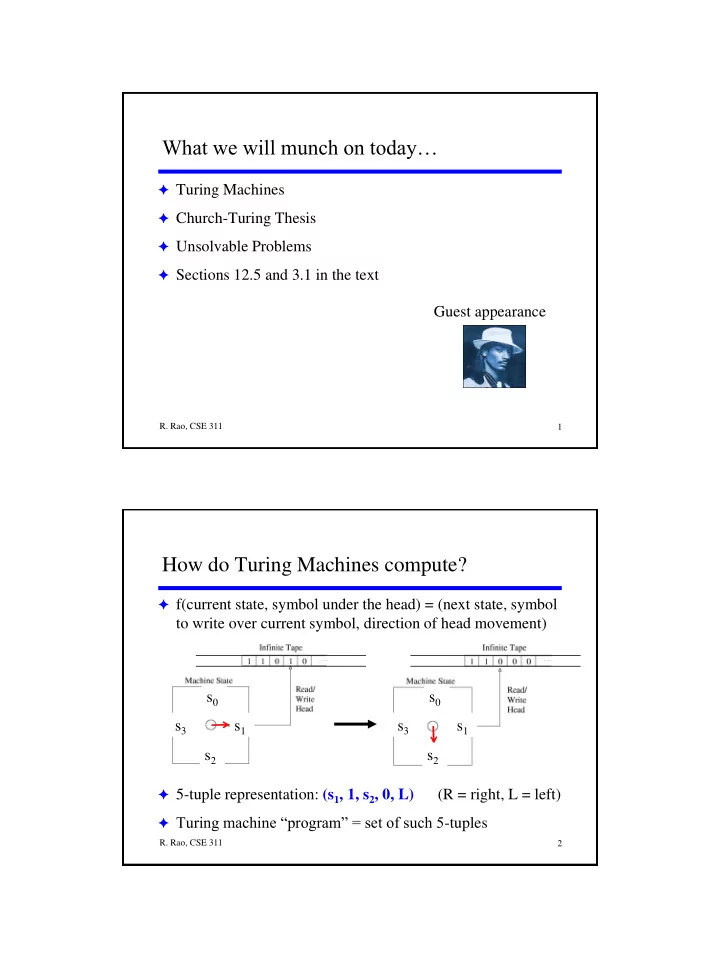
 f(current state, symbol under the head) = (next state, symbol

to write over current symbol, direction of head movement)

 5-tuple representation: (s1, 1, s2, 0, L)

(R = right, L = left)

 Turing machine “program” = set of such 5-tuples

s0 s1 s2 s3 s0 s1 s2 s3

slide-2
SLIDE 2

3

  • R. Rao, CSE 311

Turing Machine (TM) Definition

 TM T = (S, V, I, f, s0, F)  NOTE: We will use V and F in our definition of TMs; the textbook does not. Using V makes the input alphabet clear and distinct from tape alphabet I. Using F makes the final/accepting states clear.  S, s0, F are as in DFA definition  Input strings are over an alphabet V  I.  TM can use other symbols in I as markers, etc. for computing.  Blank symbol ฀ is always in I (and not in V).  f maps (state1, symbol1) to (state2, symbol2, direction)  f need not be defined for every (state,symbol) input

 f is a “partial function”

 If f not defined for a particular (state,symbol), TM halts.

4

  • R. Rao, CSE 311

Turing Machine (TM) Details

 Input string to TM given on tape

 TM always starts on leftmost nonblank symbol  If no input, then can start on any cell of the tape

 TM can halt in two types of states:  TM halts and accepts the input iff it enters a final state in F  TM halts and rejects the input when it halts in any other state (when f is not defined for a (state, symbol) pair)

 TM recognizes a string w iff it halts in a final state for w  TM can reject w by halting in any non-final state or by looping forever!

slide-3
SLIDE 3

5

  • R. Rao, CSE 311

TM that recognizes L = {anbncn | n  0} and always halts

 Such TMs are called decider TMs.

Solving Problems with Turing Machines

aaabbbccc xaabbbccc xaaybbccc xaaybbzcc xxaybbzcc …. xxxyyyzzz Idea: Mark off each a, b, and c with x, y, z. Accept if each a, b, c could be matched, and only x’s,y’s,z’s remain Input: aaabbbccc

6

  • R. Rao, CSE 311

TM for {anbncn | n  0}

Implementation Level Description of the TM:

On input w:

  • 1. If first symbol = blank, ACCEPT
  • 2. If first symbol = b or c, REJECT
  • 3. If first symbol = a,

a.

Write X over a and move right.

b.

If current symbol is a or y, move right until you see b. REJECT if

  • ther symbol.

c.

Write y over b. Skip b’s and z’s until you see c. REJECT if other symbol.

d.

Write z over c. Rewind back to rightmost x.

  • 4. If you see an a, go to 3a. If you see y, rewind and check if the tape
  • nly has x’s, y’s, z’s. If so, ACCEPT, otherwise REJECT.
slide-4
SLIDE 4

7

  • R. Rao, CSE 311

jFLAP demo

 To run the demo, download and run in jFLAP the file

turingAnBnCn.jff at:

http://www.cs.duke.edu/csed/jflap/tutorial/turing/one/turingAnBnCn.jff

8

  • R. Rao, CSE 311

Can we augment the power of Turing machines with various accessories?

slide-5
SLIDE 5

9

  • R. Rao, CSE 311

Varieties of TMs

What if we allow nondeterminism ? What if we allow multiple tapes? What if my date doesn’t show up tonight?

10

  • R. Rao, CSE 311

Various Types of TMs

 Multi-Tape TMs: TM with k tapes and k heads

 f: S  Ik  S  Ik  {L,R}k  f(si, a1, …, ak) = (sj, b1, …, bk, L, R, …, L)

 Nondeterministic TMs (NTMs)

 f: S  I  Pow(S  I  {L,R})  f(si, a) = {(s1, b, R), (s2, c, L), …, (sm, d, R)}

 Other types: TM with multiple heads on a single tape, 2D

infinite tape TM, Random Access Memory (RAM) TM, etc.

slide-6
SLIDE 6

11

  • R. Rao, CSE 311

Surprise! All TMs are born equal…

 Each of the preceding TMs is equivalent to the standard TM

 They recognize the same set of languages

 Proof idea: Simulate the “deviant” TM using a standard TM  Example: Multi-tape TM on a standard TM

 Represent k tapes sequentially on 1 tape using separators #  Use new symbol a to denote a head currently on symbol a

0 1 . . . . . . . . . . . b a h . . . . . . . . . . 3 1 1 . . . . . . . . . .

 # 0 1 # b a h # 3 1 1 # . . . . . . .

12

  • R. Rao, CSE 311

The Church-Turing Thesis

 Various definitions of “algorithms” were shown to be

equivalent in the 1930s

 Church-Turing Thesis: “The intuitive notion of algorithms

equals Turing machine algorithms”  Turing machines serve as a precise formal model for the intuitive notion of an algorithm

 “Any computation on a digital computer is equivalent to

computation in a Turing machine”

Dude, that’s pretty deep…

slide-7
SLIDE 7

13

  • R. Rao, CSE 311

A language that can be recognized by a decider TM (always halts) is called a decidable language

Some decidable languages: {anbncn | n  0}, 1*01*01* (or any reg. exp.), {0p } | p is prime}, {P | P is a syntactically correct Java program}

Decidable languages correspond to problems that we can solve using an algorithm (no infinite loops!)

14

  • R. Rao, CSE 311

Are there languages that are not decidable? (i.e., from Church-Turing thesis, are there problems that are not solvable by any computer program?

slide-8
SLIDE 8

15

  • R. Rao, CSE 311

The Halting Problem

 Consider problem: Given a program P and input w, does P halt

  • n w?

 Equivalently, given TM M and input w, does M halt on w?  Good for debugging CSE 142/143 programs…  Naïve solution: What if we run P on w and see what happens?

But what if P is still running after 1 day, 1 week,…?!!!! If P halts, we say “yes”

16

  • R. Rao, CSE 311

The Halting Problem is Unsolvable

 Theorem: There is no program which, when given as input a

program P and its input w, decides whether P halts on w.

 Proof: By contradiction.  Assume such a program exists – call it H.

Input 1: Program P Input 2: Input w H(P,w) Output: “halts” if P halts on w “loops” if P does not

slide-9
SLIDE 9

17

  • R. Rao, CSE 311

The Halting Problem is Unsolvable

 If H exists, we can create a new program K which takes as

input a program P and uses H as a subroutine as follows:

 On Input P, compute H(P,P).  If H(P,P) = “loops”, then K(P) halts.  If H(P,P) = “halts”, then K(P) loops forever.  Consider what happens when input P is K itself, i.e., K(K): K loops on K  H(K,K) = “loops”  K(K) halts (contradiction) K halts on K  H(K,K) = “halts”  K(K) loops (contradiction)  Both cases give a contradiction  Therefore, H cannot exist, i.e., halting problem is unsolvable.

QED

18

  • R. Rao, CSE 311

The Chomsky Hierarchy – Then & Now…

Decidable Undecidable

Then (1950s) Now

U.S. interventionism in the developing world

Political economy

  • f human rights

Propaganda role

  • f corporate

media Halting problem 0n1n0n

REG

0*1*

slide-10
SLIDE 10

19

  • R. Rao, CSE 311

Dat raps up Turing Machines… Let’s close with a tribute to da pumpin’ lemma

20

  • R. Rao, CSE 311

Da Pumpin’ Lemma

(adapted from a poem by Harry Mairson)

Any regulah language L hassa magic numba p Any long word s in L hasda followin’ propa’ty: In its first p symbols issa segment u can find Whoz repetition or omission leaves s amongst its kind. If ya find a lango L which fails dis acid test, And a long word ya pump becomes distinct from all da rest, By contradixion ya have shown that L ain’t certainly not A regular homie that is resilient to da pumpin’ that u’ve wrought. If on the otha’ hand, s stays within its L, Then eitha L is regulah, or else ya chose not well. s is xyz y’all where y is not empty, And y must come befo’ da p+1st symbol ya see.

Based on: http://www.cs.brandeis.edu/~mairson/poems/node1.html

Hear it on the new album: Dig dat funky DFA