What What can can we we learn learn from from present present- - - PDF document

what what can can we we learn learn from from present
SMART_READER_LITE
LIVE PREVIEW

What What can can we we learn learn from from present present- - - PDF document

04.10.2017 What What can can we we learn learn from from present present- -day day HVCs HVCs about about cold cold- -gas gas accretion accretion of of galaxies galaxies Gerhard Hensler Gerhard Hensler Dept Dept. . of of


slide-1
SLIDE 1

04.10.2017 1

1

What What can can we we learn learn from from present present-

  • day

day HVCs HVCs about about cold cold-

  • gas

gas accretion accretion of

  • f galaxies

galaxies

Gerhard Hensler Gerhard Hensler

Dept Dept. . of

  • f Astrophysics

Astrophysics, , University University of

  • f Vienna

Vienna Bastian Sander, Vienna/Magdeburg Bastian Sander, Vienna/Magdeburg Wolfgang Wolfgang Vieser Vieser, Kiel/ , Kiel/Munich Munich Sylvia Sylvia Ploeckinger Ploeckinger, Vienna/Leiden , Vienna/Leiden

2

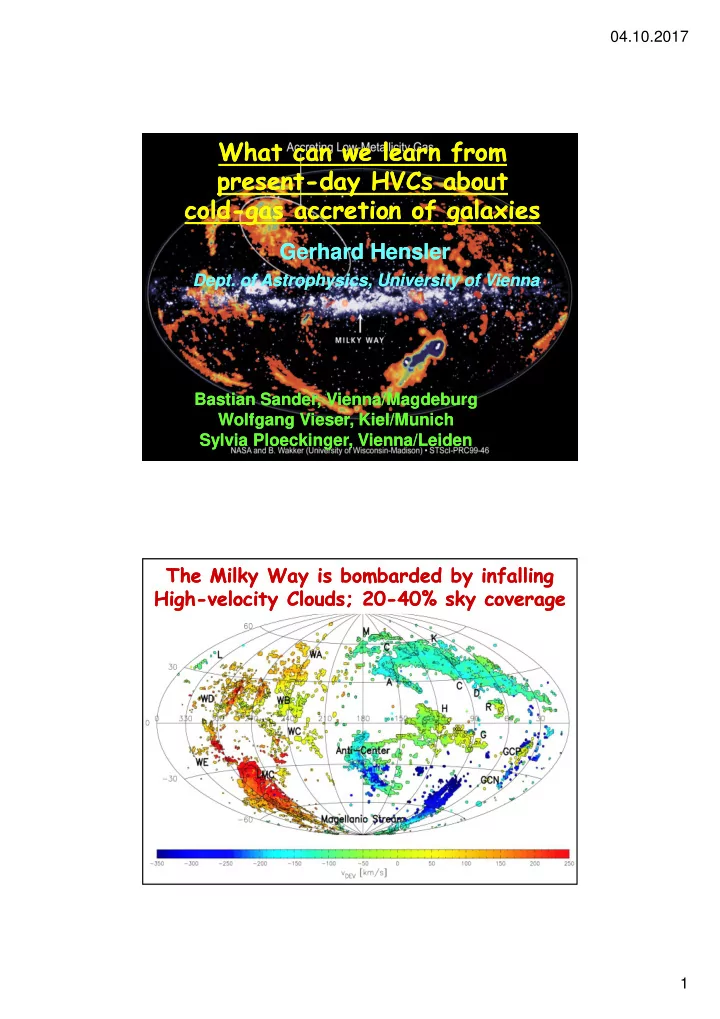
The The Milky Milky Way Way is is bombarded bombarded by by infalling infalling High High-

  • velocity

velocity Clouds Clouds; 20 ; 20-

  • 40%

40% sky sky coverage coverage

slide-2
SLIDE 2

04.10.2017 2

3

HI-detection with galactocentric velocities <-200 km/s Masses of ~108 …. 104 M ~50% of the sky are covered with infalling gas clouds. Their origin is not yet solved, but obviously various: Some from the Mag. Stream and MW satellites or even

  • f cosmological origin

Properties of HVCs Properties of HVCs

vGSR Infalling clouds are divided according to their velocities into: Intermediate-vel. clouds (IVC): -50 > vGSR [km/s] > -100 High-velocity clouds (HVCs): -100 > vGSR[km/s] > -200 Ultra-HVCs: vGSR < -200 km/s

slide-3
SLIDE 3

04.10.2017 3

5 6

HI-detection with galactocentric velocities <-200 km/s Masses of ~108 …. 104 M ~50% of the sky are covered with infalling gas clouds. Their origin is not yet solved, but obviously various: Some from the Mag. Stream and MW satellites Very massive entities exist very close to the gal. plane Full of substructures; no central mass concentration.

Properties of HVCs Properties of HVCs

slide-4
SLIDE 4

04.10.2017 4

Fox et al. 2004

Massive HVCs Massive HVCs H H exhibit exhibit complex complex internal internal structures structures C C

Simon et al. (2006) ApJ, 640 8

Cores Cores and and Head Head-

  • tail

tail Structures Structures

Smaller HVCs (~104 M) show core-halo structures ⇒ hydrostatic stratification ⇒ self-gravity head-tail structures ⇒ ram-pressure stripping and seem to survive, decelerated and stretched by interactions with the hot static halo gas.

Brüns et al. 2000

slide-5
SLIDE 5

04.10.2017 5

9

HI-detection with galactocentric velocities <-200 km/s Masses of ~108 …. 104 M ~50% of the sky are covered with infalling gas clouds. Their origin is not yet solved, but obviously various: Some from the Mag. Stream and MW satellites Very massive entities exist very close to the gal.plane Full of substructures; no central mass concentration. Mostly, head-tail structure ⇒ drag

Properties of HVCs Properties of HVCs

10

HI-detection with galactocentric velocities <-200 km/s Masses of ~108 …. 104 M ~50% of the sky are covered with infalling gas clouds. Their origin is not yet solved, but obviously various: Some from the Mag. Stream and MW satellites Very massive entities exist very close to the gal.plane Full of substructures; no central mass concentration. Mostly, head-tail structure ⇒ drag Metal-poor Normal ISM phases No stellar content! heating processes prevent cooling? B field? Core-halo structure ⇒ self-gravitating!

Properties of HVCs Properties of HVCs

slide-6
SLIDE 6

04.10.2017 6

(2004) ApJ, 615

Massive clouds passing through hot gas are exposed to ram pressure, Kelvin-Helmholtz and Rayleigh-Taylor instabilities HVCs are NOT homogeneous! Without self-gravity clouds are disrupted!

(see also Heitsch & Putman, 2009, Apj, 698)

Self-gravity is an urgent ingre-dient to be included to

  • num. models!

Are Are our

  • ur assumptions

assumptions of

  • f

numerical numerical HVC HVC models models correct correct? ?

12

Gas infall feeds galaxies! Cold streams? SFR-gas relations? Pext – H2/HI relation? How is the gas accreted? Streams vs. clouds! HVCs?

Motivation to care about HVCs especially? Motivation to care about HVCs especially?

slide-7
SLIDE 7

04.10.2017 7

13

How does the “cold accretion” scenario work? How does the “cold accretion” scenario work?

Dekel et al. (2009) Nature, 457: Colours refer to inflow rate per solid angle of point-like tracers at the centres of cubic-grid

  • cells. Box side length is 320 kpc.

Keres & Hernquist (2009) ApJ, 700: Example of the instability developing from an overdense filament in a hot dilute halo gas leading to cloud formation. 14

Gas infall feeds galaxies! Cold streams? Pext – H2/HI relation? SFR-gas relations? How is the gas accreted? Streams vs. clouds! HVCs? Where do MWG HVCs come from? 3 sources:

  • 1. Intergalactic stripped galaxy gas
  • 2. tidally stripped satellites
  • 3. Primordial clouds

Do they represent the link to missing ΛCDM subhalos, i.e. DM dominated? (see Poeckinger & Hensler, 2012, A&A, 547) How do HVCs interact with the gaseous galactic halo? Deceleration? Halo Magnetic fields? (see Jelinek & Hensler, 2011, Comp. Phys. Comm., 182) What stabilizes them against disruption by RTI & KHI? Role of Heat conduction + Gravity? (see Vieser & Hensler, 2007, A&A, 472) Do they reach the galactic disks? Gas replenishment? Triggered SF in gas disks? (see Izumi et al., 2014)

Motivation to care about HVCs especially? Motivation to care about HVCs especially?

slide-8
SLIDE 8

04.10.2017 8

Signatures as local metal deficiency in high-z galaxies are indicating low-Z/primordial gas infall.

Cresci et al. (2010) Nature, 467 16

Gas infall feeds galaxies! Cold streams? SFR-gas relations? How is the gas accreted? Streams vs. clouds! HVCs? Where do MWG HVCs come from? 3 sources:

  • 1. Intergalactic stripped galaxy gas
  • 2. tidally stripped satellites
  • 3. Primordial clouds

Do they represent the link to missing ΛCDM subhalos, i.e. DM dominated? (see Poeckinger & Hensler, 2012, A&A, 547) How do HVCs interact with the gaseous galactic halo? Deceleration? Halo Magnetic fields? (see Jelinek & Hensler, 2011, Comp. Phys. Comm., 182) What stabilizes them against disruption by RTI & KHI? Heat conduction + Gravity? (see Vieser & Hensler, 2007, A&A, 472) Do they reach the galactic disks? Gas replenishment? Triggered SF in gas disks? (see Izumi et al., 2014) Star formation in HVCs? Not observed! But SF in some RPS clouds! Why? Under which conditions?

Motivation to care about HVCs especially? Motivation to care about HVCs especially?

slide-9
SLIDE 9

04.10.2017 9

At ram-pressure stripped clouds star formation is possible: Under which conditions?

VCC1217 NGC4569

18

⇒ HVCs bridge the research fields from ISM (+ SF) to galaxy evolution and cosmology

slide-10
SLIDE 10

04.10.2017 10

19

Without self-gravity, RTI grows and facilitates ram pressure to destruct the cloud: Self-gravity is an urgent ingredient to be included! BUT: Is ram pressure the only effect of the hot halo gas on HVCs? Between hot gas and warm/cold clouds thermal conduction plays a prominent role:

  • at rest, only energy exchange leads to

evaporation or condensation.

  • in motion: KHI is suppressed.

Do HVCs survive fast motion through hot gas? Very low- mass models: 210 M, Self-grav.+cooling+therm.cond.; KHI+ RP lead to destruction

2005, MN, 342 and many other authors (see in Vieser & Hensler, 2007, A&A, 472, 141)

slide-11
SLIDE 11

04.10.2017 11

21

mass (103 M) size (pc) [Z/Z] Tc,cl/K self- grav. heat./ cool. thermal conduct. Vrel [km/s] 62.4 – 87.5 41.16 – 48.42 0.1 - 1.0 230 + – + – class. 15.1 – 19.9 11.34 – 27.0 0.1 - 1.0 1150 + – + – saturated

  • depend. ICM, Z
  • depend. ICM,

Z

  • 167,

250, 333

3D Cloud Models 3D Cloud Models

Sander & Hensler (2017) in prep.

Core-halo structure Radiative heating-cooling balance Thermal conduction

(see Vieser & Hensler, 2007a+b, A&A, 472 + A&A, 475)

Self-gravity!

22

Big HVC in 3D Big HVC in 3D

M=8.75 M=8.7510 104

4 M

M, , Z=0.1 Z Z=0.1 Z v vICM

ICM=167 km/s

=167 km/s T TICM

ICM=5.6

=5.610 106

6 K ,

K , n nICM

ICM=0.7

=0.710 103

3 cm

cm-

  • 3

3

Most of the HVC remains gravitationally bound. for 50 Myrs

slide-12
SLIDE 12

04.10.2017 12

23

Destruction Destruction vs.

  • vs. Survival

Survival: : the the mass mass dependence dependence

M=8.75 M=8.7510 104

4 M

M, , vs. vs. M=2.0 M=2.010 104

4 M

M, , Less massive

HVCs are disrupted!

Sander & Hensler (2017) in prep. 25

Cloud Cloud deceleration deceleration included included

Deceleration leads to H-T structure.

slide-13
SLIDE 13

04.10.2017 13

26

Decelerated Decelerated big big HVCs HVCs survive survive with with accretion accretion! !

Sander & Hensler (2017) in prep.

Velocity Velocity effect effect

Sander & Hensler (2017) in prep.

Higher velocity leads to: stronger Bernoulli effect HT structure, higher mass loss, stronger central concentration Jeans unstable??

slide-14
SLIDE 14

04.10.2017 14

Fast Fast big big HVCs HVCs become become Jeans Jeans unstable unstable

Vrel = 250 km/s Vrel = 330 km/s

Strong ram-pressure compresses the central concentration even further to reach Jeans instability: capable for star-formation. Slower clouds survive, but are stretched and lower densities.

Results Results and and Conclusions Conclusions: :

High-velocity Clouds are DM-free and do not solve the missing satellite problem of CDM cosmology (

(Ploeckinger Ploeckinger & & Hensler Hensler 2012) 2012)

  • HVCs

HVCs have have intergalactic intergalactic and and tidal tidal-

  • stripping

stripping origins

  • rigins.

.

  • HVCs

HVCs are are stabilized stabilized by by self self-

  • gravity

gravity and and cooling cooling. . Heat conduction reduces KHI and its mass ablation to a few % over 10 Myrs (massive HVCs). Magnetic fields do not hamper HC!

  • Small HVCs

Small HVCs are are disrupted disrupted! !

  • Clouds

Clouds are are decelerated decelerated → → IVCs IVCs ⇒ stripping stripping reduced reduced, , H H-

  • T

T shape shape! ! Clouds Clouds accrete accrete metal metal-

  • rich

rich halo halo gas? gas?

  • Are HVCs

Are HVCs the the analogues analogues of

  • f the

the cold cold-

  • gas

gas accretion accretion? ?

  • Very

Very fast massive fast massive clouds clouds can can become become Jeans Jeans unstable unstable! !

  • What

What can can we we learn learn for for SF in RPS SF in RPS clouds clouds? ?

  • Do HVCs

Do HVCs serve serve as as seeds seeds for for Globular Globular Clusters? Clusters? HVCs reach the galactic disk and serve for gas supply. Do HVCs trigger SF in local “starbursts“?

slide-15
SLIDE 15

04.10.2017 15

30 ICISE 2017

www.astronomy2018.org