When is Enough, Enough The Second Opinion: Over Treatment of Upper - - PowerPoint PPT Presentation

when is enough enough the second opinion
SMART_READER_LITE
LIVE PREVIEW

When is Enough, Enough The Second Opinion: Over Treatment of Upper - - PowerPoint PPT Presentation

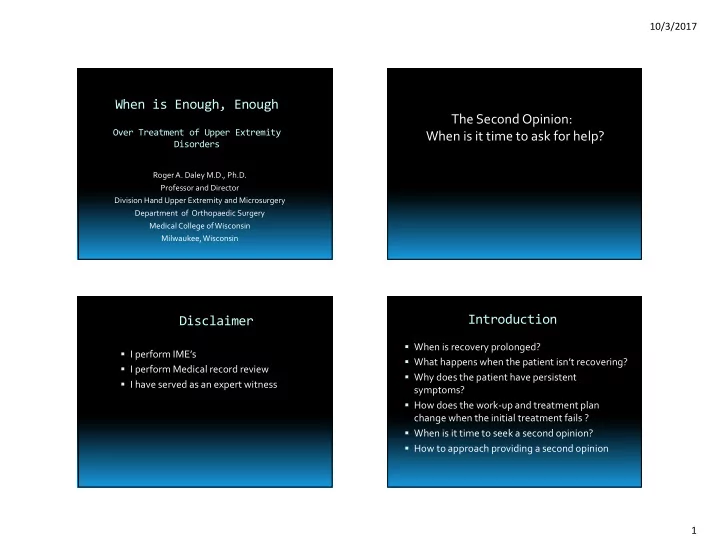
10/3/2017 When is Enough, Enough The Second Opinion: Over Treatment of Upper Extremity When is it time to ask for help? Disorders Roger A. Daley M.D., Ph.D. Professor and Director Division Hand Upper Extremity and Microsurgery Department of


slide-1
SLIDE 1

10/3/2017 1

When is Enough, Enough

Over Treatment of Upper Extremity Disorders

Roger A. Daley M.D., Ph.D. Professor and Director Division Hand Upper Extremity and Microsurgery Department of Orthopaedic Surgery Medical College of Wisconsin Milwaukee, Wisconsin

The Second Opinion: When is it time to ask for help? Disclaimer

  • I perform IME’s
  • I perform Medical record review
  • I have served as an expert witness

Introduction

  • When is recovery prolonged?
  • What happens when the patient isn’t recovering?
  • Why does the patient have persistent

symptoms?

  • How does the work‐up and treatment plan

change when the initial treatment fails ?

  • When is it time to seek a second opinion?
  • How to approach providing a second opinion
slide-2
SLIDE 2

10/3/2017 2

More Often Than Not!!

  • Physicians make the

correct diagnosis

  • Treatment is successful
  • Patient recovery is

predictable

  • Everyone is happy

Rarely

  • Symptoms persist
  • New symptoms

develop

  • Recovery is prolonged
  • Complications occur
  • No one is happy

Case 1

  • 34 yo f massage therapist, vague forearm pain

developed during work

  • Exam: non focal/diffuse pain
  • MRI: negative
  • Dx: lateral epicondylitis and wrist tendonitis
  • Treatment: off work, wrist splint and therapy (30

visits)

  • Symptoms persist
  • IME suggested Dx: Posterior Interosseous Nerve

Compression

Case 1

  • EDX/EMG: compression of PIN at elbow
  • Intra operative findings: severe compression
  • f nerve
  • Post op: therapy and activity restrictions
  • 2nd IME at 6 months: persistent symptoms
  • 3Rd IME at 16 months: slow but continued

improvement

 90 therapy sessions  Light duty work

slide-3
SLIDE 3

10/3/2017 3

Case 1

  • Expected recovery time?
  • Proper diagnosis?
  • Is continued therapy beneficial?
  • Are further diagnostic tests indicated?
  • What factors are delaying recovery?
  • Not a simple answer

Normal Expected Recovery

  • Healing takes time
  • Emphasize the time it takes to recover
  • What should be expected during recovery
  • Risk factors and variables that may delay and

impact outcome

  • provide a realistic prediction of the results of

treatment

  • Educate patient to expect recovery milestones

Reasonable Recovery Time?

  • Define : return to work, MMI,

end of healing

  • Diagnosis dependent
  • Severity of condition treated
  • Co‐morbid factors affecting

recovery

  • Patient and physicians

expectations

  • Patient motivation

Recovery guidelines

  • Fractures ‐ heal in 3 wks to 6 mos or longer
  • Tendons – min 6 wks with rehab to follow
  • Ligaments – min 6 wks plus therapy
  • Nerve regeneration – 1 mm per day
  • 3 ‐ 6 months for tenderness to resolve

following Carpal Tunnel Release !

  • Epicondylitis may take over 9 mos to get

better, treated conservatively for at least that long

slide-4
SLIDE 4

10/3/2017 4

Prolonged Recovery

  • Not meeting the expected

milestones to recovery:

 resolution of symptoms  return to normal activities (work)  Prior experience with similar

cases

  • Our responsibility as health

care providers ‐ to determine reason why

 May need to set expectations  Quickly identify delays

What Happens When the Patient Isn’t Recovering?

  • Financial impact

 Personal  employer  society

  • Psychosocial issues

 Family ‐”breadwinner”

‐“disabled mentality”

 Job stress/ job satisfaction  Doctor / Patient relationship

is challenged

Why does the patient have persistent symptoms?

What went Wrong ?

  • Treatment specific
  • Patient specific

Persistent Symptoms or New Complaints

  • 1st determine that there is not

another reason to explain symptoms

  • Recurrent Problem
  • Persistent problem

 Incomplete surgery  Wrong surgery (wrong Dx )

  • New complaints

 New diagnosis  Complication of original

treatment

slide-5
SLIDE 5

10/3/2017 5

Patient Specific Causes

  • Co‐morbid conditions

 Unrecognized Dx  Chronic disease  Age & body condition

  • Patient directed care
  • Behavior

 Factitious disorder  Conversion disorder  Malingering

Co‐morbid conditions

  • Diabetes & other chronic disease
  • Obesity
  • Smoking
  • Psychiatric conditions

Patient Directed Care

  • Alternative treatments

 Internet driven

  • Holistic medicine
  • Massage therapy
  • Acupuncture
  • Chiropractic care

Behavioral Causes

  • Factitious disorder
  • Conversion Disorder
  • Malingering
slide-6
SLIDE 6

10/3/2017 6

Factitious disorder

 Intentionally fake or create a disease  Inflict injury to create illness  Munchausen Syndrome  Munchausen Syndrome by Proxy  Aim is to obtain sympathy, nurturance, & attention

(notion of being ill)

 Often undergo unnecessary surgery  No motivation for secondary gain  Somatic Symptom and Related Disorder

Conversion Disorder

  • A psychiatric condition –

 Non‐ intentional  Believes condition is real

  • Possibly due to an overload of emotional stress
  • Doesn’t stand up to extensive scrutiny
  • Common diagnosis

 Pseudoseizures  Limb paralysis  Vision or hearing loss

Malingering

  • Intentional fake or create illness for secondary gain
  • workers comp
  • drug seeking behavior
  • Intentional abuse of the Medical System (Fraud)
  • exaggerating symptoms
  • Dis‐incentive to recover
  • Antisocial personality disorder

Considerations

  • Often difficult to differentiate real medical

problems from factitious disorders or malingering

  • Potential tell tail signs of malingering:

 Previous dx of Antisocial personality disorder  Early involvement of lawyers in a medical issue  Poor compliance with treatment  Inconsistencies in presenting symptoms

slide-7
SLIDE 7

10/3/2017 7 Health Care Provider‐Specific Causes for Delay in Recovery

  • Unaware of early signs of delay in recovery
  • Not listening to patient
  • Lacks expertise that would allow provider to

recognize problems

  • Ego‐ arrogance –

 Fail to admit that medical error occurred  Providers failure to admit that he/she lacks

expertise to treat problem

Complications that Delay Recovery

  • Infection
  • Failed hardware
  • Injury to adjacent

structures

  • Re‐injury during recovery
  • Incomplete surgery
  • Wrong surgery

Response to a Delay in Recovery

  • Identify that recovery isn’t progressing as

expected

  • React with a multi‐directional approach

 Review records, tests, reexamine patient and

rethink diagnosis

 Obtain studies when appropriate  Encourage patient to actively participate in their

  • wn recovery (therapy at home)

 Discuss case with colleagues or seek a second

  • pinion

How Does the Work‐up and Treatment Plan Change When the Initial Treatment Fails?

  • Re‐think diagnostic work‐up &

treatment to date

  • Repeat thorough exam
  • Consider other contributing

factors “Think outside the Box”

  • Look for rare or atypical

findings

  • Retesting
slide-8
SLIDE 8

10/3/2017 8 When is it Time to Seek a 2nd Opinion?

  • Patient initiated

 Not happy with status of recovery  Lost confidence in treating physician

  • Physician initiated

 Loss of confidence in own

ability to solve problem

 Seek confirmation about care  Lack of specialty training

Conditions Seen for 2nd Opinion

  • Atypical presentation of

compressive neuropathy

 Thoracic outlet syndrome  Prox. Median N. Comp

  • Complex wrist disorder

 Scaphoid nonunion  Kienbock’s disease

  • Persistent pain & loss of use

Conditions Often Seen for a 2nd Opinion

  • Highly specialized problem

 Vascular (Raynaud’s Disease)  Ulnar hammer syndrome  Complex wrist disorder

  • Infection/ complication
  • Failed surgery
  • Dissatisfied patient

 Not hearing what he wants to

hear (malingerer)

Management of Patients with Failed Surgery

  • r Those Seeking a 2nd Opinion
  • More challenging than primary

procedure

  • Must rule out non surgical causes
  • Often a significant pain

component

  • Dealing with scar
  • Frequently require a salvage or

reconstructive procedure

  • Realistic expectation of results
slide-9
SLIDE 9

10/3/2017 9 Persistent Symptoms or New Complaints

  • 1st determine that there is

not another reason to explain symptoms

  • Recurrent Problem
  • Persistent problem

 Incomplete surgery  Wrong surgery (missed Dx )

  • New complaints

 New diagnosis 

Complication of original treatment

Management of Patients with Failed Surgery

  • If you determine that more

surgery is indicated proceed with care.

  • Don’t convince yourself

that you can solve the problem

  • Have strong objective

evidence before proceeding

  • Don’t be surprised if the

patient doesn’t get better

  • Don’t follow a mistake with

another mistake

Case 2

  • 48 yo F obese with diabetes, reports a gradual
  • nset of non focal wrist pain from typing, no

reported injury. On job 18 months

  • Exam showed diffuse wrist pain, MRI should

early osteoarthritis, small volar wrist ganglion, no TFCC tear

  • Surgery for wrist arthroscopy and open

ganglionectomy, early OA appreciated, ulnar attachment of TFCC thought to be loose! Percutaneous repair and open ganglionectomy

Case 2

  • Immobilized 8 wks then therapy 2X/wk
  • MRI repeated at 4 months for persistent

symptoms ‐ Scar at peripheral repair site and defect in volar capsule (ganglion site), early OA

  • Light duty work , therapy 2x/wk
  • Seen at 7 months for persistent wrist pain a

3rd MRI was performed with no new findings

slide-10
SLIDE 10

10/3/2017 10

Case 2

  • IME ‐ questioned original diagnosis and

reason for surgery, thought 3 IME’s and 45 plus therapy sessions excessive

 Diagnosis thought to be early thumb basal joint

arthritis and mild wrist extensor tendonitis

 Recommendation for conservative care  Opinion ‐ not related to work exposure

Summary

  • When do you say Enough?
  • Many factors are involved
  • Not all patients get better and it is difficult to

identify those that will

  • When recovery is delayed, think outside the

box

  • Recognize your own limitations and seek a

second opinions

Summary

  • Providing a 2nd opinion is often challenging both

in diagnosis & treatment

  • Multiple factors come into play in patient

management

  • Don’t let your ego stand in the way of good

patient care

  • Have sound objective evidence before proceeding
  • Realistic expectations for outcome

Thank You!