SLIDE 1 Efficiency of the Use of Power Transmission with Increased Surge Impedance Loading
Midwest ISO - Expanding Edge Seminar, St. Paul, MN – September 16, 2004
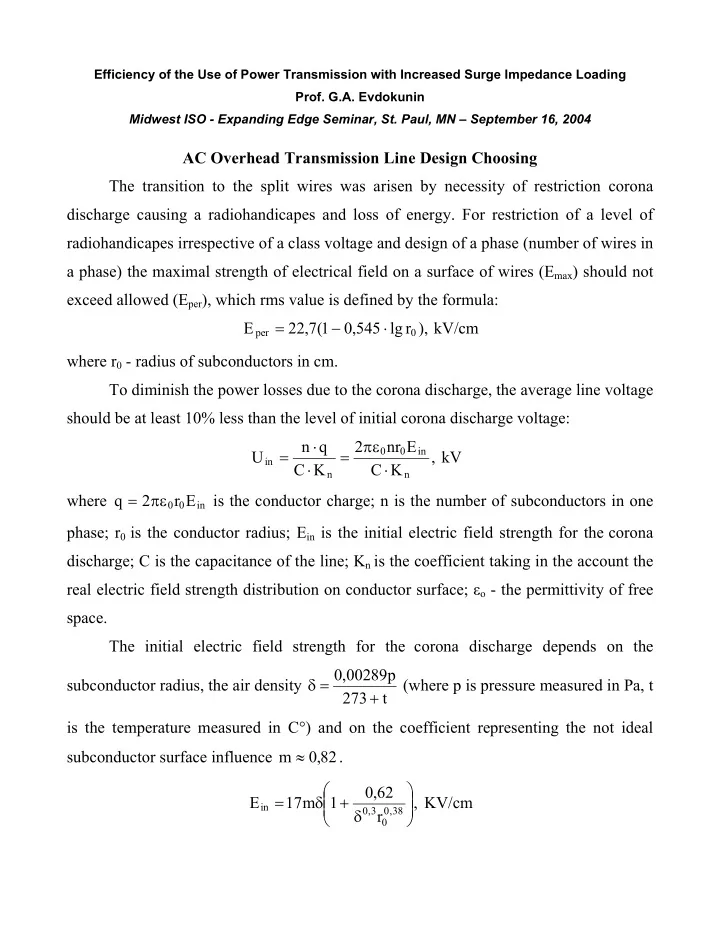
AC Overhead Transmission Line Design Choosing The transition to the split wires was arisen by necessity of restriction corona discharge causing a radiohandicapes and loss of energy. For restriction of a level of radiohandicapes irrespective of a class voltage and design of a phase (number of wires in a phase) the maximal strength of electrical field on a surface of wires (Emax) should not exceed allowed (Eper), which rms value is defined by the formula: ), r lg 545 , 1 ( 7 , 22 E
per
⋅ − = kV/cm where r0 - radius of subconductors in cm. To diminish the power losses due to the corona discharge, the average line voltage should be at least 10% less than the level of initial corona discharge voltage: , K C E nr 2 K C q n U
n in n in
⋅ πε = ⋅ ⋅ = kV where
in 0 E
r 2 q πε = is the conductor charge; n is the number of subconductors in one phase; r0 is the conductor radius; Ein is the initial electric field strength for the corona discharge; C is the capacitance of the line; Kn is the coefficient taking in the account the real electric field strength distribution on conductor surface; εo - the permittivity of free space. The initial electric field strength for the corona discharge depends on the subconductor radius, the air density t 273 p 00289 , + = δ (where p is pressure measured in Pa, t is the temperature measured in С°) and on the coefficient representing the not ideal subconductor surface influence 82 , m ≈ . , r 62 , 1 m 17 E
38 , 3 , in
δ + δ = KV/cm
SLIDE 2 2
The capacitance (C) of the split line phase, when the subconductors are evenly distributed around the circle with the radius of a bundle r and with the average spacing between the phases Dm is. , r D ln 1 2 C
eq m
πε = (2) where
n 1 eq
r nr r r =
3 ac bc ab m
D D D D =
the phases (geometric mean spacing). In practical design the Kn, as well as r0 and consequently the Ein have the small ranges and practically may be considered as constants. In traditional design of the transmission line towers the spacing between the phases Dm is also predefined. Thus, to increase the Uin it is necessary to increase the number of subconductors (while keeping the spacing between them the same). One can observe that with the increase of number of subconductors and the bundle radius r the nominator and denominator of (1) would increase (the denominator does increase due to the capacitance increase). The transmission line design practice had been evolved to keep the spacing between the subconductors the same and equal to d=0,4…0,6 m. This fact may be explained by the necessity to have the spacing between the subconductors big enough (not less than r ) 30 ... 20 ( d = ) to diminish the obliteration
- f the spacers. However this lower limit began to be considered as the upper limit and
all the designs with the phase splitting use d=0,4 m as a rule. As the bundle radius r is bound to the number of subconductors and the spacing between the sub conductors with the formula π = n sin 2 d r
SLIDE 3 3
then the only parameters left in such an approach is the number of subconductors, which led to the design with the minimal number of subconductors or with minimal space for the phase (minimal r). Let's analyze existing practice of a choice distances between phases (Table 1). Let's result endurance from PUE (Rule of the Device of Electroinstallations) minimal insulation distances between wires chosen proceeding from reliable work of a line at a continuous operating voltage and at overvoltages in view of approaching of the next phases wires under influence of a wind (a horizontal arrangement of phases). Table 1 Least distance between wires (m) at sag f (m) Unom, kV f=3 f=4 f=5 f=6 f=8 F=12 35 2,5 2,5 2,75 2,75 3,0 3,25 110 3,0 3,25 3,5 3,5 3,75 4,0 220
4,5 4,75 5,0 500
7,25 7,5 At rigid fixation of wires in span (at preservation constant phase-to-phase spacing) with the help of isolated spacers the phase-to-phase spacing can be considerably reduced in comparison with normalized PUE (at absence of isolated spacers), especial in the case of reduction of overvoltage factor
m max
U U K = (Table 2). However this reduction can appear impossible on a condition of restriction of corona discharge. So, for example, it is possible to ensure phase-to-phase spacing to D=1.2 m in the case of 110 kV line (Table 2). However it results in the paradoxical technical decision, when aspiration to ensure the maximal value of a voltage of a corona discharge Uin (at radius of a wire r > 0.7 сm) has resulted in increase phase-to-phase spacing even in comparison with normalized by PUE: for 35 kV Dm = 4 m, 110 kV - Dm = 5 m, 220 kV - Dm =8 … 9 m, 500 kV - Dm =12 … 14 m.
SLIDE 4 4
Table 2 Overvoltage factor for different phase-to-phase spacing Unom, kV 35 110 220 500 Overvoltage factor, К 3,5 1,8 3,0 1,8 3,0 1,8 2,5 1,8 Phase-to-phase spacing, D, m 0,4 0,25 1,2 0,7 2,4 1,4 4,2 3,3 High to ground, m 6 6 7 8 The additional limiting factor on ways of creation lines with reduced phase-to- phase spacing is the high level of overvoltages (Table 3). Table 3 Overvoltage factor (under PUE and possible) Unom, kV Overvoltage factor K (under PUE) Possible overvoltage factor K 35 3,5 1,8 110 3,0 1,8 220 3,0 1,8 500 2,5 1,8 And, at last, distinctive feature of all overhead line towers is the presence earth connected elements between wires of the next phases, therefore the sum of insulation distances also appears significant. All stated shows, that for rapprochement of phases their splitting is expedient. Now let us consider the current approach to the phase-to-phase spacing. Such standard defines the minimal distance, which allow reliable transmission with maximum
- perating voltage (Um) and some overvoltage (Umax) and galloping of the line
- conductors. In Russia the standard defines such a distance for 500kV line to be
D=7…7,5 m depending on the sag. This number could be reduced significantly by using
SLIDE 5 5
the rigid phase-to-phase spacing (achieved with the isolated spacers), as well as with reducing of overvoltage factor
m max
U U K = . Selecting K=2,5 brings the phase-to-phase spacing to the 4,2 m, and K=1,8 gives the value of the phase-to-phase spacing equal to 3,3 m. In reality, the 500 kV transmission line has the phase-to-phase spacing D≈12 m. Thus, with d=0,4 m to keep the condition
in m
U 9 , U ≤ and have the minimal number of subconductors (n=3), the phase-to-phase spacing should be selected bigger than it is suggested by standard (7…7,5 m), or the number of subconductors should be increased to 4. The additional reason, which does not allow to reduce the phase-to-phase spacing
- f the transmission line, is not adequate design of the towers. The grounded element of
the tower (the erected pole) is positioned between the phases and as a result the sum of isolating spacing becomes significantly large. Working in the line of the traditional design it is hard to justify the increase of the number of sub conductors above the minimal, which defined by the corona discharge prevention condition. But there is an another parameter, which may be improved, i.e. the line impedance. Particularly, the inductance of the line may be reduced. In the case of the split phase the corona discharge prevention condition could be achieved with variation of the subconductor number and the spacing between them. That gives the additional degree of freedom in the design, especially if the spacing between the subconductors would not be considered as the constant d=0,4 m. Surge Impedance Loading of Compact Design Lines In the beginning we’ll show some numerical characteristics of traditional design transmission lines. a) Range of wire cross sections (F), used in power network lines, and transmitted power (S) for lines of different voltage classes represent Table 4. Table 4
SLIDE 6
6
Wire cross section and transmitted power for overhead lines Unom, kV Fmin, mm2 Fmax, mm2 S, MVA n 35 35 120 2-11 1 110 70 300 11-90 1 220 185 600 90-300 1 500 900 1500 780-1500 3 where FJ U 3 I U 3 S
ph nom =
= , I – rated load current, J – current density, n - number of wires in a phase. b) Limits of change of surge impedance Z and surge impedance loading Pn traditional design lines for the specified distances Dm. Table 5 Surge impedance and surge impedance loading for overhead lines Unom, kV Dm, m Z, Ohm Pn, MW 35 4 415-375 2,9-3,3 110 5 405-362 30-33 220 8-9 400-375 120-130 500 14-15 284-277 880-908 where
eq m
r D ln 60 Z = , Ohm
n 1 eq
r nr r r = , m
SLIDE 7 7
c) Table 6 Relation of transmitted capacity to natural S/Pn at J=1 A/mm2. F, mm2 35 50 70 95 120
S/Pn 0,71 0,99 1,35 1,88 2,23
70 95 120 150 185 240 300 110, kV S/Pn 0,44 0,6 0,7 0,84 1,07 1,38 1,67 F, mm2 240 300 400 500 600
S/Pn 0,76 0,92 1,22 1,5 1,77
3*300 3*400 3*500
S/Pn 0,88 1,16 1,43
- The given data show, that the surge impedance practically does not depend on
cross section of a phase and, hence, surge impedance power is constant for the given voltage class irrespective of used cross section. The transmitted power S for given current density J, on the contrary, is proportional to cross section and, hence, with its growth attitude S/Pn increases because of S increasing. The closeness of subconductors with the increase of their number leads to the drop of Dm and the increase of r, which gives the increase of capacitance C in (2) and, consequently, gives the reduced value of line surge impedance
c
C 1 Z υ = (
c
υ is the light velocity), that gives us Increased Surge Impedance Loading (ISIL), or to High Surge Impedance Loading (HSIL). Below is an example of this new approach applied to the 500kV transmission line. Let us take the radius of the conductor r0=0,01 m, the spacing between the subconductors d=0,4 m and the phase-to-phase spacing D=12 m. Let us keep those parameters and vary the number of subconductors.
SLIDE 8
8
The sequence of calculation is following: with the set d and n the r is calculated and then req and C according (2). The conductor charge may be defined by approximated formula
in
r 2 E q πε = , which suggested Kn=1 and as a result we receive from (2) (under the condition
ph in
U U = ), where Uph - a line phase voltage. n C U q
ph
≈ . Also let us calculate the isolation spacing
r d Dsp 2 − =
. The results of calculations are presented in the Table 7. Table 7 Some parameters of 500 kV transmission line for different subconductors number n 3 10 20 … 10 10 r, m 0,23 0,65 1,28 … 25 2,5 C, pF/m 12 17,9 23,9 … 38,3 37,4 q/Uph 12/3 17,9/10 23,9/20 … 38,3/10 37,4/10 Dsp, m 11,5 10,9 9,7 … 11,5 3 The results show us that with the fixed spacings between the phases (centers of the phases) Dm and between the subconductors the increased number of subconductors increases the capacitance of the line C, though not so drastically, but, significantly reduce the charge on each conductor. The reduced charge provides better corona discharge prevention (we consider that acceptable relative value of the charge 3 / 12 U q
ph
= when n=3. It is possible too keep the charge on the conductor close to the acceptable value (with Dsp=11,5….12 m) increasing the spacing (d) between the sub
SLIDE 9 9
conductors (see the last column of the Table 2). With such variation the capacitance of the line grows almost proportionally to the number of subconductors (with the coefficient equals to about 3,3), though it brings the bundle radius to the gigantic and unacceptable size r=25 m. And, finally, the forth column of the Table 7 exhibits the desirable line capacitance increase with acceptable bundle radius r=2,5 m, which is achieved due to the phase-to-phase spacing decrease (here Dsp is about 3m ). As it shown above, the line power increase is possible with the significant number
- f subconductors and simultaneous decrease in the phase-to-phase spacing. This
conclusion brings the necessity of the different tower design, when the grounded elements of the tower embrace all the three phases of the transmission line. The results illustrated in the Table 7 could be substantiated with some theoretical construct. The current in the line may be represented as q C U C LC U Z U I
c c ph ph ph n
υ = υ = = = , where the charge E r 2 q πε = and condition is
per
E E ≤ . Thus the line power may be presented as
n per ph c n ph n
K E U nr 6 I U 3 P υ πε = = , which shows that with the electric field strength on each conductor close to the accepted limit Eper the surge impedance loading (Pn) of the line is proportional to the number of
- subconductors. It is not the case with the traditional methods of design where the
inductance and capacitance L, C of the line very slightly depends on the number of
- subconductors. For example the line inductive reactance x depends on the number of
subconductors in this way: x=0,4 (n=1); x=0,33 (n=2); x=0,3 (n=3); x=0,28 (n=4). In the real design the coefficient Kn, representing the irregularity of the electric field on the subconductor should take to the account the influence of other
- subconductors. The calculation of Emax and verification of
per i max
E E < should be done
SLIDE 10
10
with computer modeling. The software with optimization algorithms makes the search of the optimal configuration of subconductors. The results may represent the uneven distribution of subconductors around the circle (Fig.1a), ellipsoid configuration (Fig.1b), linear (Fig.1c), parabolic (Fig.1d), etc. Fig.1. Some distributions of subconductors for compact design lines a) b) c) d)
SLIDE 11 11
The Effectiveness of HSIL The most significant areas of HSIL technology application are the supply transmission line connecting the high power generator with the distribution grid, or the grid interconnection for the high power transmission. Such HSIL based lines allow reduce the number of reserved lines (the right of way), or transmit more power without voltage increase (especially for the short lines, when active power losses are small because of small resistance of the line). Moreover, the effectiveness of the transmission line in both types of application may be improved even if not high power transmission is involved. It will be shown for the interconnection line first. The line consumed reactive power (QL) is ) sin( Z I 3 X I 3 Q
2 L 2 L
λ ≈ = , where λ - is the wave length of the line, Z - surge impedance, I - current is approximately equal to the load current (here we neglected the capacitive current). The line generated reactive power (QC) is ) sin( Z 1 U 3 b U 3 Q
2 L 2 C
λ ≈ = . Besides we consider |U1|=|U2|=U (U1 and U2 - receiving and ending voltages at the line) and ) sin( 2 tg 2 λ ≈ λ .As a result
2 n 2 n 2 2 2 n 2 2 n 2 2 2 2 2 C L
P S ZP U 3 Z I 3 P U 3 P Z I 3 ) sin( U 3 ) sin( Z I 3 Q Q = ⋅ = = λ λ = , where S is the transmitted power, as FJ U 3 S
nom
= and J is the current density, F-
- verall phase conductor cross section.
The ratio of the reactive power QL to the transmitted power is ) sin( P S Z Z U 3 X UI 3 UI 3 X I 3 S Q
n 2 L L 2 L
λ = ⋅ = = .
SLIDE 12
12
Thus the line relative reactive power
l
Q is ) sin( S P P S S Q Q S Q
n n C L
λ − = − =
l
. From this formula one can see that with 1 P S
n
< the line produces the reactive power, and with the 1 P S
n
> , the line consumes the reactive power. With the 1 P S
n
= , the line is balanced. If the line is designed to have 1 P S
n
> , then to balance it the external reactive power source, as generator, compensator or battery of capacitors, is required. The effectiveness of transmission drops if line is not balanced. For the 220 kV transmission line the value of
n
P S depends on the phase subconductors cross section value F, and with taken J=1 А/mm2 we get the set of 76 , P S
n
= (with F=240 mm2); 0,92 (300 mm2); 1,22 (400 mm2); 1,5 (500 mm2); 1,77 (600 mm2). The conclusion is, that with the restriction on external reactive power the line with higher value of cross section carries less power. Thus, to improve the effectiveness of transmission of the line with the large value of F, chosen due to the corona discharge condition, it is necessary to split the conductor with cross section F in n sub conductors, each with cross section F0 or decrease a permissible current density while the overall cross section nF F = remains the same value. Let us consider the case of the supply transmission line (Fig.2). Fig.2. Case of supply transmission line. Z , F , l U1 U2 S
SLIDE 13
13
In the design of such lines the values of supplied voltage, the load power, the line length and the current density are the set parameters. The phase cross section F is defined through the formula J nF U 3 FJ U 3 I U 3 S
ph ph nom
= = = , where S is the load power. The formula demonstrates that the phase cross section could be represented with number of subconductors n, cross section of each is F0. The minimum for F0 could be found based on mechanical strength of the conductor, the span length, icing conditions, the available set of conductor cross sections and so on. Let us simplify the equation with the assumption 1 cos = ϕ , then S=P, and assume the active resistance of the line and its capacitance equal to zero. Then line current will be
2 ph 2
U 3 FJ U 3 U 3 P I = = and the voltage will be defined as
. 2 1
I jX U U + = ,
2 2 ph 2 2 1
X J F U U U U ⋅ ⋅ + = Solving the equation on
1 2
U U , we transfer to
2 2 1 ph 1 2
X J F U U 25 , 5 , U U ⋅ ⋅ − + = The formula reveals that voltage drop on the line would increase not only with the line length and the current density, but with the cross section size also. In other words, the bigger cross section would decrease the transmission capability of the line, as the transmitted power would be restricted by the permissible voltage drop
1 2
U U . Let us define the surge impedance loading Pn using the equation:
ph 2 ph ph n
U J F Z U 3 Z J F U 3 P S ⋅ ⋅ = ⋅ ⋅ = .
SLIDE 14 14
Then we obtain the voltage drop in different manner:
2 c 2 1 ph 1 2
Z J F U U 25 , 5 , U U υ ω ⋅ − + = l (3) where substitution
c 0Z
X υ ω = l had been used. The formula tells, that to increase the transmission capability of the line, it is necessary to decrease the surge impedance particularly in the cases when the cross section does increase. Or, as the formula (3) indicates that the transmission line is more effective (has less voltage drop and power losses), when the ratio
n
P S is minimal. It may be said that most of existing supply lines have 1 P S
n
> , and only use of the conductors with small cross section gives . Above the benefits of the increase of power transmission and the transmission distance the use of HSIL technology allows to decrease the power losses. This follows from the formula: R J F U U R I 3 P
2 2 ph 2
⋅ ⋅ = = ∆ , because the line based on HSIL technology may have higher voltage
2
U with the defined
current I. The existing approach, when the supply line is compensated by external reactive power source in case of disconnection of one of the usual two connecting lines due to the failure or just in case of the maintenance, results effectively in higher operative expanses, than the use of HSIL based lines.
SLIDE 15 15
Technical and Economic Rating of Efficiency
- f Compact Design Lines Applications.
Power transmitted on lines of the given voltage class changes over a wide range, that causes the change over a wide range of cross section of wires. Also over a wide range it is possible to change surge impedance loading of lines by change of number of subconductors in a phase. However increase of a surface of wires at constant cross section of a phase is connected to increase of cost of a line. In this connection there is a task of definition of the most economic way of maintenance of reactive power balance in power system - at the expense of installation of additional reactive power sources or by increase of line surge impedance loading. In these calculations was accepted on the data
- f design institute, that the increase of cost of 1 km of a line makes:
l L K n P n P L K ⋅ − = ∆
1 min 075 . where KL cost of 1 km of a line with surge impedance loading
min n
P . The calculations have shown, that as a rule it is more favorable to carry out compensation of consumed reactive power by increase of surge impedance loading P up to a level of transmitted S, than installation of compensating devices. The benefit is increased with growth of a voltage class since in this case cost of a line grows more slowly, than natural capacity of a line. Compact Design Line Examples Below we hold the investment needed to implement the 500 kV North-South Transit in Kazakhstan up as an example, determined on the basis of the engineering and design solutions, performed by St. Petersburg “Sevzapenergosetproject” in 2001. Individual transmission line sections of this long-distance 500 kV North-South Transit: Ekibastuz-Agadyr-Yukgres-Shu-Zhambyl differs substantially and thus necessitates itemization of project costs for each particular transmission line section.
SLIDE 16 16
At this stage, economic, financial, and social advantages of the project, cost effectiveness, operating costs, loading losses and maintenance costs were not
- determined. Table below gives the construction costs of the 500 kV North-South Transit
and shows not essential differences between the variants. Table 8 Long-distance 500 kV North-South Transit Construction cost, million USD # 500 kV line section Length of line section, km Conventional Compact line 1. Ekibastuz-Agadyr 508 95.65 99.05 2. Agadyr-Yukgres 385 71.3 72.5 3. Yukgres-Shu 270 61.53 62.82 Total 1163 228.48 234.37 Tower design for conversional and compact 500 kV lines represented on Fig.3 and Fig.4 respectively. Fig.3. Tangent Tower for Conventional 500kV Line (Kazakhstan).
SLIDE 17
17
Fig.4. Tangent Tower for Compact 500kV Line (Kazakhstan): 6 subconductors; inductive impedance X=0,167 Ohm/km; surge impedance Z=160 Ohm; surge impedance loading P=1650 MW; the phase spacing is reduced (from conventional) - 24 to 7 m. Another examples of the compact lines that are in operation are shown on Fig.5-7. Fig.5. Compact 500kV line of 740 km with 4 subconductors, 1999 (Brazil).
SLIDE 18
18
Fig.6. Tangent Tower for Compact 500kV Line (China). Fig.7. Compact 330kV line of 150 km with 4 subconductors, 1990 (Russia).
SLIDE 19
19
Parameters of compact lines, represented on Fig.6-7 are: Fig.6. Inductive impedance X=0,2 Ohm/km; surge impedance Z=191 Ohm; surge impedance loading P=1330 MW; the phase spacing is reduced (from conventional) – 24,6 to 6,7m. Fig.7. Inductive impedance X=0,19 Ohm/km; surge impedance Z=180 Ohm; surge impedance loading P=610 MW; the phase spacing is reduced (from conventional) – 9,0 to 5,5m.