SLIDE 1 Where ’s at Modern Hebrew feminine suffixes Noam Faust
1 Where 's at: the grammar of feminine suffixes in Modern Hebrew Noam Faust Université Paris 7
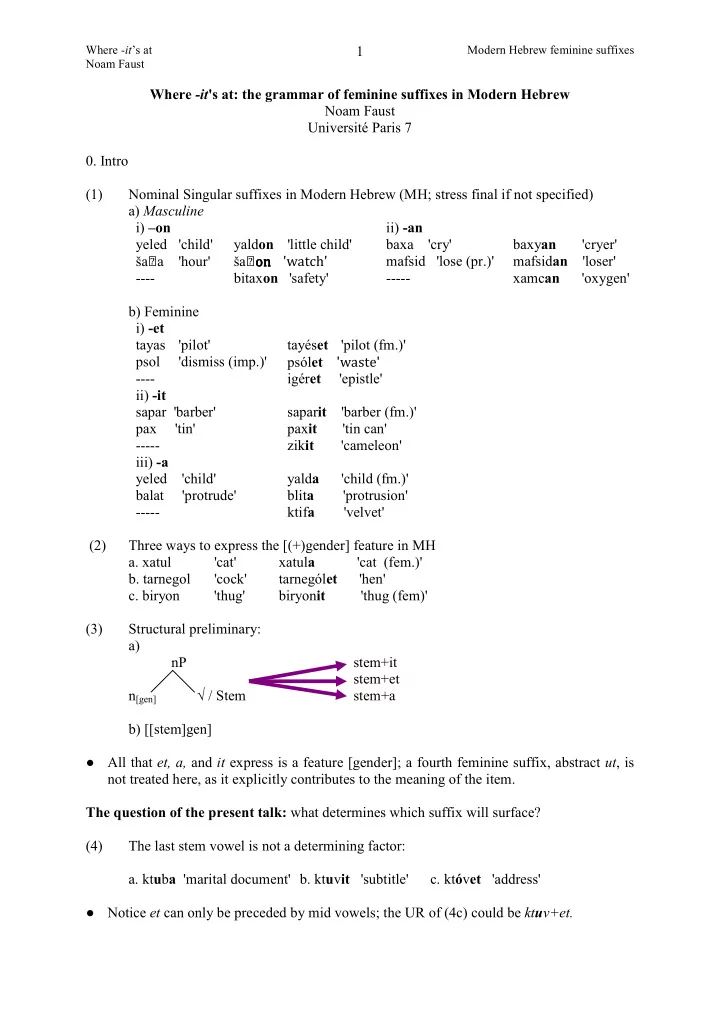
(1) Nominal Singular suffixes in Modern Hebrew (MH; stress final if not specified) a)
ii) an yeled 'child' yaldon 'little child' baxa 'cry' baxyan 'cryer' šaʕa 'hour' šaʕon
mafsid 'lose (pr.)' mafsidan 'loser' ,,,, bitaxon 'safety' ,,,,, xamcan 'oxygen' b) Feminine i) et tayas 'pilot' tayéset 'pilot (fm.)' psol 'dismiss (imp.)' psólet 'waste' ,,,, igéret 'epistle' ii) it sapar 'barber' saparit 'barber (fm.)' pax 'tin' paxit 'tin can' ,,,,, zikit 'cameleon' iii) a yeled 'child' yalda 'child (fm.)' balat 'protrude' blita 'protrusion' ,,,,, ktifa 'velvet' (2) Three ways to express the [(+)gender] feature in MH
'cat' xatula 'cat (fem.)'
'cock' tarnególet 'hen'
'thug' biryonit 'thug (fem)' (3) Structural preliminary: a) nP stem+it stem+et n[gen] √ / Stem stem+a b) [[stem]gen]
- All that and express is a feature [gender]; a fourth feminine suffix, abstract , is
not treated here, as it explicitly contributes to the meaning of the item. The question of the present talk: what determines which suffix will surface? (4) The last stem vowel is not a determining factor:
- a. ktuba 'marital document' b. ktuvit 'subtitle' c. któvet 'address'
- Notice can only be preceded by mid vowels; the UR of (4c) could be
SLIDE 2 Where ’s at Modern Hebrew feminine suffixes Noam Faust
2
- It is not phonology that determines the spelled,out form of the gender feature.
Strategy of investigation: find regularities; generalize from regularities to less regular cases, and eventually to all cases. (5) Analytic vs. Non,Analytic Morphology (inspired by Kaye 1995)
- a. Analytic
- b. Non,Analytic
[[A]B] [A B]
- c. Hypothesis: The relations in (a) and (b), where brackets represent projections, are
the only possible relations between an item and a suffix.
- d. Prediction: There are only two possible suffix,base relations, but three realizations;
at least two of the three feminine suffixes are equally "close" to the stem/root. Eventual conclusion: and correspond to (5a) and (5b) respectively. The gender feature in both spells out as one additional CV unit, accompanied by . The vowel of the suffix is epenthetic; the suffix is only . The vowel of the suffix is the realization of a nominalizing head . The suffix is an allomorph of both emerge in the same configuration.
1.1. An end to grab: morphologically complex masculine nouns (6) Two complex masculine nouns
'talker' dabranit, (*dabrénet, *dabránet, *dabrana)
'little child' yaldónet, (*yaldonit, *yaldona)
- The two masculine suffixes contrast with respect to their feminine form. They're a good
place to start. (7) Suffix imposes vocalisation on stem; dim. doesn't
'flag'
'book' digli 'my flag' sifri 'my book' diglon 'flag (dim.)' sifron 'book (dim.)' daglan 'flag bearer' safran 'librarian'
SLIDE 3 Where ’s at Modern Hebrew feminine suffixes Noam Faust
3 (8) Suffix imposes syncope; dim. doesn't
'piano'
'revolution' psanterim 'piano (pl.)' mahapexot 'revolutions' psanteron 'piano (dim.)' mahapexónet 'revolution (dim.)' psantran 'pianist' mahapxan 'revolutionary' (9) Suffix (a) may be non,transparent in meaning and (b) may have no base
'recieve' kablan 'entrepreneur' liva 'accompany' lavyan 'satellite' moteax 'suspend' motxan 'thriller'
xamcan 'oxygen' ,,,, tatran 'anosmic' ,,,, balšan 'linguist' => diminutive is always transparently diminutive and always has a base (compare to Spanish ‘mosquito’ vs. ‘fly’ ). (10)
- vs. dim:Summary of distributional generalizations
- imposes
vocalisation imposes prosody possibly non, compositional base possibly non,existent an
- safran ‘librarian’
- psantran ‘pianist’
- lavyan ‘satellite’
- tartan 'anosmic'
- ndim
,
sifron ‘small book’
,
psanteron ‘small piano’
, ,
- The properties in (10) lead us to the conclusion that is closer to the stem/root than dim.
(see also Arad 2004, Marantz 2001 for a similar approach) In Kaye’s (1995) terms, this could be presented as follows: [X an] vs. [[X] on]
Between dim. and its basethere is at least one more boundary than between and its base. In syntactic theories of Morphology (Such as Distributed Morphology, Marantz 1997), the facts in (10) could mean that and its base are part of the same phase; dim. might not belong to the same phase as its base (that is, if the bracket before it represents a phase edge): (11) versus dim. : in Distributed Morphology a) nP => [X an] n[agen] X b) nP => [[X]on] phase n[dim] nP => [X] edge? n X
SLIDE 4 Where ’s at Modern Hebrew feminine suffixes Noam Faust
4 Intermediate Summary I: we have i) parameters for detecting boundaries; and 2) a partial distinction between and . 1.2. Back to feminine suffixes
- Recall: an+=> anit, *anet ; on+ => ónet, *onit.
- Assuming there is a reason for this distribution, we will now look at how these two
sequences may contrast (12) Possible combinations of , and feminine suffix
& [[X]on] ] (an
- gen) = (on
- gen)
- b. [X an ]
& [[X]on ] II)
& [[X]on ] (an
- gen) ≠ (on
- gen)
- d. [X an ]
& [[[X]on] ]
- The options in (12.I) are identical with respect to the relation between masculine suffix
and . They thus predict that the spell,out of the feminine form will be identical in both cases, which is not the case. We are left with (12.II): (12c) [[X an] ] & [[X]on ] (12d) [X an ] & [[[X]on] ] (13) Diminutive agrees with base in gender (Bat El 1997)
‘cow’ parónet (*paron) paxit ‘tin can’ paxiyónet (*paxon) xayélet ‘soldier (fem.)’ xayalónet (*xayalon)
- That the diminutive agrees in Gender with the base
, points out that dim. and its feminine suffix spell out together, i.e. they belong to the same phase/cycle; a view [[[X]on]gen] is wrong. , supports an analysis of the diminutive the interpretation of the base, i.e. [[X]nP on] rather than [X on], where nP is a derivational edge;
- If so, we arrive at the following distinction by elimination:
(12c) [[X an] ] & [[X]on ] (14)
- vs. : structural generalization
In the environment of a preceding masculine suffix, does not belong to the same cycle as its stem; does. Intermediate Summary II: The structural distinction between and, !!" ! ", is similar to the distinction between and dim respectively.
SLIDE 5 Where ’s at Modern Hebrew feminine suffixes Noam Faust
5 1.3. Expanding the analysis Hypothesis: (14) holds for all occurrences of and # always points to a structure [[X]gen] and always points to a structure [X gen]. In other words, [[X]gen] invariably leads to Xit [X gen] invariably leads to Xet. The hypothesis is tested by comparing the distribution of these two suffixes according to the parameters established above for vs. dim. . (15) Feminine suffixes in Modern Hebrew (1b, repeated) "$$
tayas 'pilot' tayéset 'pilot (fm.)' psol 'dismiss (imp.)' psólet 'waste' ,,,, igéret 'epistle' ii) it sapar 'barber' saparit 'barber (fm.)' pax 'tin' paxit 'tin can' ,,,,, zikit 'cameleon' (16) Examples of recent coinage with vs. i) et
niyar ‘paper’ nayéret ‘paperwork’ me,tumtam ‘stupid’ tamtémet ‘the disease of being stupid’ nihel ‘to administrate' minhélet ‘logistics headquarters’ ii) it
mapa ‘map’ mapit ‘napkin’ dibur ‘talking’ diburit ‘taking device’ kalnoa ‘easy,move’ kalno’it ‘vehicle for spacially challenged’ mayonez ‘mayonnaise’ mayonit ‘brand of mayonnaise’
- Productivity:Within the nominal system, , is extremely productive in the coinage of
new words, attaching to bases of all forms. is productive only as part of the a template (most commonly %&'(, and quite rarely %&(, %&)(and%&)(;
- ther templates, like ' above, are closed groups).
(17) vs. :Summary of distributional generalizations
vocalisation imposes prosody possibly non, compositional base possibly non,existent et
- nayéret ‘paperwork’
- (part of template)
- nayéret ‘paperwork’
- igéret ‘epistle’
it , ,
- paxit ‘tin can’
- zikit ‘cameleon’
SLIDE 6 Where ’s at Modern Hebrew feminine suffixes Noam Faust
6
- Table (17) partially supports the extension to all instances of the generalizations of the
previous subsection, namely [X et] vs. [[X]it].
- Further support is found the case of QaTaL (underlyingly /QaTTaL/) bases, which I'll call
- ccupational nouns. These are the only base with which both suffixes are productive
(Phonological reminder: /qatal+et/ => [qatélet])1: (18)
- vs. : The base QaTaL
- i) et
- šayat
‘oarsman’ šayétet ‘oarswoman’ or ‘sea squadron’ sagam ‘sec. lieutenant’ sagémet ‘sec.lieut.(fm.)’ or ‘green behavior’2 ,,,, dabéšet ‘hump’ ,,,, kavéret ‘bee,hive’ ii) it
‘barber’ saparit ‘barber (fm.)’ but šadar ‘radio man’ šadarit ‘radiowoman’ nothing nagar ‘carpenter’ nagarit ‘carpenter (fm.)’ else!! ,,, *QaTaLit (17)
- vs. :occupational QaTTaL base
- imposes
vocalisation imposes prosody possibly non, compositional base possibly non,existent et
, , Conclusion: [[...X] ] Xit [...X] Xet (18) Syntactic structures a) ,suffixed nouns nP => [X ] n[gen] X b) ,suffixed nouns b) nP => [[X] ] phase n[gen] nP => [X] edge? n X
1 cf. plural form [qatalot]; see also Bat,El, to appear(b)).
2 On behalf of a second lieutenant.
SLIDE 7 Where ’s at Modern Hebrew feminine suffixes Noam Faust
7 1.4. Two advantages i) Loanwords
- Presumably, loanwords do not have internal structure; they constitute closed domains for
speakers; the only possible feminine structure for loanwords will be [[X] ]. The analysis correctly predicts that the only feminine suffix for loanwords will be . (19) Feminine of loanwords
astronáutit ‘astronaut’ (*astrownawtet, *astronawta)
stárit ‘media star’ (*starit, *staara)
ʕáwarit ‘dumb person’ (*ʕawéret, *ʕawara)
mikróbit ‘pest’ (*mikróbet, *mikroba)
flanelit ‘flannel ribbon’ (*flanelet, *flanela)
diskit ‘small plaque (*disket, *diska)
- g. kus 'vagina (arab.)' kúsit
'good looking woman (vulgar)' (*kúset, *kúsa)
- If loanwords have no internal structure, then no loanword should be loaned as [[...]gen].
Such a structure will only correspond to the forms of loanwords like the ones in (19). But loanwords may be intrinsically gendered (i.e. loaned as [+gen]). In this case, they will have the non,analytic structure [X gen]. The present view of feminine suffixation predicts that such words will have a suffix . This is indeed the case: (20a,c) shows [a],final loans, which are always feminine, regardless of their gender in the original language; final loans (20d,f) are always masculine, like all other C,final nouns. This is explicable if we assume that suffixation of , is always analytic. Loanwords that are loaned as feminine always have the form [X Y]. But can only be the result of [[X]Y], and no word is loaned with such a structure. (20) Femine loanwords with , Masculine loanwords with
- a. prézentacya ‘presentation’
- d. disk
‘disc’
‘dilemma’
‘minibus’
‘discothèque’
‘credit’ ii) Allomorphy:
- If the present account is true, there cannot be a relation of phonological allomorphy
between and , since they spell out different structures.
- (21) show a case of such phonologically conditioned allomorphy between and .
Participles in the first verbal paradigm in MH have the vocalisation {o,e} interdigitated with the root consonants {Q,T,L}, yielding QoTeL. Some roots have a weak third radical. This radical doesn’t appear in their participle form, which is thus QoTe. QoTeL and QoTe contrast with respect to their feminine form:
SLIDE 8 Where ’s at Modern Hebrew feminine suffixes Noam Faust
8 (21) QoTe(L) , a case of allomorphy of feminine suffixes QoTeL QoTe
korécet ‘wink’
kora ‘happen’
šotélet ‘plant’
šota ‘drink’
- and must therefore be identical in the structure that they spell out; we will return to
this point. Crucially, ,never appears on any participle. The morphology of feminine participles is [X ].
Kaye, Lowenstamm & Vergnaud 1990: the only possible basic prosodic constituent is ON (Onset,nucleus). There are no underlying closed syllables (later refined to a CV constituent in Lowenstamm 1996). All adjacent consonant CC have an empty nucleus between them CVC. This empty nucleus is realized as an epenthetic vowel (in MH, [e]) if it is not properly governed by a following full nucleus. (22) Government and empty Nuclei
- a. well governed empty nucleus
- b. ungoverned empty nucleus
t l t l a | | | | | C V C V => [t<e>l] C V C V => [tla] 2.1. The phonology of
- As mentioned above, a vowel becomes before the of the suffix (ganav=>ganévet
‘thief (ms,fm)’) Moreover, the suffix is unstressed, whereas the great majority of native MH words are stress,final. Bat El, (to appear(b)) suggested that 1) the suffix is lexically unstressed and 2) it needs a mid vowel before it. (23) “Segholates” , penultimately stressed surface forms
kalba ‘dog,bitch’ /kalb/
malka ‘king,queen’ /malk/
nafši ‘mind , mental (approx.)’ /nafš/
SLIDE 9 Where ’s at Modern Hebrew feminine suffixes Noam Faust
9 (24) Traditional derivation of masculine segholate /kalb/=> [kélev]: k a l b | | | | CVC VC V k a l <e> b | | | | | CVC V CV k é l <e> b | | | | | CVC V CV (25) Rule of “segholation” (which will be left at that; see e.g. Malone 1993) ae /___C<e>C
- If so, there is no justification for devising rules special to . The underlying structure of
the suffix is simply , and stress in MH native items ignores empty nuclei. (26) Derivation of ' from
- [ganav+] => [ganáv+t] => [ganávet] => [ganévet] (rule in (25))
2.2. The phonological form of feminine suffixes (27) Structure proposed for (with skeletal CV): t | CV Proposal: The same UR in (27) is inserted in both Xit and Xet. The difference in surface form is the result of [X ] vs. [[X] ]. (28) Syntactic structure [X ]: spell out of gender and n in !
- a. ganévet ‘thief (fm.)’ (fm. of ganav)
nP n[occup] ; [gen] √GNB QaTaLV tV
g a n a v t | | | | | | [ C V C V C V[occup] , C Vgen ]nP g a n e v<e> t | | | | | | | [ C V C V C V C V ]nP
- Now consider a structures like [[X] ]. [X] is a noun. it is a closed domain. The result
- f [[X] ] is also a noun. The structure we have been calling [[X] ] must be the one
in (28) (as actually assumed already in (18) above):
SLIDE 10 Where ’s at Modern Hebrew feminine suffixes Noam Faust
10 (29) Structure of [[X] gen] is [[n]nP n ]nP nP n[gen] nP n X Lowenstamm 2008: n always has phonetic content (minimally a CV constituent). (30) Syntactic structure [[X] gen]; spell out n and another n[gen] .
- a. saparit ‘barber (fm.)’ (fem. of sapar)
nP n [gen] nP n[occup] √SPR CV tV QaTaLV
s a p a r t | | | | | | [[C V C V C V[occup]]nP CVn , C Vgen ]nP s a p a r t | | | | | | [ C V C V C V C V , C Vgen ]nP Problem!!! two consequtive empti nuclei!! (31) Apophonic Chain (Guerssel & Lowenstamm 1996; Ségéral 1994) ø i a u u (32) Empty nuclei filled through apophony s a p a r ø
| | | | | / \ | [ C V C V C VCV C Vgen ]nP
SLIDE 11 Where ’s at Modern Hebrew feminine suffixes Noam Faust
11
- That is composed of and has been shown to follow from
i) the fact that always follows an interpretation boundary, and must be headed by n; and ii) independent morpho,phonological assumptions, namely that spells out its own CV. MorphoPhonological Conclusion There is no single suffix Gender in both and is expressed by . The vowel of is the spell,out of the (inert) head that carries the gender feature.
- Claiming that is in+tgender is not only more economic but also makes a prediction: the
two components should be able to appear separately.
- We have actually seen such cases (in (3) above): the diminutive of ",-.,is
") Diminutive has to agree in gender with its base (=it has no gender of its
- wn). Gender is spelled out only once (")., on the diminutive suffix; the
nominal element of the complex suffix stays next to its base (")).3 2.3. A note: Problem? Non,compositional , with no base (33) More of
X base without it i. masa'it ‘truck’ masa ‘load’ ii. musafit 'suffix' musaf ‘supplement’ iii. kapit ‘teaspoon’ kaf ‘tablespoon’ iv. kaspit ‘mercury’ késef 'silver' v. rištit ‘retina’ réšet 'net' b) with no base X it related word without it i. nakbuvit ‘small hole’ nékev ‘pore’ ii. cloxit ‘small plate’ caláxat ‘plate’ iii. mašrokit ‘whistle (the object)’ šarak ‘to whistle’ iv. gigit ‘small tub’ ,,,, v. šalpuxit ‘blister’ ,,,, vi. šuit ‘bean’ ,,,, vii. gaxlilit ‘firefly’ gaxélet ‘burning piece of coal’
‘glass’ zax ‘pure, clear’ ix. šapirit ‘dragonfly’ ,,,, x. zikit ‘cameleon’ ,,,, xi. gofrit ‘sulfur’ ,,,,
3 I cannot provide a full account of this here; suffice it to say that it is compatible with the present analysis of
being in+tgender. For a proposal that this is an OCP effect in "the suffix domain", see Bat El to appear(a).
SLIDE 12 Where ’s at Modern Hebrew feminine suffixes Noam Faust
12
- In (33a), what I've been treating as [[n]nP ]nP serves another function: to derive new
nouns from existing ones, usually with a quasi,diminutive, related instrument or natural, kind meaning.
- The nouns in (33b) exhibit a pattern Xit where X is not recognizable as an independent
word in the language. They constitute a closed group, but notably fall with but a few exceptions into the semantic classes above. I suggest that speakers analyze these nouns as [[n]nP ]nP by analogy to compositional cases.
- The non compositionality effect follows from the inanimacy of the base (when there is
- ne).4
- 3. Why , is, and about / Two additional issues
3.1. Why is.
- We have discussed the structure that the particle reflects. We haven’t discussed !
that structure exists where it does. That is, why it is that whenever we have agentive ($ ‘cryer’), the only possible feminine form is $. (34) Feminine Structures "
[[X " ] nP ↓ ↓ [[sapar]it] [ganev et] (/ganavt/) ‘barber (fm.)’ ‘thief (fm.)
[[X ]nP ]nP *[X ]nP ↓ ↓ [[baxyan]it] *[[baxyan]et] ‘cryer (fm.)’ ?
- was shown to be templatic, as is the base QaTaL (they both impose prosody and
vocalisation on their complement). The only difference is that items with are all agentives, whereas QaTTaL forms – when they exist – are not limited to one semantic
- category. The account leads us to assume the following:
=> Templatic mark the end of a phase. The form is spelled out without gender, and any elaboration on it belongs to the next cycle/phase. …which boils down to saying that there can only be one derivation per cycle/phase. In a way, this implies that agentives are a gender in their own right, but this will have to be discussed elsewhere.
4 Notice especially examples (30b iii,v); these are of the segholate paradigm, which was used to distinguish
between and As we saw, had templatic effects on a segholate, and dim. didn't. Here patterns with
- dim. again in that there are no templatic effects on the segholate: the stem vowel in rištit 'retina' is the same
that we find in rišti 'my net'.
SLIDE 13 Where ’s at Modern Hebrew feminine suffixes Noam Faust
13 3.2. Some mo[a]
- A full description of the suffix [a] cannot be provided here. This subsection summarizes
what was said above about [a] and the predictions of the present analysis on its distribution: (35) Some mo[a] a
yalda 'child (fm.)'
pirca ‘loophole’
simla ‘dress’
blita 'protrusion'
ktifa 'velvet'
kabala ‘receipt’
šayara ‘convoy’
vocalisation imposes prosody possibly non, compositional base possibly non,existent a gen
- ktifa ‘velvet’
- as part of a template
- pirca ‘loophole’
- simla ‘dress’
Conclusion: is like . Derivation with is phase,internal, like derivation with simple . Prediction: will be in complementary distribution with (both spell out same feature in same relevant syntactic structure).5 => We’ve seen, in the case of the feminine forms of participles (discussion around (21) above), that and can stand in a relation of phonologically conditioned allomorphy. => If is in a relation of allomorphy with , and is a part of , a suffix should also be found, as it is indeed (šawarma ‘kebab’, šawarmiya ‘kebab place’; pnim ‘insides’, pnimiya ‘boarding school’). Future elaboration: Whether and are really allomorphs or not, extending the present account will have to involve specifying exactly the contexts in which , as opposed to , may appear.
5 In Faust (2007) I suggested that is the spell,out of a gender feature only indirectly; it spells some other feature
and “lands” on the gender ".
SLIDE 14 Where ’s at Modern Hebrew feminine suffixes Noam Faust
14
In this talk, I used the notion of cycles (/phases) in syntactic structure (somewhat loosely) to explain the morpho,syntactic phenomenon of affix distribution and the phonological phenomenon of affix form (recent work about phonological phases in Newel 2008, Piggott and Newel 2006; Scheer, in press). I reached the following conclusions: About suffixes in Modern Hebrew There is only one feminine suffix . The vowel of the suffix is epenthetic. The of is the spell,out of an “adjunct” nominal head. The feminine forms of loanwords do not have an internal gender site, and thus must be built through adjunction that results in a suffix . The suffixes anddo not belong to the same cycle as their base; ana and et About morpho,syntax: A spelled,out [gender] feature may appear either on an inert n,head, as an adjunct, or on the first nominalizing head n. References
Arad, M. (2004) Why Syntax Matters, +!!(012345$6 83,108 Bat El, O. (1997) On the visibility of word internal morphological features. (35. Bat El, O. (to appear,(a)) A gap in the feminine paradigm of Hebrew: A consequence of identity avoidance in the suffix domain. In Curt Rice (ed.) 7!1!7#*8&London: Equinox. , (to appear, (b)), Morphologically Conditioned V,∅ alternation in Hebrew: Distinction among Nouns, Adjectives&Participles, and Verbs. In S. Armon,Lotem, G. Danon, and S. Rothstein (eds) 5 9""!:$ (. Bobaljik, J.D. (2000) The ins and outs of contextual allomorphy, In K.K. Grohmann and C. Struijke, eds., *7;"(volume 10, 35,71. Faust, N. (2007) In a position to spell,out. A paper that followed talks given at the 5th York,Essex morphology meeting and at the 36th North American conference for Afro,Asiatic linguistics. Godon, E. (1998), 9""!, ms. Université Paris 7. Guerssel, M. & Lowenstamm J., (1996) Ablaut in Classical Arabic measure I active verbal forms. InLecarme J., Lowenstam, J. & Slonsky U. (éds.), < 9 5, pp. 123–134. Holland Academic Graphics. Kaye, J. (1995) Derivations and Interfaces, In Duran, J. and Katamba, F. (eds.), =;!, London & New York: Longman, 289,332. Kaye, J., Lowenstamm, J. & J. R. Vergnaud (1985) The internal structure of phonological elements: a theory
- f charm and government, ;!>$2: pp. 305,328.
, (1990) Constituent structure in phonology, ;!>$7, 2: pp. 193,231. Lowenstamm, J. (1996) CV as the only syllable type, in ?;!!, Durand J. & B. Lakes eds, Salford, Mancherster (ESRI): pp. 419,441.
SLIDE 15
Where ’s at Modern Hebrew feminine suffixes Noam Faust
15
Lowenstamm, J. (2008) On n, ROOT, and types of nouns. In Hartmann, J. M., V. Hegedus and H. van Riemsdijk (eds.) (2008). < <# @" @ < ;! Amsterdam: Elsevier. Malone, J.L. (1993) &$:$ ;! Eisenbrauns. Marantz, A. (1997) No escape from syntax: don’t try morphological analysis in the privacy of your own lexicon, *;7;"(4.2: 201,225 , (2001) “Words”, ms. MIT, Cambridge, Mass. Newell, H. (2008) Doctoral Dissertation, ms. McGill University Newell, H. & Piggott, G. “Syllabification, stress and derivation by phase in Ojibwa” in 57;" (. 20:1. Rucart, P. (2006), "!$"!, thèse de doctorat, ms. Paris VII. Scheer, T. (in press) “Intermodular Argumentation and the Word,Spell,Out,Mystery” in Grohmann, K. (ed.) Explorations of Phase Theory: Interpretation at the Interfaces, Berlin: Mouton de Gruyter. Ségéral, P. (1994) *!''''6""!. Thèse de doctorat, Université Paris 7. Zidane, Z. (2006) “coup de boule” (in French) in: Football World Cup Final, Berlin: FIFA