Who am I? Optimal decisions in organic steer production a model - - PDF document

who am i
SMART_READER_LITE
LIVE PREVIEW

Who am I? Optimal decisions in organic steer production a model - - PDF document

Who am I? Optimal decisions in organic steer production a model including winter M.Sc. agriculture + Ph.D. June 2003 feed level, grazing strategy and Organic beef production slaughtering policy Feeding trials


slide-1
SLIDE 1

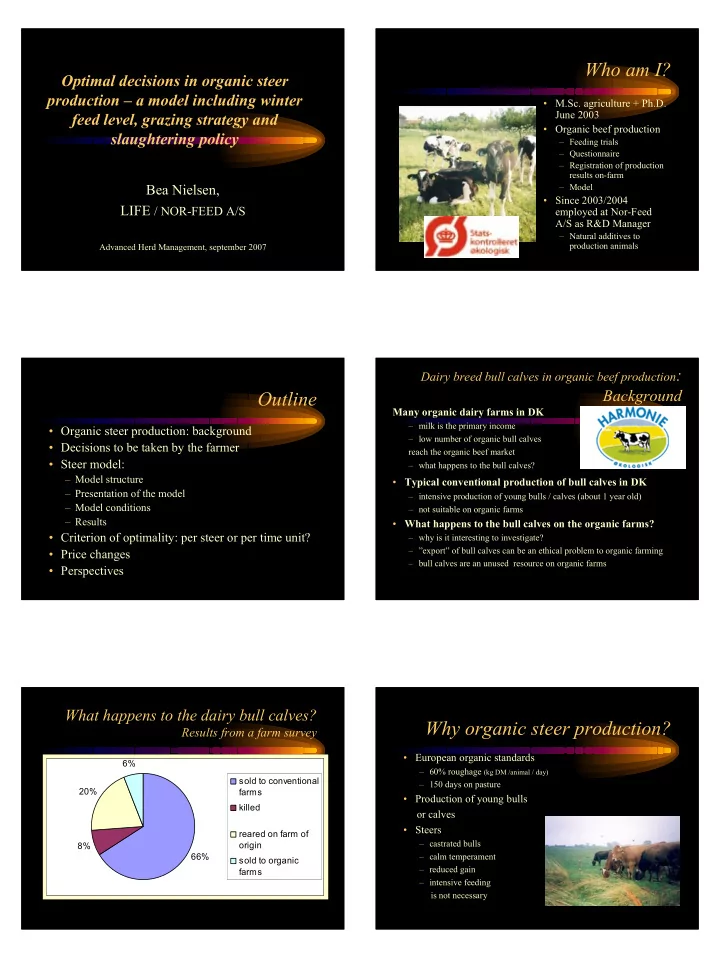
Optimal decisions in organic steer production – a model including winter feed level, grazing strategy and slaughtering policy

Bea Nielsen, LIFE / NOR-FEED A/S

Advanced Herd Management, september 2007

Who am I?

  • M.Sc. agriculture + Ph.D.

June 2003

  • Organic beef production

– Feeding trials – Questionnaire – Registration of production results on-farm – Model

  • Since 2003/2004

employed at Nor-Feed A/S as R&D Manager

– Natural additives to production animals

Outline

  • Organic steer production: background
  • Decisions to be taken by the farmer
  • Steer model:

– Model structure – Presentation of the model – Model conditions – Results

  • Criterion of optimality: per steer or per time unit?
  • Price changes
  • Perspectives

Dairy breed bull calves in organic beef production:

Background

Many organic dairy farms in DK

– milk is the primary income – low number of organic bull calves reach the organic beef market – what happens to the bull calves?

  • Typical conventional production of bull calves in DK

– intensive production of young bulls / calves (about 1 year old) – not suitable on organic farms

  • What happens to the bull calves on the organic farms?

– why is it interesting to investigate? – ”export” of bull calves can be an ethical problem to organic farming – bull calves are an unused resource on organic farms

What happens to the dairy bull calves?

Results from a farm survey

66% 8% 20% 6% sold to conventional farms killed reared on farm of

  • rigin

sold to organic farms

Why organic steer production?

  • European organic standards

– 60% roughage (kg DM /animal / day) – 150 days on pasture

  • Production of young bulls
  • r calves
  • Steers

– castrated bulls – calm temperament – reduced gain – intensive feeding is not necessary

slide-2
SLIDE 2

Steer production

100 200 300 400 500 600 1.1 1.5 1.11 1.5 1.11 1.1

Months W eight, kg

intensive extensive

Summer Summer

900 g/d

900 g/d

600 g/d

600 g/d 600 g/d 614 kg 602 kg

Decisions to be taken

  • Which pasture?

– marginal grass (low quality and gain) – clover grass (high quality and gain)

  • Feeding level in winter?

– low feeding level result in compensatory growth on pasture

  • When should fattening start?
  • Slaughter weight?

The steer model

  • 4-level hierarchical Markov process with

decisions defined at three levels

– child level 1:

  • grazing strategy (marginal grass or clover grass),
  • feed level in winter (high and low)

– child level 2: time for beginning of fattening (19-27 months) – child level 3: time of slaughter (19-30 months)

Model structure: Action space

Keep or slaughter Continue or start fattening or slaughter Summer: Marginal grass or clover grass Winter: High or low feeding level Dummy Child level 3 Child level 2 Child level 1 Founder Proces

Model structure

Live weight gain Live weight gain Live weight Birt month State space 1 month stage1: until 19 months stage2-6: 1 month grazing / winter season Life span of the steer Stage length Finite Finite Finite Infinite Time horizon Child level 3 Child level 2 Child level 1 Founder Proces

The steer model: Founder process

  • process tree
  • state space: birth

month, 12 levels

slide-3
SLIDE 3

Child level 1

  • stages of child

level 1: stable and grazing periods

Child level 1

  • stable period

– action space: low and high

  • grazing period

– state space: 7 weight levels – low and high previous winter feeding – action space

Child level 2

  • 2 grazing period

– clover grazing is chosen – child level 2 is defined - age of 19 months is reached – at 19 months (August) fattening can start – stage length – action space

Child level 3

  • action child level 2:

start fattening

  • 4 stages in child

level 3 (19-22 months)

  • 3 states (weight

gains)

  • action: keep and

replace

Parameters Model conditions

slide-4
SLIDE 4

Model conditions

  • Growth on clover

grass pastures following low winter feeding

  • steers born January

Simulation: Gain per steer

Optimal strategy in the second grazing period (child level 1) according to month of birth and LW.

Permanent pasture following high feed level Clover pastures following low feed level

Optimal strategies for all seasons (child level 1) for steers born in August.

Optimal strategy in the second grazing period (child level 1) according to previous winter feed level, examples of month of birth and LW at the beginning of the period.

Month of birth Previous winter feed level LW at the beginning of the period, kg Optimal pasture decision January Irrespective Irrespective Ryegrass/clover March Irrespective Irrespective 240-360 230 Ryegrass/clover Permanent May Irrespective Irrespective 220-240 250-330 Permanent Ryegrass/clover July High High 350-410 420-610 Permanent Ryegrass/clover Low Irrespective Ryegrass/clover September High High 330-400 410-590 Permanent Ryegrass/clover Low Irrespective Ryegrass/clover November High High 310-400 410-470 Permanent Ryegrass/clover Low 310-470 Ryegrass/clover

Optimal strategies at child level 2 are shown for steers born in January in the third stable period with low feeding level.

slide-5
SLIDE 5

Optimal strategies at child level 3

steers born in January in the third stable period at low feeding level, a LW

  • f 470 kg at the beginning of the third stable period and with the

beginning of fattening in January at an age of 24 months.

Net return, DKK/steer

100 200 300 400 500 600 JAN FEB MAR APR MAY JUN JUL AUG SEP OCT NOV DEC Months of birth Net return relative to minimum net return, DKK/steer

Optimal slaughter weight, kg

100 200 300 400 500 600 JAN FEB MAR APR MAY JUN JUL AUG SEP OCT NOV DEC Months of birth Optimal slaughter weight, kg

Conclusions

  • child level 1

– low feeding level in winter – permanent pastures the 1. grazing season – clover pastures for steers with high liveweight

  • child level 2

– only few steers should be fattened

  • child level 3

Is the hierarchic Markov proces useful to describe the given problem?

  • organic steer production has well defined

phases

  • decisions are linked to these phases
  • well suited for the state and action spaces of

the multi-level hierarchic Markoc proces

  • a big model (474,000 state combinations),

but the hierarchic structure makes it possible

Optimal criterion

Per steer Per time unit

Net return per produced steers is maximised Net return per year is maximised Replacement with a new steer

slide-6
SLIDE 6

The effect of optimal criterion

  • n optimal strategy child level 1 – grazing period

Per steer criterion, low previous winter feed level 50 100 150 200 250 300 350 January February March April May June July August September October November December Month of birth Live weight at start of season, kg Permanent Ryegrass Per steer criterion, high previous winter feed level 50 100 150 200 250 300 350 January February March April May June July August September October November December Month of birth Live weight at start of season, kg Ryegrass Permanent Per time unit criterion, low previous winter feed level

50 100 150 200 250 300 350 January February March April May June July August September October November December Month of birth Live weight at start of season, kg Permanent Ryegrass

Per time unit criterion, high previous winter feed level 50 100 150 200 250 300 350 January February March April May June July August September October November December Month of birth Live weight at start of season, kg Ryegrass Permanent

The effect of optimal criterion

  • n optimal strategy child level 2 – third stable period

Continue as usual < 690 kg Continue as usual ≥ 690 Start finishing < 480 kg and > 540 kg Slaughter 480-540 Start finishing < 450 kg and ≥ 550 kg Slaughter 450-549 kg Continue as usual < 650 Continue as usual ≥ 650 kg Slaughter < 750 kg Continue as usual ≥ 750 Slaughter < 760 kg Continue as usual ≥ 760 Start finishing 22 23-24 25 26 27 Low feeding level Third Stable period Optimal strategy per steer Optimal strategy per time unit Age, months Feeding level

Net return per steer, when optimised per time unit or per produced steer

Simulation: steers born in different months

500 1000 1500 2000 2500 3000 3500 4000 4500 Jan Feb March Apr May June July Aug Sep Oct Nov Dec Months of birth Net return per steer/DKK Optimised per time unit Optimised per produced steer

Slaughter weight and age at slaughter, when steers are produced under optimal conditions

Simulation: steers born in different months

100 200 300 400 500 600 700 Jan Feb March Apr May June July Aug Sep Oct Nov Dec Months of birth Slaughter weight when steers are produced under optimal strategies, kg 5 10 15 20 25 30 Optimised per produced steer Optimised per time unit Age at slaughter, months (optimized per steer) Age at slaughter, months (optimised per time unit)

Sensitivity analysis

  • What happens to the key figures (i.e net return) if

the conditions change

– Feed prices

  • i.e. finishing period in winter: 1.4 DKK/SFU – 0.2 (the same

as winter (high feeding level) and + 20%)

– Beef prices

  • i.e. class 3 (P+): 17 DKK/kg +/- 5 and 10 DKK
  • Probabilistic Markov chain simulations were run

under the calculated optimal strategy: per time unit

  • Simulations are used to calculate technical and

economic key figures characterizing the optimal policy.

The effect of changes in feed prices (summer) on optimal strategies per time unit at child level 1 for steers born in January.

Ryegrass Ryegrass Ryegrass Ryegrass Third grazing period Ryegrass Both ryegrass and permanent Permanent especially after high feed level in winter Both ryegrass and permanent Permanent especially after high feed level in winter and light steers (< 270 kg) Ryegrass Second grazing period Ryegrass Permanent Permanent Ryegrass First grazing period Marginal pasture + 0.3 DKK Marginal pasture

  • 0.35 DKK

Ryegrass pasture + 0.5 DKK Ryegrass pasture

  • 0.3 DKK (same

price as marginal pasture)

slide-7
SLIDE 7

The effect of changes in feed prices (winter) on optimal strategies per time unit at child level 1 for steers born in January

Low feeding intensity High feeding intensity is

  • ptimal for many

steers (all steers born from Febr. to May) and half of the steers born the

  • ther months

More feeding at high feed level compared to standard prices (all steers born from Febr-May) No changes compared to standard price Third winter period All steers should be fed at low feeding intensity Only high feeding level for steers born from Jan. to May and also some steers born in June and July. Others low feeding level Low feeding intensity Steers born in January and February: high feed level No changes compared to standard price Second winter period Feed prices winter high + 0.5 DKK Feed prices winter high

  • 0.5 DKK

Feed prices winter low + 0.5 DKK Feed prices winter low

  • 0.5 DKK

Effect of price variations on net return

1000 2000 3000 4000 5000 6000 Standard prices minus plus minus plus plus minus plus minus plus minus plus minus minus plus Meat Prices Premiums winter, high feed winter, low feed marginal grazing clover grazing fattening Feed prices Net return per steer, DKK 50 100 150 200 250 300 Net return per time unit, DKK

  • ptimised per steer
  • ptimised per time unit
  • ptimised per steer
  • ptimised per time unit

The effect of price variations on live weight at slaughter

100 200 300 400 500 600 700 Standard prices minus plus minus plus plus minus plus minus plus minus plus minus minus plus Meat Prices Premiums w inter, high feed w inter, low feed level marginal grazing clover grazing fattening Feed prices

Live weight at slaughter, kg

  • ptimised per steer
  • ptimised per time

Conclusions: criterion of optimality

  • In general the optimal strategy only changes

slightly depending on the criterion (net returns per steer versus per time unit).

  • An optimization per time unit in some cases

favours a more intensive production based on high feeding level in winter and finishing of steers as well as earlier slaughtering compared to an

  • ptimization per steer.

Conclusions: Simulations of key figures

  • Finishing of steers seemed not to be an optimal

strategy from an economic point of view and price changes in feed, beef and premiums did not favour finishing of steers.

  • Most important factors with effect on net return:

– Beef prices – prices for ryegrass/white clover pasture – Prices for low feeding level

Article in farmer newspaper “Organic Farming”

slide-8
SLIDE 8

Article in farmer newspaper “Organic Farming”

Perspectives

  • optimal strategies for an overall organic steer

production

  • data from specific farms can be included and
  • ptimal strategies can be simulated on farm and

animal level

  • data on single animal level might be introduced in

steer production

  • effects of price changes can be determined quite

easy with simulations – not time consuming

  • the effect of fattening of dairy bred steers should be

revised