
SLIDE 1
Who Am I?
2000 ¡ 2008 ¡ 2014 ¡ 2015 ¡ (Ph.D.) ¡
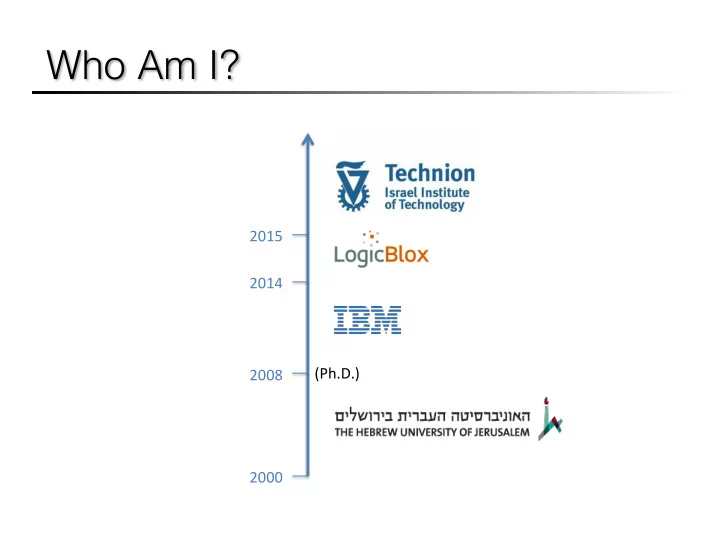
Who Am I? 2015 2014 (Ph.D.) 2008 2000 Melbourne, - - PowerPoint PPT Presentation
Who Am I? 2015 2014 (Ph.D.) 2008 2000 Melbourne, VIC, Australia June 3 rd , 2015 On the Principles of Joyful Research Joyful Research [in Computer Science] Benny Kimelfeld Technion,
2000 ¡ 2008 ¡ 2014 ¡ 2015 ¡ (Ph.D.) ¡
June 3rd, 2015
Benny Kimelfeld
Technion, Israel
[in ¡Computer ¡Science] ¡
Excitement in problem solving Impact Recognition
Building, ¡engineering, ¡ theorem ¡proving, ¡social ¡ interacDons ¡ Uses ¡of ¡my ¡results ¡/ ¡ soIware, ¡#citaDons ¡ Accepted ¡papers, ¡awards, ¡ invitaDons, ¡job ¡offers, ¡ casual ¡nicety ¡
Doing research as a profession?
Balance is key, personal, art
Correlated, ¡not ¡ the ¡same! ¡
Can I convince my non- scientist fellows? Do I believe that success will do good? Am I defending my project not just because it is mine?
Actually, ¡very ¡useful ¡to ¡ carefully ¡prepare ¡an ¡elevator ¡ pitch ¡for ¡every ¡project ¡
Any “formal” indication (e.g., study) of a need?
§ Be careful with the motivation and/or search methodology!
What has been done for solving the problem? Common mistake: “Central contribution is X; delta from existing work is Y”
“A ¡et ¡al. ¡[A+14] ¡also ¡studied ¡this ¡ problem, ¡but ¡they ¡considered ¡only ¡ inches; ¡we ¡also ¡do ¡cm” ¡
§ Motivated problem; but why hasn’t your angle been studied?
(recent ¡use ¡cases, ¡recent ¡ developments, ¡etc.) ¡
Should be clear that there is an a-priori chance of failure! failure!
Or ¡else, ¡why ¡academic ¡research ¡to ¡ deal ¡with ¡the ¡problem? ¡
“Interesting solution” is not interesting if there is a much simpler one (usually)
Clear ¡away ¡any ¡obvious ¡simpler ¡ algorithm ¡/ ¡proof ¡
On the other hand, there should be convincing reasons for optimism!
A ¡substan?al ¡approach ¡overlooked, ¡ recent ¡developments, ¡… ¡
from latex files”
body of the paper, given the intro”
Theoretical work has built in measurability
§ In ¡other ¡words, ¡is ¡there ¡more ¡than ¡formalism ¡for ¡formality? ¡
§ Historical ¡aDempts? ¡
In empirical/systems it is harder
were your hypothesis wrong?
numbers (quality/cost)? Standard fake-data generators? Convincing user study?
methodology is often a (valuable) contribution by itself (highlight ¡it) ¡
For fruitfulness and happiness, ≥ 2 directions:
Highly challenging problem with low progress/effort rate
progress rate risk of failure expected reward
“I know ± what to do, optimistic about expected obstacles”
progress rate risk of failure
reward
But, do not maintain too many threads! Or ¡else, ¡quality ¡will ¡be ¡compromised ¡
My past projects Didn’t involve any crisis Crisis was a showstopper Crisis resolved; I went on
Crisis led to strong insights, shift of focus, much better work
Crisis is part of the game; try to leverage!
“Oh ¡ man... ¡ the ¡ minor ¡ issue ¡ we ¡ kept ¡ ignoring ¡ casts ¡ the ¡ whole ¡ system ¡useless!” ¡ “Damn! ¡A ¡bug ¡in ¡the ¡proof ¡... ¡ Does ¡it ¡all ¡collapse?” ¡