WHO AND WHY ? Who? Kellie Cassidy Clinical Psychologist Karri - - PDF document

who and why
SMART_READER_LITE
LIVE PREVIEW

WHO AND WHY ? Who? Kellie Cassidy Clinical Psychologist Karri - - PDF document

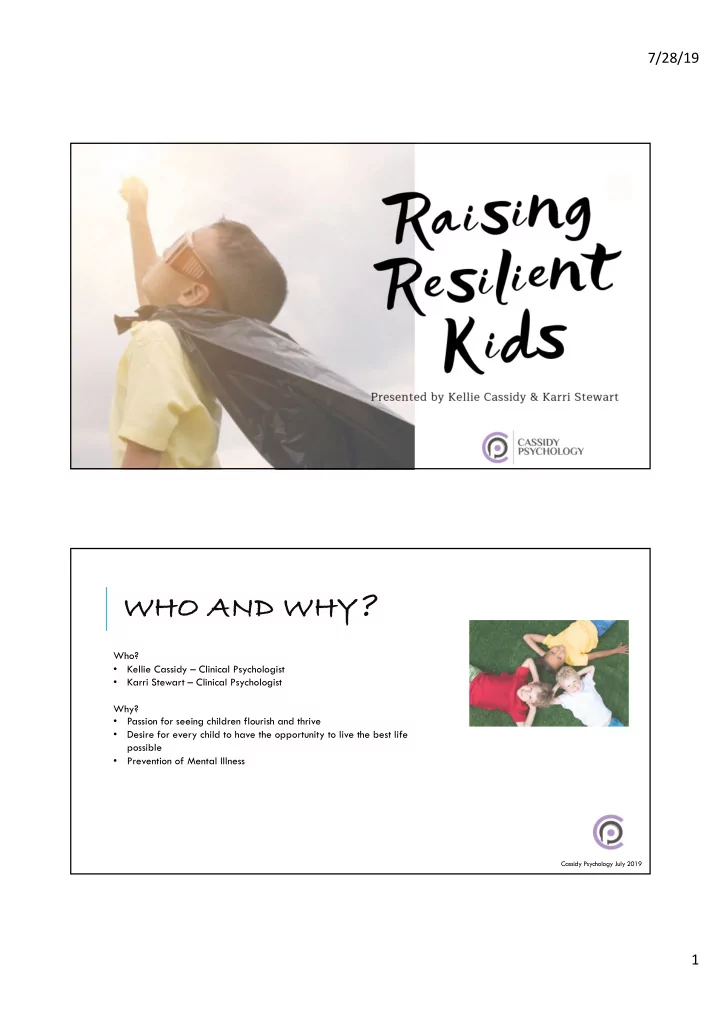
7/28/19 WHO AND WHY ? Who? Kellie Cassidy Clinical Psychologist Karri Stewart Clinical Psychologist Why? Passion for seeing children flourish and thrive Desire for every child to have the opportunity to live the


slide-1
SLIDE 1

7/28/19 1

WHO AND WHY?

Cassidy Psychology July 2019

Who?

  • Kellie Cassidy – Clinical Psychologist
  • Karri Stewart – Clinical Psychologist

Why?

  • Passion for seeing children flourish and thrive
  • Desire for every child to have the opportunity to live the best life

possible

  • Prevention of Mental Illness
slide-2
SLIDE 2

7/28/19 2

WHAT IS RESILIENCE?

Bouncing back with optimism Being flexible about how we see things Being able to cope when things go wrong Willing to take risks Taking Action Knowing when to keep going Knowing when to ask for help Resilience is not the absence of distress or difficulty. Resilience is the ability to adapt and grow following adversity.

https://www.youtube.com/watch?v=7WyR4AqRweY

Boundin – Youtube Clip

slide-3
SLIDE 3

7/28/19 3

BOUNCE FORWARD, NOT JUST BACK

Resilience is not just about coming back to the same position as before More recent research teaches us that when we bounce back from adversity we also need to bounce forward Bouncing forward may require learning new skills, reflecting on past mistakes, planning for the future

WHY RESILIENCE MATTERS

Resilient children are more likely to:

  • have better school results
  • have less physical health problems
  • reduce risk of mental health problems
  • better quality relationships

Generally research indicates that resilient children are more likely to succeed in life

slide-4
SLIDE 4

7/28/19 4

SIGNS TO LOOK OUT FOR

  • low self-confidence
  • difficulty managing their

feelings

  • sensitive and struggle when

things do not go to plan

  • easily stressed or
  • verwhelmed
  • avoiding things
  • give up easily
  • sore losers
  • think negatively about

themselves and/or the world

  • unable to talk or reflect on

feelings Children who lack resilience may display some of the following:

RESILIENCE CAN BE CHANGED/IMPROVED

Whilst some people are born with a greater propensity for resilience, the good news is that it can be fostered and developed. Resilience is not an inherent skill. It can be affected by life events.

slide-5
SLIDE 5

7/28/19 5

WHAT CAN PARENTS DO?

  • 1. Teach skills children need for success
  • 2. Teach children to manage their feelings
  • 3. Teach problem solving skills and don’t provide all the answers
  • 4. Let kids make mistakes and take risks
  • 5. Ask how questions
  • 6. Model resilience

TEACH SKILLS

Develop Optimism Develop competence and mastery Develop executive functioning Asking for help Social Development Growth Mindset Gratitude

slide-6
SLIDE 6

7/28/19 6

MANAGE FEELINGS

Children need to :

  • Be allowed to experience all

emotions

  • Have their emotions validated
  • Have skills to manage their

emotions

  • Match their emotion to the size
  • f the problem

PROBLEM SOLVE

Problem solving is a key skill to developing independence and being successful in life Too often as parents we race in and try and solve problems for our children Guide your children through a problem solving process instead of providing all the answers

  • 1. Identify all possible solutions – no matter how crazy
  • 2. Evaluate each option and select the best one
  • 3. Try it out
  • 4. Head back to step 2 if it didn’t work
slide-7
SLIDE 7

7/28/19 7

ALLOW MISTAKES

To develop independence we must allow children to make mistakes and learn from these mistakes We can not rescue our children all of the time. We need to learn to tolerate their distress Allow children to take risks and learn from experience Encourage children to face fears with support

ASK HOW

Asking Why often results in ‘I don’t know’ Instead try and be forward focused and ask a how question How did you decide to do X? How can be fix this problem now? How will you do things differently in the future?

slide-8
SLIDE 8

7/28/19 8

NURTURE RELATIONSHIPS

Social relationships are crucial to developing resilience Provide unconditional love Research tells us that it’s not rugged self-reliance, determination

  • r inner strength that leads kids through adversity, but the

reliable presence of at least one supportive relationship Coping skills can be developed through our relationships with

  • thers

MODEL IT!

Children learn from watching Make it explicit what you are doing to cope when things go wrong Talk out loud:

­ Using positive self-talk and self-encouragement e.g. I can get through this ­ Expressing thoughts and feelings and not pushing strong/difficult feelings away ­ Using strategies to manage our emotions (e.g. breathing, relaxation, physical activity) ­ Demonstrating perseverance

Exercise: Think of a time you have been resilient

slide-9
SLIDE 9

7/28/19 9

Think of a time in your life that was challenging: What was your goal? What was the outcome? What obstacles did you have to overcome? What unpleasant feelings and thoughts do you remember having in the situation? Who, if anyone, did you receive external help and support from? What specific attitudes and skills helped you cope with the situation? How would you rate your resilience in that situation? Why wasn’t it 0%? What strengths and personal qualities helped you? If it wasn’t 100%, how could your resilience be improved during similar situations in the future? Based on your experience how might you advise someone else to cope with a similar situation in the future?

BOUNCE BACK! PROGRAM

  • 6 week program
  • Children age 8-10
  • Advantage of being able to

practice with peers and know that they are not the only ones

B ad times don’t last. Things always get better. Stay optimistic. O ther people can help if you talk to them. Get a reality check. U nhelpful thinking makes you feel more upset. Think again. N obody is perfect – not you and not others. C oncentrate on the positives (no matter how small) and use laughter. E verybody experiences sadness, hurt, failure, rejection and setbacks sometimes, not just you. They are a normal part of

  • life. Try not

to personalise them. B lame fairly. How much of what happened was due to you, to others and to bad luck or circumstances? A ccept what can’t be changed (but try to change what you can change first). C atastrophising exaggerates your worries. Don’t believe the worst possible picture. K eep things in perspective. It’s only part of your life.
slide-10
SLIDE 10

7/28/19 10

YOUR TAKE AWAY

What is the one thing you have learned today that you can start implementing from this afternoon with your children? Take a moment to think of an answer and how you will action this.

RESOURCES

Dan Siegal – The Yes Brain Child Martin Seligman – The Optimistic Child Beyond Blue – Building Resilience in Children http://resources.beyondblue.org.au/prism/file?token=BL/1810_A Our Blog - https://cassidypsychology.com/blog/ Our Facebook page - https://www.facebook.com/cassidypsychology/ Our Closed Facebook Group - https://www.facebook.com/groups/flourishthrivelive/

slide-11
SLIDE 11

7/28/19 11

QUESTIONS? CONTACT US

Cassidy Psychology Kellie Cassidy & Karri Stewart 10/7 The Esplanade Mt Pleasant 4/259 Bannister Rd Canning Vale Ph: 6381 0071 Email: kellie@cassidypsychology.com www.cassidypsychology.com