WHO Global Health Sector Strategy on HIV 2016-2021 one year on the - - PowerPoint PPT Presentation

who global health sector strategy on hiv 2016 2021 one
SMART_READER_LITE
LIVE PREVIEW

WHO Global Health Sector Strategy on HIV 2016-2021 one year on the - - PowerPoint PPT Presentation

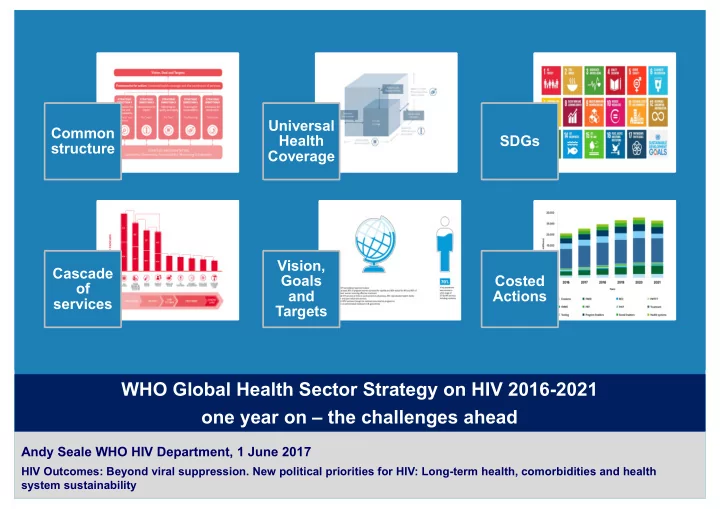
Universal Common Health SDGs structure Coverage Vision, Cascade Goals Costed of and Actions services Targets WHO Global Health Sector Strategy on HIV 2016-2021 one year on the challenges ahead Andy Seale WHO HIV Department, 1


slide-1
SLIDE 1

Andy Seale WHO HIV Department, 1 June 2017

HIV Outcomes: Beyond viral suppression. New political priorities for HIV: Long-term health, comorbidities and health system sustainability

WHO Global Health Sector Strategy on HIV 2016-2021

  • ne year on – the challenges ahead

Common structure Universal Health Coverage SDGs Cascade

  • f

services Vision, Goals and Targets Costed Actions

slide-2
SLIDE 2

2 |

Presentation overview

§ Setting the scene § The global health sector strategy and regional action plan on HIV 2016- 2021 – adopted in 2016 § Strategy innovations related to chronic care § Monitoring progress: TB/HIV and other comorbidities § Future challenges

slide-3
SLIDE 3

3 |

HIV, chronic care and ageing

Professor Peter Reiss summarized existing evidence at the December 2016 PCB Thematic session and concluded by summarizing lessons learned so far: §Comorbidity burden consistently increased in HIV as people age – co-infections and NCDs – TB is still leading cause of death in eastern part of region §Traditional lifestyle-related -factors are key drivers §There is additional risk from ART for some but not all co-morbidities §Longer time spent at low CD4 counts, rather than longer overall exposure to ART, generally contributes to greater risk §Persistent inflammation and innate immune activation contributes towards risk for some but not all co-morbidities §Promotion of healthy lifestyle and management of traditional risk are key §Early HIV diagnosis and treatment initiation reduces risk

Prof Reiss presentation to PCB Dec 2016 http://www.unaids.org/sites/default/files/media_asset/20161208_UNAIDS_PCB39_T hematic_Dr_Reiss_PPT.pdf

slide-4
SLIDE 4

4 |

Between 2011 and 2015 percentage of HIV/TB co-infection almost doubled, from 5.5% to 9.0%

Source: European Centre for Disease Prevention and Control/WHO Regional Office for Europe. Tuberculosis surveillance and monitoring in Europe 2017.

HIV co-infection among TB patients continues to rise in Europe, 2015

slide-5
SLIDE 5

An accelerated HIV response at global, regional and country levels

Global strategy Regional Action Plans National Strategies Global HIV and Hepatitis Strategies, 2016-21 European Action Plans, HIV and HEP National HIV Strategies and Plans

World Health Assembly (WHA69) – Global strategies adopted (May 2016)

Regional Committee (RC66) – Regional Action Plans adopted (Sep 2016)

slide-6
SLIDE 6

6 |

slide-7
SLIDE 7

7 |

slide-8
SLIDE 8

8 |

2020 strategic targets

§ Reduce tuberculosis deaths among people living with HIV by 75% § Reduce hepatitis B and C deaths among people co-infected with HIV by 10%, in line with mortality targets for all people with chronic hepatitis B and C infection § Provision of access by 90% of countries to integrated health services covering HIV, tuberculosis, hepatitis B and C, reproductive health and sexually transmitted infections* * Not in the regional action plan

slide-9
SLIDE 9

9 |

Examples of programmatic indicators

Progress monitoring supported by a number of programmatic indicators included in the Consolidated Strategic Information Guidelines for HIV in the health sector - for example: §% of PLHIV in HIV care who were screened for TB in HIV care settings §% of PLHIV and newly enrolled in HIV care who have active TB disease §% of PLHIV and newly enrolled in HIV care who have started on TB preventive therapy §% of PLHIV who complete the course of TB preventive therapy §% of PLHIV in HIV care who were screened for hepatitis B §% of PLHIV in HIV care who were screened for hepatitis C

Consolidated strategic information guidelines for HIV in the health sector http://www.who.int/hiv/pub/guidelines/strategic-information-guidelines/en/

slide-10
SLIDE 10

10

Strategy Area Accountability

  • A. Goals and Targets
  • Incidence, Mortality
  • 90, 90, 90
  • Discrimination
  • TB, Hep B and C

1. SDG reporting process: HIV responsible progress on HIV incidence, mortality and HIV treatment as part of universal access (2020 targets) 2. Global AIDS Monitoring (GAM): progress to 90, 90, 90 by 2020 (WHO responsible for validation of 90, 90, 90 targets) 3. Global AIDS Monitoring (GAM): additional indicators with UNAIDS, hepatitis and TB (TB, Hep B and C deaths among co-infected, discrimination PLHIV and health sector, financing and integration see below) 4. Global Reports: Baseline, mid-term (2018) and end of strategy (2020) with

  • Formal, process evaluation and review to input and form next strategy
  • B. Strategic Directions 1-5
  • Implement strategy

directions

  • Financing, integration and

innovation 1. The “What”, “How” and “Where” – progress to 90, 90, 90

  • Implementation of key guidelines and policy adaptation – country intelligence

annual and biannual accountability

  • Closing Cascade gaps in fast track countries - annual review of national and sub

national cascade gaps with cascade data and analysis 2. “Financing”, “Integration”, “Innovation” – finance and domestic investments reach 26 US$ billion, 90% countries integrated HIV, TB, Hep, STI services

  • Review of country strategies for integration, financing, inclusion innovations, and
  • f key populations (2018). Country Intelligence to track one key innovation per

area of guidelines e.g. self testing, new drugs, unique identifiers

  • C. WHO Actions –

country actions and impact 1. Country Intelligence – annual review of WHO actions by strategy action by country. Epi and Impact reviews with each region for 2018 report on implementation

Accountability Framework for Strategy Implementation
slide-11
SLIDE 11

11 |

Future challenges

§ The dynamic nature of the epidemic and response § Constrained resources and competing health and development priorities § Working towards greater intersections between health and social care – including

  • n how health systems finance this in the context of ageing populations

§ HIV drug resistance § Monitoring and evaluating progress at each stage of the expanded continuum of services WHO plans to disseminate new guidelines for patient monitoring and case-based surveillance this year to support country efforts to improve treatment adherence and viral suppression among people on ART and to strengthen chronic care

slide-12
SLIDE 12

12 |

Thank you

References

Prof Peter Reiss presentation to PCB Thematic http://www.unaids.org/sites/default/files/media_asset/20161208_UNAIDS_PCB39_Thematic_Dr_Reiss_PPT.pdf WHO global health sector strategy on HIV 2016-2021 http://www.who.int/hiv/strategy2016-2021/ghss-hiv/en/ WHO Prevent HIV, test and treat all - WHO support for country impact. Progress Report 2016. http://www.who.int/hiv/pub/progressreports/2016-progress-report/en/ WHO Action plan for the health sector response to HIV in the WHO European Region http://www.euro.who.int/__data/assets/pdf_file/0006/318318/European-action-plan-HS-HIV.pdf?ua=1 WHO Guidelines http://www.who.int/hiv/en/