Who is not in the room that would shame, fear, pity or ridicule - - PowerPoint PPT Presentation

who is not in the room that would
SMART_READER_LITE
LIVE PREVIEW

Who is not in the room that would shame, fear, pity or ridicule - - PowerPoint PPT Presentation

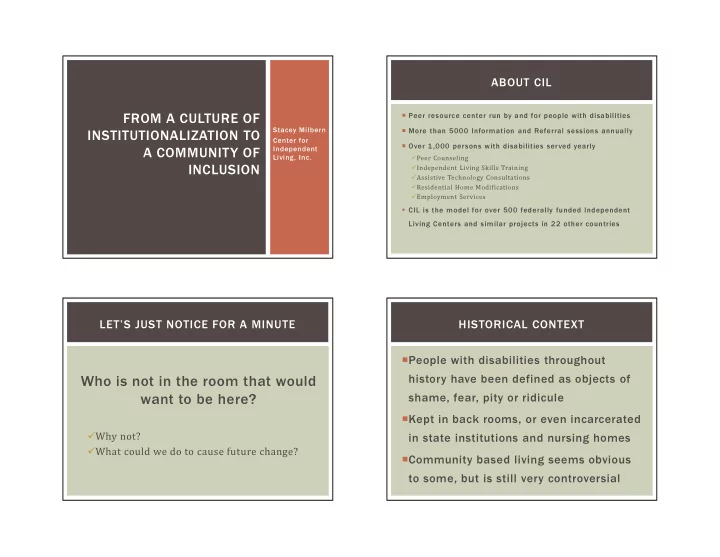
ABOUT CIL Peer resource center run by and for people with disabilities FROM A CULTURE OF Stacey Milbern More than 5000 Information and Referral sessions annually INSTITUTIONALIZATION TO Center for Over 1,000 persons with disabilities


slide-1
SLIDE 1

Stacey Milbern Center for Independent Living, Inc.

FROM A CULTURE OF INSTITUTIONALIZATION TO A COMMUNITY OF INCLUSION

Peer resource center run by and for people with disabilities More than 5000 Information and Referral sessions annually Over 1,000 persons with disabilities served yearly

Peer Counseling Independent Living Skills Training Assistive Technology Consultations Residential Home Modifications Employment Services

CIL is the model for over 500 federally funded Independent Living Centers and similar projects in 22 other countries

ABOUT CIL

Who is not in the room that would want to be here?

Why not? What could we do to cause future change?

LET’S JUST NOTICE FOR A MINUTE People with disabilities throughout history have been defined as objects of shame, fear, pity or ridicule Kept in back rooms, or even incarcerated in state institutions and nursing homes Community based living seems obvious to some, but is still very controversial HISTORICAL CONTEXT

slide-2
SLIDE 2

Forced legal sterilization of disabled people

As recent as 1979

Entrenched in fear of the unknown Its roots crossed almost every sector

“WE DON’T WANT MORE LIKE YOU” ACROSS SECTORS BURDEN

Students with disabilities often leave their communities to go to segregated schools Argument for Institutionalization is that the need of the individual cannot be met in a particular environment

Value Question: What actually needs to be a specialized service? What can be a mainstream service?

“WE CAN’T HANDLE YOU HERE”

slide-3
SLIDE 3

Some laws prohibited people with certain disabilities from appearing in public

Started in San Francisco in 1867; many not repealed until 1970s

Designed to reduce “beggar population”, had devastating effect

“WE DO NOT WANT TO SEE YOU”

Minneapolis City Code

  • Est. 1877

“Persons who had “no visible means of support”, who live “idly without lawful employment”, and who could not give a judge a good account of themselves could be fined or required to spend 90 days in the workhouse.”

“WE DO NOT WANT TO SEE YOU”

http://www.accesspress.org/

Chicago City Code

  • Est. 1881

“No person who is diseased, maimed, mutilated or in any way deformed so as to be an unsightly or disgusting object or improper person to be allowed in

  • r on the public ways or other public places in this

city, or shall therein or thereon expose himself to public view, under a penalty of not less than one dollar nor more than fifty dollars for each offense.”

UGLY LAW ORDINANCE

http://www.accesspress.org/

Bipartisan “Hidden Army” advocated for ADA

“Let the shameful walls of exclusion finally come tumbling down.”

– President Bush, at signing

AMERICANS WITH DISABILITIES ACT

slide-4
SLIDE 4

Affords rights to people with disabilities in employment, commerce, communication, transportation and other areas Requires commerce and public places to be accessible

AMERICANS WITH DISABILITIES ACT

Two institutionalized women with developmental disabilities wanted to receive services in the community Upheld ADA Requires services to be provided in the least restrictive environment possible

OLMSTEAD DECISION

The problem is not with the individual and their impairment, but an inaccessible, inflexible environment Foundation of Disability Rights Movement

SOCIAL MODEL OF DISABILITY

Recent changes around federal workers with disabilities, can still do more advocacy (e.g. sheltered workshops) Medical care for people with developmental disabilities

How do we resolve issues around time it takes to serve us, and time that is billable?

PROGRESS MADE, STILL WORK TO DO

slide-5
SLIDE 5

Many continue to be institutionalized unnecessarily Money Follows the Person Demonstration project

How can we make the transition to a community-based setting more than a geography change?

PROGRESS MADE, STILL WORK TO DO

Independent Living Skills and transition-oriented training Blogs and modernization

  • f resources for parents

and people with disabilities The more a community is exposed to differences, the less fear there is around it.

PROGRESS MADE, STILL WORK TO DO

Donations make the work we do possible. Please consider supporting us. ☺

CONTACT US

Stacey Milbern

Program Manager Center for Independent Living (510) 841-4776 ext 3162 smilbern@cilberkeley.org