
SLIDE 1
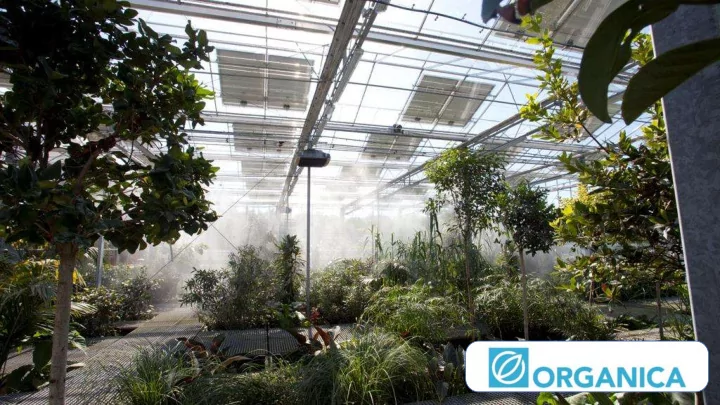
Who is Organica Water? Interior of an Organica biological reactor - - PowerPoint PPT Presentation
Who is Organica Water? Interior of an Organica biological reactor area Organica Water is a provider of cost SouthPest WWTP 80.000 m 3 /day and space efficient solutions for biological wastewater treatment Organica Water has +18 years of
Organica Water is a provider of cost and space efficient solutions for biological wastewater treatment Organica Water has +18 years of history and 100 references operating
80,000 m3/d Organica Water provides facility design and specialty equipment supply, enabling local companies to deliver projects Organica Water pioneers the future standard “operating system” for municipal wastewater treatment plants (WWTPs) in the 21st century
Interior of an Organica biological reactor area SouthPest WWTP – 80.000 m3/day
ARCHITECTURE NATURE PROCESS ENGINEERING A new way of thinking in wastewater technology
4
4
2 1 22 29 7 4 8
28 81
Organica Princeton Office, USA
Plans in Design & Build
1 17 6 5 5 17
0-2 years 2-4 years 4-6 years 6-8 years 8+ years
Years in Operation
1 19 1 1 1 2 1 1 1
Organica Jakarta Office, Indonesia
Organica Shanghai Office, China Organica New Delhi Office, India Organica Budapest Office, Europe
Organica Offices Plants in Operation
2 1 2 1 2
Environment and Climate change (2nd place, Verulam)(2018) The Institute of Municipal Engineering of Southern Africa (IMESA) and the Consulting Engineers of South Africa (CESA) Paulson Prize for Sustainable Cities-Honorable Mention by Paulson Prize for Sustainable Cities Water Reuse Gardens - Best Innovation (2018) by the Technical Committee of ALADYR Conference China Water Industry Starlight Award 2017” (2017 水业星光奖 By China Water Association Best Performer in Global Expansion (2017) IDinvest International Award Best Practices Award for Global Biological Wastewater Treatment (2017) by Frost and Sullivan Global Water Intelligence Industrial Water Project of the Year (2016) Nominee, MM2100 WWTP Cleantech Connect Most Innovative Company (2016) by GP Bullhound, selected from over 150 companies by esteemed panel of judges from across the Cleantech Sector Lux Research Top Ten Global Innovative Company (2015) Profiled 1200 companies across 20 sectors/selected 10 most innovative Best Overall Innovation Winner (2013) by CIWEM West Midlands Institute of Water, Innovations Showcase Global CleanTech “Company of the Year” - Europe & Israel (2013) by CleanTech Group Global CleanTech TOP 100 (2013, 2014, 2015 and 2016) by CleanTech Group Global Water Intelligence Wastewater Project of the Year (2013) Honorable Mention, South Pest WWTP WEX Innovation Award (2013) Water and Energy Exchange Innovation Award recognizing significant achievement in the field of Water and Wastewater Management European Business Awards for the Environment nomination (2010) by the Hungarian Jury for the EU Environmental Awards The "Environment Award" (2004 and 2008) by the Association of Environmental Manufacturers and Service Providers Frost & Sullivan Innovation Prize (2005) for the ORGANICA Technology wastewater treatment solution Company of the Year (2004) by the Hungarian Venture Capital and Private Equity Association Innovation Award (2004) by the Hungarian Innovation Foundation
Organica cooperates with a global and local network of partners for the design, delivery, financing, and
infrastructure throughout the world.
Treatment 9%
Sewer Networking 91%
Wastewater Management Costs
Treatment Sewer Networking
7
If we can save 10% on network costs, treatment is ”free”
Sources: UN, GWI, World Bank
7
Natural Plants Odor Control Media Root Zone Patented Biofiber Media Fine Bubble Aeration
Architecture Process Design Mechanical
Engineering
Civil
Engineering
Odor control Electrical Design Control &
Instrumentation
EFFICIENT PROCESS
utilizing diverse biology
INTEGRATION OF DISCIPLINES
including Architecture
8
Plants on the supporting mesh Fine bubble aeration Walkway and plant supporting rack
Root zone (1.5m) as fixed film carrier Artificial supporting media as fixed film carrier
Organica BIOMODULE
Organica BIOMODULE Organica Food Chain Reactor (FCR)
Plant Roots and Organica Engineered Media creates a much better habitat for biomass growth
11
11
12
❑ Attached biomass in Organica Biomodule is equivalent to 8 – 10 kg/m3 of biomass (in AS the concentration is 3 to 4 kg/m3). ❑ A higher concentration and more specialized biomass allows treating the same wastewater flow in less reactor volume. ❑ FCR reactors are typically 30% - 40% smaller than conventional activated sludge reactors for the same capacity.
Attached biomass in Organica Biomodule
❑ The biological process takes place in a series of cascade reactors, with standard pretreatment at the beginning, and phase separation (via Organica Disc Filters or Secondary Clarifiers) and final polishing at the end (if required). ❑ As water flows through from one reactor zone to the next, different ecologies will grow and adapt to the conditions in each stage. This configuration allows the “food chain effect” to develop, as higher level organisms become predators for the simpler organisms. ❑ The result is enhanced removal efficiency and resiliency, while utilizing less energy and producing less sludge.
PHASE SEPARATION
11.550 m2 36.000 m2
Reactor Volume and Clarifiers: 21.300 m3 vs. 66.500 m3 Organica Food Chain Reactor Conventional Activated Sludge
0% 20% 40% 60% 80% 100% 120% 140% Relative energy consumption in Organica FCR relative to other technologies
Organica FCR: attached biofilm No biomass in suspension (MLSS) in the reactor Suspended solids concentration in the Organica FCR reactor → 200 – 300 mg/l therefore: Oxygen transfer efficiency (alpha- factor) in Organica FCR reactors is extremely high (0,90 – 0,95)
The largest industrial park in Indonesia needed to double WWTP treatment capacity while preserving land value. The new Organica plant was designed with 2x EXISTING CAPACITY WHILE OCCUPYING 50% OF THE LAND. The solution allows the developer to sell the land adjacent to the Organica plant including the plot occupied by the old CAS plant.
Example: MM2100 Organica WWTP. Bekasi, Jakarta (Indonesia) – Capacity: 45.000 m3/day
New Organica Plant - 45 MLD Old CAS Plant - 22MLD Honda Factory
Example: MM2100 Organica WWTP. Bekasi, Yakarta (Indonesia) – Capacity: 45.000 m3/day
Example: South Pest Organica WWTP. Budapest (Hungary) – Capacity: 80.000 m3/day
BEFORE – Concrete Activated Sludge Reactors AFTER – UPGRADED TO ORGANICA FCR
Example: South Pest Organica WWTP. Budapest (Hungary) – Capacity: 80.000 m3/day
Example: South Pest Organica WWTP. Budapest (Hungary) – Capacity: 80.000 m3/day
Example: Wusong WWTP. Shanghai (China) – Capacity: 40.000 m3/day
Example: Wusong WWTP. Shanghai (China) – Capacity: 40.000 m3/day
Example: Hainan Island WWTP. Hainan (China) – Capacity: 7.000 m3/day
Organica plant design (top picture) and under construction (right picture) in a trafic circle. Residential buildings around the future traffic circle are buing built in the background.
Example: Hainan Island WWTP. Hainan (China) – Capacity: 7.000 m3/day
Organica real and operating plant!
Example: He Yuan WWTP. He Yuan City, Hong Kong (China) – Capacity: 30.000 m3/day
Example: He Yuan WWTP. He Yuan City, Hong Kong (China) – Capacity: 30.000 m3/day
Parameter Limit COD < 20 mg/l BOD < 4 mg/l TSS < 5 mg/l NH4-N < 1 mg/l TN < 10 mg/l TP < 0,2 mg/l
Example: Sechelt WWTP. Sechelt (Canada) – Capacity: 4.000 m3/day
Example: DIP WWTP. Dubai Investment Park, Dubai (UAE) – Capacity: 3. 500 m3/day
Example: Anshun WWTP. Anshun, Guizhou (China) – Capacity: 50.000 m3/day
Lead – Feb 2016 Contract – May 2016 Delivery – Aug 2016 Commissioning – Sept 2016
34
Over 4,600 facility designs generated. Continuous development that includes Artificial Intelligence to optimize the architectural and civil design (minimize footprint) and Machine Learning for process design. Built on AWS services to gain infrastructure flexibility, speed of design runs, and infinite scalability for improvements. Produces an expanding variety of professional and complete preliminary engineering design outputs with limited human input.
SaaS Licenses Design Generator Engine WWTPDesigns.com
WWTPs with proprietary engine, developed by software and engineering experts, allows Organica to produce infinite designs/optimizations at minimal cost, and drives various forms of recurring revenue via Organica Digital Services.
The software configures preliminary wastewater treatment engineering designs specific to locations and water quality needs. Improving infrastructure effects, this tool can populate the following documents:
Once the user enters data, OCS validates the inputs based on extensive regional databases and process validation algorithms The tool is based on the Organica team’s hundreds of years experience designing WWTPs all over the world The tool improves organizational efficiency by having 24/7 access to designs in just 8 hours, while being able to adjust and re-design and
MANILA NORTH 50 MLD
Interface for entering Basic information
Interface for data entry, including commercial considerations and wastewater characteristics (influent/effluent/temperature/flow)
The tool keeps track of all of the User’s designs and allows to re-run them any number of times.
Once the data is validated it is used for process sizing, simulation (365 days with diurnal flow), and final equipment selection. This ultimately generates key documents such as P&ID, Process Scheme, and Equipment BOQs. After equipment selection the Design Generator generates a detailed 3D CAD model
produce the Civil Design with Layouts and Sections. The simulation tool and process models were built in cooperation with some of the leading experts in the wastewater design and modeling field.
Site Plan 3D View Sections
Bill of Quantities Equipment list
Takes full advantage of the Design Generator Developed over the last 5 years Unique engineering automation software SaaS (Software as a Service) Strategic inroads with long lasting revenue streams Game changer for engineering-centric firms with significant manhour costs
that data-driven insights can offer. The road ahead is long, but the opportunity huge: Data- driven business intelligence has the potential to radically transform the way water and water infrastructure is understood, managed and used.*
paradigm shift for the water industry from being reactive to being proactive and
adoption
customer relationship management (CRM) technology within retail industries such as banking and mobile phones**
reliable & efficient
influent water qualities
to innovate and implement automation with Digital tools (IoT)
while managing risk and increasing capital spend
*Deloitte Water Tight 2.0 **McKinsey
72
At a global level, around 80% of wastewater produced is discharged into the environment untreated, causing widespread water pollution. 850 billion gallons untreated waste and storm water discharged annually While 2.1 billion people gained access to improved sanitation facilities since 1990, 2.4 billion still do not have access to improved sanitation and nearly 1 billion people worldwide still practice open defecation. Only 26% of urban and 34% of rural sanitation and wastewater services effectively prevent human contact with excreta along the entire sanitation chain and can therefore be considered safely managed.
Possibilities to accelerate change in the in water infrastructure through the use of software, hardware and global expertise. Identification of the local problem is where we start.
Storm Water Mgmt. Smart Billing Leak Detection Utility Planning Real time Water Quality Mgmt. Pressure Mgmt.
Demand Forecasting
Wastewater treatment Drinking water treatment
Measure River Health Index
how to properly treat it.
have them addressed quickly to decrease harm to environment and health risks.
people.
“The River Rehabilitation Program takes into consideration the effects of water quality and quantity to the ecosystem. Under the program, the LLDA has organized River Basin Councils all
Expertise & Collaboration Software & Analytics Hardware & Sensors
76
system
+ Digital saves 10-20% OPEX on average
COST TIME AS DIGITAL SERVICES ARE IMPLEMENTED Chemicals Energy Sludge
77
77
Data & Analytics Platform Online & Offline measurement
Ability to visualize and gain insight into the operations. Giving data the opportunity to create returns on investment
Other data Sources Lab data
Features
Trending Alarming Reporting Calculations Analytics Asset health Data management
Services
Expert oversight Operational efficiency Support maintenance
Sensor Data
78
Internet Central Database
River Location 1 River Location 2 River Location 3
Mechanical Equipment Room Sludge Storage Blowers Disc Filters 79
In a typical WWTP the inefficiencies are 15-40% Software thus allows for operational efficiency
Fine Bubble Diffusers Organica Digital Expert Team & Software
DO Sensors
Outsourced dewatering and sludge service Control Room Oxygen
saving energy Greenhouse or Shading Structure
TSS Sensors
80
1. Process control systems are designed to ensure stable process operation against varying disturbances 2. Main objectives are:
3. Aeration accounts for ~50% of the energy consumption of a plant
aeration with 15-25% compared to DO-based aeration control 80
81
Wastewater Plants Imperatives
Maintenance
Compliance
Oversight including budget ➢ Increased reliability of the wastewater infrastructure ➢ Improved, consistent effluent quality, assuring compliance ➢ Optimized infrastructure CAPEX spending ➢ Wastewater expertise to reduce Services OPEX
Digital Services Assist with
81
81