Why Is This Important? How can we perform multiple DB operations as - - PDF document

why is this important
SMART_READER_LITE
LIVE PREVIEW

Why Is This Important? How can we perform multiple DB operations as - - PDF document

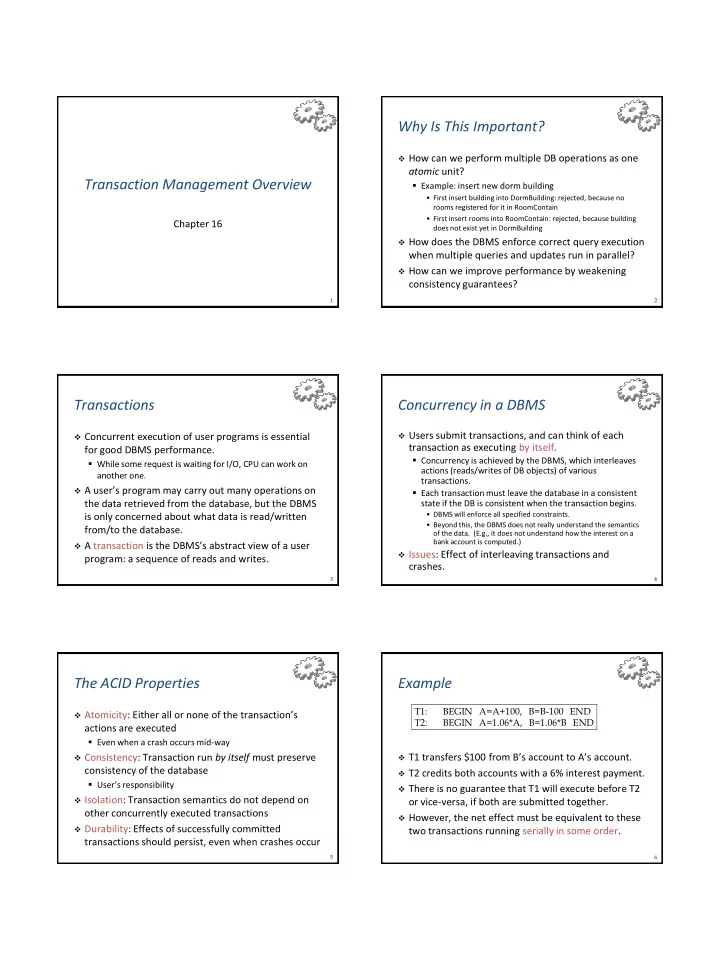
Why Is This Important? How can we perform multiple DB operations as one atomic unit? Transaction Management Overview Example: insert new dorm building First insert building into DormBuilding: rejected, because no rooms registered for


slide-1
SLIDE 1

1

Transaction Management Overview

Chapter 16

2

Why Is This Important?

 How can we perform multiple DB operations as one

atomic unit?

  • Example: insert new dorm building
  • First insert building into DormBuilding: rejected, because no

rooms registered for it in RoomContain

  • First insert rooms into RoomContain: rejected, because building

does not exist yet in DormBuilding  How does the DBMS enforce correct query execution

when multiple queries and updates run in parallel?

 How can we improve performance by weakening

consistency guarantees?

3

Transactions

 Concurrent execution of user programs is essential

for good DBMS performance.

  • While some request is waiting for I/O, CPU can work on

another one.

 A user’s program may carry out many operations on

the data retrieved from the database, but the DBMS is only concerned about what data is read/written from/to the database.

 A transaction is the DBMS’s abstract view of a user

program: a sequence of reads and writes.

4

Concurrency in a DBMS

 Users submit transactions, and can think of each

transaction as executing by itself.

  • Concurrency is achieved by the DBMS, which interleaves

actions (reads/writes of DB objects) of various transactions.

  • Each transaction must leave the database in a consistent

state if the DB is consistent when the transaction begins.

  • DBMS will enforce all specified constraints.
  • Beyond this, the DBMS does not really understand the semantics
  • f the data. (E.g., it does not understand how the interest on a

bank account is computed.)  Issues: Effect of interleaving transactions and

crashes.

5

The ACID Properties

 Atomicity: Either all or none of the transaction’s

actions are executed

  • Even when a crash occurs mid-way

 Consistency: Transaction run by itself must preserve

consistency of the database

  • User’s responsibility

 Isolation: Transaction semantics do not depend on

  • ther concurrently executed transactions

 Durability: Effects of successfully committed

transactions should persist, even when crashes occur

6

Example

 T1 transfers $100 from B’s account to A’s account.  T2 credits both accounts with a 6% interest payment.  There is no guarantee that T1 will execute before T2

  • r vice-versa, if both are submitted together.

 However, the net effect must be equivalent to these

two transactions running serially in some order.

T1: BEGIN A=A+100, B=B-100 END T2: BEGIN A=1.06*A, B=1.06*B END

slide-2
SLIDE 2

7

Example (Contd.)

 Consider a possible interleaving (schedule):  This is OK. But what about:  The DBMS’s view of the second schedule:

T1: A=A+100, B=B-100 T2: A=1.06*A, B=1.06*B T1: A=A+100, B=B-100 T2: A=1.06*A, B=1.06*B T1: R(A), W(A), R(B), W(B) T2: R(A), W(A), R(B), W(B)

8

Scheduling Transactions

 Serial schedule: Schedule that does not interleave the actions

  • f different transactions.
  • Easy for programmer, easy to achieve consistency
  • Bad for performance

 Equivalent schedules: For any database state, the effect (on

the objects in the database) of executing the first schedule is identical to the effect of executing the second schedule.

 Serializable schedule: A schedule that is equivalent to some

serial execution of the transactions.

  • Retains advantages of serial schedule, but addresses performance

issue

 Note: If each transaction preserves consistency, every

serializable schedule preserves consistency.

9

Anomalies with Interleaved Execution

 Reading Uncommitted Data (WR Conflicts, “dirty

reads”)

 Example: T1(A=A-100), T2(A=1.06A), T2(B=1.06B),

C(T2), T1(B=B+100)

 T2 reads value A written by T1 before T1 completed

its changes

 Notice: If T1 later aborts, T2 worked with invalid data

T1: R(A), W(A), R(B), W(B), Abort T2: R(A), W(A), C

10

More Anomalies

 Unrepeatable Reads (RW Conflicts)  T1 sees two different values of A, even though it did

not change A between the reads

 Example: online bookstore

  • Only one copy of a book left
  • Both T1 and T2 see that 1 copy is left, then try to order
  • T1 gets an error message when trying to order
  • Could not have happened with serial execution

T1: R(A), R(A), W(A), C T2: R(A), W(A), C

11

Even More Anomalies

 Overwriting Uncommitted Data (WW Conflicts)  T1’s B and T2’s A persist, which would not happen

with any serial execution

 Example: 2 people with same salary

  • T1 sets both salaries to 2000, T2 sets both to 1000
  • Above schedule results in A=1000, B=2000, which is

inconsistent T1: W(A), W(B), C T2: W(A), W(B), C

12

Aborted Transactions

 All actions of aborted transactions have to be

undone

 Dirty read can result in unrecoverable schedule

  • T1 writes A, then T2 reads A and makes modifications

based on A’s value

  • T2 commits, and later T1 is aborted
  • T2 worked with invalid data and hence has to be aborted

as well; but T2 already committed…

 Recoverable schedule: cannot allow T2 to commit

until T1 has committed

  • Can still lead to cascading aborts
slide-3
SLIDE 3

13

Preventing Anomalies through Locking

 DBMS can support concurrent transactions while

preventing anomalies by using a locking protocol

 If a transaction wants to read an object, it first

requests a shared lock (S-lock) on the object

 If a transaction wants to modify an object, it first

requests an exclusive lock (X-lock) on the object

 Multiple transactions can hold a shared lock on an

  • bject

 At most one transaction can hold an exclusive lock

  • n an object

14

Lock-Based Concurrency Control

 Strict Two-phase Locking (Strict 2PL) Protocol:

  • Each Xact must obtain the appropriate lock before

accessing an object.

  • All locks held by a transaction are released when the

transaction is completed.

  • All this happens automatically inside the DBMS

 Strict 2PL allows only serializable schedules.

  • Prevents all the anomalies shown earlier

15

The Phantom Problem

 Assume initially the youngest sailor is 20 years old  T1 contains this query twice

  • SELECT rating, MIN(age) FROM Sailors

 T2 inserts a new sailor with age 18  Consider the following schedule:

  • T1 runs query, T2 inserts new sailor, T1 runs query again
  • T1 sees two different results! Unrepeatable read.

 Would Strict 2PL prevent this?

  • Assume T1 acquires Shared lock on each existing sailor tuple
  • T2 inserts a new tuple, which is not locked by T1
  • T2 releases its Exclusive lock on the new sailor before T1 reads

Sailors again

 What went wrong?

16

What Should We Lock?

 T1 cannot lock a tuple that T2 will insert  …but T1 could lock the entire Sailors table

  • Now T2 cannot insert anything until T1 completed

 What if T1 computed a slightly different query:

  • SELECT MIN(age) FROM Sailors WHERE rating = 8

 Now locking the entire Sailors table seems excessive,

because inserting a new sailor with rating <> 8 would not create a problem

  • T1 can lock the predicate [rating = 8] on Sailors

 General challenge: DBSM needs to choose

appropriate granularity for locking

17

Deadlocks

 Assume T1 and T2 both want to read and write objects A

and B

  • T1 acquires X-lock on A; T2 acquires X-lock on B
  • Now T1 wants to update B, but has to wait for T2 to release its

lock on B

  • But T2 wants to read A and also waits for T1 to release its lock
  • n A
  • Strict 2PL does not allow either to release its locks before the

transaction completed. Deadlock!

 DBMS can detect this

  • Automatically breaks deadlock by aborting one of the involved

transactions

  • Tricky to choose which one to abort: work performed is lost

20

Performance of Locking

 Locks force transactions to wait  Abort and restart due to deadlock wastes the work done

by the aborted transaction

  • In practice, deadlocks are rare, e.g., due to lock downgrades

approach

 Waiting for locks becomes bigger problem as more

transactions execute concurrently

  • Allowing more concurrent transactions initially increases

throughput, but at some point leads to thrashing

  • Need to limit max number of concurrent transactions to prevent

thrashing

  • Minimize lock contention by reducing the time a Xact holds

locks and by avoiding hotspots (objects frequently accessed)

slide-4
SLIDE 4

21

Controlling Locking Overhead

 Declaring Xact as “READ ONLY” increases

concurrency

 Isolation level: trade off concurrency against

exposure of Xact to other Xact’s uncommitted changes

Isolation Level Dirty Read Unrepeatable Read Phantom READ UNCOMMITTED Maybe Maybe Maybe READ COMMITTED No Maybe Maybe REPEATABLE READ No No Maybe SERIALIZABLE No No No

22

Locking vs. Isolation Levels

 SERIALIZABLE: obtains locks on (sets of) accessed

  • bjects and holds them until the end

 REPEATABLE READ: same locks as for serializable

Xact, but does not lock sets of objects at higher level

 READ COMMITTED: obtains X-locks before writing

and holds them until the end; obtains S-locks before reading, but releases them immediately after reading

 READ UNCOMMITTED: does not obtain S-locks for

reading; not allowed to perform any writes

  • Does not request any locks ever

23

Summary

 Concurrency control is one of the most important

functions provided by a DBMS.

 Users need not worry about concurrency.

  • System automatically inserts lock/unlock requests and can

schedule actions of different Xacts in such a way as to ensure that the resulting execution is equivalent to executing the Xacts one after the other in some order.

 DBMS automatically undoes the actions of aborted

transactions.

  • Consistent state: Only the effects of committed Xacts

seen.