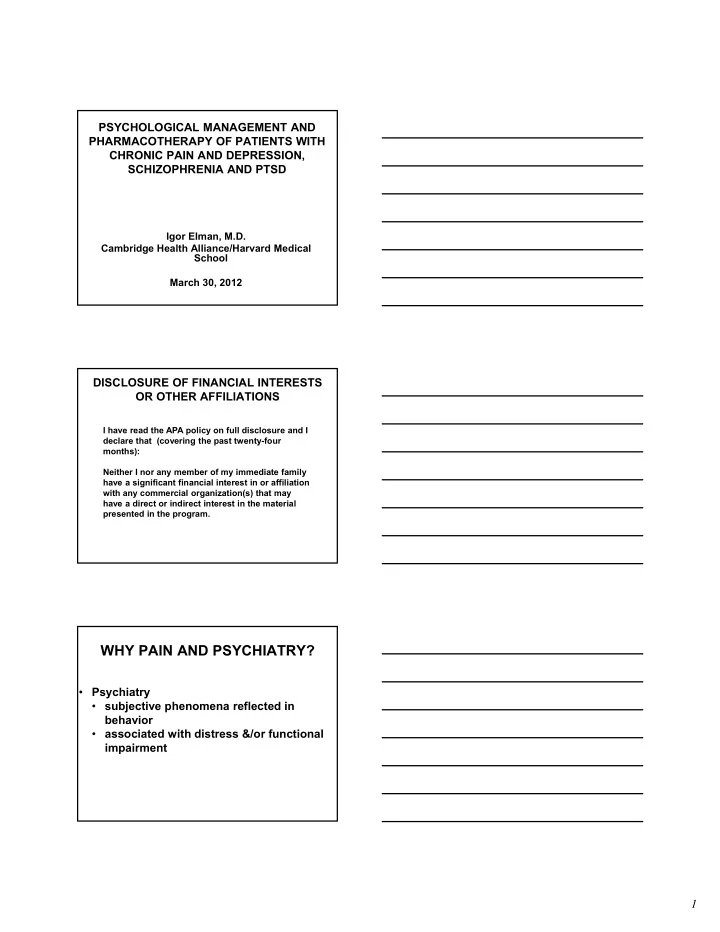
WHY PAIN AND PSYCHIATRY? Psychiatry subjective phenomena reflected - - PDF document

why pain and psychiatry
SMART_READER_LITE
LIVE PREVIEW

WHY PAIN AND PSYCHIATRY? Psychiatry subjective phenomena reflected - - PDF document

PSYCHOLOGICAL MANAGEMENT AND PHARMACOTHERAPY OF PATIENTS WITH CHRONIC PAIN AND DEPRESSION, SCHIZOPHRENIA AND PTSD Igor Elman, M.D. Cambridge Health Alliance/Harvard Medical School March 30, 2012 DISCLOSURE OF FINANCIAL INTERESTS OR OTHER


slide-1
SLIDE 1

1 PSYCHOLOGICAL MANAGEMENT AND PHARMACOTHERAPY OF PATIENTS WITH CHRONIC PAIN AND DEPRESSION, SCHIZOPHRENIA AND PTSD

Igor Elman, M.D. Cambridge Health Alliance/Harvard Medical School March 30, 2012

DISCLOSURE OF FINANCIAL INTERESTS OR OTHER AFFILIATIONS

I have read the APA policy on full disclosure and I declare that (covering the past twenty-four months): Neither I nor any member of my immediate family have a significant financial interest in or affiliation with any commercial organization(s) that may have a direct or indirect interest in the material presented in the program.

WHY PAIN AND PSYCHIATRY?

  • Psychiatry
  • subjective phenomena reflected in

behavior

  • associated with distress &/or functional

impairment

slide-2
SLIDE 2

2

BODY – MIND

  • Permeated human cognition for over 3,000 years
  • Homer: will of Gods → behaviors motivations
  • Millennium later: Plato &“psyche”
  • Plato & Freud: behavior – conflict of rational,

instinctual & emotional forces

  • Aristotle: body – mind amalgamation, holistic &

indivisible nature

  • Descartes: body – mind dualism
  • mind: spiritual domain, no physical qualities

BODY – MIND

  • Identity (Pavlov, Kandel)
  • Independence (Freud, Wundt)
  • Interaction (Hippocrates: bodily humors

(yellow and black bile, phlegm, and blood; Descartes)

Four blind people encounter an elephant leg is a tree trunk. tail is a whip trunk is a hose side is a wall

slide-3
SLIDE 3

3

BODY – MIND

  • Dualism – a state of two parts
  • Duality – a dual state or quality
  • e.g., both wave & particle properties

EPIDEMIOLOGY

  • >70 million Americans
  • the most common concern
  • annual cost ~ $100 billion
  • medical expenses
  • loss of earnings & productivity
slide-4
SLIDE 4

4

DEMOGRAPHICS

  • ↑ geriatric patients
  • > 65 years
  • 4% early 1900s
  • 12% now
  • projected > 20% in 25 yrs
  • ↑ risk for pain-related conditions
  • 50% of community-dwelling
  • 80% of nursing home residents

PAIN & REWARD: A CONTINUUM FUNCTIONAL RELATIONSHIP

  • Pain → ↓ reward
  • Reward → ↑ analgesia (i.e., ↓ pain)
  • Common currency: pain pleasure
  • Motivation-decision model (Fields)
  • highest priority (e.g., childbirth)
slide-5
SLIDE 5

5

PHILOSOPHY

  • Aristotle (Rhetoric): “We may lay it down that

Pleasure is a movement, a movement by which the soul as a whole is consciously brought into its normal state of being; and that Pain is the opposite.”

  • Spinoza (Ethics Part 3, Definitions of the emotions)
  • Two extremes on the same scale: "a passive state

wherein the mind passes to …”

  • pleasure – “a greater perfection”
  • pain – "a lesser perfection”
  • Nietzsche (The gay science): pleasure and pain are

“so knotted together that whoever wants as much as possible of the one, must also have as much as possible of the other…”

NEUROANATOMY

  • Nociception processing networks
  • lateral: sensory
  • thalamocortical projections to 10 & 20

somatosensory cortex

  • medial: emotional/motivational coloring
  • f pain (10 & 20 pain affect & pain

unrelated affect)

  • limbic & reward structures
slide-6
SLIDE 6

6

SCHEMATIC OVERVIEW OF THE INTERFACE BETWEEN NEUROBIOLOGICAL & PSYCHOLOGICAL FACTORS INVOLVED IN THE EXPERIENCE OF CHRONIC PAIN

  • Frontocingulate
  • chronic pain → brain reorganization (via glu) →

emotional & cognitive impairments → negative affective states & compromised decision-making → ↑dysphoria → ↑ pain

  • Subcortical systems
  • acute pain → ↑DA
  • chronic pain → ↓ DA → ↓ motivation

INTERFACE BETWEEN NEUROBIOLOGICAL & PSYCHOLOGICAL FACTORS INVOLVED IN THE EXPERIENCE OF CHRONIC PAIN

slide-7
SLIDE 7

7

PHYSICAL AND EMOTIONAL PAIN: TWO SIDES OF THE SAME COIN

  • fMRI work (O'Connor et al, 2008):
  • grief-related emotional pain: periaqueductal gray,

insula and the anterior cingulate cortex

  • physical pain: reward/motivational circuits
  • International Association for the Study of Pain: An

unpleasant sensory and emotional experience associated with actual or potential tissue damage

  • DSM-IV: Axis1 Pain Disorder (3/5 criteria)
  • A. Pain . . . is of sufficient severity to warrant clinical

attention

  • B. Pain causes clinically significant distress or

impairment in social, occupational, or other important areas of functioning

  • C. Psychological factors

PHYSICAL PAIN

  • DSM-IV, Axis III, medical conditions
  • Distinction of Axis I & III is not obvious
  • share clinical characteristics, symptom severity

& functional impairment

  • blurring of diagnostic boundaries in

lay language; the term pain is used interchangeably

PAIN & THE BRAIN: IMPLICATIONS FOR EMOTIONAL & MOTIVATIONAL PROCESSING

  • Chronic pain
  • not a unitary sensation
  • modulated by genetic, environmental,

cognitive & emotional factors

  • Majority neuropathic
  • caused by CNS alterations
  • spinal cord pathways: hyperalgesia &

allodynia

  • emotional/motivational circuits: negative

affective states & drive to eliminate pain

slide-8
SLIDE 8

8

COMORBIDITY OF PAIN & PSYCHIATRIC DISORDERS

  • Pain → emotional abnormalities in healthy
  • Neuropsychopathology → ↑ pain
  • diathesis-stress theory
  • Psychiatric conditions: entire diagnostic range

from "Disorders Usually First Diagnosed in Infancy, Childhood, or Adolescence" to "Other Conditions That May Be a Focus of Clinical Attention”

PAIN & MAJOR DEPRESSIVE DISORDER

  • MDD: the 2nd common disability (projected)
  • Depressed vs. happy affective states → ↑ & ↓ pain

in healthy & chronic pain

  • MDD
  • ↑ prevalence
  • ↑ in severity → ↑ pain
  • pain → depressive symptomatology → MDD
  • MDD + pain
  • ↑ symptoms severity of depressive symptoms
  • ↓treatment outcomes

PAIN & MDD

  • fMRI pain stimulus (Strigo et al., 2008): ↑ amygdala

activity proportionally (to depressive symptoms)

  • Recursive, partly shared neural systems
  • serotonergic and noradrenergic pathways
  • SNRI, TCA analgesic action
  • ther treatment modalities (eg, TMS or VNS)
  • pioidergic abnormalities in MDD
  • MDD and pain can trigger and perpetuate each
  • ther owing to overlapping neural and emotional

alterations

  • Assessment of pain function may provide

important diagnostic & therapeutic leads in MDD

slide-9
SLIDE 9

9

PAIN & PTSD

  • Anxiety commonly comorbid with pain
  • poorer prognosis
  • PTSD conditioned fear & anxiety syndrome
  • reward/motivational circuitry involvement
  • Pain-PTSD link
  • neuroanatomy: dopamine terminal fields play key roles

in stress, aversive responses & PTSD

  • pathophysiology: peritraumatic pain is among PTSD

independent risk factors

  • timely morphine reduces the severity & prevents PTSD

PAIN & PTSD: MECHANISMS

  • Pain – conditioned stimulus
  • "mutual maintenance“
  • ↑ Opiodergic tone in PTSD
  • sensitized pain (glutamatergic)
  • prophylactic use of opioids

PTSD & REWARD

Elman et al, Biological Psychiatry, 2009

slide-10
SLIDE 10

10

PAIN & SCHIZOPHRENIA

  • DA pain & reward
  • ↑↑ Endorphines in CSF & plasma
  • parallel severity of psychosis
  • pain insensitivity (Haslam, 1798; Kraepelin,

1919; Bleuler, 1924)

  • reversal by opioid antagonism
  • Molecular abnormalities in opioid genes:

prodynorphin & proenkephalin

  • Clinically: tissue damage, finger burns from

cigarettes; grave medical outcomes; silent MI; delays in management of abdominal emergencies perforated bowel & ruptured appendix

slide-11
SLIDE 11

11

Elman, I. et al. Arch Gen Psychiatry 2011;68:12-20.

Schematic diagram of potential mechanisms involved in drug-related motivational changes during adequate treatment, undertreatment, or

  • vertreatment of pain with opioid analgesics

ADDICTION-LIKE PHENOMENA

  • Pseudo-addiction: compulsive seeking of
  • pioid drugs driven by the desire to

ameliorate inadequately treated pain or to avoid a feared opioid withdrawal

  • Pseudo-opioid resistance: self-reported pain

with adequate analgesia owing to unwarranted anxiety about an impending

  • pioid dose reduction
  • Therapeutic dependence: attempts to avoid a

feared opioid withdrawal

ROLE OF PSYCHIATRISTS

  • Recognize and treat subtle psychological

processes

  • expression of feelings via pain concerns
  • defense mechanisms (denial & repression
  • vs. lying & malingering)
  • conscious and unconscious motivations
  • Motivational enhancement
  • Fostering compliance
slide-12
SLIDE 12

12

TREATMENT STRATEGIES

  • Numerous cognitive & behavioral strategies

(e.g., cognitive restructuring, stress management & systemic desensitization)

  • NIH Technology Panel
  • muscle relaxation techniques
  • Psychopharmacology: opioids,

antidepressants, dopamine agonists, cholinergic agents, adrenergic agents, anticonvulsants & neuroleptics

  • Suicidality, comorbidities

PAIN & 2ND GENERATION ANTIPSYCHOTICS

  • Dopamine the most extensively investigated

neurotransmitter

  • Some SGAs (clozapine, olanzapine & risperidone)

enhance opioidergic system

  • clinically olanzapine overdose = opioid

intoxication

  • both human & rodent models:

analgesic/antinociceptive properties

  • Therapeutic implications: if excess of central opioid

activity is consequential to the schizophrenia neuropathology it is reasonable to expect amelioration of the symptoms through the blockade

  • f opioid receptors

CONCLUSIONS

  • Broad public health interest
  • Additional clinical expertise
  • Pain rooted in numerous specialties (neurology,

medicine, surgery & anesthesiology)

  • Integration of psychiatry into mainstream medical

care

  • Significance of attending in concert to both mental &

physical problems

slide-13
SLIDE 13

13 REFERENCES

Elman I, Zubieta JK, Borsook D: The Missing “P” in Psychiatric Training: Why it is important to teach pain to psychiatrists, Archives of General Psychiatry, 68(1):12- 20, 2011 Elman I, Borsook D, Lukas S: Food Intake and Reward Mechanisms in Patients with Schizophrenia: Implications for Metabolic Disturbances and Treatment with Second Generation Antipsychotic Agents, Neuropsychopharmacology, 2006, 31(10):2091- 120 Elman I, Lowen S, Frederick BB, Chi W, Becerra L, Pitman RK: Functional neuroimaging of reward circuitry responsivity to monetary gains and losses in post-traumatic stress disorder, Biological Psychiatry, 66(12):1083-90, 2009. Elman I, Tschibelu E, Lowen S, Borsook D: Reward and motivational systems in post traumatic stress disorder. In Neurobiology of Post-traumatic Stress Disorder, Nova Science Publishers, New York Jarcho JM, Mayer EA, Jiang ZK, Feier NA, London ED Pain, affective symptoms, and cognitive deficits in patients with cerebral dopamine dysfunction. Pain. 153(4):744-54, 2012