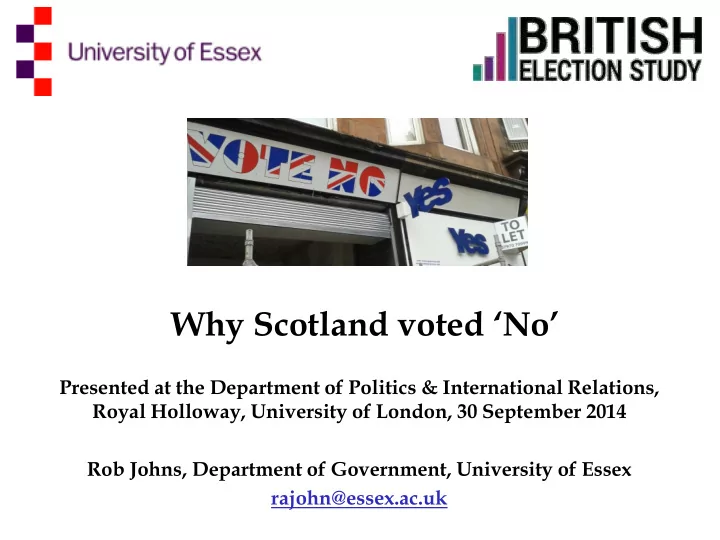
SLIDE 1
Why Scotland voted ‘No’
Presented at the Department of Politics & International Relations, Royal Holloway, University of London, 30 September 2014 Rob Johns, Department of Government, University of Essex rajohn@essex.ac.uk
SLIDE 2
The key background
10 20 30 40 50 1999 2003 2007 2011
% of voters/respondents
Support SNP (list) Support independence
SLIDE 3
Boredom, then excitement
SLIDE 4
- Two waves of a multi-wave panel survey
- Conducted over the internet via YouGov
- British Election Study Wave 2
– June 2014
– Rolling cross-section in four one-week batches – 22 August-17 September 2014
Data sources
SLIDE 5
Why a big lead for ‘No’?
SLIDE 6 Scottish > British identity
10 20 30 40 50 60 Not at all 2 3 4 5 6 Very strongly
% of respondents Self-reported national identities
British Scottish
SLIDE 7
- Not a matter of identity
- Not a preference for multi-level governance
Why a big lead for ‘No’?
SLIDE 8 Where powers should lie
10 20 30 40 50 60 70 80 Energy Welfare benefits Pensions Tax levels Immigration Defence & foreign affairs % opting for UK/Scottish Parliament UK Scottish
SLIDE 9
- Not a matter of identity
- Not a preference for multi-level governance
- Not widespread optimism about the Union
Stage 1: why a big lead for ‘No’?
SLIDE 10
Consequences of remaining in Union
Likely (%) Unlikely (%) UK government would cut spending available for Scottish public services 49 28 Gap between rich and poor would get wider 57 14 Westminster will transfer substantially more powers to the Scottish Parliament 33 41 The UK will vote in a referendum to leave the European Union 53 19 Trident submarines would remain based at Faslane on the Clyde 79 7 Welfare benefits will go down 54 14
SLIDE 11
- Not a matter of identity
- Not a preference for multi-level governance
- Not widespread optimism about the Union
- Not widespread pessimism about independence
Stage 1: why a big lead for ‘No’?
SLIDE 12
Consequences of independence
Likely (%) Unlikely (%) The general economic situation in Scotland would be worse 41 38 Scotland would keep using the pound 56 26 Scotland would retain membership of the EU on similar terms 41 39 Scotland would have a weaker voice in the world 47 35 There would be passport and border controls between Scotland and England 25 57 Scotland and the UK would arrange defence cooperation 48 25 I personally would be better off 23 42
SLIDE 13
- Not a matter of identity
- Not a preference for multi-level governance
- Not widespread optimism about the Union
- Not widespread pessimism about independence
- So what, then?
- Fear, risk, uncertainty – independence as an
existential threat
- And how much people have to lose…
Stage 1: why a big lead for ‘No’?
SLIDE 14 ‘Yes’ voting by risk-willingness
0% 20% 40% 60% 80% 100%
Not at all 1 2 3 4 5 6 7 8 9 Very
In Intendin ing to
es' How willi illing to
ake ris risks?
SLIDE 15 ‘Yes’ voting by openness to experience
20 40 60 Least open 2 3 Most open % intendin ing to
SLIDE 16
Q1: On a scale from 1 (“doesn’t bother me”) to 10 (“utterly terrified”), what number best describes your reaction to that photo? Q2: Should Scotland be an independent country? 1 2 3 4 5 6 7 8 9 10 Yes No
SLIDE 17
You win £25 You win nothing
Would you like £10? Or would you prefer to toss a coin…
SLIDE 18
You give me £25 You give me nothing
Now, you have to give me £10 Or we can toss a coin…
SLIDE 19
Voting by council area
SLIDE 20
Deprivation and ‘Yes’ voting
SLIDE 21 Age Age squared Female Born rUK Lived rUK Degree Protestant Catholic Income lowest 1/4 Income highest 1/4 Owner-occupier Social renter Fear unemployment
0.02 0.06 0.10 Effect on probability of Yes vote of 1 s.d. increase in predictor
Socio- economic drivers of vote choice
SLIDE 22 Why the new voters made little difference
20 40 60 16-29 30-39 40-49 50-59 60-69 70+ % intendin ing to
Age e grou
SLIDE 23 General economic situation worse Keep using the pound Retain EU membership Weaker voice in world Narrower gap between rich and poor Personally better off UK government cut public services Wider gap between rich and poor Substantially more devolution UK votes to leave EU Welfare benefits to be cut
0.0 0.2 0.4 Effect on probability of Yes of 1 s.d. increase in predictor
What drove decisions?
SLIDE 24
Late dynamics: in general
SLIDE 25 Late dynamics: in expectations after a Yes
10 20 30 40 50 60 70 June 4 weeks 3 weeks 2 weeks 1 week
% 'very' or 'fairly' likely
General economy worse Keep using the pound Greater equality Personally better off
SLIDE 26 Late dynamics: in expectations after a No
10 20 30 40 50 60 70 June 4 weeks 3 weeks 2 weeks 1 week
% 'very' or 'fairly' likely
UK govt cut public services Substantially more devolution
SLIDE 27
- Identity provided core support for both camps
- But economic risk decided the outcome
- The median voter:
– Feels more Scottish than British – Wants almost all powers at Scottish level – Questions legitimacy of Westminster government – Optimistic about independence but economic doubts
- ‘No’ campaign didn’t change what Scots want; just
scared them out of going for it
- So is that really it for a generation…?
Conclusions
SLIDE 28
Why Scotland voted ‘No’
Presented at the Department of Politics & International Relations, Royal Holloway, University of London, September 2014 Rob Johns, Department of Government, University of Essex rajohn@essex.ac.uk